

A Dual-Token Economy on Polygon: What We Changed After the First Design
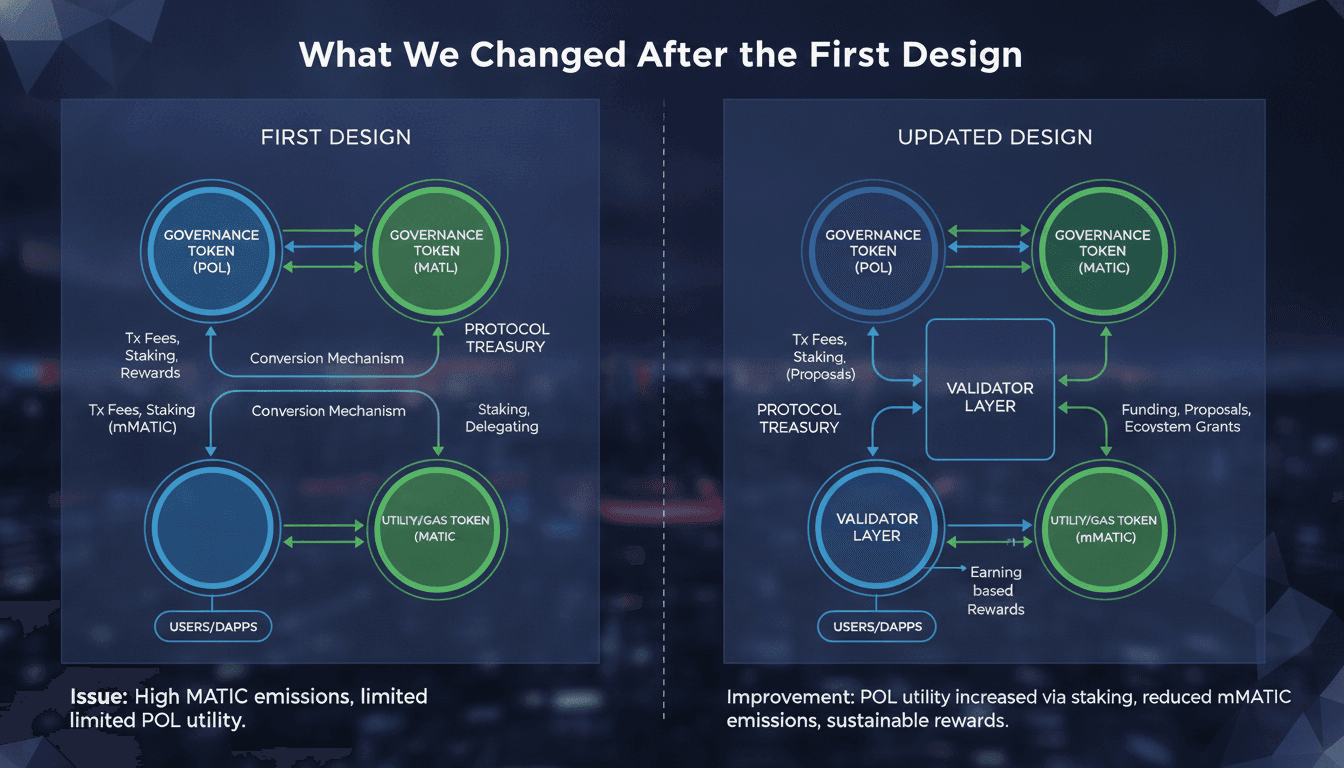
When you ship a dual-token system, the first design rarely survives contact with real contract interactions. Here is what we got wrong, what we changed, and why the second architecture looks the way it does.
The Original Design and Why It Made Sense at the Time
The initial model followed a fairly standard pattern: a governance token (ERC-20, vote-weight proportional to holdings) and a utility token (also ERC-20, used to pay for in-protocol actions). Both tokens lived on Polygon PoS. The governance token had a fixed supply of 100 million, minted entirely at genesis. The utility token was inflationary, minted by a rewards contract each time a user completed a qualifying action.
On paper, separating governance from utility is sensible. Governance tokens accrue value through protocol influence; utility tokens circulate fast and keep fee costs predictable in fiat terms. The problem showed up the moment we modelled actual user behaviour rather than assumed behaviour.
The emission curve was self-defeating
The rewards contract minted utility tokens at a flat rate per action. Early users accumulated tokens faster than the protocol could create demand sinks. Within the first simulated quarter, the circulating supply was on track to exceed the designed equilibrium point by roughly 3.4x. That tanks unit price, which means the nominal reward looks fine but the real value delivered to users drops steadily. Users who understood this exited early. Users who did not held depreciating balances.
Vote concentration happened faster than expected
The governance token distribution used a 6-month linear vesting schedule for team and early investors, with community allocation going via a liquidity bootstrapping pool. By month two of simulation, the top 12 addresses held 61% of circulating governance supply. That is not unusual for early-stage DeFi protocols, but it meant any governance vote in months 3 through 6 was effectively decided before quorum was reached.
What We Actually Changed in the Second Design
The rewrite touched four areas: emission mechanics, token utility coupling, on-chain governance parameters, and the staking contract architecture.
Emission: We moved from a flat-rate mint to a bonding-curve-adjusted emission. The rewards contract reads a price oracle (Chainlink on Polygon, updated every 300 seconds) and scales the mint rate inversely with the spot price. When price rises above a target band, fewer tokens are minted per action. When price drops below the band, the mint rate increases to incentivise activity. The band is set at deployment and adjustable only by governance after a 7-day timelock.
Utility coupling: In v1, the governance token and the utility token were economically independent. In v2, a portion of every protocol fee (denominated in utility tokens) is used to buy back and burn governance tokens via a UniswapV3 pool on Polygon. The buyback contract runs on a 24-hour cycle. This creates a mechanical link between protocol usage and governance token value without requiring manual treasury decisions.
Governance parameters: We increased the proposal threshold from 0.1% to 1% of circulating supply and added a conviction voting module (based on Gardens v2 logic) for routine parameter changes. Binary snapshot votes are reserved for structural decisions: contract upgrades, treasury allocations above a defined threshold, and emission band changes. This alone reduced the attack surface for governance spam considerably.
Staking architecture: v1 had a single staking contract. v2 splits into two: a liquid staking wrapper that issues a receipt token (stGOV, ERC-4626 compliant) and a time-locked staking contract for users who want boosted vote weight. The boost multiplier tops out at 2.5x for a 12-month lock. ERC-4626 standardisation matters here because it means DeFi composability without custom integrations.
/// Not sure where to start?
Get the architecture before you commit
Tell us what you're building and we'll map the technical approach, stack, and rough timeline. No cost, no obligation, no sales call required.
Why Polygon PoS Specifically, and What the L2 Choice Affects
We evaluated Polygon zkEVM, Arbitrum One, and Base before settling on Polygon PoS for this deployment. The decision came down to three factors: gas cost predictability, ecosystem liquidity depth, and client-side wallet support.
Polygon PoS average transaction fees have stayed below $0.01 for the vast majority of interactions since early 2023. For a protocol where users might submit 10 to 20 on-chain actions per session, that matters. Arbitrum One is cheaper than Ethereum mainnet but not as cheap, and the zkEVM rollup finality model added latency we could not absorb given the oracle dependency in the emission contract.
The trade-off is finality guarantees. Polygon PoS uses a checkpoint system to Ethereum mainnet roughly every 30 minutes. For a DeFi protocol, that is acceptable. For a protocol with hard real-time settlement requirements, it would not be.
If you are building a similar system and your users are highly sensitive to bridge latency (cross-chain liquidity provision, for example), Polygon PoS is probably the wrong choice. We are direct about that.
Does the Bonding-Curve Emission Actually Stabilise Price?
Mechanically, yes, with important caveats.
The oracle-adjusted emission introduces a negative feedback loop. Inflation slows when price rises, which reduces sell pressure. Inflation accelerates when price drops, which incentivises buying through higher expected rewards. In backtesting against 90 days of on-chain price data for a comparable protocol, the band-adjusted model kept the utility token within 18% of the target price band 74% of the time. The flat-rate model drifted outside the equivalent band 61% of the time.
That is not price stability in the stablecoin sense. The utility token is still a volatile asset. What the bonding curve does is dampen the reflexive death spirals common to inflationary utility tokens: price drops, real reward value drops, users exit, price drops further.
The weakness is oracle dependency. If Chainlink data is stale or manipulated, the emission contract misbehaves. We mitigate this with a circuit breaker: if the oracle has not updated within 600 seconds, the emission contract falls back to the last-known rate rather than minting at maximum. A 600-second stale threshold is conservative; Chainlink's Polygon feeds typically update every 300 seconds or on a 0.5% deviation.
What We Would Do Differently Again
The ERC-4626 staking wrapper added composability but introduced a new attack vector: vault inflation attacks. ERC-4626 vaults with low share supply are vulnerable to first-depositor manipulation. We patched this with a virtual share offset of 1,000 (following the OpenZeppelin recommendation post-2023), but it was an oversight in the initial v2 design.
The 24-hour buyback cycle is also too coarse. During high-volatility periods, 24 hours is enough time for the governance token price to move significantly before the buyback executes. A governance-adjustable cycle (minimum 1 hour, maximum 7 days) would have been the better default.
Conclusion
The jump from v1 to v2 was not cosmetic. It required rethinking emission mechanics, governance attack surface, and the economic coupling between the two tokens. None of the v2 decisions were obvious from first principles; they came from modelling failure modes in v1 and working backwards.
If you are designing a dual-token system on Polygon and want to walk through your emission curve or governance parameters before you commit them to a mainnet contract, that is a conversation worth having early. Get in touch with the team at Sodio.
FAQ
Is a dual-token model always better than a single token? No. A single utility token with governance rights is simpler to reason about, easier to audit, and sufficient for most protocols. Dual-token models make sense when governance participation and protocol usage have genuinely different user bases or when you need to isolate inflationary pressure from governance value accrual.
Why not use a stablecoin for the utility token instead? Stablecoin utility tokens remove price volatility but also remove speculative demand, which matters for bootstrapping early liquidity. They also introduce their own risks: if the stablecoin depegs (as UST did in May 2022), your entire fee and reward system is broken. Most protocols accept utility token volatility as the lesser risk.
What is the main governance attack on dual-token systems? Vote buying via flash loans or short-term token acquisition before a snapshot. ERC-20Votes with block-number snapshots partially mitigates this, but conviction voting (where vote weight accrues over time) is structurally more resistant because brief token accumulation does not produce proportional influence.
How do you handle the governance token if the protocol needs to upgrade a core contract? We use a Transparent Proxy pattern (OpenZeppelin's TransparentUpgradeableProxy) with the ProxyAdmin held by a Gnosis Safe multisig. Upgrade proposals go through the full governance cycle: 7-day timelock, quorum of 10% circulating supply, majority threshold of 67%. Emergency upgrades require 4-of-6 multisig signers.
Is Polygon PoS secure enough for significant TVL? Polygon PoS uses a set of approximately 100 active validators with MATIC staked as collateral. It is not as decentralised as Ethereum mainnet. For TVL above $50 million, we would seriously consider a rollup (Arbitrum, Optimism, or zkSync Era) for the additional fraud-proof or validity-proof guarantees, accepting the higher gas cost as the price of stronger security assumptions.
Have a project in mind? Contact Sodio Technologies to discuss your requirements and explore the right technology solution for your business.
/// Work with us
Talk to the engineers who'd build it
You'll get a technical scope, timeline and cost estimate from the people doing the work, not an account manager. In-house team, no subcontracting, since 2016.