

Agent Guardrails: Allowlists, Spend Caps and Approval Gates
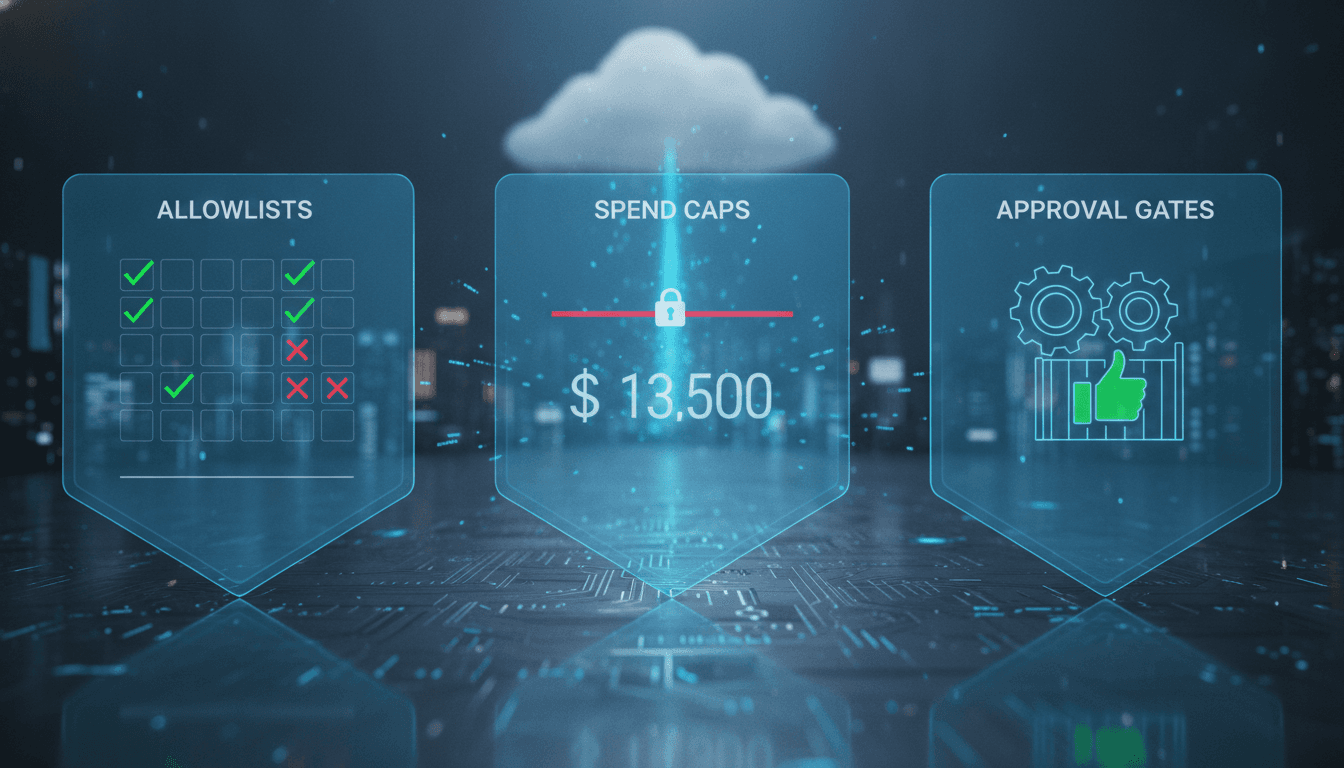
AI agents that can browse the web, call APIs, write code, and execute transactions are genuinely useful. They are also genuinely dangerous without the right constraints. This post covers the three control primitives that matter most: allowlists, spend caps, and approval gates. How they work, where they break, and how to combine them without making your agent useless.
Why Unconstrained Agents Fail in Production
An agent that can do anything will eventually do something you didn't intend. This is not a theoretical concern. In early 2024, a reported incident involving an autonomous shopping agent placed repeat orders because the stop condition was ambiguous. The agent was correct by its own reasoning; the outcome was wrong.
The failure mode is almost never the model "going rogue." It is the gap between what the engineer intended and what the system prompt actually specifies. Guardrails are the mechanism that closes that gap at runtime, independent of the model's interpretation.
There are three layers worth building:
- Allowlists define what the agent is permitted to touch
- Spend caps bound the financial or computational cost of any action sequence
- Approval gates require a human (or a second automated system) to sign off before irreversible actions proceed
Each solves a different failure class. You need all three.
What Do Allowlists Actually Cover?
The term "allowlist" is overloaded. In agent systems it applies to at least four distinct scopes.
Tool allowlists
An agent runtime like LangGraph or AutoGen exposes a set of callable tools. The tool allowlist controls which tools are available in a given context. A customer support agent gets get_order_status and issue_refund_under_threshold. It does not get delete_account or export_all_users, even if those tools exist in the codebase.
This is trivially enforced at the tool registration layer. The harder problem is dynamic tool loading, where an agent can request new capabilities at runtime. If you support that pattern, the allowlist must be evaluated per-request, not just at initialisation.
Domain and URL allowlists
Agents that browse the web or call external APIs need a domain-level allowlist. Without one, a prompt injection in a third-party page can instruct the agent to exfiltrate data to an attacker-controlled endpoint. The fix is a DNS-resolved allowlist checked before every outbound HTTP request, not a regex on the URL string (which can be bypassed with redirects).
Data scope allowlists
This is access control applied to the agent's read/write permissions on your data layer. An agent working on user A's data should be scoped to user A's records. Row-level security in PostgreSQL 15 or Attribute-Based Access Control (ABAC) policies in OPA are common implementations. The agent's database credentials should reflect these constraints, not just the system prompt.
Action allowlists
Some actions are categorically off-limits regardless of instruction. Dropping a database table, sending emails to more than N recipients, or making changes to production infrastructure outside a deployment window. These are hard-coded exclusions, not configuration.
How Do Spend Caps Work Without Breaking the Agent?
Spend caps bound what an agent can spend, in money, API calls, or tokens, before it must stop or ask for authorisation.
The naive implementation is a global budget per session. Spend more than $X in LLM costs, stop. This works but it is too blunt. An agent mid-way through a multi-step task hits the cap and leaves the system in a partially modified state, which is often worse than either completing or not starting.
A more useful pattern is a hierarchical budget tree:
| Level | Scope | Example cap |
|---|---|---|
| Organisation | All agents, all time | Monthly API spend |
| Agent type | All instances of one agent | Daily token budget |
| Session | Single task execution | Per-run cost ceiling |
| Action | Single tool call | Max $ per API call |
Each level enforces independently. A session can exhaust its budget without affecting the organisational ceiling. An action-level cap prevents a single runaway call from consuming the session budget in one shot.
For financial transactions specifically, a spend cap needs to be enforced at the payment processor level, not just in application code. Application-level caps can be bypassed by a bug or a sufficiently creative model output. Stripe's maximum_amount parameter on PaymentIntents is one example of an enforcement point that lives outside your agent's control flow.
Token budgets are cheaper to enforce. Pass max_tokens in the API call, or use a token counting middleware layer that checks cumulative usage against a Redis-stored counter before forwarding to the model.
/// Not sure where to start?
Get the architecture before you commit
Tell us what you're building and we'll map the technical approach, stack, and rough timeline. No cost, no obligation, no sales call required.
When Should an Agent Stop and Ask?
This is the question most teams get wrong. They either gate too much (the agent is constantly interrupting) or too little (the agent does irreversible things silently).
The right framing is action reversibility, not action risk in the abstract. A useful classification:
- Fully reversible: read operations, draft creation, sandbox execution. No gate needed.
- Reversible with effort: sending an email, posting to a staging environment. Gate optional, depends on context.
- Difficult to reverse: database writes, external API mutations, file deletions. Gate recommended.
- Irreversible: financial transfers, production deployments, legal document submission. Gate mandatory.
Approval gates for irreversible actions should present the agent's proposed action in plain language, not a JSON blob, to the approver. The approver needs to understand what they are signing off on in under 30 seconds. If your gate UI shows raw tool call arguments, you will get rubber-stamping, which is worse than no gate because it creates false confidence.
Implementation-wise, a gate is a pause in the agent's execution graph. In LangGraph, this maps to an interrupt node that serialises the current state to a persistent store, emits an approval request (via webhook, Slack, email), and resumes execution only when the approval event is received. State must be durable; an in-memory pause that survives a container restart is not a gate, it is a bug waiting to happen.
Combining the Three Layers Without Making the Agent Useless
Guardrails have a cost. Every constraint you add reduces the agent's ability to complete tasks autonomously. The goal is precision, not maximum restriction.
Some practical points:
- Allowlists should be role-scoped, not global. An agent acting on behalf of a billing admin gets broader data access than one acting on behalf of a read-only analyst. Build the scope into the agent's initialisation context.
- Spend caps should be asymmetric: tight on irreversible spend (financial), loose on reversible spend (LLM tokens for analysis). A $0.50 token budget for a research task is penny-wise and pound-foolish.
- Approval gates should be rare by design. If your agent is hitting gates on 30% of actions, your allowlist is too narrow or your agent's task scope is too broad. Tune the allowlist first.
- Log every guardrail trigger. Not just the block, but the full action context that caused it. This is your primary debugging surface when the agent behaves unexpectedly.
One anti-pattern to avoid: encoding guardrail logic in the system prompt. "Do not send more than 10 emails" in a prompt is not a guardrail. It is a suggestion the model can reason its way around. Guardrails belong in deterministic code, not probabilistic text.
What Breaks and How Do You Know?
Guardrails fail silently more often than loudly. An allowlist that has a logic error will not throw an exception; it will just permit the wrong things. A spend cap that resets on the wrong clock boundary will allow double the intended spend at midnight.
Testing guardrails requires adversarial cases:
- Prompt injections that instruct the agent to ignore its constraints
- Edge cases at cap boundaries (exactly at the limit, one unit over)
- State corruption tests where the approval gate receives a malformed resume event
- Allowlist bypass attempts using URL redirects or aliased tool names
Red-teaming your agent with a separate model instructed to find bypasses is a cheap and effective way to catch these before production. Run it as part of your CI pipeline, not as a one-off exercise.
Observability tooling matters here. LangSmith, Arize, and Weights & Biases all support agent trace logging with tool call visibility. Pick one and use it from day one. Debugging a guardrail failure without traces is guesswork.
Conclusion
Allowlists, spend caps, and approval gates are not optional features you add after the agent is working. They are part of the agent's design. Get the action reversibility classification right first. Build the allowlist narrow and widen it with evidence. Set asymmetric spend caps. Gate the irreversible stuff with a UI that approvers will actually read.
If you are designing an agent system and want to pressure-test the control architecture before it goes near production data, that is exactly the kind of review worth doing early.
FAQ
Do guardrails need to change if I switch from GPT-4o to Claude 3.5 Sonnet? The model should not matter to your guardrails. If your allowlist, spend cap, or approval gate logic depends on which model is running, that logic is in the wrong place. Guardrails belong in deterministic middleware that wraps the model call, not inside it.
Can I use the system prompt to define my allowlist? You can describe intended behaviour in a system prompt, but it is not an allowlist. A model can reason around natural language instructions, especially under adversarial prompting. An actual allowlist is a check in code that runs before or after the model call, independent of the model's output.
How small should a spend cap be? Set it at two to three times the expected cost of the task in normal conditions. If a task reliably costs $0.10 in tokens, a cap of $0.25 to $0.30 gives headroom for retry logic without permitting runaway loops. Revisit caps quarterly as model pricing changes.
What is the minimum viable approval gate for a production agent? At minimum: a durable state store (not in-memory), a human-readable summary of the proposed action, a single approve/reject endpoint, and a timeout that defaults to reject if no response is received within a defined window (commonly 24 hours for low-urgency tasks).
Do spend caps apply to open-source models running on my own infrastructure?
Token budgets still apply, since compute has a cost, but the mechanism changes. You are capping GPU-hours or inference time rather than API spend. The enforcement point moves to your inference server configuration, for example max_new_tokens in vLLM or TGI, combined with a request counter in your orchestration layer.
Have a project in mind? Contact Sodio Technologies to discuss your requirements and explore the right technology solution for your business.
/// Work with us
Talk to the engineers who'd build it
You'll get a technical scope, timeline and cost estimate from the people doing the work, not an account manager. In-house team, no subcontracting, since 2016.