

Agribusiness Marketplaces: Connecting Farmers and Buyers
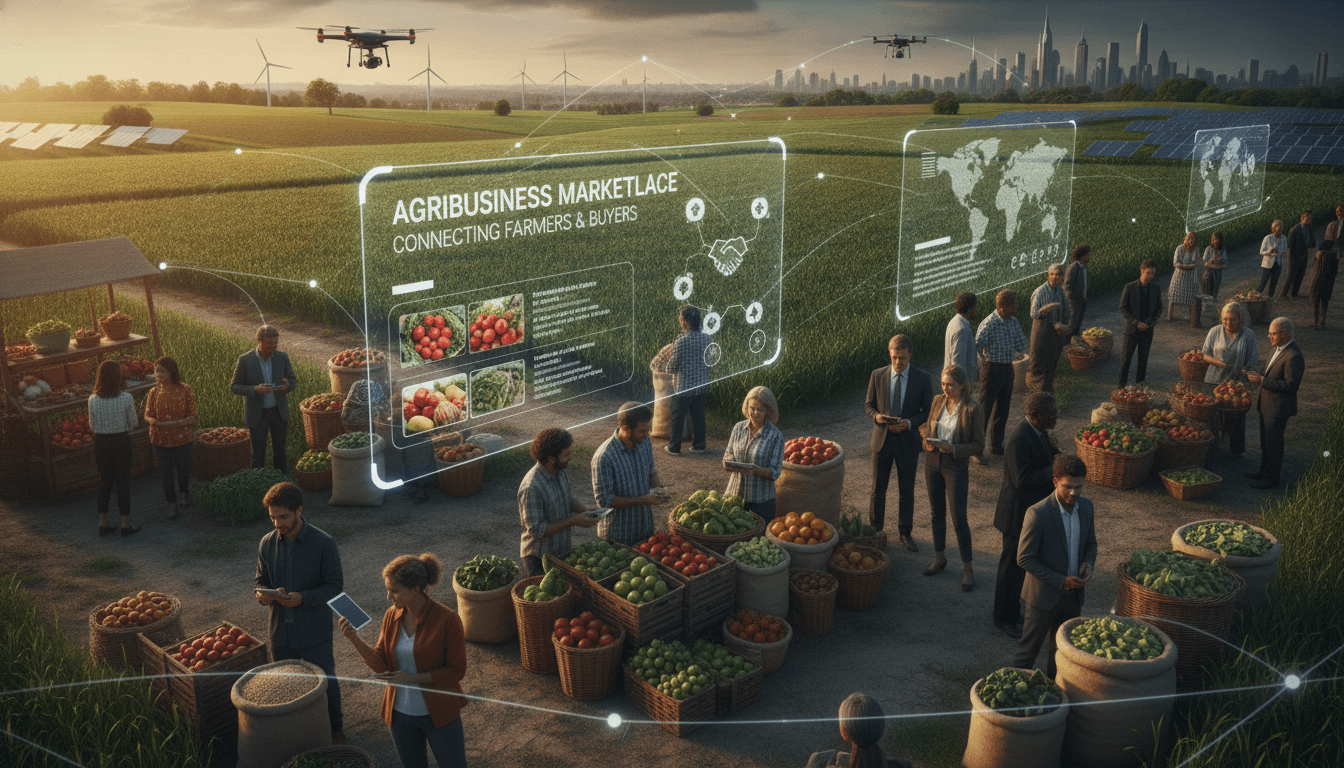
Digital marketplaces are reshaping how agricultural produce moves from farm to buyer. Here is what the architecture actually looks like, where the hard problems sit, and what you need to get right before you write a line of code.
What Does an Agribusiness Marketplace Actually Need to Do?
The surface-level answer is: connect sellers and buyers. The real answer is more demanding.
A farmer in Karnataka with 2 tonnes of tomatoes needs a buyer who can take delivery within 48 hours, pay reliably, and preferably not charge 18% commission to a middleman. A food processing company in Pune needs consistent grade, volume, and lead time. These two parties have completely mismatched information, trust levels, and negotiating power. Your platform is the layer that closes those gaps.
That means the core jobs are:
- Discovery: exposing supply and demand across geography, crop type, grade, and timing
- Price formation: whether that is a fixed listing, a reverse auction, or a negotiated OTC deal
- Quality assurance: some form of grading or certification that both parties can trust
- Logistics coordination: cold chain, last-mile, and the handoff between farm gate and warehouse
- Payment and settlement: reliable, low-friction, ideally with working capital access for the farmer
If your platform does not address all five, the ones you skip will be handled by someone else, usually at a high cost to one of your users.
How Do You Handle Trust and Quality at Scale?
This is the hardest part. A buyer in a city cannot inspect every lot. A farmer cannot afford a failed sale after harvest.
Grading and Certification
Manual grading by a third-party inspector works at low volume. It does not scale. The practical options are:
- Standardised self-declaration with dispute resolution: The seller declares grade; the platform holds payment until the buyer confirms on delivery. Simple, low cost, breaks down when grades are ambiguous.
- Third-party lab integration: Partner with FSSAI-accredited labs or state agriculture department graders. Adds 24 to 72 hours and real cost, but is defensible.
- Machine vision at collection centres: Models trained on labelled datasets (colour, size, defect detection) can grade produce in seconds. OpenCV-based pipelines work for structured environments; you will need custom training data for each crop. Accuracy for tomato grading can reach 94 to 97% under controlled lighting, but degrades in field conditions.
Most production platforms use a hybrid: machine vision for initial sort, human review for edge cases and disputes.
Identity and KYC
Farmer identity is a genuine problem. Many small-holders do not have GST registration. Aadhaar-based eKYC via the UIDAI API works for individual farmers. For FPOs (Farmer Producer Organisations), you will need to verify the FPO registration number with the Ministry of Agriculture's FPO portal. Do not skip this step; it is also where you establish the legal entity for payment.
/// Not sure where to start?
Get the architecture before you commit
Tell us what you're building and we'll map the technical approach, stack, and rough timeline. No cost, no obligation, no sales call required.
What Does the Technical Architecture Look Like?
A typical agribusiness marketplace is not a single system. It is three or four systems that need to talk to each other reliably.
Listing and Catalogue Service
This is your supply-side data. Each listing needs: crop type, variety, quantity, grade, location (GPS coordinates, not just district), available from / to dates, minimum order quantity, and price expectation. Store this in PostgreSQL with PostGIS extensions if you want efficient geospatial queries. Elasticsearch on top gives you fast full-text and faceted search across a large catalogue.
Matching and Discovery Engine
A naive keyword search is not enough. Buyers often do not know exactly what they want until they see it. A recommendation layer trained on historical transactions (crop, season, buyer profile, quantity) improves match rates significantly. Start with collaborative filtering; move to a two-tower retrieval model (TensorFlow Recommenders or Faiss-backed) once you have 50,000+ transactions.
Payments and Escrow
UPI is the right rail for small ticket transactions in India. For larger B2B amounts, NEFT/RTGS is more reliable. Escrow is non-negotiable: hold funds until delivery confirmation. Razorpay and Cashfree both offer escrow APIs; the compliance burden is on you, not the payment gateway. For working capital, look at integrating an NBFC partner for invoice discounting, particularly for FPO aggregators who need to pay farmers before they receive buyer payment.
Logistics Integration
The two realistic options are building a logistics abstraction layer (hitting Shiprocket, Delhivery, or Porter APIs) or partnering with cold-chain operators like Snowman or ColdEX. Do not build logistics. Coordinate it. Your job is the order handoff, track-and-trace, and proof-of-delivery, not the trucks.
Should You Use Blockchain for Traceability?
Possibly, but only for one specific job: an immutable, auditable record of custody that multiple parties (farmer, aggregator, processor, retailer) can all read without trusting each other's database.
If your use case is a single buyer sourcing directly from farmers, a traditional database with signed audit logs is simpler and cheaper. If you have a multi-party supply chain where four or five organisations each maintain their own records and need to reconcile, a permissioned blockchain like Hyperledger Fabric or Polygon PoS makes sense. The traceability record becomes the asset; the chain prevents any single party from quietly editing history.
The trade-off is operational: every node in your Fabric network needs uptime, patching, and a key management strategy. It is additional infrastructure cost with real maintenance overhead.
| Approach | Best for | Trade-off |
|---|---|---|
| Traditional DB + audit log | Single-org or tight partnerships | Requires trust in one party's infra |
| Hyperledger Fabric | Large multi-party consortia | High operational overhead |
| Polygon PoS / public chain | Tokenised commodity receipts, DeFi integration | Gas costs, regulatory uncertainty |
How Do You Get Supply and Demand Online at the Same Time?
The cold-start problem in two-sided marketplaces is well-documented. In agri marketplaces it is worse because neither side has strong digital habits.
The practical approach is to seed one side first. Most successful Indian agri platforms started on the buyer side: signed up 10 to 20 committed institutional buyers (processors, exporters, hotel chains) before approaching farmers. A guaranteed off-take makes the pitch to farmers straightforward.
Field agents matter more than the app in the early phase. Aarav, an FPO aggregator who handles 200 farmers in Nashik, is a better acquisition channel than any digital campaign. Build the tools for agents to list on behalf of farmers before you build the farmer-facing app. Agent-assisted onboarding with voice and WhatsApp integration (using the WhatsApp Business API) reduces the literacy and connectivity barrier significantly.
On retention: price transparency is your strongest lever. Show farmers the APMC mandi price alongside your platform price. If your price is better, they come back. If it is not, they should not.
Conclusion
Building an agribusiness marketplace means solving logistics, trust, identity, and payment in parallel, not sequentially. The technology is tractable; the coordination is the hard part.
If you are evaluating whether to build this in-house or bring in a team with marketplace architecture experience, start with a two-week scoping exercise focused specifically on your grading and payment flows. Those two components determine whether the platform is trustworthy, and trust is what the whole thing runs on. Get in touch with the Sodio team if you want a technical review of your current architecture or a ground-up scoping conversation.
FAQ
Can a small agri-tech startup afford to build a marketplace from scratch? It depends on scope. A minimum viable marketplace covering listing, basic matching, and UPI payments can be built in 12 to 16 weeks with a team of four to five engineers. The expensive parts are grading infrastructure and logistics integration. Most early-stage startups should defer those and use manual processes initially to validate demand.
What regulations apply to running an agribusiness marketplace in India? You need to comply with the Agricultural Produce Market Committee (APMC) Act, which varies by state. Several states have amended their APMC laws to allow direct farmer-to-buyer trade outside mandis, but rules differ. FSSAI registration applies if you handle or store food. Payment escrow arrangements may require an NBFC licence depending on structure; take legal advice early.
How do you handle perishables with short shelf lives? Perishables require time-bounded listings with automatic expiry, real-time inventory updates, and logistics coordination that can execute within 12 to 24 hours. Cold-chain integration is not optional for produce like tomatoes, leafy vegetables, or dairy. Build your matching engine to weight proximity heavily for perishable categories.
Is machine vision for grading accurate enough to use in production? For controlled environments (collection centres with standardised lighting), yes. Published accuracy for tomato and mango grading using convolutional neural networks ranges from 92 to 97%. In field conditions, accuracy drops. Use machine vision as a first pass and build a dispute workflow where either party can trigger a human re-grade.
Should farmers list directly or go through aggregators like FPOs? Both, but weight your early effort toward FPOs and aggregators. A single FPO can represent 200 to 500 farmers and offer consistent volume and a single point of contact for logistics. Direct farmer listings make sense once your platform has enough buyer liquidity that a 500 kg lot gets matched quickly.
Have a project in mind? Contact Sodio Technologies to discuss your requirements and explore the right technology solution for your business.
/// Work with us
Talk to the engineers who'd build it
You'll get a technical scope, timeline and cost estimate from the people doing the work, not an account manager. In-house team, no subcontracting, since 2016.