

Benefits of Angular.js for Frontend Development
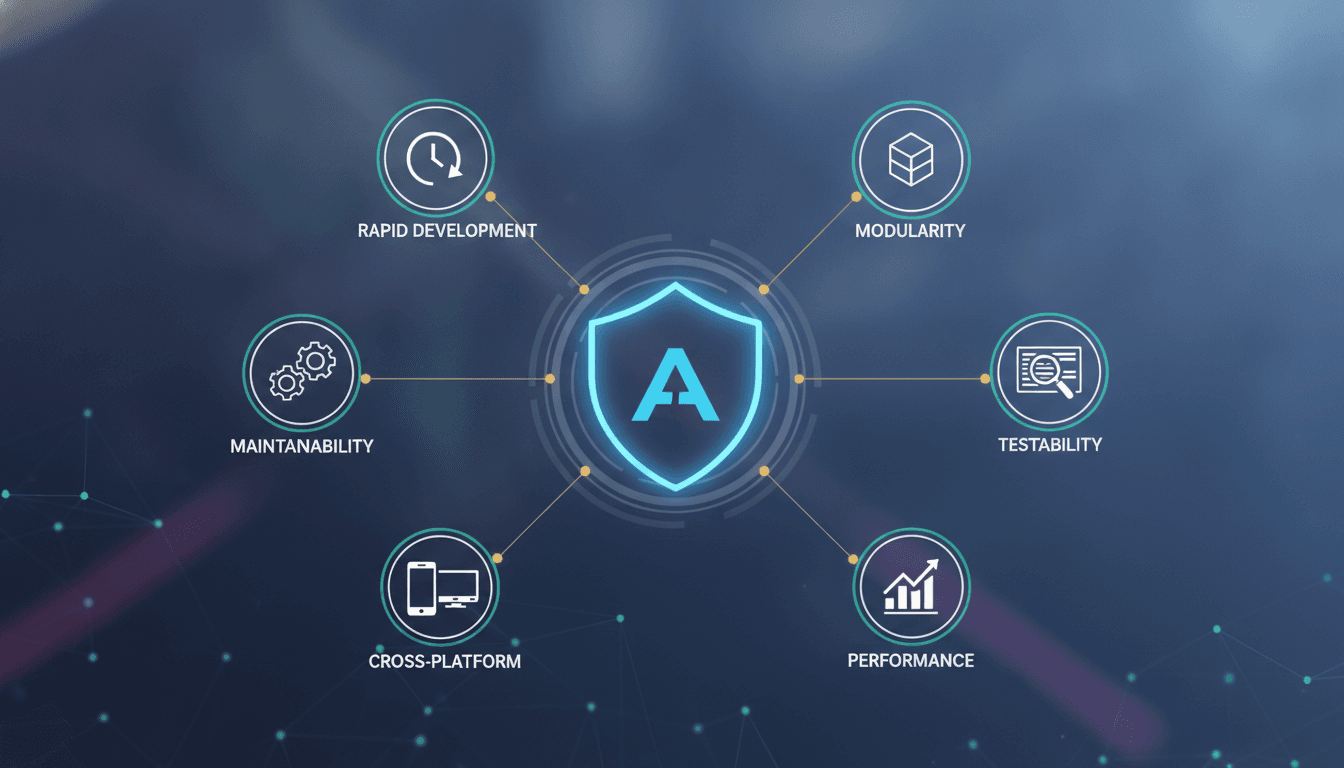
Angular has been a production frontend framework since 2016. If you're already shipping React or Vue, you know the trade-offs. This post is for engineers who want an honest look at where Angular earns its place and where it gets in the way.
What Does Angular Actually Give You That Others Don't?
The honest answer is: a complete, opinionated system out of the box.
React is a view library. You assemble the rest: routing, state management, HTTP, forms. That works fine when your team has strong opinions and time to make choices. Angular makes those choices for you. @angular/router, HttpClient, ReactiveFormsModule, dependency injection via @NgModule or the newer standalone API — it's all first-party, versioned together, and documented together.
That matters at scale. When a team of 15 engineers is working on the same codebase, having a single canonical way to write a service or a form reduces the surface area for disagreement. With React, you debate Zustand vs Redux Toolkit vs Jotai. With Angular, you write an injectable service and move on.
TypeScript Is Not Optional
Angular was rewritten in TypeScript from Angular 2 onwards and has never pretended otherwise. The framework's decorators, dependency injection tokens, and change detection all assume strong typing. That's a constraint, but a useful one. Type errors surface at compile time, not in production. IDE support — particularly in VS Code with the Angular Language Service extension — is noticeably better than in loosely typed React codebases.
The Angular compiler (ngc) also performs template type-checking in strict mode ("strictTemplates": true). A typo in an *ngIf binding becomes a build error, not a runtime blank screen.
Component Architecture and Change Detection
Angular's change detection is zone-based by default, using zone.js to intercept async operations and trigger UI updates. This is why a plain setTimeout or XMLHttpRequest inside a component causes the view to update without you doing anything explicit.
The trade-off: zone.js adds about 98 KB (minified, pre-gzip) and can trigger more checks than necessary in large trees. The fix is ChangeDetectionStrategy.OnPush, which limits re-renders to explicit input changes or Observable emissions. Teams that adopt OnPush consistently see measurable performance improvements in component-heavy UIs.
Angular 17 introduced Signals as a reactive primitive, bringing a model closer to SolidJS. Signals are now stable in Angular 18. The long-term direction is zoneless change detection, which removes the zone.js dependency entirely. That migration is underway in Angular's own test suite. If you're starting a new project today, writing signal-based components is a reasonable bet.
Is Angular Too Heavy for a Modern Single-Page App?
It depends on what you're building and how you configure the build.
A default Angular CLI project with Ivy compiler produces a baseline bundle of roughly 140–180 KB gzipped for a minimal app. React with a comparable set of libraries (router, state, HTTP) typically lands around 100–130 KB gzipped. The gap is real but narrower than it was with Angular 8 and the View Engine compiler.
Ivy, introduced in Angular 9, changed how the compiler works. It compiles each component independently, which means the build tool can tree-shake unused framework code. An Angular app that doesn't use HttpClient won't ship HttpClient. That wasn't reliably true with the older compiler.
For large apps, Angular's module system (and increasingly, standalone components introduced in Angular 14) enables lazy loading at the route level. A route that loads AdminModule only when a user navigates to /admin is a few lines of configuration. The framework's CLI scaffolding makes this the default recommended pattern.
If you're building a marketing site or a simple public dashboard with minimal interactivity, Angular is probably the wrong choice. Next.js or Astro will give you better static generation support with less configuration overhead.
/// Not sure where to start?
Get the architecture before you commit
Tell us what you're building and we'll map the technical approach, stack, and rough timeline. No cost, no obligation, no sales call required.
How Does Angular Handle Large-Scale Applications?
This is where Angular's design decisions pay off most clearly.
Monorepo and Module Boundaries
The Angular team officially supports Nx for monorepo management. Nx adds module boundary enforcement: you define which libraries can depend on which, and the linter enforces it. In a codebase with 50+ feature modules, that enforcement is the difference between a maintainable system and a spaghetti dependency graph.
Angular's own module system (@NgModule) has historically been the mechanism for encapsulation. With standalone components now stable, there's a migration path away from NgModules, but existing codebases don't need to migrate immediately. The two approaches coexist.
Testing Infrastructure
Angular's TestBed is a full dependency injection container that mirrors the production environment. You can test a component with real child components, or stub them out. The HttpClientTestingModule lets you intercept HTTP calls and assert on requests without hitting a network. This is more structured than setting up mocks manually in Jest with React Testing Library, though it's also more verbose.
The Angular CLI wires up Karma and Jasmine by default, though most teams replace Karma with Jest for faster test runs. The migration is well-documented and widely adopted.
Enterprise Patterns
Angular's dependency injection system supports hierarchical injectors. A service provided at the root level is a singleton. A service provided at the component level is scoped to that component's subtree. This maps cleanly to domain-driven design: a CartService can be scoped to a checkout feature, isolated from the rest of the app.
Forms handling is a particular strength. ReactiveFormsModule gives you a programmatic model for form state, validation, and submission. A complex multi-step form with conditional fields, async validators, and cross-field validation rules is manageable in Angular's reactive forms API. The same form in an unstructured React setup often becomes hard to test and harder to hand off.
Internationalisation, Accessibility, and Angular Material
Angular's i18n tooling is built into the compiler. You mark strings with i18n attributes, run ng extract-i18n, and get XLIFF or XMB files. The compiled output is one bundle per locale, which means no runtime translation overhead. That's a different trade-off from libraries like react-i18next, which resolve translations at runtime. Compile-time i18n is faster for the end user; runtime i18n is more flexible for dynamic content.
Angular Material (the official component library, now at version 18) follows the Material Design specification and ships with built-in ARIA attributes, keyboard navigation, and focus management. For enterprise internal tools where accessibility compliance (WCAG 2.1 AA) is a requirement, starting with Angular Material reduces the custom ARIA work significantly. The components are not always the right visual fit for consumer-facing products, but they're a solid foundation.
Conclusion
Angular is a well-engineered framework with clear strengths: TypeScript-first design, a complete standard library, strong tooling for large codebases, and a consistent upgrade path (Angular has maintained backward compatibility through major versions since v2, with automated migration schematics). It costs you some bundle size and a steeper initial learning curve compared to React.
The next concrete step: if you're evaluating Angular for a new project, scaffold a minimal app with the Angular CLI (ng new --standalone), enable strictTemplates, and write one reactive form and one lazy-loaded route. That exercise will tell you more than any comparison article, including this one.
FAQ
Is Angular a good choice for a team that already knows React? The core concepts transfer: component thinking, reactive state, unidirectional data flow. The friction comes from TypeScript strictness and Angular's opinionated patterns. Expect a 4–6 week ramp-up period before a React-experienced team is writing idiomatic Angular. After that, productivity typically equalises.
What version of Angular should a new project target?
Angular 18 is the current stable release as of mid-2024. It includes stable Signals, stable standalone APIs, and experimental zoneless support. Start there. Angular's schematic-based migrations (ng update) make version upgrades less painful than they used to be.
Does Angular support server-side rendering?
Yes, through Angular Universal, now integrated into the core CLI as @angular/ssr. Hydration support improved significantly in Angular 16 and 17. It's not as mature as Next.js for SSR-first applications, but it's a viable option for Angular apps that need SEO or first-paint performance requirements.
When should you not use Angular? If your team is small (fewer than 4 frontend engineers), your app is mostly static content, or you need to ship a prototype in under two weeks, Angular's setup overhead is hard to justify. React with Next.js or a Vite-based setup will get you moving faster with less initial configuration.
How does Angular handle state management? Angular has no first-party state library equivalent to Redux. The common choices are NgRx (Redux-pattern, well-integrated with Angular's DI), Akita, or simply RxJS-based services. With Signals now stable, lightweight signal-based state is increasingly viable without a third-party library. NgRx adds meaningful boilerplate; weigh that against the benefit of a strict unidirectional data flow for your specific app complexity.
Have a project in mind? Contact Sodio Technologies to discuss your requirements and explore the right technology solution for your business.
/// Work with us
Talk to the engineers who'd build it
You'll get a technical scope, timeline and cost estimate from the people doing the work, not an account manager. In-house team, no subcontracting, since 2016.