

EDI Mapping Layers for Partners Who Disagree
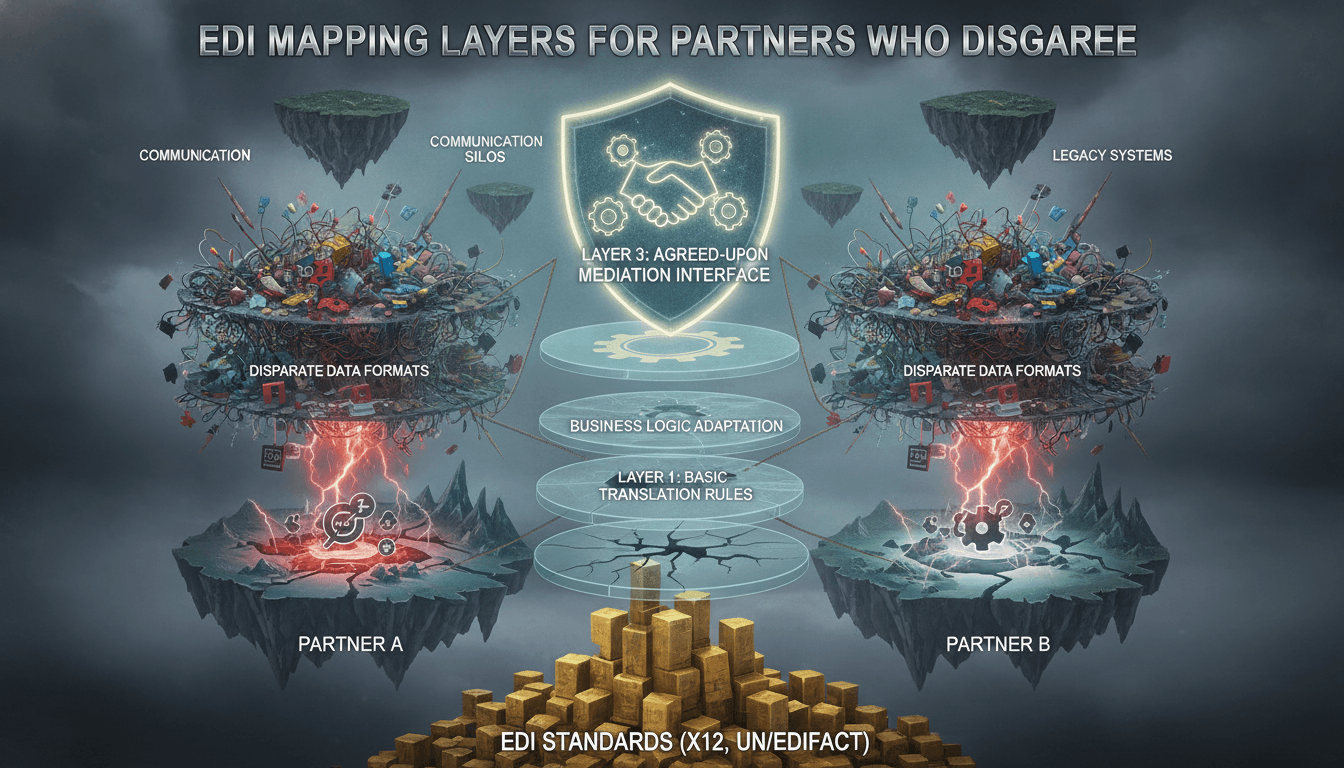
When two trading partners both claim their EDI setup is correct and the transaction still fails, the problem is almost never in the data. It's in the layer where translation happens, and specifically in who owns that layer.
This post is about building mapping layers that survive partner disagreement: mismatched segment expectations, conflicting qualifier interpretations, version drift, and the Monday-morning phone call where both sides have logs proving they're right.
What "disagreement" actually looks like in production
Two common failure modes show up repeatedly.
The first is version mismatch. One partner sends X12 4010, the other expects 4030. The segments exist in both, but the 4010 NM1 loop for an 850 Purchase Order has a different repetition ceiling than 4030. Your map passes validation internally; their VANs reject it silently or, worse, accept it and drop the loop.
The second is qualifier ambiguity. The ISA06 sender qualifier field is a 15-character identifier, and the qualifier code in ISA05 tells you what kind. Code "01" means DUNS, "12" means phone number, "ZZ" means mutually defined. "ZZ" is where agreements go to die. Every partner who uses ZZ has a different internal convention, and none of them document it the same way.
Both problems have the same root cause: there is no shared, versioned contract sitting between the two EDI environments. Each side has a map. Neither map knows the other exists.
Why a single map is not enough
Most EDI implementations treat mapping as a one-time translation exercise. You get the partner's implementation guide, you build a map in Gentran, MuleSoft, or a custom XSLT transform, you test against their sample files, and you ship.
That works until the partner changes something. And partners change things constantly, usually without a formal change notice. A retailer on a 997 Functional Acknowledgement cycle may start sending a 999 Implementation Acknowledgement without notice because their TMS vendor upgraded. Your system now receives a transaction set you never mapped, acknowledges nothing, and the partner marks the exchange as failed.
The correct architecture has three layers, not one:
| Layer | Responsibility | Who owns it |
|---|---|---|
| Inbound canonical transform | Convert raw EDI to an internal normalised format | Your team |
| Partner agreement manifest | Declarative record of what each partner sends and expects | Shared or versioned in source control |
| Outbound partner-specific transform | Convert canonical to partner's actual format | Your team, per partner |
The canonical layer is the stabiliser. It means a change in partner B's X12 version does not touch your business logic. It only touches layer 1 and layer 3 for that partner.
How do you structure a partner agreement manifest?
A partner agreement manifest is a machine-readable document that captures the negotiated interpretation of an implementation guide. Think of it as the diff between the published X12 or EDIFACT standard and what this partner actually does.
A minimal manifest in JSON covers:
- Transaction sets in scope (e.g., 850, 855, 856, 810)
- X12 version or EDIFACT message version per transaction set
- Segment usage: mandatory vs. situational, per-partner overrides
- Qualifier codes in use and their partner-specific meanings
- Envelope settings: ISA05/ISA06, GS02/GS03, control number ranges
- Acknowledgement expectations: 997 vs. 999, timing SLA in hours
This manifest lives in source control alongside your map code. When a partner changes something, you raise a PR against the manifest. The map generator (or a validation step in your CI pipeline) catches divergence before it hits production.
Tools like Stedi's EDI platform and AWS B2B Data Interchange take a similar declarative approach. If you're building a custom stack, a JSON Schema or YAML file checked into Git achieves the same audit trail without vendor lock-in.
/// Not sure where to start?
Get the architecture before you commit
Tell us what you're building and we'll map the technical approach, stack, and rough timeline. No cost, no obligation, no sales call required.
What happens when the partner's implementation guide is wrong?
This is more common than the EDI world admits publicly. A partner publishes an implementation guide that says a segment is optional, but their actual system rejects any file that omits it. Or the guide says REF01 accepts "DP" (Department), but their validation engine only accepts "DP" if it appears in a specific loop position that the guide doesn't mention.
You find out through rejection, not documentation.
The approach that holds up: treat the first 20 live transactions as a calibration phase, not a go-live. Log every inbound and outbound segment. Diff your produced output against what the partner actually acknowledges without error. Any segment or qualifier that appears in their accepted files but not in the guide goes into the manifest as an undocumented requirement, flagged explicitly.
This is not elegant. It is accurate.
Some partners will share their internal validation rules if you ask directly. A surprising number will not, because those rules are embedded in legacy software nobody wants to document. In that case, you are reverse-engineering their validator from observed behaviour, and you should say so clearly in your own documentation so the next engineer who touches the map understands the epistemological status of what they're reading.
Handling segment-level disagreements formally
When a partner insists a segment you're not sending is required, and you disagree based on the published guide, resolve it in writing before touching the map. A short email thread with an explicit agreement is enough. The point is to have a record that the deviation is intentional and agreed, not a bug waiting to be "fixed" by either side.
Map comments and manifest annotations should reference that agreement. Something like # agreed 2024-03-11: partner requires CTT02 even on zero-line orders, contra guide v4030 section 5.4 is exactly the right level of documentation.
Building for version drift over time
EDI relationships outlast software. A partner integration built in 2019 will still be running in 2027, and by then the person who built it has moved on.
Version drift is the slow accumulation of undocumented changes. The manifest approach handles this only if you enforce the discipline of updating it with every change. That means two things in practice.
First, automated validation against the manifest on every inbound file. If a file arrives with a segment or qualifier not in the manifest, it does not fail silently. It logs a manifest divergence event and routes to a review queue. You want to know when the partner changes something, not find out three months later when a downstream process starts producing wrong data.
Second, a periodic reconciliation cadence with each partner. Quarterly is enough for stable relationships. After any partner system upgrade, do it immediately. Compare your manifest against their current implementation guide. Treat the guide as the source of truth for what changed; treat observed file behaviour as the source of truth for what their system actually does.
The gap between those two is your risk surface.
Conclusion
EDI mapping disagreements are almost always coordination problems with a technical surface. The map is fine. The missing piece is a shared, versioned record of what was actually agreed between the two parties.
Start by separating your canonical transform from your partner-specific transforms if they're currently combined. Then build a manifest for your highest-volume or highest-risk partner first. Version it in Git, validate inbound files against it, and document every deviation with a date and a reason.
That single practice eliminates most of the Monday-morning debugging calls, because when something breaks, both sides can look at the same document and ask whether the file matches what was agreed rather than what the standard says.
FAQ
What's the difference between an EDI map and a partner agreement manifest? An EDI map is executable code that translates one format to another. A partner agreement manifest is a declarative document that records what a specific partner actually sends and expects, including deviations from the published standard. The manifest drives or validates the map; it is not a replacement for it.
Should we use a VAN or build direct AS2/SFTP connections? VANs (Value Added Networks) reduce connectivity overhead but add cost per kilocharacter and introduce a third party into debugging conversations. AS2 or SFTP direct connections give you full visibility into the envelope and transmission timing. For high-volume or latency-sensitive transactions, direct is usually worth the setup cost. For long-tail partners with low volume, a VAN is often more practical.
How do we handle a partner who refuses to share their implementation guide? Calibrate from observed traffic. Send test transactions that cover every segment variant you might need. Log what they accept without error. Build the manifest from observed behaviour and flag every entry as "inferred, not documented." Ask for formal confirmation of the inferred rules in writing, even if they only respond partially.
Is X12 or EDIFACT better for new integrations? Depends entirely on your trading partner base. North American retail, logistics, and healthcare use X12 almost exclusively. European and global supply chains lean toward EDIFACT. If you're building a platform that will face both, design your canonical internal format to be agnostic and keep the EDI standard as a transport concern, not a data model concern.
How often do implementation guides actually change? More often than you'd expect. Major retailers issue guide revisions annually or after significant system upgrades. Healthcare payers under HIPAA change guides when transaction set versions are mandated by CMS. Track guide version numbers in your manifest and subscribe to partner portals or mailing lists for change notices. Most outages from guide changes happen because nobody noticed the revision was published.
Have a project in mind? Contact Sodio Technologies to discuss your requirements and explore the right technology solution for your business.
/// Work with us
Talk to the engineers who'd build it
You'll get a technical scope, timeline and cost estimate from the people doing the work, not an account manager. In-house team, no subcontracting, since 2016.