

Enterprise Resource Planning (ERP) in Manufacturing
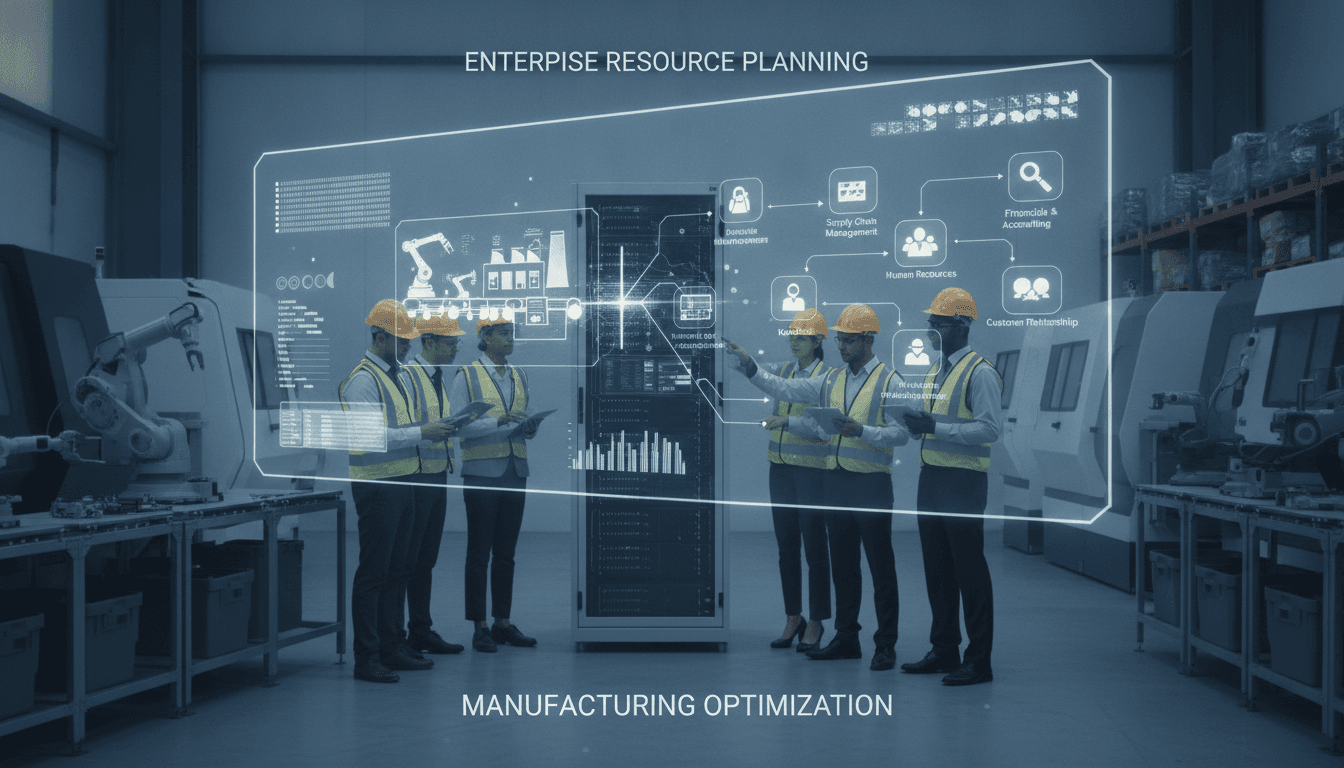
Manufacturing ERP is not a solved problem. Despite decades of SAP and Oracle deployments, most mid-size manufacturers still run on a patchwork of spreadsheets, legacy MES systems, and point solutions that don't talk to each other. This post covers what a modern manufacturing ERP actually needs to do, where the common implementations fall short, and the architectural decisions that matter most.
What Does a Manufacturing ERP Actually Need to Handle?
Generic ERP handles finance, HR, and procurement. Manufacturing ERP has to go further. It needs real-time visibility into the shop floor, and that means integrating with systems that most ERP vendors treat as an afterthought.
The core domains a manufacturing ERP must cover:
- Bill of Materials (BOM) management — multi-level, variant-aware, and version-controlled
- Production planning and scheduling — MRP II or constraint-based, depending on your shop
- Shop floor execution (MES integration) — machine data, work order tracking, operator inputs
- Inventory and warehouse management — lot tracking, serial numbers, FEFO/FIFO rules
- Quality management — inspection plans, non-conformance tracking, SPC data
- Maintenance (CMMS) — preventive schedules tied to production calendars
- Costing — standard cost, actual cost, and variance analysis against work orders
Most off-the-shelf ERPs cover the first four reasonably well. Quality and maintenance are where the gaps appear, and costing is where the mismatches between what the ERP thinks happened and what actually happened on the floor become expensive.
Why Do So Many Manufacturing ERP Implementations Fail?
The failure rate is not exaggerated. Gartner has consistently put ERP project failure or significant overrun rates above 55–75% depending on how failure is defined. In manufacturing, the number skews worse because of the shop floor integration problem.
The root cause is usually one of three things.
BOM complexity is underestimated. A discrete manufacturer building configurable products may have thousands of BOM variants. Getting those into an ERP cleanly, with the right parent-child relationships and the right effectivity dates, takes months of data work before a single line of configuration is written.
MES and ERP are treated as separate concerns. They are not. If your MES records actual production quantities and your ERP runs MRP on planned quantities, your inventory records drift within weeks. The integration layer between ISA-95 Level 2 and Level 3 systems is where most projects quietly fall apart.
Change management is started too late. Operators and planners have workarounds that work. They will not abandon them for a new system unless the new system is demonstrably better for their specific job. Training scheduled for two weeks before go-live is not change management.
/// Not sure where to start?
Get the architecture before you commit
Tell us what you're building and we'll map the technical approach, stack, and rough timeline. No cost, no obligation, no sales call required.
How Should You Approach the Build-vs-Buy Decision?
This depends on where your differentiation actually sits.
If your manufacturing process is relatively standard — discrete assembly, standard routings, predictable demand — then a configurable off-the-shelf solution like SAP S/4HANA Manufacturing, Microsoft Dynamics 365 Supply Chain Management, or Infor CloudSuite Industrial is almost certainly the right starting point. The implementation cost is high, but the ongoing cost of maintaining custom code is higher.
| Scenario | Recommended Approach |
|---|---|
| Standard discrete manufacturing, <500 users | Dynamics 365 SCM or Infor CSI, configured |
| Process manufacturing with complex recipes | SAP S/4HANA with PP-PI, or Aptean Process Manufacturing |
| High-mix, low-volume with complex configurator | Custom CPQ + ERP integration layer |
| Legacy shop floor, phased modernisation | Thin integration layer first, ERP migration second |
| Heavily regulated (FDA, IATF 16949) | SAP or Oracle with validated QMS module |
Where custom development makes sense is at the edges: the configurator that needs to handle your specific product rules, the scheduling engine that understands your specific constraints, or the reporting layer that surfaces the KPIs your operations team actually uses. Building a custom ERP core from scratch in 2025 is almost never justified.
The Shop Floor Integration Problem
This is the part that gets skipped in vendor demos.
A modern manufacturing shop has PLC data coming off machines via OPC-UA or MQTT, SCADA systems aggregating it, an MES (or a spreadsheet pretending to be one) tracking work orders, and an ERP sitting above all of that. The data flows between these layers are where accuracy breaks down.
The ISA-95 standard defines the interface between enterprise systems (Level 4) and manufacturing operations systems (Level 3). In practice, most integrations are custom REST or SOAP bridges that were built for one version of both systems and never properly maintained.
What works better is an event-driven architecture at the boundary. Publish machine events and production completions to a message broker (Apache Kafka is the most common choice at scale; RabbitMQ for lower throughput). The ERP subscribes to production completion events and updates inventory and work order status in near real-time. The MES subscribes to work order release events from the ERP. Neither system calls the other directly.
This decoupling means you can replace either system without rebuilding the integration. It also means you have a durable event log that tells you exactly what happened and when, which is valuable for costing variance analysis and for regulatory audit trails.
Costing, Variance Analysis, and Why Your Numbers Are Probably Wrong
Standard costing is simple: set a standard cost per unit at the start of the period, absorb it as you produce, analyse the variance at the end of the month. The problem is that standard costs in most manufacturers are set once a year and then forgotten. When material prices move 15–20%, as they did across most industries in 2021–2023, the variances become noise rather than signal.
Actual costing gives you real numbers but is computationally heavier. SAP S/4HANA supports actual costing via the Material Ledger, but getting it configured correctly, including the handling of revaluation across multiple production levels, requires someone who has done it before. The default configuration in most implementations leaves it half-finished.
The useful middle ground for most manufacturers is a rolling average cost with tight period-end variance reporting by cost element: material, labour, machine, and overhead separately. If your ERP cannot show you variance by cost element at the work order level, you are flying blind on profitability.
Conclusion and Next Step
A manufacturing ERP project fails or succeeds in the details: BOM data quality, the integration architecture between MES and ERP, and whether the costing model reflects what actually happens on the shop floor. Getting the vendor selection right matters less than getting these three things right.
If you are scoping a manufacturing ERP implementation or an integration programme, the most useful first step is a data audit: BOM completeness and accuracy, inventory record accuracy (cycle count data will tell you this), and a map of every system currently touching production data. That audit will surface the real scope of the project faster than any vendor workshop.
FAQ
What is the difference between an ERP and an MES in manufacturing? An ERP handles business-level planning: orders, inventory positions, financials, and procurement. An MES handles shop floor execution: work order dispatching, machine and operator data capture, and real-time production tracking. They need to exchange data continuously, but they operate at different latencies and with different data models.
How long does a manufacturing ERP implementation typically take? For a mid-size discrete manufacturer (100–500 shop floor users), a full SAP S/4HANA or Dynamics 365 SCM implementation typically runs 18–30 months from scoping to go-live. Faster timelines are possible with a phased approach: finance and procurement first, manufacturing second. Compressing below 12 months almost always results in post-go-live pain.
Should we build custom ERP modules or configure off-the-shelf ones? Configure first. Custom code in an ERP core creates upgrade risk and maintenance cost that compounds over years. Build custom only where the off-the-shelf functionality genuinely cannot support your process and where that process is a real competitive differentiator, not just a historical habit.
What data do we need to clean up before an ERP go-live? At minimum: BOM accuracy (every active product, correct quantities and units of measure), item master completeness (lead times, lot sizes, costing data), open purchase orders, and a physical inventory count reconciled to your current system. Missing or wrong data in any of these will cause MRP to generate bad plans from day one.
Is cloud ERP suitable for manufacturing environments with poor internet connectivity? It depends on the architecture. SaaS ERP with no offline capability is a problem for shop floors with unreliable connectivity. Some vendors, including SAP with its edge integration capabilities and Microsoft with Dynamics 365 offline mode, support local caching and sync. Verify specifically whether the shop floor transactions you need (work order confirmations, goods movements) are supported offline before committing to a cloud-only deployment.
Have a project in mind? Contact Sodio Technologies to discuss your requirements and explore the right technology solution for your business.
/// Work with us
Talk to the engineers who'd build it
You'll get a technical scope, timeline and cost estimate from the people doing the work, not an account manager. In-house team, no subcontracting, since 2016.