

Environmental Monitoring: Ensuring Compliance
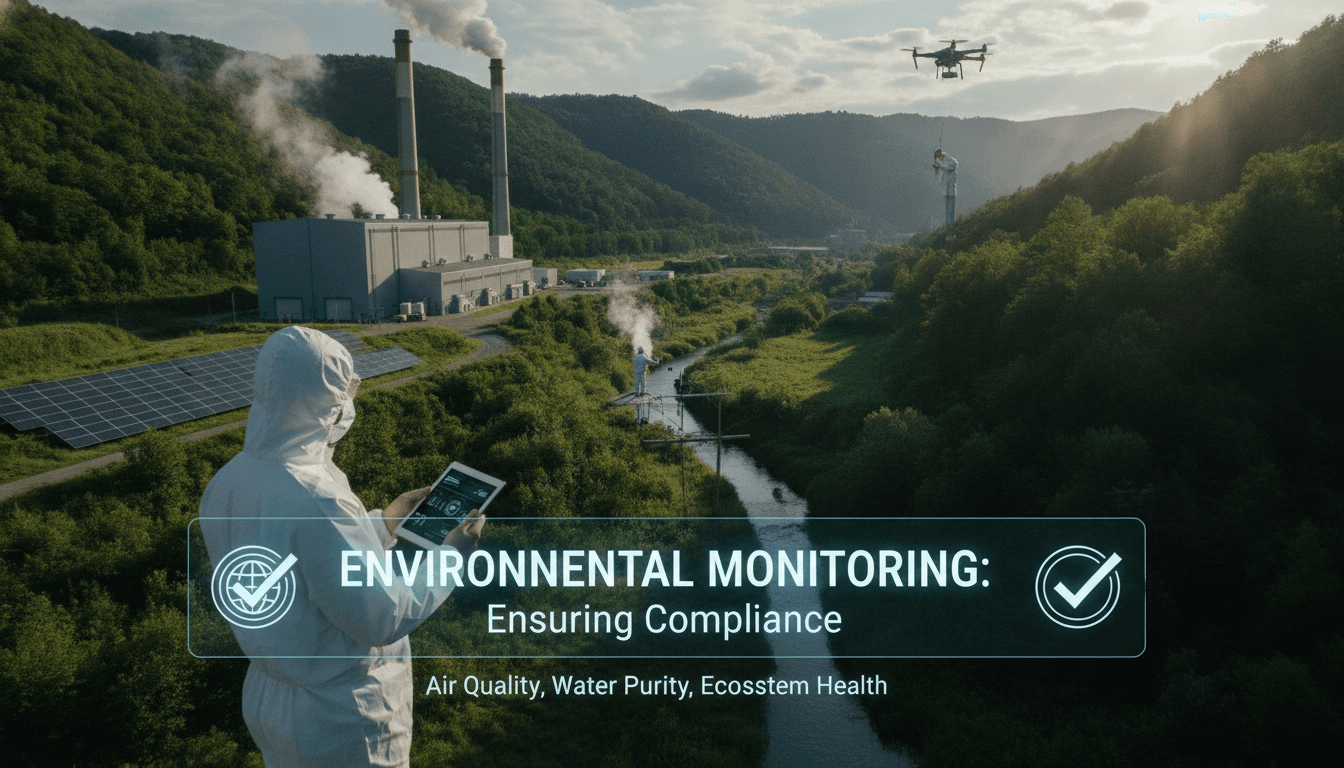
Environmental compliance used to mean a clipboard, a site visit, and a spreadsheet uploaded once a month. Regulators are moving faster now, and the gap between what your sensors know and what your compliance report says is where the real risk lives.
What Does an Environmental Monitoring Stack Actually Look Like?
At the hardware layer, you have sensors measuring particulate matter (PM2.5, PM10), CO₂, NOₓ, SO₂, VOCs, temperature, humidity, and water quality parameters like dissolved oxygen, turbidity, and pH. These sensors talk over a mix of protocols: Modbus RTU for legacy industrial kit, MQTT over cellular (LTE-M or NB-IoT) for remote sites, and LoRaWAN where power budgets are tight and backhaul is sparse.
Data lands in a time-series store. InfluxDB and TimescaleDB are the two most common choices. InfluxDB handles high-frequency writes well and its Flux query language is expressive for sensor aggregations. TimescaleDB sits on top of PostgreSQL, which matters if you want to JOIN sensor readings with relational data like asset IDs, permit thresholds, or site metadata without pulling data into application code.
Above that sits the processing layer. For real-time alerting, Apache Kafka with Kafka Streams or Flink is the standard. For batch compliance reporting, most teams land on Spark or dbt transforming data in a warehouse like BigQuery or Redshift. These are not interchangeable choices. Kafka gives you sub-second latency for exceedance alerts. Spark gives you auditable, reproducible batch transforms that a regulator can inspect.
Edge vs. Cloud Processing
There is a real decision here. Processing at the edge (on an industrial gateway like a Raspberry Pi CM4 or a Moxa UC-8100) reduces data transmission costs and keeps you operational when connectivity drops. The trade-off is that edge firmware is harder to update, harder to audit, and harder to secure.
For most compliance use cases, the right answer is a hybrid: edge nodes do anomaly detection and local buffering, cloud does authoritative record-keeping. The compliance record must live in the cloud with an immutable audit trail. Regulators do not accept "the gateway lost connectivity" as an explanation for a gap in the record.
How Do You Handle Data Integrity for Regulatory Submissions?
This is where most teams underinvest. A sensor reading is only as good as its provenance chain. Regulators in the EU (under the Industrial Emissions Directive), the US EPA (40 CFR Part 75), and India's CPCB all require that submitted data be traceable to a calibrated instrument with a documented calibration schedule.
Practically, this means:
- Every data point needs a sensor ID, firmware version, last calibration timestamp, and calibration certificate reference
- Calibration drift detection should be automated. If a sensor's baseline reading shifts more than your allowed tolerance (typically ±2% for continuous emissions monitoring systems), it should flag and quarantine readings
- Data gaps must be handled by a substitution methodology defined in your monitoring plan, not left as nulls
For immutability, some teams write hashes of daily data batches to a blockchain, typically a private Hyperledger Fabric or a public chain like Polygon, as a timestamped commitment. This gives you a cryptographic proof that a dataset has not been altered since submission. It is not mandatory under most regulations yet, but it is a strong position to be in if readings are ever disputed.
/// Not sure where to start?
Get the architecture before you commit
Tell us what you're building and we'll map the technical approach, stack, and rough timeline. No cost, no obligation, no sales call required.
What Breaks in Production That Does Not Break in a Pilot?
Pilots run for 30–90 days in good weather with someone actively watching the dashboards. Production runs for years, through monsoons, firmware updates, sensor fouling, and staff turnover.
The failure modes that matter:
Sensor drift and fouling. Electrochemical sensors for NOₓ and SO₂ have a service life of 12–24 months. Optical PM sensors get fouled in high-humidity environments. If your system does not track sensor age and flag approaching end-of-life, you will submit bad data without knowing it.
Clock skew. Time-series data with misaligned timestamps is worse than no data. Use NTP with GPS fallback on edge devices. Check that your ingestion pipeline rejects or flags readings with timestamps more than 60 seconds in the past or future.
Schema drift. A firmware update changes a field name or adds a new pollutant channel. If your ingestion pipeline is schema-rigid, you lose data. If it is schema-flexible, you risk silently ingesting garbage. The practical answer is schema registry (Confluent Schema Registry or AWS Glue Schema Registry) with backward-compatibility enforcement.
Alerting fatigue. A system that sends 200 alerts a day trains operators to ignore them. Tune your thresholds. Use alert suppression windows during planned maintenance. Escalation paths matter: who gets the 3 AM SMS when a site crosses the permit limit?
Reporting: From Raw Readings to Submission-Ready Documents
Regulators want data in specific formats. The US EPA uses Electronic Data Reporting (EDR) XML schemas. India's CPCB requires data pushed to their Continuous Ambient Air Quality Monitoring (CAAQM) portal via their API. The EU uses E-PRTR reporting formats. None of these are the same.
Build your reporting layer as a translation layer, not as your primary data model. Your internal schema should be clean and normalised. Format-specific outputs are generated at report time. This means when a regulator changes their submission format (and they do), you update one transformation, not your entire data model.
Automated report generation with a human review step is the right pattern. Generate the draft programmatically, flag any readings that required substitution or were flagged during QA, and require a named sign-off before submission. That sign-off and the reviewer's identity should be part of the audit trail.
| Reporting Standard | Region | Format | Push/Pull |
|---|---|---|---|
| 40 CFR Part 75 | US EPA | EDR XML | Push (quarterly) |
| CPCB CAAQM | India | JSON API | Push (real-time) |
| E-PRTR | EU | XML (GML-based) | Annual upload |
| EA Reg 70 | UK | CSV/XML | Annual |
Conclusion
The monitoring system itself is usually the straightforward part. The hard parts are data provenance, calibration tracking, schema resilience, and generating submission-ready outputs in the format a specific regulator expects on a specific schedule.
If you are building this from scratch, start with your regulatory obligations and work backwards. Define your required data fields, retention periods, and submission formats before you pick a database or a message broker. That order of operations saves significant rework.
If you already have sensors in the ground and are trying to make sense of patchy data, audit your sensor metadata first. Missing calibration records are the most common reason environmental submissions get rejected.
FAQ
What is the difference between continuous monitoring and periodic monitoring for compliance? Continuous monitoring (CEMS) records readings at fixed intervals, typically every minute or hour, and is required for large point sources like power plants and refineries. Periodic monitoring involves scheduled manual or automated spot checks. Regulators specify which applies based on source type, emission volumes, and permit conditions.
How long does environmental monitoring data need to be retained? Retention requirements vary by jurisdiction. The US EPA mandates a minimum of five years for most CEMS records under 40 CFR Part 75. India's CPCB and EU E-PRTR both require at least three years. In practice, keep data for the life of the permit plus the statutory limitation period for regulatory action, which is often longer.
Can you use a public blockchain for environmental compliance records? You can, but understand what it gives you. A blockchain entry proves a hash existed at a timestamp. It does not prove the underlying data is accurate. Regulators care about sensor calibration and methodology, not chain-of-custody proofs. Blockchain adds a useful layer for dispute resolution, but it does not substitute for a sound quality assurance plan.
What happens when a sensor goes offline during a reporting period? Most regulatory frameworks require a documented data substitution methodology in your monitoring plan. This typically means using the 90th percentile of readings from the same period in the previous 30 days as a conservative substitute. The gap and substitution must be flagged in your submission. Undocumented gaps can result in permit violations regardless of actual emissions.
Is edge computing necessary for environmental monitoring? Not always. If your sites have reliable connectivity and your alerting latency requirements are measured in minutes rather than seconds, a cloud-only architecture is simpler to operate and audit. Edge processing earns its complexity when you have remote sites with intermittent connectivity, need sub-10-second exceedance alerts, or face data transmission costs that make continuous cloud streaming uneconomical.
Have a project in mind? Contact Sodio Technologies to discuss your requirements and explore the right technology solution for your business.
/// Work with us
Talk to the engineers who'd build it
You'll get a technical scope, timeline and cost estimate from the people doing the work, not an account manager. In-house team, no subcontracting, since 2016.