

Flight Booking Systems: Connecting Travelers with Airlines
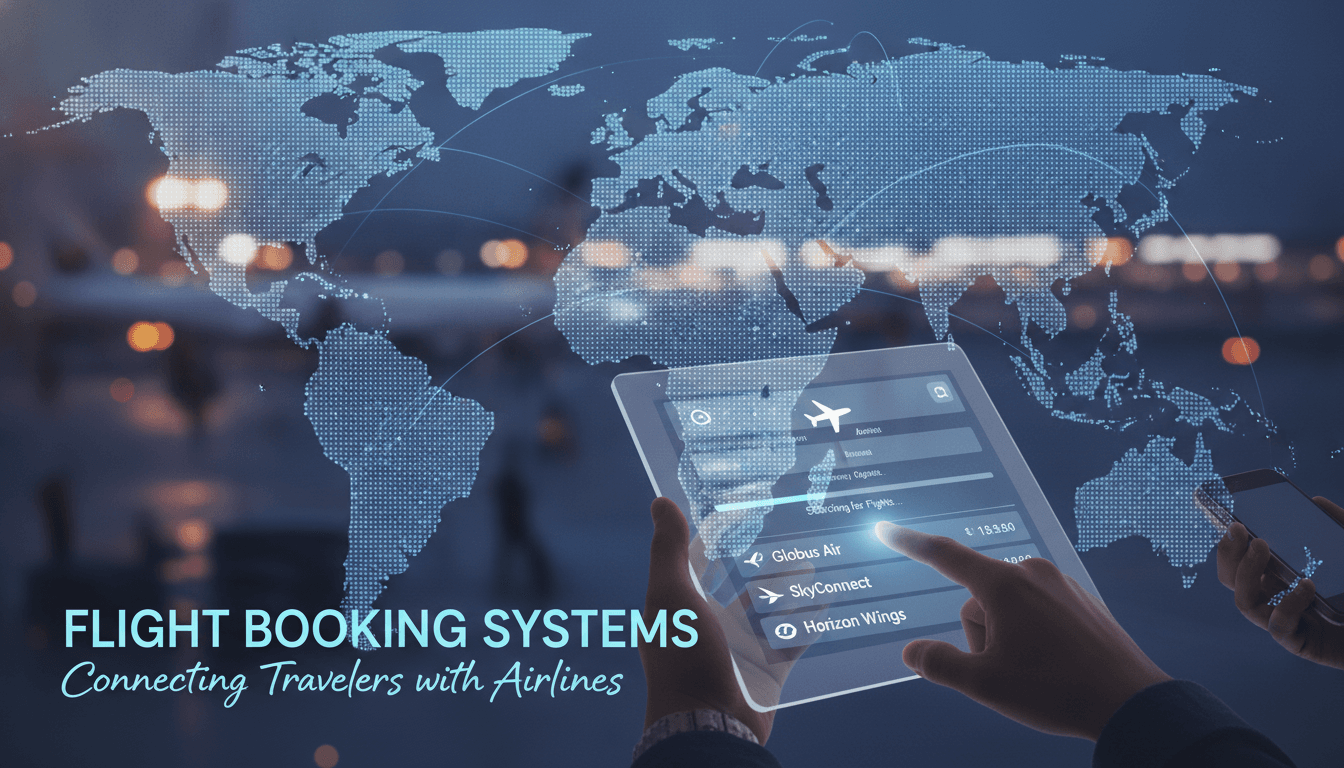
Flight booking systems sit at the intersection of real-time data, distributed inventory, and financial transactions happening at scale. If you're thinking about building one, integrating with one, or extending an existing one, here's what the architecture actually looks like under the hood.
How Does a Flight Booking System Actually Work?
At its core, a flight booking system does four things: it queries availability, presents options, reserves inventory, and processes payment. Each of those steps touches a different system, often owned by a different party.
The critical piece most people underestimate is inventory. Airlines don't just have "seats." They have fare classes, booking codes (like Y, B, M, Q), cabin configurations, ancillary products, codeshare agreements, and interline rules. A single flight can have 26 or more distinct fare buckets, each with its own price, conditions, and availability count. When you search for a ticket, the system isn't querying a simple database row — it's resolving a fare combination across segments, applying routing rules, and checking seat availability in real time.
The Role of GDS
Most booking engines don't talk directly to airlines. They talk to a Global Distribution System: Amadeus, Sabre, or Travelport. A GDS aggregates inventory from hundreds of airlines and exposes it through a unified API. The dominant GDS players process tens of millions of transactions daily.
Amadeus GDS, for example, uses EDIFACT-based messaging under the hood, though modern integrations use REST APIs via Amadeus for Developers or the Amadeus Self-Service APIs. Sabre exposes its content through SynXis and the Sabre Dev Studio REST APIs. Both offer sandbox environments for development.
If you're building a consumer-facing OTA (Online Travel Agency), you will almost certainly need a GDS contract. Direct airline NDC connections are possible but require individual agreements with each carrier and significantly more integration work.
NDC: The Newer Standard
IATA's New Distribution Capability (NDC) is an XML-based data transmission standard, currently at schema version 21.3. It was designed to let airlines distribute richer content (seat maps, ancillaries, bundles) directly to aggregators and agencies without going through a GDS.
NDC adoption is real but uneven. Airlines like Lufthansa, British Airways, and American Airlines have made significant NDC investments. Others are still largely GDS-dependent. If you're building an aggregation layer, you'll likely need to handle both legacy EDIFACT/GDS content and NDC content simultaneously, which adds schema translation work.
What Does the Technical Stack Look Like?
A production flight booking system has several distinct layers. Here's a rough breakdown:
| Layer | Responsibility | Common Technologies |
|---|---|---|
| Search & Availability | Query GDS/NDC, cache results | Node.js, Go, Redis, Elasticsearch |
| Pricing Engine | Fare calculation, tax computation | Java, C++, custom rules engines |
| Booking & Reservation | PNR creation, ticketing | GDS APIs, airline DCS integration |
| Payment Processing | Card processing, fraud detection | Stripe, Adyen, 3DS2 |
| Ancillary Management | Seats, baggage, meals | NDC OrderCreate, GDS SSR codes |
| Notifications | Itinerary updates, schedule changes | Kafka, SendGrid, FCM |
The search layer is where most of the engineering complexity sits. Flight search is inherently a graph traversal problem. Finding the optimal combination of flights across origins, destinations, and connection points is computationally expensive. Systems like ITA Software's QPX (now part of Google Flights) were engineered specifically to solve this efficiently. Most OTAs either license a search engine or build simplified versions that cover the majority of routes.
Caching Strategy
You cannot hit a GDS on every keystroke. GDS transactions are metered and priced per call. A common approach is to pre-cache availability data for high-demand routes at fixed intervals (typically every 15 to 30 minutes) and fall back to live queries for low-frequency or long-tail routes. Redis with TTL-based expiry works well here. The challenge is cache invalidation when a flight fills up or a schedule changes.
PNR and Ticketing
A PNR (Passenger Name Record) is the booking record held in the airline's or GDS's reservation system. Creating one involves sending a structured message with passenger details, itinerary, and payment authorisation. Ticketing is a separate step — it's when the airline issues the actual e-ticket (an Electronic Miscellaneous Document or ET number). The gap between PNR creation and ticketing is where most booking failures happen, especially during high-load periods.
/// Not sure where to start?
Get the architecture before you commit
Tell us what you're building and we'll map the technical approach, stack, and rough timeline. No cost, no obligation, no sales call required.
How Do You Handle Real-Time Seat Availability Without Overselling?
This is a genuine distributed systems problem. Airlines use their own Departure Control Systems (DCS) and Inventory Management Systems (IMS) to track seat counts. GDS systems mirror this inventory but with some lag. The reservation flow typically works like this:
- A soft block is placed on the seat during payment processing (usually 15 minutes).
- Payment is confirmed.
- The booking is committed to the airline's reservation system.
- The e-ticket is issued.
If step 3 or 4 fails after payment, you have a money-collected-but-no-ticket situation. This needs explicit compensating transactions in your booking flow. Idempotency keys matter here — if a ticketing API call times out, you need to be able to safely retry it without double-ticketing.
Overselling itself is a deliberate airline practice, not a bug. Airlines overbook flights based on historical no-show rates. The booking system doesn't prevent this — the DCS manages it at check-in.
Regulatory and Compliance Overhead
Flight booking isn't just an engineering problem. There's real compliance overhead.
PCI-DSS applies the moment you're handling card data. If you're using Stripe or Adyen with their hosted fields, your scope is significantly reduced (SAQ A or SAQ A-EP). Building your own payment page changes that calculus entirely.
GDPR and data residency matter for passenger data. PNR data shared with non-EU carriers or stored on US-based infrastructure has specific transfer mechanism requirements.
IATA accreditation is required if you want to issue tickets directly. Without it, you're issuing tickets through an accredited consolidator, which adds a dependency and a margin layer.
BSP (Billing and Settlement Plan) is IATA's financial clearing mechanism between travel agencies and airlines. If you're handling money for ticket sales, you'll interact with BSP reporting, which has its own data formats and reconciliation requirements.
Conclusion
Flight booking systems are complex because the underlying industry is complex. The GDS model is 60+ years old and still dominates, NDC is a real but incomplete shift, and the real-time inventory problem is genuinely hard at scale.
If you're starting from scratch, the fastest path to a working product is a GDS integration with a mid-office system like TravelFusion or Farelogix for ancillary handling. Building a proprietary search engine only makes sense at very high search volumes where GDS transaction costs become a meaningful line item.
If you're extending an existing system, audit your PNR failure and ticketing failure rates first. That's where most revenue leakage hides.
Talk to us if you're working through the architecture — we've built booking and aggregation layers and can walk you through the decisions that actually matter for your specific use case.
FAQ
What is the difference between a GDS and a direct airline API? A GDS aggregates inventory from hundreds of airlines into a single API. A direct airline API gives you richer, more current content for that specific carrier, but you need separate agreements and integrations for each airline. Most OTAs use a mix of both, prioritising direct connections for their highest-volume routes.
What is an NDC connection and do I need one? NDC is an IATA XML standard that lets airlines distribute content directly without a GDS. You need it if you want access to ancillary products, personalised offers, or fare content that airlines have deliberately withheld from GDS channels. Not all airlines have mature NDC implementations, so GDS fallback is usually still necessary.
How long does it take to build a basic flight booking integration? A basic GDS-connected search and booking flow with payment processing typically takes three to five months for a small team, assuming no prior GDS integration experience. NDC-only integrations can be faster for a single airline but take longer to scale across carriers. Mid-office and ancillary features add significantly to that timeline.
What happens when a ticketing call fails after payment? You have a charged customer with no confirmed booking. Your system needs a compensating transaction flow: either retry ticketing automatically with idempotency safeguards, or trigger a refund and notify the customer. Both paths require explicit handling in your booking state machine. Treating this as an edge case is a mistake — it happens regularly under load.
Is it worth building a proprietary flight search engine? Almost never, unless you're processing millions of searches daily. GDS transaction costs are real but modest relative to engineering costs at most OTA scales. The routing and fare combination logic is genuinely hard to get right across all itinerary types. Licensing a search engine or using GDS-provided low-fare search is the right call for most products.
Have a project in mind? Contact Sodio Technologies to discuss your requirements and explore the right technology solution for your business.
/// Work with us
Talk to the engineers who'd build it
You'll get a technical scope, timeline and cost estimate from the people doing the work, not an account manager. In-house team, no subcontracting, since 2016.