

Gaming and Interactive Media: Engaging Users
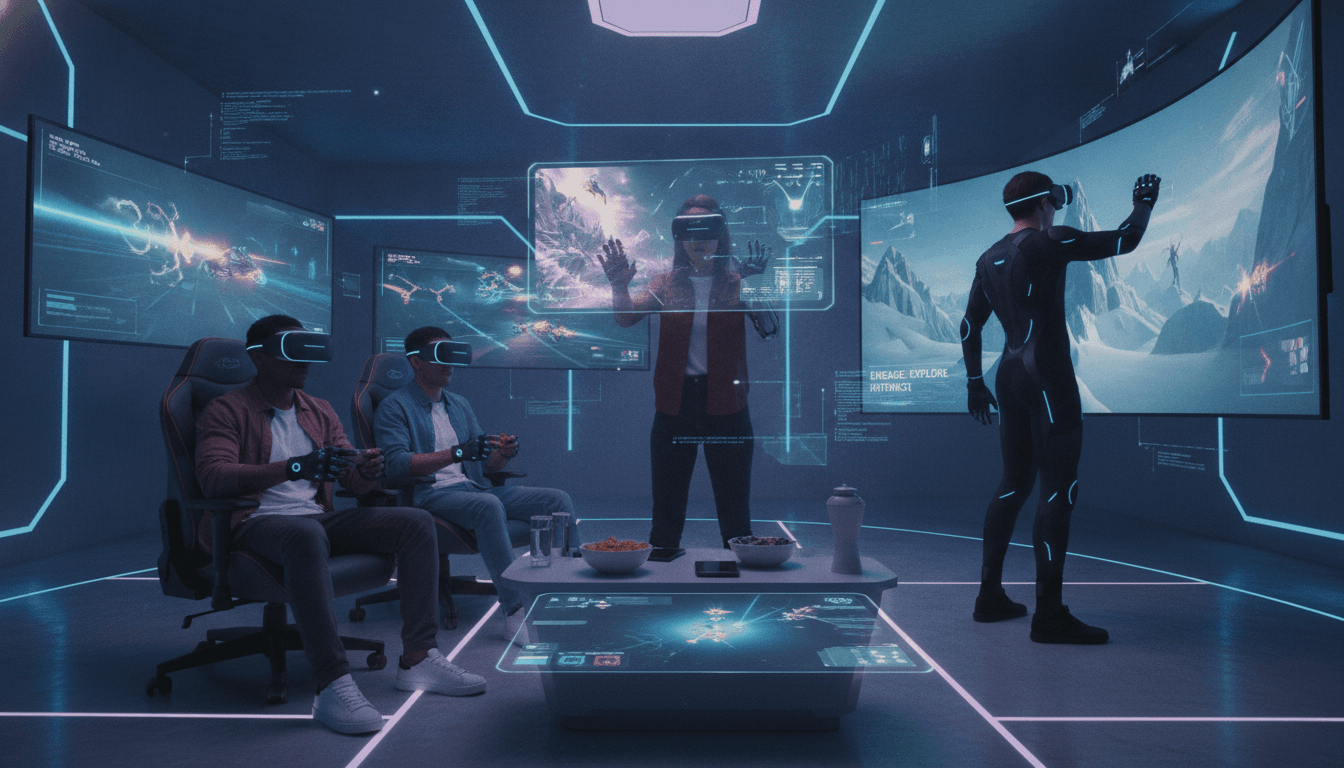
How modern games and interactive platforms hold attention, drive retention, and build communities worth keeping — from an engineering perspective.
What Has Actually Changed in How Users Engage with Games?
The shift isn't cosmetic. Ten years ago, engagement meant time-on-app. Now it means community formation, user-generated content pipelines, and real economic participation. Players don't just play; they create, trade, stream, and earn. The systems underneath have had to catch up fast.
A few numbers that set the context: the global gaming market was valued at roughly $184 billion in 2023 (Newzoo). Monthly active users on platforms like Roblox exceeded 88 million in 2024. User-generated content on Roblox alone drove over 4.5 billion hours of play in a single quarter. These aren't edge cases; they're the new baseline expectation.
The technical challenge is that engagement at this scale requires real-time state synchronisation, low-latency multiplayer infrastructure, personalisation engines running on millions of concurrent sessions, and economy systems that don't collapse under abuse. Each of those is a hard engineering problem on its own.
How Do Multiplayer and Social Systems Actually Drive Retention?
Retention in interactive media correlates more strongly with social graph depth than with content volume. A player with two friends on a platform churns at a much lower rate than a solo player with twice the content available. This is well-documented across platforms and genres.
Real-Time Infrastructure
Building low-latency multiplayer today typically means choosing between authoritative server models and peer-to-peer with rollback. For competitive titles, authoritative servers running on geographically distributed nodes (AWS GameLift, Agones on GKE, or self-managed with Nakama) are standard. Rollback netcode, popularised by GGPO, is now expected in fighting games and increasingly in other genres where determinism is achievable.
The latency budget for a responsive feel is tight: under 50ms round-trip for most action games, under 100ms for turn-based. Beyond that, player perception of "lag" degrades experience measurably.
Social Graph Features That Actually Move Metrics
- Party and squad systems with persistent state across sessions
- Asynchronous social hooks: gifting, challenges, leaderboards scoped to friend networks
- Presence systems showing what friends are playing in real time
- Guilds or clans with shared progression and economics
The last point matters more than it looks. Shared progression creates inter-player accountability. When a guild has a shared resource pool or a collective objective, individual churn directly harms others. That social cost suppresses churn in ways that no individual reward system can replicate.
Personalisation Engines: What's Worth Building vs. Buying?
Personalisation in games covers content recommendation, difficulty adjustment, reward timing, and narrative branching. The tooling options vary widely in maturity.
| Problem | Build | Buy / Use |
|---|---|---|
| Dynamic difficulty adjustment | Worth building; game-specific | — |
| Content recommendation | Off-the-shelf ML pipelines (Vertex AI, SageMaker) | Rarely worth custom |
| Reward timing optimisation | Hybrid: use RL frameworks, custom reward functions | — |
| Player segmentation | Standard clustering (k-means, DBSCAN) on event data | Amplitude, Mixpanel for lightweight cases |
| Cheat/abuse detection | Almost always custom | Anti-cheat SDKs as a layer, not a full solution |
Dynamic difficulty adjustment (DDA) deserves specific attention. Systems like flow-based DDA (drawing from Csikszentmihalyi's flow theory) adjust enemy behaviour, loot probability, or puzzle complexity in response to player performance signals. Implementing this with a simple PID controller on a difficulty parameter is a reasonable starting point; more sophisticated approaches use reinforcement learning with player frustration and boredom as negative rewards.
The honest trade-off: personalisation systems cost data infrastructure. You need clean event pipelines (Kafka or Kinesis feeding a data warehouse), labelled behavioural data, and model serving infrastructure. For studios shipping their first title, this is usually over-engineering. For a live-service game with 100,000+ DAU, it becomes necessary within months of launch.
/// Not sure where to start?
Get the architecture before you commit
Tell us what you're building and we'll map the technical approach, stack, and rough timeline. No cost, no obligation, no sales call required.
What Does a Healthy In-Game Economy Actually Look Like?
Virtual economies are harder to design than they look. The failure mode isn't usually hyperinflation from too many sources; it's deflation from poorly tuned sinks, or toxicity from real-money secondary markets that undermine trust.
Currency Architecture
Most well-functioning game economies use a dual-currency model: a soft currency earned through play, and a hard currency purchased with real money. This creates a natural separation between grind rewards and premium access. The mistake is making the exchange rate between them obvious, which lets players price everything in real money and creates resentment.
Blockchain-Based Economies
On-chain economies via NFTs (ERC-721, ERC-1155 on EVM chains, or SPL tokens on Solana) are viable for specific use cases: genuine asset ownership, player-to-player trading without a platform cut, and interoperability across titles. The real constraint isn't the technology; it's regulatory clarity and user onboarding friction. Wallet management for mainstream players remains a significant UX problem.
Where blockchain economies have worked, they've worked because asset scarcity was real (not artificial), the secondary market was liquid, and the game itself was worth playing without the economic layer. Axie Infinity's collapse in 2022 is the clearest case study in what happens when play-to-earn becomes the primary reason to play.
Anti-Abuse at Scale
Economy abuse includes botting for resource farming, arbitrage between regional price points, and real-money trading (RMT) that violates terms of service. Detection is a machine learning problem: flag anomalous transaction patterns, velocity outliers, and account behaviour that deviates from cohort norms. Automated soft-bans (rate limits, invisible currency caps) tend to be more effective than hard bans for catching borderline cases, because they allow investigation before irreversible action.
Narrative Interactivity and Branching: The Engineering Side
Interactive storytelling has moved well past simple dialogue trees. Modern systems like Ink (used in games including 80 Days and Heaven's Vault), Yarn Spinner, and proprietary graph-based engines manage thousands of nodes with conditional state tracked at the player level.
The engineering challenge is state management. A branching narrative with 50 binary decision points has 2^50 theoretical paths. In practice, most branches converge, but the state space is still large. Tracking this cleanly, persisting it across sessions, and making it inspectable for writers and QA is non-trivial. A document-oriented store (MongoDB or DynamoDB) with a well-typed state schema works better than a relational model here, mostly because the schema changes constantly during production.
AI-generated narrative is entering this space with LLMs. GPT-4-class models can generate contextually aware NPC dialogue at runtime, but hallucination and consistency remain real problems. The practical pattern right now is constrained generation: LLMs fill dialogue within a narrative graph the designers control, rather than generating the graph itself.
Conclusion
The systems that keep users engaged across gaming and interactive media are specific: low-latency networking, social graph mechanics, personalisation pipelines, carefully designed economies, and interactive narrative engines. Each has well-understood solutions and well-understood failure modes.
If you're building or extending a live-service game or interactive platform, the next concrete step is an audit of your event instrumentation. Almost every personalisation and economy problem downstream is caused by missing or malformed behavioural data. Fix the pipeline before adding the ML layer.
FAQ
Does blockchain add real value to game economies, or is it mostly hype? For genuine asset ownership and permissionless player-to-player trading, yes, it adds real value. For most games, a conventional economy with a well-designed dual-currency model achieves better outcomes with far less friction. The question is whether true asset ownership is a core value proposition of your title.
What's the minimum DAU before personalisation infrastructure is worth investing in? A reasonable threshold is around 50,000 to 100,000 daily active users with at least three months of behavioural data. Below that, manual segmentation and A/B testing on feature flags gives you most of the value at a fraction of the infrastructure cost.
How do you prevent a virtual economy from inflating out of control? Design currency sinks before you ship, not after. Common sinks include cosmetic upgrades, consumables, and time-limited events with hard currency costs. Monitor the ratio of currency entering versus leaving the economy daily. If sources consistently outpace sinks, adjust drop rates or add sinks before the imbalance becomes visible to players.
Is rollback netcode always better than delay-based for multiplayer games? Not always. Rollback netcode requires deterministic game simulation, which adds implementation complexity and constrains certain design choices. For games with small, fast interactions (fighting games, racing), it's clearly superior. For games with complex physics or large player counts, the determinism requirement may outweigh the latency benefits.
How do LLMs fit into interactive narrative today? Mostly as a constrained generation layer within a designer-controlled graph, not as autonomous storytellers. The practical use cases are NPC dialogue variation, procedural flavour text, and hint generation. Using an LLM to generate the narrative structure itself introduces consistency problems that are difficult to QA at production scale.
Have a project in mind? Contact Sodio Technologies to discuss your requirements and explore the right technology solution for your business.
/// Work with us
Talk to the engineers who'd build it
You'll get a technical scope, timeline and cost estimate from the people doing the work, not an account manager. In-house team, no subcontracting, since 2016.