

How to Make an App Like Acorns
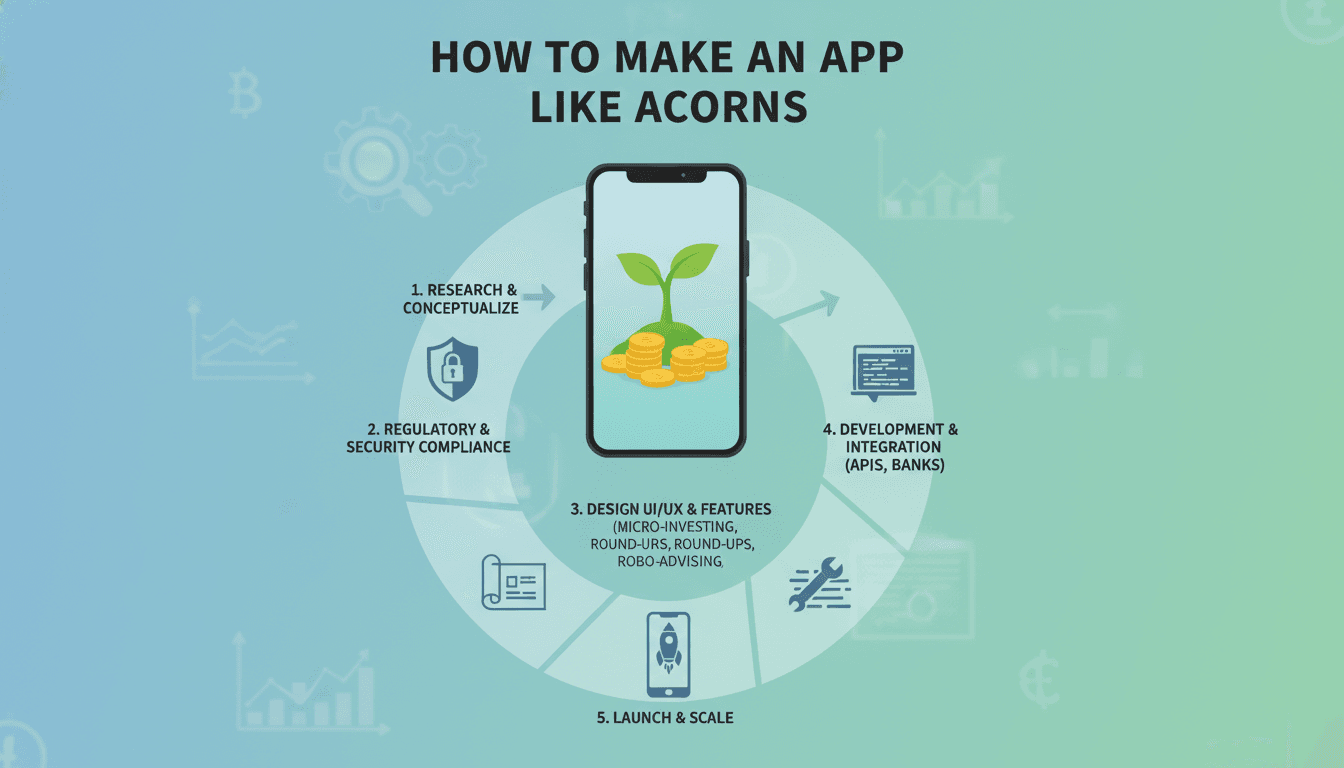
Building a micro-investing app is a product and engineering problem simultaneously. The architecture decisions you make in month one will either support or constrain you at 100,000 users. This post walks through what it actually takes to build something in the same category as Acorns — from the financial data layer to the regulatory wrapper.
What Does Acorns Actually Do Under the Hood?
Acorns is a round-up investing app. When a user spends £2.60 on a coffee, Acorns rounds up to £3.00 and invests the £0.40. It also supports recurring deposits and a handful of pre-built ETF portfolios. Simple UX, moderately complex backend.
The core technical pieces are:
- A bank account aggregation layer (read transactions in near-real-time)
- A round-up calculation engine
- A brokerage integration for placing fractional share or ETF orders
- A portfolio management layer (rebalancing, dividend reinvestment)
- A compliance and KYC layer
Each of those is a system you build or buy. The choices compound.
What Tech Stack Should You Use?
This is where most teams spend too long debating and too little time validating. Here is a practical breakdown.
Backend
Python (FastAPI or Django REST Framework) or Node.js (NestJS) both work. The real constraint is your team's existing skill set and the latency requirements on your transaction processing jobs.
For the round-up engine specifically, you want a reliable job queue. Celery with Redis works well at small scale. At higher throughput, consider moving to a dedicated message broker like RabbitMQ or Apache Kafka. Kafka becomes worth the operational overhead when you are processing north of 50,000 transaction events per day.
Financial Data Aggregation
You are not going to scrape bank accounts. You will use Plaid, MX, Finicity, or a regional equivalent (Open Banking APIs in the UK, Account Aggregator in India). Plaid is the most mature in the US market and supports webhooks for real-time transaction updates. Budget roughly $0.30–$0.50 per connected account per month at volume on their production tier.
One architectural point worth flagging: treat your aggregation layer as a separate microservice. The failure modes are different from your core investment logic, and you will want to swap providers without rewriting half your application.
Brokerage Integration
For fractional investing, your options in the US include Alpaca, DriveWealth, and Apex Clearing. DriveWealth is the one Acorns actually used historically. Each of these offers a broker-dealer-as-a-service API. They handle the actual securities execution; you handle the UX and the sweep logic.
The key thing to understand: you are not becoming a broker-dealer. You are building on top of one. That changes your regulatory footprint significantly.
Mobile
React Native is a reasonable choice if you want one codebase for iOS and Android with a smaller team. Flutter gives you better rendering performance but a more constrained ecosystem for financial SDKs. For a fintech product with heavy native SDK dependencies (biometrics, device attestation, bank-grade TLS pinning), native Swift and Kotlin give you more control, at roughly 1.4x the development cost.
/// Not sure where to start?
Get the architecture before you commit
Tell us what you're building and we'll map the technical approach, stack, and rough timeline. No cost, no obligation, no sales call required.
How Do You Handle KYC and Compliance?
This is the piece most engineering teams underestimate. You need KYC (Know Your Customer) before any user can invest. In the US, that means complying with FinCEN rules and FINRA requirements under your broker-dealer partner. In the UK, it means FCA registration.
Practically, you are integrating a KYC provider: Jumio, Onfido, or Persona are the common choices. They handle document verification and liveness checks. Expect 85–92% auto-approval rates; the rest require manual review queues that you need to build or outsource.
AML (Anti-Money Laundering) screening runs alongside this. You need to screen against OFAC, PEP lists, and adverse media. Most KYC providers bundle basic screening, but dedicated tools like ComplyAdvantage or Refinitiv give you more granular control.
Your compliance obligations do not end at onboarding. You need audit trails for every transaction, data retention policies (typically 5–7 years depending on jurisdiction), and the ability to produce records on regulatory request. Build your data layer with this in mind from day one. Retrofitting audit logging is painful.
The Round-Up Engine: Where the Product Actually Lives
The round-up logic sounds trivial. It is not.
Consider the edge cases: pending transactions that never settle, transactions that are refunded after the round-up has already been swept, duplicate transaction events from your aggregation provider, users with insufficient funds in their funding source, and ACH transfer timing windows (ACH in the US has a T+1 settlement window, which creates a gap between when you initiate a sweep and when funds are available to invest).
A well-designed round-up engine does the following:
- Deduplicates incoming transaction webhooks by a stable transaction ID
- Only fires on settled transactions, not pending ones
- Batches micro-sweep amounts to stay above the ACH minimum viable transfer (practically, batching below $5 creates disproportionate transfer fees)
- Handles insufficient fund failures with retry logic and user notification
- Maintains a local ledger of pending sweeps, separate from the brokerage account balance
The local ledger point is important. Your users' displayed balance has to account for in-flight ACH transfers. If it does not, you get support tickets and user distrust.
Portfolio Management and Rebalancing
Acorns offers a handful of fixed portfolios ranging from conservative to aggressive, all built on low-cost ETFs (Vanguard, iShares). This is intentional. Managing individual stock selection at scale for micro-investors is operationally expensive and regulatory burdensome.
Rebalancing runs periodically, usually triggered either by time (monthly) or drift threshold (e.g., when any asset class drifts more than 5% from its target allocation). DriveWealth and Alpaca both support fractional shares, which is essential when you are sweeping amounts like $1.20 into a $380 ETF.
Dividend reinvestment (DRIP) needs a separate handling path. Dividends land as cash in the brokerage account and need to be reinvested according to the portfolio allocation. This is a distinct job from the round-up sweep.
How Long Does It Take to Build, and What Does It Cost?
Rough estimates, assuming a team of four to five engineers:
| Phase | Duration | Key Deliverables |
|---|---|---|
| Architecture and vendor selection | 4–6 weeks | Tech stack, broker-dealer partner, KYC provider chosen |
| Core backend and integrations | 12–16 weeks | Aggregation, round-up engine, brokerage API connected |
| Mobile app (React Native) | 10–14 weeks | Onboarding, portfolio view, transaction history |
| KYC and compliance layer | 6–8 weeks | Jumio/Onfido integration, audit logging, AML screening |
| QA, security audit, and soft launch | 6–8 weeks | Pen test, load test, limited beta |
Total: roughly 9–12 months to a production-ready beta. Budget $300,000–$600,000 USD for the build depending on team location and seniority. Ongoing infrastructure and compliance costs run $15,000–$40,000 per month at early scale.
If you are outside the US, add time for regulatory approval in your jurisdiction. FCA authorisation in the UK takes 6–12 months on average and is not something you can rush with better engineering.
Conclusion
Building a micro-investing app is achievable, but the hard parts are not the UI. They are the financial data integrations, the edge cases in the round-up engine, and the compliance infrastructure that sits under everything.
The next concrete step: pick your broker-dealer partner first. That decision constrains your regulatory path, your geography, and your product roadmap more than any other single choice. Get sandbox access from Alpaca or DriveWealth this week and run a test order flow before you write a single line of your own backend.
FAQ
How much does it cost to build an app like Acorns? A production-ready build typically costs $300,000–$600,000 USD, depending on team size, location, and the complexity of your compliance requirements. Ongoing monthly operating costs (infrastructure, compliance tooling, broker-dealer fees) add another $15,000–$40,000 per month at early scale.
Do you need a broker-dealer licence to build a micro-investing app? No, but you need to partner with one. Companies like DriveWealth, Alpaca, and Apex Clearing offer broker-dealer-as-a-service APIs. They handle securities execution and hold the regulatory licence. You build the product layer on top and operate under their regulatory umbrella, which significantly reduces your compliance burden.
What is the hardest technical part of building a round-up investing app? The bank data aggregation layer and the round-up edge cases. Pending transactions, refunds, ACH timing gaps, and duplicate webhook events all create scenarios where the naive implementation fails. Getting the local ledger right, so displayed balances are always accurate, is where most teams spend unexpected engineering time.
Which mobile framework should you use for a fintech app? React Native works well for most fintech products and reduces your team size requirement. Native Swift and Kotlin give you more control over device-level security features. Avoid Flutter if you have heavy dependencies on financial SDKs that do not have first-class Dart packages yet.
How long does regulatory approval take for a micro-investing app? In the US, if you are operating under a broker-dealer partner's licence, you avoid the longest approval timelines. In the UK, FCA authorisation averages 6–12 months. In India, SEBI registration for an investment advisor has its own timeline and capital requirements. Regulatory timelines are almost always the constraint, not engineering ones.
Have a project in mind? Contact Sodio Technologies to discuss your requirements and explore the right technology solution for your business.
/// Work with us
Talk to the engineers who'd build it
You'll get a technical scope, timeline and cost estimate from the people doing the work, not an account manager. In-house team, no subcontracting, since 2016.