

How to Make an App Like Binance
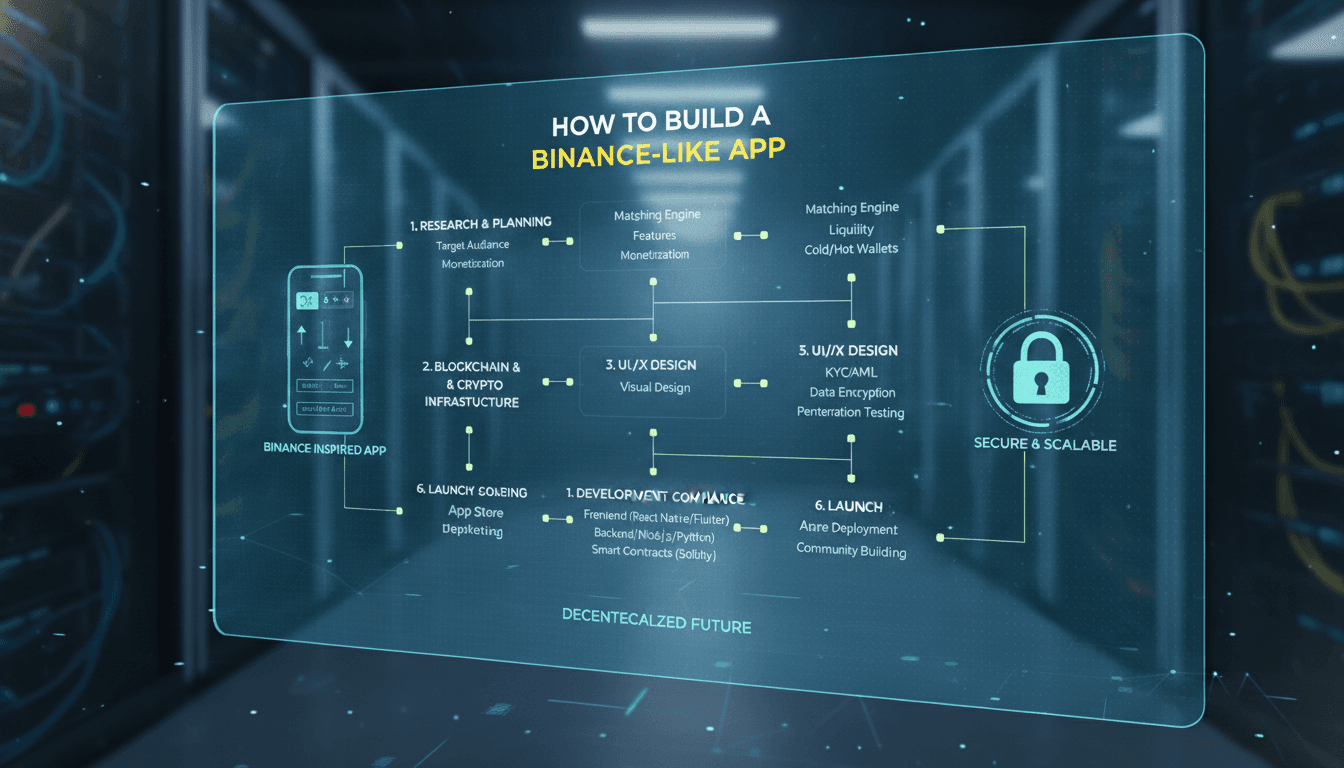
How to Make an App Like Binance
Binance processes tens of billions of dollars in trading volume on an average day and serves well over 200 million registered users. That kind of scale makes it the obvious reference point for anyone who wants to build a crypto exchange app. But "make an app like Binance" is really shorthand for a much bigger question: how do you build a secure, high-throughput, compliant trading platform that people trust with their money?
This guide walks through what Binance actually is under the hood, the features you need, the tech choices that matter, regulatory realities, cost expectations, and how to sequence your build so you launch something viable rather than something half-finished.
We cover a closely related subject in How to Make an App Like Huobi.
What Binance Actually Does
Before writing a line of code, it helps to separate Binance into its component businesses. Most people think of it as "the app where you buy Bitcoin," but it's a stack of distinct products:
- Spot exchange — order-book trading between crypto pairs
- Fiat on/off-ramp — bank transfers, card payments, and local payment methods
- Custodial wallet — hot and cold storage of user assets
- Derivatives — futures, perpetual swaps, options, and margin trading
- Earn products — staking, savings, liquidity farming
- P2P marketplace — user-to-user trades with escrow
- Convert / instant buy — simplified swap flow for beginners
- Launchpad and NFT marketplace — token sales and digital collectibles
You do not need all of this. In fact, trying to ship all of it at once is the single most common reason crypto exchange projects fail. Pick a wedge — a region, an asset class, a user type — and build the spot exchange plus fiat ramp properly first.
Related reading: How to Make an App Like Bitstamp.
Choosing Your Exchange Model
Your architecture, licensing burden, and cost all hinge on this decision.
Centralised Exchange (CEX)
You hold custody of user funds, run your own matching engine, and control the order book. This gives you speed, deep liquidity control, and a familiar user experience. It also makes you a custodian, which means heavy regulatory obligations and a very large security target. Binance, Coinbase, and Kraken are all CEXs.
Decentralised Exchange (DEX)
Trades settle on-chain through smart contracts and automated market makers. Users keep custody via their own wallets. Far lighter on compliance and custody risk, but you inherit blockchain throughput limits, gas costs, and a steeper learning curve for mainstream users. Uniswap and PancakeSwap are the models here.
Hybrid
Off-chain order matching for speed with on-chain settlement and non-custodial wallets. Technically the most demanding path, but increasingly popular as regulators tighten custody rules.
Broker or White-Label
You plug into an existing exchange's liquidity via API and focus entirely on the front end and user acquisition. Fastest to market, lowest cost, thinnest margins, and you're dependent on someone else's infrastructure. Good for validating demand.
Core Feature Set
User Onboarding and KYC
- Email, phone, and social sign-up with mandatory 2FA
- Tiered KYC: document capture, liveness/selfie check, proof of address
- Automated identity verification via a provider like Sumsub, Onfido, or Jumio
- AML and sanctions screening, plus PEP checks
- Risk scoring that gates withdrawal limits by verification tier
Wallet Infrastructure
- Hot wallets for operational liquidity, cold storage for the bulk of reserves
- Multi-signature and MPC (multi-party computation) key management
- HD wallet address generation per user, per asset
- Deposit detection with configurable confirmation thresholds
- Withdrawal queue with allowlisting, time locks, and manual review above thresholds
- Proof-of-reserves reporting
Trading Engine
This is the technical heart of the product.
- Limit, market, stop-limit, OCO, and trailing stop orders
- In-memory order book with price-time priority matching
- Sub-millisecond matching latency under load
- Deterministic, replayable event log for audit and recovery
- Separate risk engine for margin and liquidation logic if you offer leverage
Market Data and Charting
- Real-time WebSocket feeds for ticker, depth, and trade streams
- Candlestick charts with indicators — most teams integrate TradingView's charting library rather than building their own
- Order book depth visualisation and recent trades tape
- Price alerts and watchlists
Fiat and Payments
- Bank transfer rails (SEPA, ACH, Faster Payments, UPI, or local equivalents)
- Card acquiring through a crypto-friendly PSP
- P2P escrow module if you're targeting markets with limited banking access
- Settlement reconciliation and chargeback handling
Portfolio and Account
- Real-time balances, P&L, and allocation breakdown
- Full transaction and order history with CSV/tax export
- Recurring buys and price-triggered orders
- Referral programme and fee tier based on volume or native token holdings
Admin and Operations
- Listing management: add assets, configure trading pairs, set fee schedules
- Liquidity monitoring and market maker integration
- Compliance dashboard with transaction monitoring and SAR workflow
- Support ticketing with account lookup and manual intervention tools
- Feature flags and regional gating
Technology Stack
Matching engine: Rust, C++, or Java for deterministic low-latency performance. Keep it in memory, single-threaded per trading pair, with event sourcing for durability. This is the one component where language choice genuinely matters.
Backend services: Go or Node.js for APIs, user management, and orchestration. Python for analytics, risk models, and internal tooling.
Messaging: Kafka or Redpanda for the event backbone between matching, settlement, ledger, and notification services.
Databases: PostgreSQL for the ledger and relational data, Redis for caching and session state, ClickHouse or TimescaleDB for time-series market data.
Blockchain integration: Self-hosted full nodes for major chains where possible; node providers like Alchemy, QuickNode, or Infura for breadth. Blockchain indexers for deposit detection.
Mobile: Native Swift and Kotlin if you want maximum performance and platform fidelity. React Native or Flutter if you need to move fast with one team — both are perfectly capable of handling real-time trading UIs when the data layer is done well.
Web: React or Next.js with a dedicated WebSocket client layer and virtualised rendering for order books.
Infrastructure: Kubernetes on AWS, GCP, or a colocation setup for latency-sensitive components. Multi-region with active failover.
Observability: Prometheus, Grafana, OpenTelemetry, and a dedicated financial reconciliation job that proves internal ledger balances match on-chain reality every cycle.
Security Is the Product
Users do not choose an exchange because of its UI. They choose it because they believe their money is safe. Treat security as a first-class feature, not a hardening pass at the end.
Custody controls. Keep 90–95% of assets in cold storage. Use MPC or HSM-backed key management. Require multi-party approval for any movement out of cold wallets. Never let a single engineer hold enough access to move funds.
Application security. Enforce 2FA with TOTP or hardware keys, not SMS. Withdrawal address allowlisting with a cooling-off period. Anti-phishing codes on all outbound email. Device fingerprinting and session binding. Rate limiting and bot detection on every sensitive endpoint.
Operational security. Zero-trust internal network. Separate production access from development. Immutable audit logging. Background checks on anyone with infrastructure access.
Assurance. Independent smart contract audits, regular penetration testing, a public bug bounty, and SOC 2 Type II certification. Maintain an insurance fund and publish proof of reserves.
Monitoring. Real-time anomaly detection on withdrawal patterns, login geography, and order flow. Circuit breakers that halt trading or withdrawals automatically on abnormal signals.
Liquidity: The Chicken-and-Egg Problem
An exchange with no liquidity has wide spreads, which drives users away, which keeps liquidity thin. Breaking this loop is a business problem more than a technical one.
Common approaches include contracting professional market makers to quote both sides of your books, aggregating liquidity from partner exchanges via API so your order book is backed by external depth, seeding your own inventory in the early months, and focusing on a narrow set of pairs where you can guarantee tight spreads rather than listing 200 assets with terrible depth.
Regulation and Compliance
This is where most "build an app like Binance" projects hit a wall. Binance itself has paid billions in settlements and exited multiple markets over compliance failures. Do not treat licensing as a later problem.
For a closer look at a related topic, read our guide on How to Make an App Like Kraken.
Depending on your target markets you may need a Money Services Business registration (US FinCEN plus state-level money transmitter licences), a MiCA authorisation in the EU, an FCA cryptoasset registration in the UK, a VASP licence in various jurisdictions, or a Digital Asset Service Provider licence.
Operationally you'll need a documented AML/CTF programme, a designated compliance officer, transaction monitoring with Travel Rule support (Chainalysis, Elliptic, or TRM Labs), suspicious activity reporting, geofencing for restricted jurisdictions, segregated customer funds, and data protection compliance such as GDPR.
Budget for legal counsel in every jurisdiction you enter before you write the code that touches those users.
Development Roadmap
Phase 1 — Discovery and Compliance Design (6–10 weeks). Market and competitor analysis, jurisdiction selection, legal opinion, licensing pathway, technical architecture, threat model, and a prioritised feature backlog.
Phase 2 — Design (6–8 weeks). Information architecture, trading interface design, onboarding and KYC flows, design system, and usability testing with both beginner and experienced traders. Note that beginner and pro users want almost opposite things — plan for two distinct modes.
Phase 3 — Core Build (16–28 weeks). Matching engine, ledger, wallet infrastructure, KYC integration, fiat rails, API layer, mobile and web clients, admin console.
Phase 4 — Security and Testing (8–12 weeks, overlapping). Internal audit, third-party penetration test, load testing at 10x expected peak, chaos engineering, disaster recovery drills, and a full reconciliation test suite.
Phase 5 — Beta and Launch (8–12 weeks). Closed beta with capped balances, market maker onboarding, staged geographic rollout, and 24/7 support readiness.
Phase 6 — Scale. Derivatives, staking, additional chains, institutional APIs, and new markets.
Cost Expectations
Costs vary enormously with model and scope, but broad ranges look like this:
- White-label or broker model: $60,000 – $150,000 to launch, plus licensing fees
- MVP centralised exchange (spot trading, one fiat rail, mobile plus web): $200,000 – $450,000
- Full-featured CEX with derivatives, multi-region fiat, and staking: $600,000 – $1.5M+
- Decentralised exchange with audited contracts and a polished front end: $120,000 – $350,000
On top of build cost, plan for ongoing expenses that are easy to underestimate: legal and licensing ($50k–$500k+ depending on jurisdiction), security audits and bug bounties ($40k–$150k annually), liquidity provision and market making, node and cloud infrastructure, KYC/AML vendor fees per verification, and round-the-clock support staffing.
Monetisation
- Trading fees — maker/taker spread, typically 0.02%–0.2%, tiered by volume
- Withdrawal fees — flat per-asset network fee plus margin
- Fiat deposit and card fees — 0.5%–3% on card purchases
- Spread on instant convert — simplified swaps at a marked-up rate
- Listing fees — charged to projects wanting exposure
- Margin interest and funding rates on leveraged products
- Earn product margin — a cut of staking or lending yield
- Native token — fee discounts, launchpad access, and governance
Mistakes to Avoid
Building every feature before launching any. Ship spot trading and one solid fiat ramp. Add derivatives once you have users.
Treating compliance as post-launch. Retrofitting KYC, geofencing, and monitoring into a live system is painful and expensive. Design for it from day one.
Under-resourcing the ledger. Double-entry accounting with immutable records and continuous reconciliation is non-negotiable. Balance discrepancies destroy trust permanently.
Designing for one user type. Beginners need three taps to buy Bitcoin. Traders need depth charts, hotkeys, and API access. Serve both with distinct modes.
Ignoring support. Crypto users panic about stuck deposits and pending withdrawals. Slow support reads as insolvency. Staff accordingly.
Copying Binance's feature list instead of its fundamentals. What made Binance win was execution speed, liquidity, and relentless product iteration — not the sheer number of tabs in its app.
Final Thoughts
Building an app like Binance is a fintech infrastructure project with a crypto veneer, not a mobile app project. The trading interface is the visible 10%; the ledger, custody, compliance, and liquidity operations are the other 90% and they're where the difficulty lives.
The teams that succeed start narrow — one region, one asset class, one clear advantage over the incumbents — get security and compliance right before they scale, and expand from a foundation that already works. The ones that fail try to clone the whole Binance product surface in version one.
If you're weighing up a crypto exchange build, the most useful next step is a discovery engagement that pins down your jurisdiction strategy, custody model, and liquidity plan. Everything else in the architecture follows from those three decisions.
Have a project in mind? Contact Sodio Technologies to discuss your requirements and explore the right technology solution for your business.
/// Work with us
Talk to the engineers who'd build it
You'll get a technical scope, timeline and cost estimate from the people doing the work, not an account manager. In-house team, no subcontracting, since 2016.