

How to Make an App Like Bitstamp
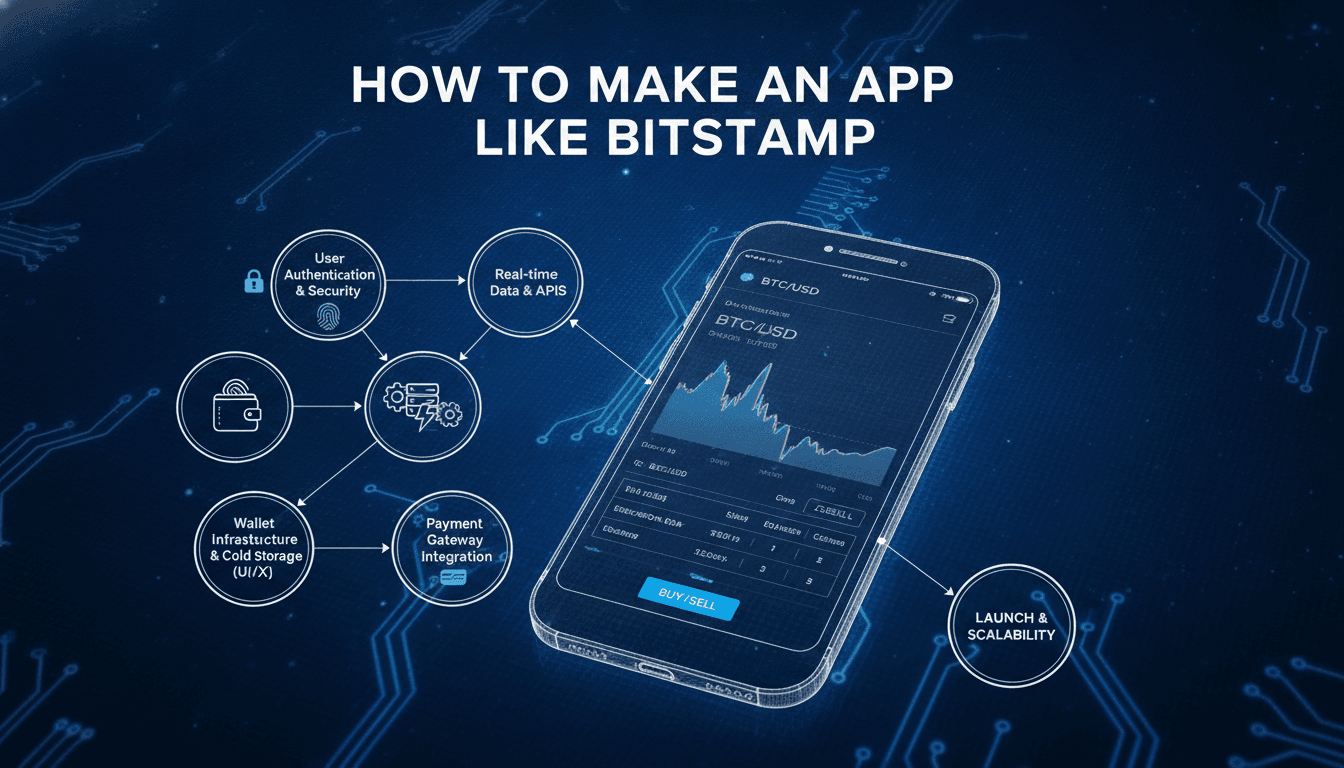
How to Make an App Like Bitstamp
Bitstamp is one of the longest-running cryptocurrency exchanges in the world. Founded in 2011, it earned its reputation not through flashy marketing but through regulatory compliance, deep liquidity, and an interface that both beginners and institutional traders can navigate. If you're planning to build a crypto trading app, Bitstamp is an excellent blueprint to study.
This guide walks through what it actually takes to build an exchange app like Bitstamp — the features, architecture, tech stack, compliance requirements, timeline, and budget.
Related reading: How to Make an App Like Kraken.
Why Model Your App on Bitstamp?
Before diving into development, it helps to understand what makes Bitstamp work:
- Regulatory-first approach — Bitstamp holds licenses in the EU, UK, and US, which builds trust with cautious users.
- Simplicity over feature bloat — The app focuses on buying, selling, and holding rather than overwhelming users with derivatives and leverage.
- Institutional-grade infrastructure — A matching engine that handles high throughput with minimal latency.
- Transparent fee structure — Tiered fees that reward volume without hidden costs.
Your app doesn't need to copy Bitstamp feature-for-feature. But these four pillars — trust, simplicity, performance, and transparency — should guide every decision you make.
Related reading: How to Make an App Like Binance.
Core Features of a Bitstamp-Like App
1. User Onboarding and KYC/AML
This is where most exchanges lose users, and where regulators pay the most attention.
- Email and phone verification
- Government ID upload with OCR extraction
- Liveness detection and selfie matching
- Proof of address documentation
- Automated sanctions and PEP screening
- Tiered verification levels tied to withdrawal limits
Integrate with providers like Sumsub, Jumio, Onfido, or Persona rather than building this from scratch. The compliance rules change constantly, and specialized vendors keep up so you don't have to.
For a closer look at a related topic, read our guide on How to Make an App Like Coinbase.
2. Wallet Infrastructure
Custody is the single biggest technical and security risk in your product.
- Hot wallets for immediate withdrawal liquidity (keep balances small)
- Cold storage for the bulk of user funds, air-gapped and multi-sig
- Warm wallets as an intermediate buffer
- Multi-party computation (MPC) key management
- Automated sweeping from deposit addresses to cold storage
- Per-user deposit address generation with HD wallets
Many new exchanges start with a custody partner — Fireblocks, BitGo, or Copper — then bring custody in-house once volume justifies the operational overhead.
3. Trading Engine
The matching engine is the heart of the exchange.
- Order book maintained in memory for microsecond-level matching
- Support for market, limit, stop-loss, and stop-limit orders
- Price-time priority matching algorithm
- Trade settlement and ledger updates as atomic transactions
- Deterministic replay from an event log for auditing and recovery
Write this component in a low-latency language — Rust, C++, Go, or Java with careful GC tuning. Never build a matching engine on top of a traditional relational database as the primary source of truth; use event sourcing with in-memory state.
4. Fiat On-Ramps and Off-Ramps
Bitstamp's strength has always been fiat connectivity.
- SEPA and SEPA Instant for EUR
- Faster Payments for GBP
- ACH and wire transfers for USD
- Card purchases through a PSP like Checkout.com or Stripe
- Automatic reconciliation of incoming bank transfers to user accounts
This requires banking relationships, which are the hardest non-technical part of launching an exchange. Start these conversations months before you plan to go live.
5. Mobile App Experience
- Portfolio dashboard with performance charts
- Simple buy/sell flow for casual users
- Advanced trading view with candlestick charts and depth
- Real-time price alerts and push notifications
- Recurring buy scheduling
- Transaction history with exportable tax reports
- Biometric authentication and device binding
6. Security Layer
- Mandatory 2FA via TOTP (avoid SMS as a primary factor)
- Withdrawal address allowlisting with time-delayed activation
- Email confirmation on all withdrawals
- Device and IP anomaly detection
- Rate limiting and bot protection on all public endpoints
- Session management with short-lived tokens
7. Admin and Compliance Console
Often overlooked, always essential.
- KYC review queue for manual escalations
- Transaction monitoring with configurable risk rules
- Suspicious activity report generation
- User account freeze and unfreeze controls
- Liquidity and treasury dashboards
- Full audit logging of every admin action
8. Public and Institutional APIs
- REST API for account management and order placement
- WebSocket feeds for order book and trade streams
- FIX protocol support if you're targeting institutions
- API key management with granular permissions and IP allowlists
Recommended Tech Stack
Mobile front end React Native or Flutter for a shared codebase, or native Swift and Kotlin if you need the absolute best chart rendering and security posture.
Web front end React or Next.js with TypeScript, TradingView Charting Library for price visualization.
Backend services Go or Rust for the matching engine and wallet services. Node.js, Python, or Java for account management, notifications, and reporting.
Data layer PostgreSQL for the ledger and user data, Redis for caching and rate limiting, Kafka or NATS for event streaming, ClickHouse or TimescaleDB for historical market data.
Infrastructure Kubernetes on AWS, GCP, or a bare-metal provider for latency-sensitive components. Terraform for infrastructure as code. Prometheus and Grafana for observability.
Blockchain integration Self-hosted nodes for major chains (Bitcoin, Ethereum) plus a provider like Alchemy, Infura, or QuickNode as a fallback.
Architecture Principles
Separate the ledger from the blockchain. Internal balances live in your double-entry ledger. On-chain movement is a separate, asynchronous process. Never let a blockchain confirmation delay block a trade.
Use double-entry accounting everywhere. Every balance change should be two offsetting ledger entries. This is how you prove solvency and catch bugs before your users do.
Design for idempotency. Network retries are inevitable. Every write operation should accept an idempotency key.
Isolate the hot path. Trading should keep working even if KYC uploads, email delivery, or reporting services are down.
Plan for proof of reserves. Users increasingly expect Merkle-tree-based attestations that their funds exist. Building this in from the start is far easier than retrofitting it.
Regulatory and Licensing Considerations
This is not optional, and it will likely determine your launch timeline more than engineering does.
- EU — MiCA authorization through a national competent authority
- UK — FCA registration as a cryptoasset business
- US — FinCEN MSB registration plus state-by-state money transmitter licenses (or a BitLicense for New York)
- Singapore — MAS Payment Services Act license
- UAE — VARA licensing in Dubai
Budget for legal counsel early. Many teams launch in a single friendly jurisdiction, prove the model, then expand licensing from revenue.
Development Timeline
Phase 1 — Discovery and compliance planning (4–6 weeks) Jurisdiction selection, legal structure, feature scoping, architecture design.
Phase 2 — Core backend (10–14 weeks) Matching engine, ledger, wallet infrastructure, KYC integration.
Phase 3 — Client applications (8–12 weeks, parallel) Mobile apps, web app, admin console.
Phase 4 — Fiat integration (6–10 weeks) Banking partner onboarding, payment rails, reconciliation.
Phase 5 — Security audit and penetration testing (4–6 weeks) Third-party smart contract and infrastructure audits, bug bounty setup.
Phase 6 — Beta and launch (6–8 weeks) Limited release, liquidity bootstrapping, monitoring hardening.
Realistically, a compliant, production-ready exchange takes 9 to 15 months with an experienced team.
Cost Breakdown
| Component | Estimated Cost |
|---|---|
| MVP (single jurisdiction, limited pairs) | $150,000 – $300,000 |
| Full-featured exchange | $400,000 – $900,000 |
| Licensing and legal | $50,000 – $500,000+ |
| Security audits | $30,000 – $80,000 |
| Annual infrastructure | $60,000 – $250,000 |
| Ongoing compliance staff | $150,000+ per year |
The engineering cost is often the smaller half of the equation. Licensing, capital requirements, and compliance headcount frequently exceed development spend.
Monetization Models
- Trading fees — tiered maker/taker structure based on 30-day volume
- Spread on instant buy — higher margin on the simplified retail flow
- Withdrawal fees — flat fee per asset covering network costs plus margin
- Staking and earn products — revenue share on delegated assets
- Institutional services — OTC desk, custody-as-a-service, API tiers
- Card products — interchange revenue on a crypto-linked debit card
Common Mistakes to Avoid
Underinvesting in the ledger. Balance discrepancies destroy user trust faster than downtime.
Launching without liquidity. An empty order book is worse than no exchange. Line up market makers before your public launch.
Treating compliance as an afterthought. Retrofitting KYC and transaction monitoring into a live product is painful and expensive.
Overbuilding for launch. Bitstamp succeeded with a narrow feature set executed extremely well. Ship spot trading on a handful of pairs before you touch derivatives.
Ignoring customer support. Exchange users have money at stake. Slow support responses generate regulatory complaints, not just bad reviews.
Final Thoughts
Building an app like Bitstamp is less about replicating a UI and more about earning trust at scale. The technical challenges — low-latency matching, secure custody, reliable accounting — are solvable with the right team. The harder work is regulatory positioning, banking relationships, and operational discipline.
Start narrow. Pick one jurisdiction, a handful of trading pairs, and a single fiat rail. Get the ledger provably correct, get the security audited, and let volume justify each subsequent expansion. That's the path Bitstamp took over more than a decade, and it remains the most durable way to build in this space.
Have a project in mind? Contact Sodio Technologies to discuss your requirements and explore the right technology solution for your business.
/// Work with us
Talk to the engineers who'd build it
You'll get a technical scope, timeline and cost estimate from the people doing the work, not an account manager. In-house team, no subcontracting, since 2016.