

How to Make an App Like Call of Duty Mobile
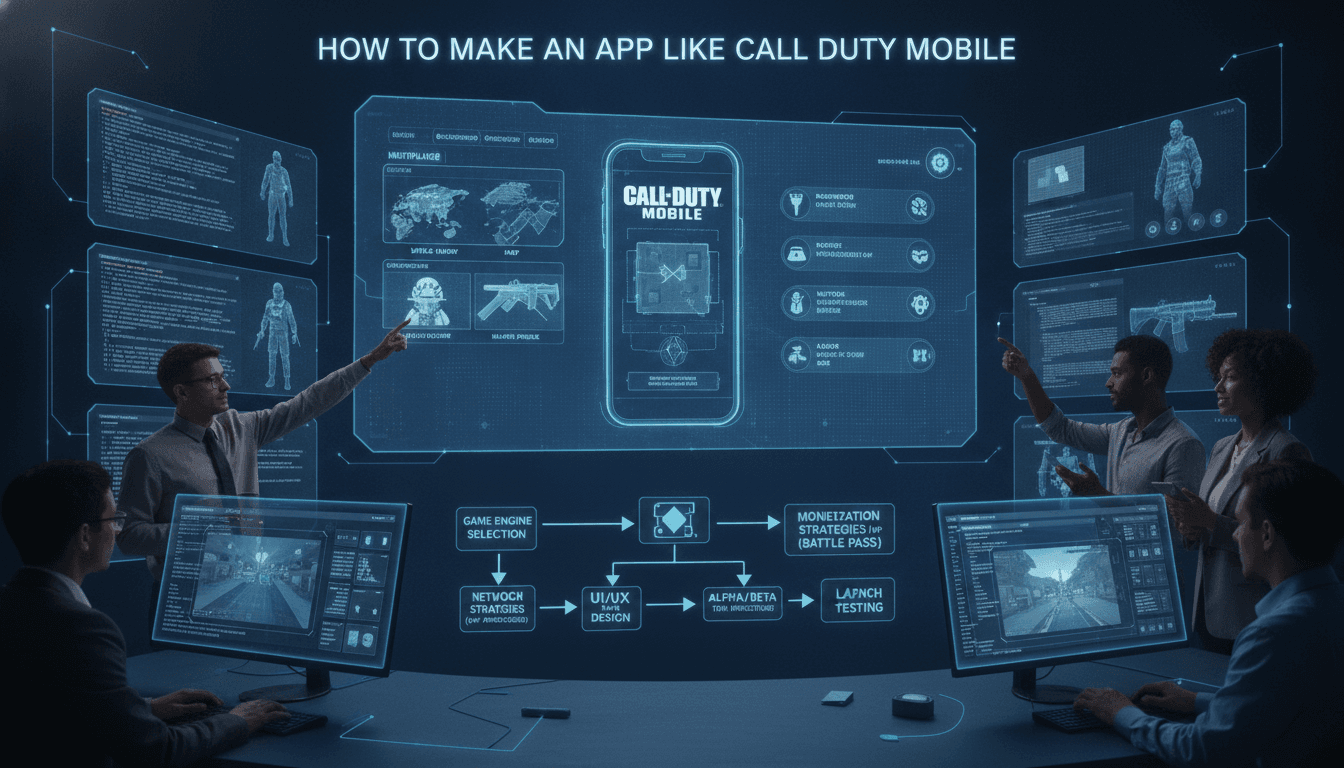
Building a mobile game at the scale of Call of Duty Mobile means handling real-time multiplayer for millions of concurrent users, complex 3D rendering on mid-range Android hardware, and a live-ops economy that never goes down for maintenance. This post breaks down the architecture, the tooling choices, and the trade-offs you'll actually face.
What Does the Technical Stack of a Game Like CoD Mobile Look Like?
Call of Duty Mobile was built by TiMi Studio Group on a heavily modified version of the Unreal Engine, with proprietary server infrastructure underneath. You are unlikely to replicate that directly. What you can do is pick a stack that gets you to the same feature surface with a team of 20–50 engineers rather than 400.
Game Engine
Unity (2022 LTS or 2023) is the practical choice for most independent studios targeting iOS and Android. Unreal Engine 5 gives you better out-of-the-box fidelity but the binary asset pipeline and longer compile cycles slow mobile iteration significantly. If your art direction demands physically based rendering at console quality, Unreal is defensible. If you want to ship in 18–24 months, Unity wins.
For rendering on mobile specifically, Unity's URP (Universal Render Pipeline) with GPU instancing enabled is the right starting point. Avoid HDRP on mobile; it was not designed for it and you will spend months fighting shader complexity.
Networking Layer
Real-time shooters require authoritative server architecture. The client sends inputs; the server simulates and sends state back. Peer-to-peer is not acceptable for a competitive shooter because latency variance and cheating are unmanageable.
The standard approach in 2024 is to run dedicated game servers using a framework like Photon Fusion 2 or Valve's GameNetworkingSockets, deployed on bare-metal or cloud-adjacent infrastructure via Multiplay (Unity Gaming Services) or Agones on Kubernetes. Photon Fusion 2's shared mode gives you faster prototyping; host mode gives you more control over server authority.
Related reading: How to Make an App Like Fortnite.
Your tick rate matters. CoD Mobile runs at 30Hz server tick with client-side prediction and lag compensation. Running at 60Hz doubles your server cost per session. Start at 20Hz during development and measure whether it feels acceptable before committing to higher tick rates.
Backend Services
Separate your game services from your game logic early. You need:
- A session and matchmaking service (region-aware, skill-based)
- A player profile and progression store (low-latency reads, eventual consistency is fine)
- An inventory and economy service (strong consistency required, especially for paid items)
- An analytics pipeline (Kafka or Kinesis into a columnar store like ClickHouse or BigQuery)
Each of these should be independently deployable. Coupling them is one of the most common mistakes in early-stage game backends and it becomes expensive to fix once you have live players.
How Do You Handle Real-Time Multiplayer at Scale?
Matchmaking is not just "put players in a room." At launch you have low concurrent user counts, which means your skill-based matchmaking (SBMM) brackets are too narrow to fill quickly. You need to implement bracket widening with a timer: start with a tight MMR range, widen it every 8–10 seconds until a match fills or a maximum wait time is reached.
Regional server placement is critical. A player in Mumbai connecting to a server in Frankfurt will have 160–200ms latency. That is unplayable in a shooter. Plan your server regions before you start infrastructure work, not after. AWS, GCP, and Azure all have game-specific offerings (GameLift, Google Cloud for Games, PlayFab) that handle server fleet scaling but differ significantly in pricing models at volume.
Client-side prediction with server reconciliation is mandatory for weapons and movement. The standard implementation uses a circular buffer of input states on the client. When a server correction arrives, the client rewinds to the corrected state and replays buffered inputs. Unity's Netcode for GameObjects handles this but the abstraction leaks at high complexity; most serious studios write their own prediction layer after the prototype stage.
/// Not sure where to start?
Get the architecture before you commit
Tell us what you're building and we'll map the technical approach, stack, and rough timeline. No cost, no obligation, no sales call required.
How Do You Build the Economy and Live-Ops Layer?
CoD Mobile's revenue comes primarily from cosmetic items sold through battle passes and direct-purchase bundles, not pay-to-win mechanics. This is worth noting because it shapes your entire economy architecture.
You need a virtual currency system with at minimum two currencies: one earned through play, one purchased with real money. Never allow direct conversion from purchased currency to gameplay advantage. Beyond the regulatory risk in several jurisdictions, it destroys player trust.
The battle pass is a time-gated progression track, typically 60–90 days, with free and premium tiers. Implement it as a configuration-driven system where the rewards, XP thresholds, and duration are data, not code. This lets you ship a new season without an app store update, which is operationally important.
To explore this further, see How to Make an App Like Among Us.
Item bundling, limited-time offers, and dynamic pricing require an offer management service. This is often underestimated. You need to be able to push new offers, expire old ones, and A/B test pricing without engineering involvement after the system is built.
Anti-Cheat
Anti-cheat on mobile is harder than on PC. You have a wider hardware surface, more OS fragmentation, and root/jailbreak detection is an arms race. The practical approach for a new title is:
- Server-side validation of all game-affecting actions (kills, damage, movement bounds)
- Rate limiting and anomaly detection on the backend
- A player reporting system with human review for escalations
Client-side anti-cheat tools like BattlEye are not available on mobile in the same form as PC. You are primarily relying on server authority and statistical detection.
To explore this further, see How to Make an App Like PUBG Mobile.
What Does a Realistic Build Timeline Look Like?
| Phase | Duration | Output |
|---|---|---|
| Pre-production | 3–4 months | GDD, prototype, stack decisions |
| Core gameplay | 6–8 months | Playable build, one map, 2–3 weapons |
| Backend and matchmaking | 4–6 months (parallel) | Auth, sessions, leaderboards |
| Live-ops and economy | 3–4 months | Battle pass, store, analytics |
| QA and soft launch | 2–3 months | Regional launch, iteration |
| Global launch | Month 20–24 | Full release |
These phases overlap. Your backend team starts during core gameplay development. The timeline assumes a team of 25–35 people with prior mobile game experience. If your team is building a shooter for the first time, add 30–40% to each phase.
Conclusion
The core challenge in building a game at this scale is not any single technical problem. It is keeping the multiplayer server, backend services, and game client in sync across a long development cycle without accumulating so much technical debt that live-ops becomes painful after launch.
Start with a playable loop on a single map. Validate the feel of the movement and shooting before you build the economy. Ship to a small region first with real players before scaling infrastructure. The architecture decisions above give you a foundation, but how you prioritise the build order matters as much as the choices themselves.
If you are at the stage of scoping this project and want to pressure-test your architecture plan, the Sodio engineering team is available for a technical review.
FAQ
How much does it cost to build a game like Call of Duty Mobile? A realistic budget for a competitive mobile shooter with live-ops is $3–8 million over 18–24 months, depending on team location and scope. That covers engineering, art, QA, and infrastructure. Marketing budget is separate and typically exceeds development cost for a title competing in this genre.
Can you build a multiplayer mobile shooter on Unreal Engine 5? Yes, but UE5's mobile support is still maturing. Features like Lumen and Nanite are not available on mobile targets. You would be using UE5 primarily for its networking primitives and tooling, not its flagship rendering features. For most studios targeting Android and iOS, Unity URP is the faster path to a shippable build.
What server infrastructure does a mobile shooter need at launch? At soft launch with 10,000 concurrent users, you need roughly 500–1,000 dedicated game server instances depending on session length and player count per match. Managed services like Multiplay or GameLift handle scaling automatically but cost more per hour than self-managed Agones clusters at sustained load.
How do you handle cheating in a mobile multiplayer game? The most effective layer is authoritative servers that validate every game-affecting action. Clients cannot be trusted. Supplement this with statistical anomaly detection, e.g. flagging players with headshot rates above 3 standard deviations from the mean, and a manual review queue for reported players.
Is it better to license an existing game engine or build a custom one? For a studio that has not shipped a mobile title before, building a custom engine is almost never the right call. The cost is measured in years and tens of millions of dollars. Unity and Unreal are mature enough that the remaining gaps, usually around specific network topologies or rendering tricks, can be filled with custom modules without abandoning the engine entirely.
Have a project in mind? Contact Sodio Technologies to discuss your requirements and explore the right technology solution for your business.
/// Work with us
Talk to the engineers who'd build it
You'll get a technical scope, timeline and cost estimate from the people doing the work, not an account manager. In-house team, no subcontracting, since 2016.