

How to Make an App Like Car2Go
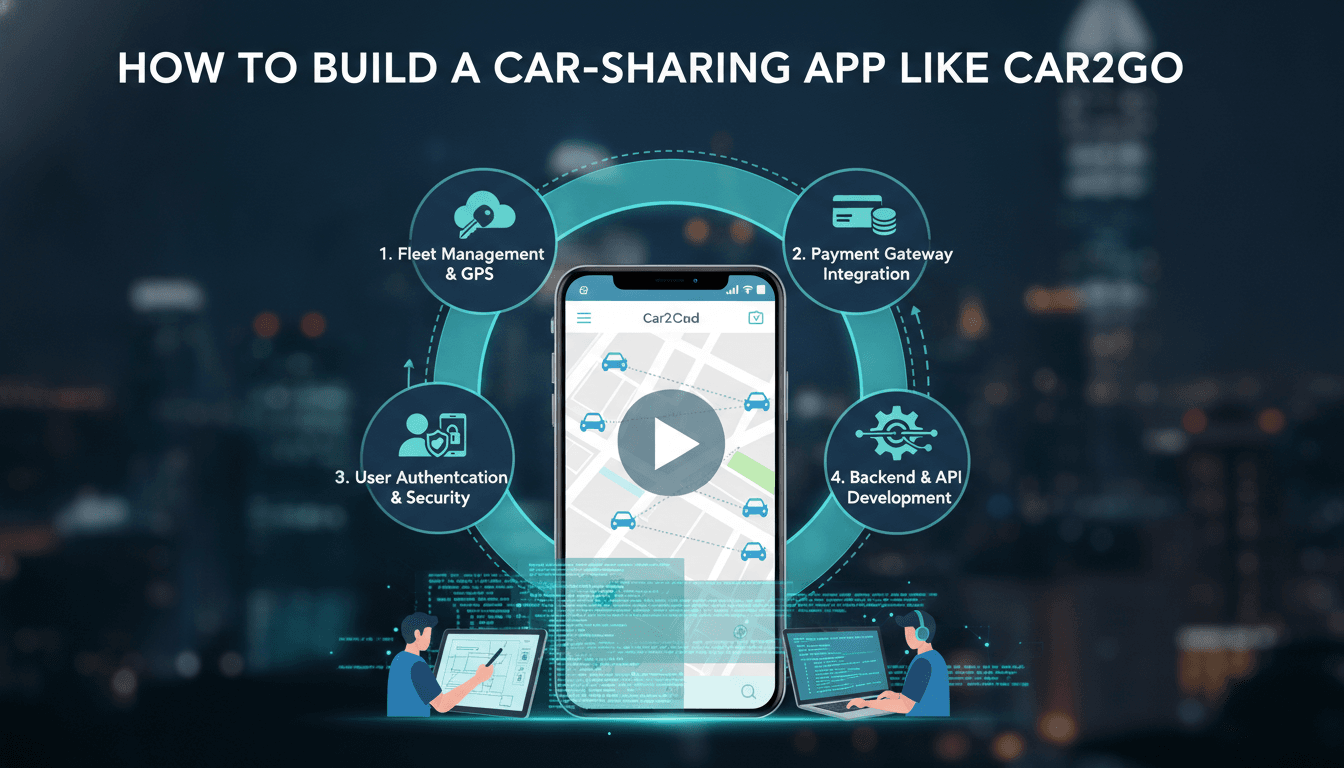
Building a car-sharing app is genuinely hard engineering. The product looks simple from the outside — find a car, unlock it, drive, park, pay. Under the hood you're coordinating real-time telematics, IoT hardware, payment orchestration, geofencing, and a fleet operations dashboard simultaneously. This post walks through the architecture decisions that matter, where teams typically go wrong, and what realistic timelines and costs look like.
What Does a Car-Sharing App Actually Need to Do?
Car2Go (now ShareNow) operated in over 26 cities at its peak and managed roughly 14,000 vehicles. The app's core job is deceptively simple: match a driver to a nearby available vehicle, handle the unlock/lock cycle, track the trip, and settle payment. But each of those steps carries real complexity.
To explore this further, see How to Make an App Like Hertz 24/7.
The unlock cycle alone requires a cellular or Bluetooth connection to vehicle hardware, a backend command that validates the user's licence status and active booking, and a fallback if the hardware misses the first signal. If your average command-delivery latency is above 3–4 seconds, users start hammering the button and you get duplicate unlock events.
The other non-obvious requirement is free-floating versus station-based. Car2Go was free-floating: users could park anywhere within a defined zone. That changes your geofencing model, your parking enforcement logic, and your pricing calculation significantly compared to a station-based system like Zipcar.
We cover a closely related subject in How to Make an App Like Zipcar.
| Feature | Free-floating | Station-based |
|---|---|---|
| Zone enforcement | Polygon geofence per city | Fixed lot list |
| Parking validation | Street detection + user photo | Bay sensor / QR scan |
| Pricing model | Per-minute / per-km | Hourly block |
| Fleet rebalancing | Active (operations team moves cars) | Passive (cars stay at lots) |
| Backend complexity | Higher | Lower |
Pick your model early. It affects the data model, the driver app flow, the operations tooling, and your pricing engine all at once.
Related reading: How to Make an App Like Enterprise CarShare.
What Tech Stack Should You Use?
There is no single correct answer, but there are wrong ones.
Mobile
React Native works for most car-sharing apps at the MVP stage. You get one codebase covering iOS and Android, and the BLE and GPS APIs you need are available via well-maintained libraries. If you expect very high-frequency GPS polling or complex real-time map rendering, a native implementation in Swift/Kotlin will perform better. For most teams, that is a premature optimisation at launch.
The map layer is usually Mapbox or Google Maps Platform. Mapbox gives you more control over tile styling and offline caching, which matters if you're operating in areas with patchy connectivity. Google Maps has better POI data and simpler pricing at low volume.
Backend
A Node.js or Go service works well for the real-time command layer (unlocks, locks, trip events) because both handle concurrent connections efficiently. Your trip data pipeline can be a separate service. Separating these means a spike in trip-end events (end of peak hour) doesn't affect your vehicle command latency.
PostgreSQL with PostGIS is the standard choice for geospatial queries. Finding all available vehicles within a 500-metre radius of a given coordinate is a single indexed spatial query in PostGIS. Don't try to do this in application code.
For vehicle telematics, most hardware vendors (Webfleet, Geotab, Teltonika) expose a REST or MQTT feed. You'll ingest that into a time-series store. InfluxDB and TimescaleDB are both reasonable; TimescaleDB has the advantage of sitting on Postgres, which simplifies your operational setup.
Vehicle Hardware
This is where most teams underestimate effort. The IoT layer between your backend and the physical car involves:
- A telematics unit (TU) wired into the OBD-II port or the vehicle's CAN bus
- A cellular module (4G LTE, with 2G fallback in some markets)
- Optionally a Bluetooth module for proximity unlock
- Firmware that handles the lock/unlock relay and transmits ignition, GPS, and door state
Sourcing a TU with a published SDK and a simulator environment saves significant integration time. Without a simulator, every hardware test requires a physical vehicle and a developer in a car park.
/// Not sure where to start?
Get the architecture before you commit
Tell us what you're building and we'll map the technical approach, stack, and rough timeline. No cost, no obligation, no sales call required.
How Do You Handle Payments and Pricing?
Use Stripe or Adyen. Both support pre-authorisation holds, which is what you need: authorise a fixed amount at trip start, then capture the actual amount at trip end. Stripe's Payment Intents API handles this in a straightforward way.
Your pricing engine needs to be a standalone service with its own configuration store. Pricing rules change frequently — promotional rates, surge pricing, per-zone rates, corporate account discounts. If pricing logic is embedded in your trip service, every rule change requires a deployment. Externalise it.
Tax compliance is usually the part teams forget. If you operate across multiple countries, you need a tax calculation layer (TaxJar or Avalara are the standard tools) that applies the correct VAT or GST rate per booking based on jurisdiction.
Fraud is real in car-sharing. Users share accounts, use stolen payment methods, or create multiple accounts to exploit sign-up credits. Minimum viable fraud controls at launch: phone number verification via OTP, driving licence OCR and face-match (Onfido or Jumio handle this), and velocity checks on new accounts before allowing bookings.
What Does a Realistic Build Look Like?
A lean MVP covering one city, one vehicle type, and no corporate accounts typically takes 6–9 months with a team of 6–8 engineers. The breakdown:
- Months 1–2: Backend core, data model, auth, telematics integration with one hardware vendor
- Months 3–4: Driver app (iOS + Android), map, booking flow, unlock/lock
- Months 5–6: Payment integration, pricing engine, admin dashboard
- Months 7–9: Licence verification, fraud controls, QA, beta fleet testing
The fleet testing phase is consistently underestimated. You will find bugs that only appear in a moving vehicle, in a tunnel, with a slow cellular connection. Plan for at least 4–6 weeks of real-world testing before any public launch.
Cost depends heavily on where your team is located. A mid-market engineering team in India typically runs the full build at $120,000–$200,000 USD. A comparable team in Western Europe or North America would be $400,000–$700,000 for the same scope.
Should You Build In-House or Outsource?
If you have a fleet business and are not a software company, outsourcing the initial build is usually the right call. You get to market faster, and the code is yours at handover. The risk is that you need someone internal who can review architecture decisions critically — not just accept whatever the vendor delivers.
If you are building a platform you plan to evolve continuously, you need an internal engineering team eventually. The question is whether you staff that team before or after the MVP. Staffing after is cheaper and lower-risk, but you need a clean handover and good documentation.
The middle path is a hybrid: outsource the MVP build with a partner who will work alongside one or two of your internal hires, then transition ownership to the internal team post-launch. That preserves institutional knowledge.
Conclusion
Building a car-sharing app is a multi-system engineering problem, not a mobile app problem. The mobile app is the visible surface; the real work is in the telematics integration, the geofencing logic, the pricing engine, and the fraud controls.
If you're scoping this out, the most useful first step is to define your operational model — free-floating or station-based, which cities, how many vehicles at launch — before writing a line of code. Those decisions cascade into every technical choice that follows.
If you want to talk through the architecture for your specific model, the Sodio engineering team is available for a technical scoping call. No slides, just a whiteboard conversation.
FAQ
How long does it take to build a car-sharing app like Car2Go? A focused MVP covering one city typically takes 6–9 months with a team of 6–8 engineers. That includes telematics integration, mobile apps for iOS and Android, payment processing, and a basic admin dashboard. Corporate features, multi-city support, and advanced pricing add 3–6 months on top.
What is the biggest technical challenge in building a car-sharing app? Integrating with vehicle hardware reliably. Cellular connectivity in parking garages and dense urban areas is inconsistent, and the lock/unlock command must be idempotent and fast. Most teams underestimate how much time real-world fleet testing takes compared to development against a hardware simulator.
**Can I use a white-label platform instead of building from scratch? ** Yes. Vendors like Vulog, Ridecell, and Invers offer white-label fleet management platforms. They work well if your requirements are standard. If you need custom pricing logic, unusual hardware integrations, or deep control over the user experience, the white-label constraints become expensive workarounds quickly.
What geospatial database should I use? PostgreSQL with the PostGIS extension covers the majority of car-sharing geospatial requirements: zone polygon storage, vehicle proximity queries, and trip path recording. For high-frequency telematics data ingestion, add TimescaleDB (which runs on Postgres) to handle the time-series workload separately.
How do I prevent fraud on a car-sharing platform? The baseline is phone OTP at registration, driving licence OCR with a face-match step (Onfido and Jumio both offer this), and velocity rules that flag accounts booking within the first 10 minutes of sign-up. Pre-authorisation payment holds and linking bookings to a verified licence significantly reduce bad-actor risk.
Have a project in mind? Contact Sodio Technologies to discuss your requirements and explore the right technology solution for your business.
/// Work with us
Talk to the engineers who'd build it
You'll get a technical scope, timeline and cost estimate from the people doing the work, not an account manager. In-house team, no subcontracting, since 2016.