

How to Make an App Like Carma
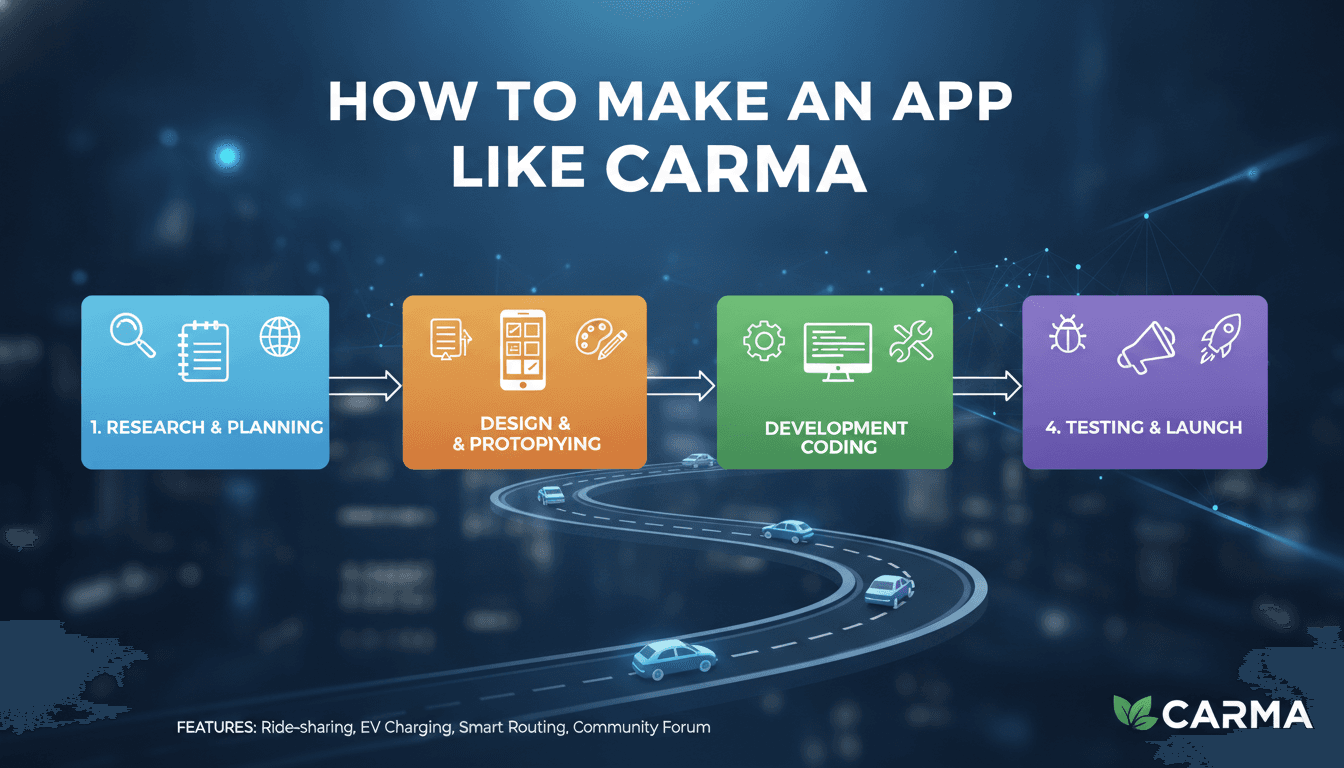
How to Make an App Like Carma
Carpooling and ride-sharing apps have quietly become one of the most practical answers to congestion, commuting costs, and carbon emissions. Carma built its reputation by connecting drivers and passengers travelling the same way, splitting the cost of the trip, and making the daily commute feel less wasteful. If you're thinking about building something similar, this guide walks through the product thinking, feature set, technology, and business model you'll need.
What Carma Actually Does
Before writing a line of code, it helps to be precise about the product category. Carma is not a taxi-hailing app. There is no professional driver, no surge pricing, and no fleet. It is a peer-to-peer carpooling platform, and that distinction changes nearly every design decision you'll make.
To explore this further, see How to Make an App Like Waze Carpool.
The core loop looks like this:
- A driver publishes a trip — origin, destination, departure time, and available seats.
- Passengers search for trips that roughly match their own route and schedule.
- The platform matches them, handles the booking, and calculates a fair cost split.
- Both parties meet, share the ride, and rate each other afterwards.
Everything else — notifications, wallets, verification, corporate dashboards — exists to make that loop smoother and more trustworthy.
For a closer look at a related topic, read our guide on How to Make an App Like Scoop.
Step 1: Pick Your Niche Before You Pick Your Stack
Generic carpooling apps struggle. The ones that succeed tend to anchor themselves to a specific, repeatable use case:
- Commuter carpooling — the same route, the same people, five days a week. High retention, predictable liquidity.
- Corporate and campus programs — a company or university sponsors the app for its employees or students. This is where Carma found real traction, because the employer solves the trust problem and the parking problem at once.
- Long-distance intercity rides — the BlaBlaCar model. Fewer trips, higher value per trip.
- Event-based ride sharing — concerts, conferences, sports fixtures.
Choosing one gives you a clear answer to the hardest problem in any marketplace: how do you get enough drivers and passengers in the same place at the same time on day one?
For a closer look at a related topic, read our guide on How to Make an App Like Hitch.
Step 2: Solve the Cold Start Problem
A carpooling app with three drivers is worthless. Launch strategies that actually work:
- Geo-fence aggressively. One city, or even one corridor within one city. Depth beats breadth.
- Go B2B2C. Sign a single large employer with a parking shortage. You inherit a pre-built, pre-verified user base with identical commute patterns.
- Partner with transit authorities. Many cities offer HOV lane access, parking incentives, or outright subsidies for verified carpools.
- Seed the supply side. Drivers are the scarce resource. Incentivise them first.
Step 3: Core Feature Set
For Passengers
- Social and email sign-up with identity verification
- Route-based search with flexible pickup radius and time windows
- Driver profiles showing ratings, verification badges, vehicle details, and bio
- Seat booking with instant or request-to-book confirmation
- In-app payments and automatic cost splitting
- Live trip tracking and ETA sharing with a trusted contact
- In-app messaging (masked, so phone numbers stay private)
- Post-trip rating and review
For Drivers
- Vehicle registration with license, insurance, and registration document upload
- Trip publishing with recurring schedule support for regular commutes
- Booking request management — accept, decline, or auto-approve
- Automated fare calculation based on distance, fuel cost, and seats filled
- Earnings dashboard and payout management
- Navigation handoff to Google Maps, Apple Maps, or Waze
For Admins
- User and document verification queues
- Trip and transaction monitoring
- Dispute resolution and refund tools
- Fraud and anomaly detection
- Analytics on liquidity, match rate, and retention
- Corporate client dashboards with emissions and parking-saved reporting
Step 4: The Matching Engine
This is the genuine technical heart of the product. Naive matching — exact origin to exact destination — produces almost no matches. Real matching requires:
- Route corridor analysis. Decode driver polylines and test whether a passenger's origin and destination fall within an acceptable detour buffer.
- Detour cost calculation. Compute the incremental time and distance a driver takes on. Reject matches above a configurable threshold, typically 10–15%.
- Temporal flexibility windows. Match on departure ranges, not exact timestamps.
- Spatial indexing. Use PostGIS, geohashing, or H3 cells so you aren't scanning every trip in the database on every query.
- Preference and compatibility filters. Gender preference, smoking, pets, music, conversation level — small things that heavily influence whether someone books twice.
Get this wrong and users see an empty results screen. Empty results screens kill marketplaces.
Step 5: Trust and Safety
Strangers are getting into cars together. Safety architecture is not a feature — it's the product's foundation.
- Government ID and selfie liveness verification
- Driving license and insurance validation
- Optional background checks where legally permitted
- Corporate email domain verification for workplace programs
- Two-way ratings with reviews that actually surface
- Masked phone numbers and in-app chat only
- Live trip sharing with emergency contacts
- In-app SOS button with location dispatch
- Clear reporting flows and a responsive trust and safety team
Step 6: Payments and the Legal Line
Here's the part that trips up most founders. In most jurisdictions, a driver who profits from carrying passengers is operating a commercial taxi service and needs a license, commercial insurance, and regulatory approval. A driver who merely recovers costs does not.
So your fare engine must be capped at genuine cost recovery — fuel, wear, tolls — divided by occupants. Build this as a configurable rule set, because the thresholds differ by country and sometimes by state.
On the payments side you'll want:
- Stripe Connect, Adyen, or a similar marketplace-capable processor
- Escrow-style holds until trip completion
- Automatic splitting and driver payouts
- Wallets and credits for refunds and promotions
- Cancellation policies with fair penalty logic
- Full tax reporting where required
Step 7: Technology Stack
Mobile
- Flutter or React Native for a single codebase across iOS and Android
- Swift and Kotlin if you need deep native background location performance
Backend
- Node.js with NestJS, or Python with Django or FastAPI
- Go for the matching service if latency becomes a bottleneck
- Microservices for matching, payments, notifications, and identity
Data
- PostgreSQL with PostGIS for geospatial queries
- Redis for caching hot routes and active sessions
- Elasticsearch for trip search
- Kafka or RabbitMQ for event-driven trip lifecycle handling
Infrastructure and APIs
- AWS or GCP with autoscaling — carpooling traffic is extremely spiky around rush hour
- Google Maps Platform or Mapbox for routing, geocoding, and distance matrices
- Firebase Cloud Messaging and APNs for push
- Twilio for SMS, OTP, and number masking
- Segment plus Mixpanel or Amplitude for product analytics
Step 8: Battery and Background Location
Underrated, and a common reason carpooling apps get uninstalled. Continuous GPS tracking drains batteries fast. Mitigate it with:
- Significant-location-change APIs rather than continuous polling
- Geofence triggers around pickup and drop-off points
- Adaptive sampling rates based on speed and proximity
- Tracking only during active trips, never in the background otherwise
- Transparent, well-timed permission prompts explaining exactly why you need location
Step 9: Monetisation
Peer-to-peer carpooling has thin margins by design — you're capped at cost recovery. Realistic revenue models include:
- B2B SaaS subscriptions. Employers pay per seat for a managed commute program. This is the strongest model.
- Small booking fee on top of the cost split, charged to the passenger.
- Municipal and transit contracts funded by congestion-reduction budgets.
- Carbon credit generation from verified emissions reductions.
- Premium tiers for priority matching, preferred seat selection, or ad-free use.
- Contextual partnerships with EV charging networks, insurers, or parking operators.
Step 10: Development Timeline and Cost
A realistic path from zero to launched product:
| Phase | Duration | Focus |
|---|---|---|
| Discovery and design | 3–5 weeks | Research, user flows, UI/UX, prototypes |
| MVP build | 12–16 weeks | Auth, trips, matching, payments, chat |
| Testing and compliance | 3–4 weeks | QA, security audit, legal review |
| Launch and iterate | Ongoing | Analytics, growth, feature expansion |
Budget ranges vary widely by region and team composition, but an MVP typically lands between $50,000 and $120,000, with a full-featured platform including corporate dashboards and advanced matching running $150,000 to $300,000+.
Metrics That Actually Matter
Forget downloads. Track:
- Match rate — percentage of searches that return a bookable trip
- Fill rate — percentage of published seats that get booked
- Repeat ride rate — the single best predictor of long-term viability
- Time to first ride — onboarding friction, measured honestly
- Driver retention at 30 and 90 days
- Cancellation and no-show rate
- CO₂ saved and cars removed from the road — your B2B sales pitch in one number
Common Mistakes to Avoid
- Launching in too many cities at once and achieving liquidity in none
- Treating it like Uber and building surge pricing into a cost-sharing product
- Underinvesting in verification, then dealing with a safety incident
- Ignoring regulatory classification until after launch
- Building a matching algorithm that's too strict to ever return results
- Neglecting the driver experience — no drivers, no marketplace
Final Thoughts
An app like Carma is deceptively simple on the surface and genuinely hard underneath. The UI is a search box and a list of trips. The difficulty lives in geospatial matching, trust architecture, regulatory nuance, and the brutal chicken-and-egg problem of marketplace liquidity.
Start narrow. Own one corridor or one employer completely. Make the matching generous and the safety uncompromising. Then expand outward from a base of users who genuinely rely on you every weekday morning — because that habit, more than any feature, is what turns a carpooling app into a business.
Have a project in mind? Contact Sodio Technologies to discuss your requirements and explore the right technology solution for your business.
/// Work with us
Talk to the engineers who'd build it
You'll get a technical scope, timeline and cost estimate from the people doing the work, not an account manager. In-house team, no subcontracting, since 2016.