

How to Make an App Like Cash App
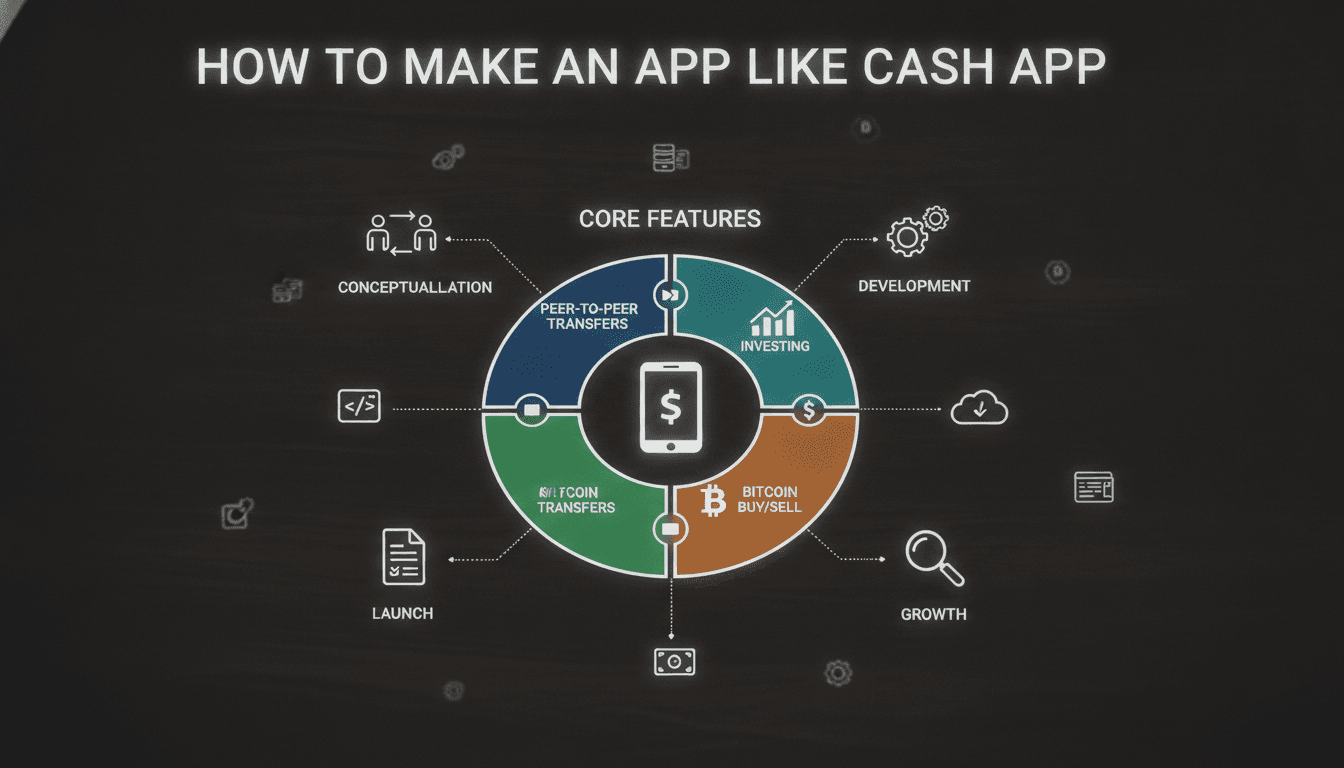
How to Make an App Like Cash App
Peer-to-peer payment apps have moved from novelty to necessity. Cash App, launched by Block (formerly Square) in 2013, now serves tens of millions of monthly active users who send money, deposit paychecks, buy stock, and trade Bitcoin — all from a single, deceptively simple interface.
If you're planning to build a fintech product in this space, the good news is that the technology stack is more accessible than ever. The challenge isn't writing the code — it's navigating compliance, building trust, and designing an experience simple enough that someone can send $20 to a friend in under ten seconds.
For a closer look at a related topic, read our guide on How to Make an App Like Venmo.
Here's a practical roadmap for building an app like Cash App.
Understand What Cash App Actually Is
Before scoping features, it helps to recognize that Cash App isn't one product. It's a bundle:
- A P2P payment rail for sending and receiving money instantly
- A stored-value wallet holding a user balance
- A banking-adjacent product with a debit card (Cash Card), direct deposit, and routing numbers
- An investment platform for fractional stock and Bitcoin purchases
- A social layer with $Cashtags, payment notes, and profile customization
Most successful competitors didn't launch with all of this. They nailed one thing — usually instant P2P transfers — and expanded outward once they had users and regulatory footing.
If this is relevant to your project, check out How to Make an App Like Square Cash.
Step 1: Choose Your Business Model
Your monetization strategy shapes your architecture, so decide early.
Transaction fees. Charge a percentage for instant transfers, credit card-funded payments, or business accounts. Cash App charges roughly 1.5% for instant deposits and 3% for credit card payments.
Interchange revenue. Issue a debit card and earn a slice of the interchange fee every time a user swipes. This is a major revenue line for neobanks.
Trading spreads. Crypto and equities trading generate revenue through spreads or payment for order flow.
Premium tiers. Subscription features like higher limits, advanced analytics, or business tools.
Float and lending. Interest on held balances, plus short-term advances or Buy Now, Pay Later products.
Step 2: Solve Compliance Before You Write Code
This is where most fintech startups stumble. Payment apps are regulated financial products, and the requirements are non-negotiable.
Related reading: How to Make an App Like Google Pay.
Licensing
In the US, moving money on behalf of others generally requires Money Transmitter Licenses (MTLs) in each state you operate in — a process that can take 12–24 months and cost hundreds of thousands of dollars. Two common workarounds:
- Partner with a sponsor bank or a licensed Banking-as-a-Service provider that lets you operate under their licenses
- Use a regulated payment processor that handles the money movement layer for you
In the EU, you'll need an Electronic Money Institution (EMI) or Payment Institution license. In the UK, FCA authorization. In India, RBI approval and UPI integration through a partner bank.
KYC and AML
You must verify identity before allowing meaningful transaction volume:
- Government ID capture and document verification
- Biometric liveness checks (selfie matching)
- Sanctions and PEP screening against OFAC and similar watchlists
- Ongoing transaction monitoring with suspicious activity reporting
- Customer Due Diligence records retained for regulatory audits
Providers like Persona, Alloy, Onfido, Jumio, and Sumsub handle much of this via API.
Data and Security Standards
- PCI DSS compliance if you touch card data
- SOC 2 Type II for enterprise credibility
- GDPR / CCPA for data privacy
- GLBA for financial data handling in the US
Step 3: Define Your MVP Feature Set
Resist the urge to clone everything. A focused MVP gets you to market faster and de-risks your compliance burden.
Core MVP Features
Onboarding and identity
- Phone or email signup with OTP verification
- Tiered KYC (light verification for low limits, full KYC to unlock higher ones)
- Biometric app lock (Face ID / fingerprint)
Wallet and balance
- Stored balance with clear available vs. pending states
- Linked bank accounts via Plaid, Yodlee, or TrueLayer
- Linked debit and credit cards
Send and request money
- Unique usernames (Cash App's $Cashtag model) so users never share account numbers
- QR codes for in-person transfers
- Payment notes and emoji
- Request money with reminders
- Split-payment support
Deposits and withdrawals
- ACH transfers (free, 1–3 days) vs. instant transfers (fee-based, via RTP or debit rails)
- Direct deposit support with assigned account and routing numbers
Transaction history
- Searchable, filterable activity feed
- Receipts and export
- Dispute initiation
Notifications
- Real-time push for every money movement
- Security alerts for new device logins
Phase Two Features
- Physical and virtual debit cards with spending controls
- Cashback rewards ("Boosts")
- Fractional stock investing
- Crypto buy/sell and withdrawal
- Bill pay and recurring payments
- Business accounts and merchant checkout
- Savings goals and round-ups
- Tax filing integration
Step 4: Design for Speed and Trust
Fintech UX has an unusual dual mandate: it must feel effortless and feel safe.
Make the primary action unmistakable. Cash App's home screen is a number pad. There's no ambiguity about what the app is for. Resist dashboard clutter.
Reduce steps ruthlessly. Amount → recipient → confirm. Three taps. Every additional screen costs you conversions.
Use confirmation friction where stakes are high. Large transfers, new recipients, and crypto withdrawals deserve an extra confirmation step. Small transfers to known contacts don't.
Communicate state clearly. "Pending," "Completed," "Failed — funds returned." Ambiguity about money creates support tickets and churn.
Show security without shouting. Biometric prompts, masked account numbers, and a visible "Security" section build confidence quietly.
Design the empty states. A new user with zero balance and no contacts should still see a clear next action.
Step 5: Pick Your Technology Stack
Mobile Front End
- React Native or Flutter for cross-platform efficiency and a shared codebase
- Swift (iOS) and Kotlin (Android) for native builds when you need maximum performance, deeper biometric and secure-enclave integration, or platform-specific payment APIs
Most fintech teams start cross-platform and go native for specific modules (card scanning, secure storage) as they scale.
Backend
- Languages: Node.js, Go, Java, or Python
- Architecture: Microservices — separate services for identity, ledger, payments, notifications, and compliance. This isolates your most sensitive code and lets you scale hot paths independently.
- API layer: REST or GraphQL with strict rate limiting
The Ledger
This is the heart of your product and the part you should not outsource lightly. Build a double-entry ledger where every transaction writes balanced debits and credits. Never store a user's balance as a mutable integer you increment — derive it from immutable ledger entries. This makes reconciliation, auditing, and dispute resolution possible.
Key properties:
- Immutable, append-only entries
- Idempotency keys on every write to prevent duplicate charges from retries
- ACID guarantees (PostgreSQL is the common choice)
- Event sourcing for full transaction replay
Infrastructure
- Cloud: AWS, GCP, or Azure with multi-region redundancy
- Containers: Docker and Kubernetes
- Messaging: Kafka or RabbitMQ for event-driven flows
- Caching: Redis for sessions and rate limits
- Monitoring: Datadog, Prometheus, Sentry
- CI/CD: Automated pipelines with staged rollouts and instant rollback
Third-Party Integrations
- Bank linking: Plaid, MX, TrueLayer
- Payment processing: Stripe, Adyen, Dwolla, Marqeta
- Card issuing: Marqeta, Galileo, Lithic
- BaaS partners: Unit, Treasury Prime, Synapse-style providers
- KYC/AML: Persona, Alloy, Sumsub
- Crypto: Fireblocks, Zero Hash, Coinbase Prime
- Push notifications: Firebase Cloud Messaging, APNs
Step 6: Build Security In From Day One
Payment apps are high-value targets. Security cannot be a later sprint.
Encryption. TLS 1.3 in transit, AES-256 at rest. Tokenize card and account numbers so raw PANs never sit in your database.
Authentication. Multi-factor by default. Biometric unlock. Device fingerprinting and binding so a session can't be replayed from a new device.
Fraud detection. Real-time scoring on velocity, geolocation anomalies, device reputation, and behavioral patterns. Machine learning models that flag account takeover attempts and mule accounts.
Limits and cooldowns. Tiered transaction limits based on verification level and account age. Cooling-off periods for newly added recipients.
Secrets management. HSMs or cloud KMS for key storage. No credentials in code or config files.
Testing. Regular penetration testing, dependency scanning, and a bug bounty program once you have scale.
Social engineering defense. A huge share of real-world P2P fraud isn't technical — users are tricked into sending money voluntarily. In-app warnings, scam education, and irreversibility disclosures matter enormously.
Step 7: Plan Your Development Timeline
A realistic phased approach:
Discovery and compliance planning (4–8 weeks). Market research, regulatory strategy, partner selection, technical architecture.
Design (4–6 weeks). Wireframes, user flows, high-fidelity UI, prototype testing.
Core development (16–24 weeks). Backend ledger, identity service, payment integrations, mobile apps.
Security audit and QA (4–6 weeks). Penetration testing, load testing, compliance review.
Beta launch (4–8 weeks). Limited user cohort, tight transaction limits, close monitoring.
Public launch and iteration (ongoing).
Total: roughly 8–14 months to a credible public launch, depending on scope and licensing path.
Step 8: Budget Realistically
Costs vary widely by region and team composition, but broad ranges:
- Simple MVP (P2P transfers, wallet, basic KYC via BaaS partner): $80,000 – $150,000
- Mid-tier product (adds debit card, direct deposit, rewards): $150,000 – $300,000
- Full-featured platform (investing, crypto, business accounts, proprietary licensing): $300,000 – $700,000+
Add ongoing costs that founders routinely underestimate:
- Compliance and legal counsel: $50,000–$200,000/year
- BaaS and processor fees: per-transaction and monthly minimums
- KYC checks: $1–$3 per verification
- Cloud infrastructure: scales with transaction volume
- Customer support: money problems demand fast human response
- Fraud losses: budget for them, because they will happen
Step 9: Go to Market
P2P payments have a brutal chicken-and-egg problem — the app is useless until your friends use it too.
Lean on network effects. Referral bonuses work extraordinarily well here. Cash App's referral program paid both parties real money and drove enormous organic growth.
Pick a wedge audience. A specific community, campus, gig-worker segment, or remittance corridor gives you density. Density makes the app useful. Usefulness drives retention.
Make sharing native. Payment requests sent to non-users should be a frictionless invitation to join.
Build a personality. Cash App's cultural presence — giveaways, artist partnerships, distinctive branding — made it more than a utility. In a commoditized category, brand is a moat.
Invest in support. When money goes missing, response time determines whether a user churns or becomes an advocate.
Common Pitfalls to Avoid
- Treating compliance as a phase two problem. It will block your launch.
- Storing balances as simple integers. You will lose the ability to reconcile.
- Ignoring idempotency. Network retries will double-charge users.
- Launching with high transaction limits. Fraudsters find new apps fast. Start conservative.
- Cloning every feature. Focus beats breadth for a new entrant.
- Underestimating support load. Financial products generate far more tickets than typical consumer apps.
Final Thoughts
Building an app like Cash App is less a coding challenge than an orchestration challenge. The engineering — a solid ledger, clean APIs, a fast mobile client — is well-understood. What separates the products that survive is regulatory groundwork, fraud resilience, and an interface so simple that trust becomes automatic.
Start narrow. Get one money movement flow flawless. Build the compliance foundation properly the first time. Then expand into cards, investing, and everything else once you've earned the right to hold your users' money.
If you're planning a fintech product and need a team that understands both the code and the compliance, the right development partner will save you far more than they cost.
Have a project in mind? Contact Sodio Technologies to discuss your requirements and explore the right technology solution for your business.
/// Work with us
Talk to the engineers who'd build it
You'll get a technical scope, timeline and cost estimate from the people doing the work, not an account manager. In-house team, no subcontracting, since 2016.