

How to Make an App Like Charles Schwab
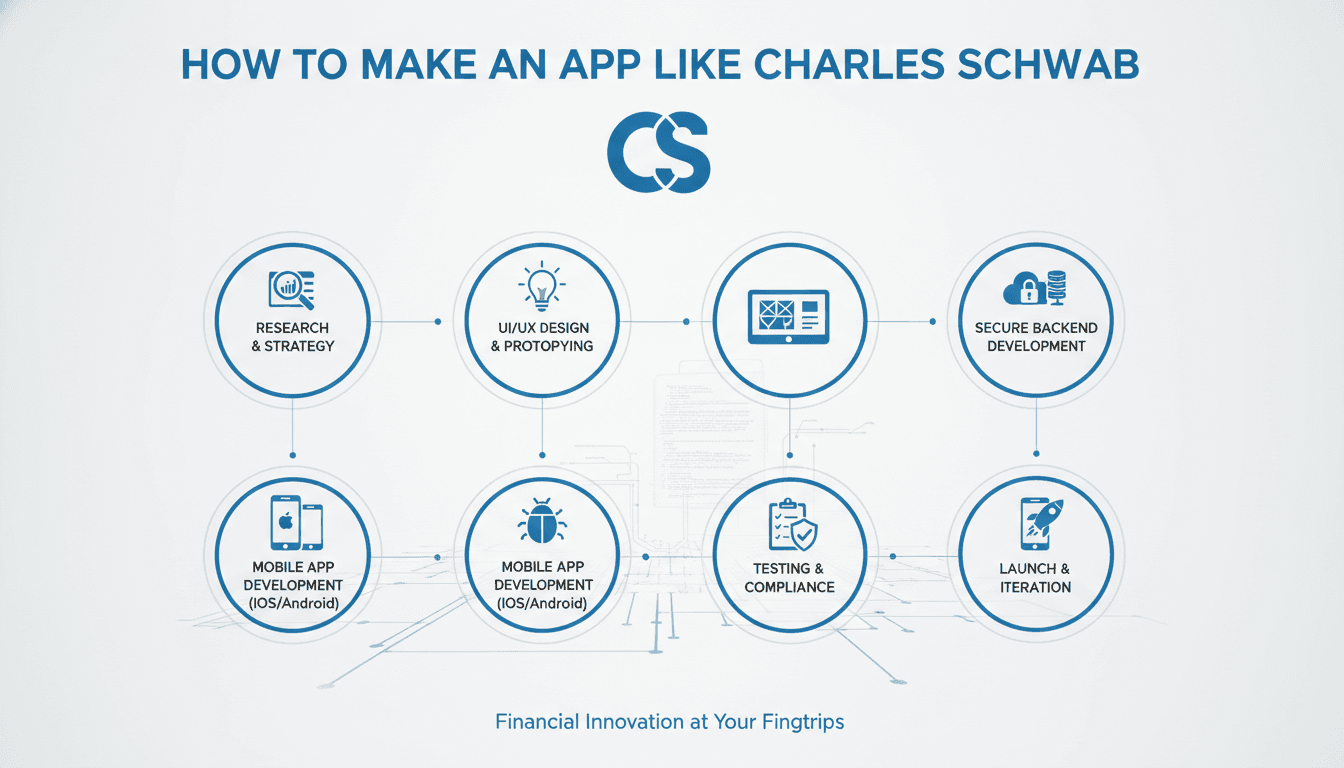
How to Make an App Like Charles Schwab
Charles Schwab didn't become a household name by accident. What started as a discount brokerage in the 1970s has evolved into one of the most trusted digital investment platforms in the world, serving over 35 million brokerage accounts and managing trillions in client assets. Its mobile and web applications have become the daily companion of investors ranging from first-time savers to seasoned traders.
If you're planning to build a fintech product in the investment and wealth management space, Charles Schwab is an excellent blueprint. This guide walks through what it actually takes to design, build, and launch an app like Charles Schwab — from core features and tech stack to regulatory hurdles, timelines, and budget.
Related reading: How to Make an App Like Fidelity Investments.
Why the Charles Schwab Model Works
Before writing a single line of code, it's worth understanding what makes Schwab's digital experience so sticky.
It consolidates the entire financial life. Brokerage accounts, retirement accounts, banking, checking, debit cards, and advisory services all live under one roof. Users don't need five apps.
It balances simplicity with depth. A casual investor can buy an index fund in three taps. A day trader can pull up Level II quotes, options chains, and technical overlays. The interface scales with the user's expertise.
It earns trust through transparency. Zero-commission trades, clear fee disclosures, and educational content position the platform as an ally rather than a middleman extracting value.
It leans on research and education. Market commentary, screeners, and learning centers keep users engaged even when they aren't trading.
Any app competing in this space needs to replicate that combination of breadth, usability, and trustworthiness.
Core Features Your Schwab-Like App Needs
1. Onboarding and KYC
Account opening is where most fintech apps lose users. Schwab's flow is deliberately streamlined, and yours should be too.
Related reading: How to Make an App Like Webull.
- Identity verification with document scanning and liveness detection
- KYC (Know Your Customer) and AML (Anti-Money Laundering) screening
- Accredited investor and suitability questionnaires
- SSN/Tax ID collection and IRS reporting setup
- Bank account linking via Plaid, Yodlee, or MX
- E-signature for account agreements
Aim for under ten minutes from download to funded account.
2. Account Dashboard
The home screen is the product. It should answer three questions instantly: What am I worth? What changed today? What should I do next?
- Total portfolio value with day change and all-time performance
- Asset allocation breakdown by class, sector, and geography
- Multiple account views (individual, joint, IRA, Roth, 401(k), custodial)
- Available cash and buying power
- Pending transactions and settlement status
3. Trading Engine
This is your technical center of gravity.
- Order types: market, limit, stop, stop-limit, trailing stop, bracket orders
- Asset coverage: stocks, ETFs, options, mutual funds, bonds, futures, fractional shares
- Real-time quotes with configurable Level I and Level II data
- Order preview and confirmation with estimated costs and fees
- Extended hours trading for pre-market and after-hours sessions
- Recurring investments for dollar-cost averaging
Order routing, execution quality, and latency are what separate a credible platform from a toy. You'll either build direct exchange connectivity or partner with a clearing firm like Apex Clearing, DriveWealth, or Alpaca.
For a closer look at a related topic, read our guide on How to Make an App Like M1 Finance.
4. Research and Market Data
- Interactive charts with technical indicators and drawing tools
- Company fundamentals, earnings history, and analyst ratings
- Stock and fund screeners with custom filters
- News feeds and market commentary
- Watchlists with price alerts
- Third-party research integration (Morningstar, S&P, Argus)
5. Banking and Money Movement
Schwab's competitive advantage is blurring the line between brokerage and bank.
- ACH transfers and wire transfers
- Mobile check deposit
- Debit card issuance with ATM fee reimbursement
- Bill pay and direct deposit
- Instant internal transfers between linked accounts
6. Retirement and Planning Tools
- IRA, Roth IRA, SEP, and rollover account support
- Contribution tracking against annual limits
- Retirement calculators and goal projections
- Required minimum distribution (RMD) reminders
- Tax-loss harvesting suggestions
7. Robo-Advisory Layer
Schwab Intelligent Portfolios brought automated investing to the masses. A modern competitor almost certainly needs one.
- Risk tolerance questionnaire
- Algorithmic portfolio construction
- Automatic rebalancing
- Goal-based investing buckets
- Optional hybrid access to human advisors
8. Reporting and Documents
- Monthly and annual statements
- Tax documents (1099-B, 1099-DIV, 5498)
- Realized and unrealized gain/loss reports
- Cost basis tracking with lot selection
- Transaction history with export
9. Security Infrastructure
Non-negotiable in fintech.
- Biometric login (Face ID, Touch ID, fingerprint)
- Multi-factor authentication with hardware key support
- End-to-end encryption in transit and at rest
- Device fingerprinting and anomaly detection
- Session timeouts and remote logout
- Fraud monitoring and transaction alerts
The Technology Stack
Mobile
Native (Swift for iOS, Kotlin for Android) gives you the best performance for real-time data streaming and complex charting. Most serious trading platforms go native.
Cross-platform (Flutter or React Native) cuts development cost substantially and works well if your app leans toward passive investing rather than active trading.
Backend
- Languages: Java, Go, or Node.js for services; Python for analytics and ML
- Architecture: microservices with clear domain boundaries (accounts, orders, positions, payments, notifications)
- Messaging: Kafka or RabbitMQ for event streaming and order flow
- Real-time delivery: WebSockets for live quotes and position updates
Data Layer
- Transactional: PostgreSQL for account and order data
- Time-series: InfluxDB or TimescaleDB for market data history
- Caching: Redis for quotes, sessions, and hot lookups
- Analytics: Snowflake or BigQuery for reporting and BI
Infrastructure
- AWS, Azure, or GCP with multi-region failover
- Kubernetes for orchestration
- Infrastructure as code via Terraform
- Comprehensive observability with Datadog, Prometheus, and Grafana
Third-Party Integrations
| Need | Options |
|---|---|
| Market data | Polygon.io, IEX Cloud, Refinitiv, Nasdaq |
| Clearing & custody | Apex Clearing, DriveWealth, Alpaca |
| KYC/AML | Jumio, Onfido, Persona, Alloy |
| Bank linking | Plaid, MX, Yodlee |
| Payments | Dwolla, Stripe Treasury, Modern Treasury |
| Card issuing | Marqeta, Galileo |
Regulatory Requirements
This is where fintech projects live or die. In the United States, you'll likely need:
- SEC registration as a broker-dealer
- FINRA membership and approval of your business plan
- SIPC membership for customer asset protection
- State registrations in every state where you operate
- Registered Investment Advisor (RIA) status if you offer advisory services
- Bank partnership or charter for banking features
- Compliance program covering AML, BSA, Reg BI, and recordkeeping
Two practical paths exist. You can pursue your own licenses, which takes 12 to 24 months and significant legal spend. Or you can launch on a Broker-Dealer-as-a-Service partner who holds the licenses while you own the front end. The second route gets you to market far faster and is how most modern investing apps started.
Budget for legal counsel specializing in securities law from day one. This is not a place to improvise.
Development Roadmap
Phase 1: Discovery and Compliance Strategy (4–8 weeks)
Market research, competitive analysis, feature prioritization, regulatory pathway decision, and partner selection.
Phase 2: UX/UI Design (6–10 weeks)
Information architecture, wireframes, design system, high-fidelity mockups, and clickable prototypes. Usability testing with real investors is essential here.
Phase 3: MVP Development (16–24 weeks)
Build the non-negotiables: onboarding and KYC, account funding, a dashboard, basic equity and ETF trading, watchlists, and security. Resist scope creep.
Phase 4: Testing and Certification (6–10 weeks)
Functional QA, load testing against peak market volume, penetration testing, and clearing partner certification.
Phase 5: Beta and Launch (4–8 weeks)
Limited release, monitoring, bug fixes, then public rollout with staged onboarding.
Phase 6: Iteration
Options trading, robo-advisory, retirement accounts, banking features, and advanced research get layered in post-launch based on usage data.
Budget Expectations
Costs vary enormously with scope and regulatory path.
MVP (basic equity trading, single platform, BaaS partner): $150,000 – $300,000
Mid-tier product (iOS + Android + web, options, retirement accounts, robo-advisor): $350,000 – $700,000
Full-scale Schwab competitor (multi-asset, banking, advisory, proprietary infrastructure): $1,000,000+
Add ongoing costs for market data licensing ($5,000–$50,000+ per month depending on depth and redistribution rights), cloud infrastructure, compliance staff, customer support, and continuous development. Annual maintenance typically runs 20–30% of initial build cost.
Monetization Strategies
With commission-free trading now the baseline, revenue comes from elsewhere.
- Net interest margin on uninvested cash balances — often the single largest revenue line
- Payment for order flow where permitted, though increasingly scrutinized
- Advisory fees on managed portfolios (typically 0.25%–0.50% AUM)
- Premium subscriptions for advanced research, data, and tools
- Margin lending interest
- Securities lending revenue
- Proprietary funds and ETFs with embedded expense ratios
- Interchange fees from debit card usage
Common Pitfalls to Avoid
Underestimating compliance. Teams routinely budget for engineering and forget that legal, licensing, and ongoing compliance can match or exceed development costs.
Poor performance under load. Markets move fast and users pile in simultaneously. An app that crashes during a selloff loses trust permanently. Load test at 10x expected peak.
Overloading the interface. Cramming every data point onto one screen is the fastest way to intimidate new investors. Progressive disclosure is your friend.
Neglecting customer support. When someone's money is involved, they want a human. Build support infrastructure alongside the app, not after.
Ignoring education. Schwab invests heavily in teaching users. Educated users trade more thoughtfully, stay longer, and refer others.
Weak security posture. One breach in fintech is often fatal to the brand. Invest in security engineering early and audit continuously.
How to Differentiate
Copying Schwab feature-for-feature won't win. Find an angle.
- Underserved demographics — Gen Z investors, gig workers, immigrants building credit and wealth
- Thematic or values-based investing — ESG, faith-based, sector-specific portfolios
- Community features — social investing, verified performance sharing, discussion around holdings
- AI-powered guidance — personalized insights, natural language portfolio queries, automated tax optimization
- Regional focus — markets where incumbent platforms are weak or nonexistent
- Vertical integration — combining investing with tax filing, estate planning, or insurance
Final Thoughts
Building an app like Charles Schwab is one of the more demanding projects in software, not because the code is uniquely hard, but because the intersection of real money, real-time data, and heavy regulation leaves no room for sloppiness.
The winning approach is almost always the same: start narrow, launch on a licensed partner's infrastructure, obsess over onboarding and reliability, and expand your asset classes and features only once you've earned user trust. The platforms that scaled fastest in the last decade all began as focused products that did one thing exceptionally well before becoming everything to everyone.
If you're serious about entering this space, assemble three things before you build: a securities attorney, a clearing partner, and an engineering team with genuine fintech experience. With those in place, the rest is execution.
Have a project in mind? Contact Sodio Technologies to discuss your requirements and explore the right technology solution for your business.
/// Work with us
Talk to the engineers who'd build it
You'll get a technical scope, timeline and cost estimate from the people doing the work, not an account manager. In-house team, no subcontracting, since 2016.