

How to Make an App Like Clue
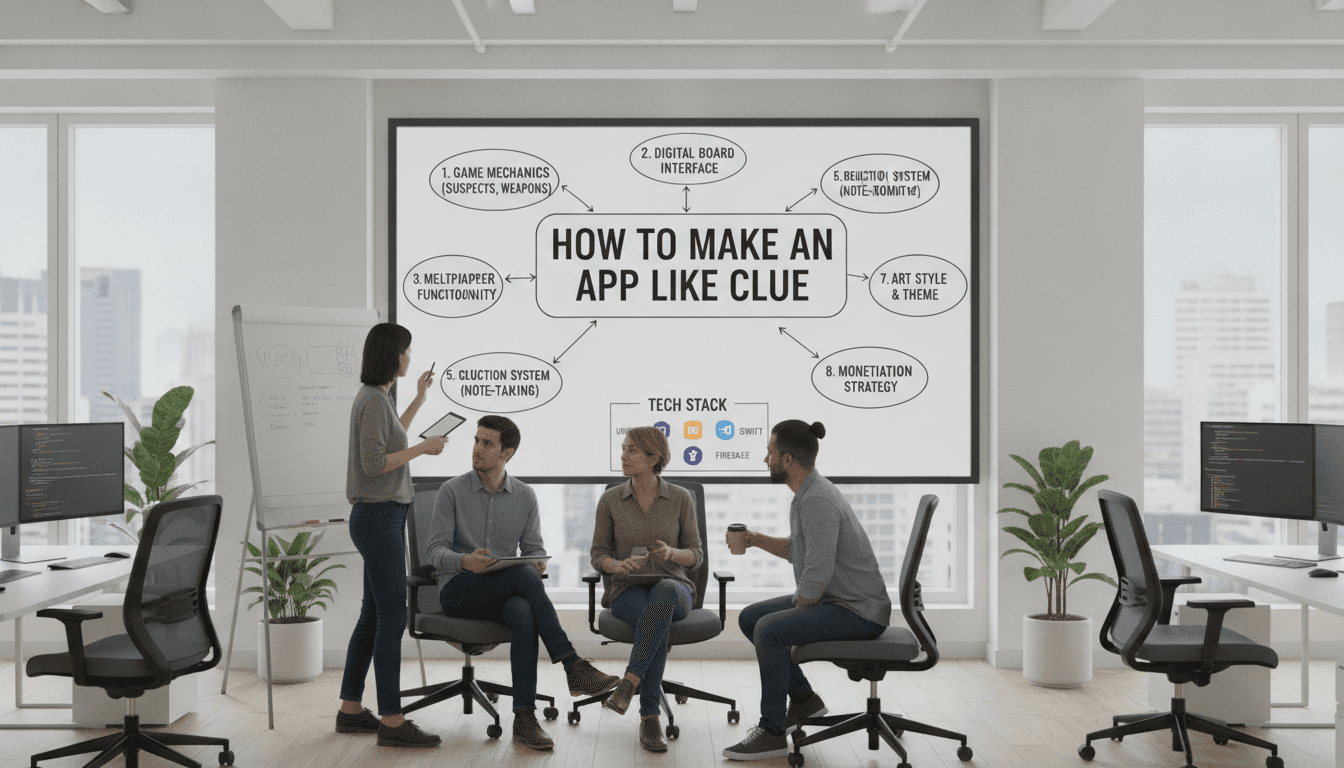
A practical breakdown of the architecture, feature set, and build decisions behind a period-tracking app — from cycle prediction models to HIPAA-adjacent data handling.
What Does "an App Like Clue" Actually Mean to Build?
Clue is a menstrual cycle and reproductive health tracker. On the surface it looks simple: log symptoms, get predictions, view a calendar. Under the surface it's a combination of a time-series data model, a statistical inference engine, push notification scheduling, and a data privacy architecture that has to hold up under GDPR, CCPA, and increasingly, US state-level health data laws.
The complexity is not in the UI. It's in the prediction logic, the sensitivity of the data, and the retention and deletion guarantees you have to make to users who, reasonably, do not want their menstrual data sold or subpoenaed.
If you're building in this space, you need to make decisions about each of those layers before you write a single line of application code.
Core Features and the Technical Work Each One Requires
Clue's feature set looks like a short list. It isn't, once you break each item into its actual engineering surface area.
Cycle tracking and calendar view
This is a date-range UI backed by a per-user event log. Each log entry carries a timestamp, a category (period start, period end, symptom, mood, medication, etc.), and a value. The schema is straightforward. The complication is that users edit historical entries, skip days, and log retroactively. Your data model has to handle sparse, unordered input gracefully.
Symptom logging
Clue tracks over 30 data points per day: flow intensity, pain, mood, energy, skin, digestion, sexual activity, sleep, and more. Each category needs a defined enum or scale. Storing these as key-value pairs against a date and user ID keeps the schema flexible, but you need indexing strategy sorted out early — querying "all users who logged headache on day 14 of their cycle" for aggregate anonymised research is a different access pattern from "show this user their last 6 months."
Cycle prediction
This is where most teams underestimate the work. A naive implementation averages the last N cycle lengths. Clue's published research (they have an in-house science team and have published in Nature Digital Medicine) uses a Bayesian model that accounts for cycle-to-cycle variability, recent trend shifts, and data sparsity when a user is new. You don't need to replicate their exact model on day one, but you do need to decide: rule-based heuristics, a statistical model, or an ML model trained on your own cohort data?
For a new product with no cohort data, start with a Gaussian model. Mean and standard deviation of logged cycle lengths per user, with a prior pulled from published population data (mean cycle length is approximately 28.5 days, standard deviation approximately 7.5 days, per research published in NPJ Digital Medicine in 2019). As you accumulate data, you can retrain.
Notifications and reminders
Period predictions need to translate into scheduled push notifications. This means a background job that runs nightly, recalculates predictions for users with upcoming windows, and schedules or updates APNs/FCM tokens accordingly. Firebase Cloud Messaging handles the delivery layer. The scheduling logic lives in your backend. Do not let the client schedule its own notifications for something this stateful — it breaks every time the user reinstalls.
Insights and trends
Aggregated views over time: average cycle length, symptom patterns by cycle phase, correlations the user can explore. This is mostly a query and visualisation problem. Keep raw event logs immutable. Derive aggregates on read, or materialise them on a schedule if query latency becomes a problem at scale.
/// Not sure where to start?
Get the architecture before you commit
Tell us what you're building and we'll map the technical approach, stack, and rough timeline. No cost, no obligation, no sales call required.
How Should You Handle Health Data Privacy?
This is the question most teams get wrong, usually by treating it as a compliance checkbox rather than an architectural decision.
Health data in a period tracking app is sensitive in a specific and serious way. Post-Dobbs, several US states criminalise certain reproductive outcomes. Apps like Clue faced immediate scrutiny about whether their data could be subpoenaed. Clue (a German company, operating under GDPR) responded by publishing explicit data retention policies and confirming they do not sell data to third parties.
If you're building for a US audience, you need to decide:
- Whether you process data on-device, server-side, or both
- What your data retention schedule looks like and whether it's enforced programmatically
- Whether you will respond to law enforcement requests and under what conditions
- Whether you will use third-party analytics SDKs that could exfiltrate health data as a side effect
On-device ML inference (Core ML on iOS, TensorFlow Lite on Android) keeps prediction computation local. That's a meaningful privacy posture. It's also more complex to update models and harder to use cohort data for improvement. You're trading product velocity for user trust. For this category, that trade is often worth making.
HIPAA does not automatically apply to consumer health apps unless you're a covered entity or business associate. But GDPR applies if you have EU users, and it classifies health data as a special category requiring explicit consent and stricter processing rules. California's CMIA (Confidentiality of Medical Information Act) adds another layer for CA users.
Minimum viable privacy architecture:
- Encrypt at rest (AES-256) and in transit (TLS 1.3)
- Separate PII from health event logs — link via a pseudonymous user ID
- Enforce hard deletion (not soft delete) when a user requests account removal
- Audit log all data access, including internal tooling
- Do not include advertising SDKs in the default build
What Tech Stack Makes Sense?
There is no single right answer, but here are the trade-offs as they actually play out.
| Layer | Option A | Option B | Trade-off |
|---|---|---|---|
| Mobile | React Native | Flutter | React Native has a larger hiring pool; Flutter renders more consistently across platforms |
| Backend | Node.js + PostgreSQL | Python + PostgreSQL | Python has better ML library support if you're building inference server-side |
| Prediction engine | On-device (Core ML / TF Lite) | Server-side (Python, scikit-learn or PyTorch) | On-device is more private; server-side is easier to update |
| Auth | Firebase Auth | Custom JWT + refresh tokens | Firebase is faster to ship; custom gives you more control over data residency |
| Push notifications | Firebase Cloud Messaging | AWS SNS | FCM is simpler; SNS fits better if you're already deep in AWS |
| Hosting | AWS / GCP | DigitalOcean / Render | AWS/GCP scale better; simpler platforms reduce ops overhead early on |
For a first version targeting iOS and Android simultaneously, React Native or Flutter are both defensible. If your team has existing React Native experience, use that. If you're starting fresh and care about pixel-perfect UI consistency, Flutter is worth the ramp-up time.
How Long Does It Take and What Does It Cost?
A reasonable MVP, with cycle tracking, symptom logging, basic prediction, notifications, and account management, takes 16 to 22 weeks with a team of four to five engineers. That includes a backend engineer, two mobile engineers, a designer, and a QA engineer.
The prediction engine adds two to four weeks depending on how sophisticated you want the initial model to be. Data privacy architecture, if you treat it properly rather than bolting it on later, adds another two to three weeks.
Rough cost range for a competent team: $80,000 to $140,000 USD for an MVP, depending on location and seniority. That's not a ceiling — it's a starting point for a product that's actually usable and compliant.
What delays projects in this space: underestimating the prediction engine, ignoring privacy architecture until late in the build, and trying to build too many symptom categories before validating which ones users actually log.
Conclusion
If you're building a period tracking app, the core engineering challenge is not the calendar UI. It's the combination of time-series data modelling, statistically sound cycle prediction, and a privacy architecture that can hold up to legal scrutiny. Get those three things right first.
The next concrete step: define your data model before you touch the UI. Sketch out your event log schema, decide where prediction runs (device or server), and write down your data retention and deletion policy. Those three decisions will constrain every other technical choice you make.
If you want a technical review of your architecture before you build, or a team to build it with you, talk to us at Sodio.
FAQ
How accurate can cycle predictions be in a new app with no user history?
With no personal data, a population-level prior gives you predictions accurate to within two to four days for users with regular cycles. Accuracy improves meaningfully after three to six logged cycles. Users with irregular cycles (PCOS, perimenopause) need longer history and benefit most from a Bayesian model that handles high variance.
Do I need HIPAA compliance for a period tracking app?
Not automatically. HIPAA applies to covered entities (healthcare providers, insurers) and their business associates. A standalone consumer app is not automatically a covered entity. But GDPR applies to EU users regardless, and California's CMIA applies to CA users. Treat health data with HIPAA-level care even when not legally required — the legal landscape is shifting fast.
Can I build cycle prediction without training my own ML model?
Yes. A Gaussian model using published population priors (mean ~28.5 days, SD ~7.5 days) works well for users with regular cycles and requires no training data. As you accumulate user logs, you can retrain a personalised model. Many production apps use a rules-based or statistical approach for years before introducing a neural model.
Should predictions run on-device or on the server?
On-device is better for privacy and works offline. Server-side is easier to update and lets you use cohort data to improve the model. For a privacy-forward product in the reproductive health space, on-device (Core ML on iOS, TensorFlow Lite on Android) is the stronger default. You can always add server-side inference later for aggregate research features.
What's the biggest technical mistake teams make when building apps like Clue?
Treating the prediction engine as a simple average. Averaging the last three cycle lengths ignores variance, recent trend shifts, and the sparsity problem for new users. It also produces confidently wrong predictions, which destroys user trust fast. Build a proper statistical model from the start, even if it's just a Gaussian with a population prior.
Have a project in mind? Contact Sodio Technologies to discuss your requirements and explore the right technology solution for your business.
/// Work with us
Talk to the engineers who'd build it
You'll get a technical scope, timeline and cost estimate from the people doing the work, not an account manager. In-house team, no subcontracting, since 2016.