

How to Make an App Like Crypto.com
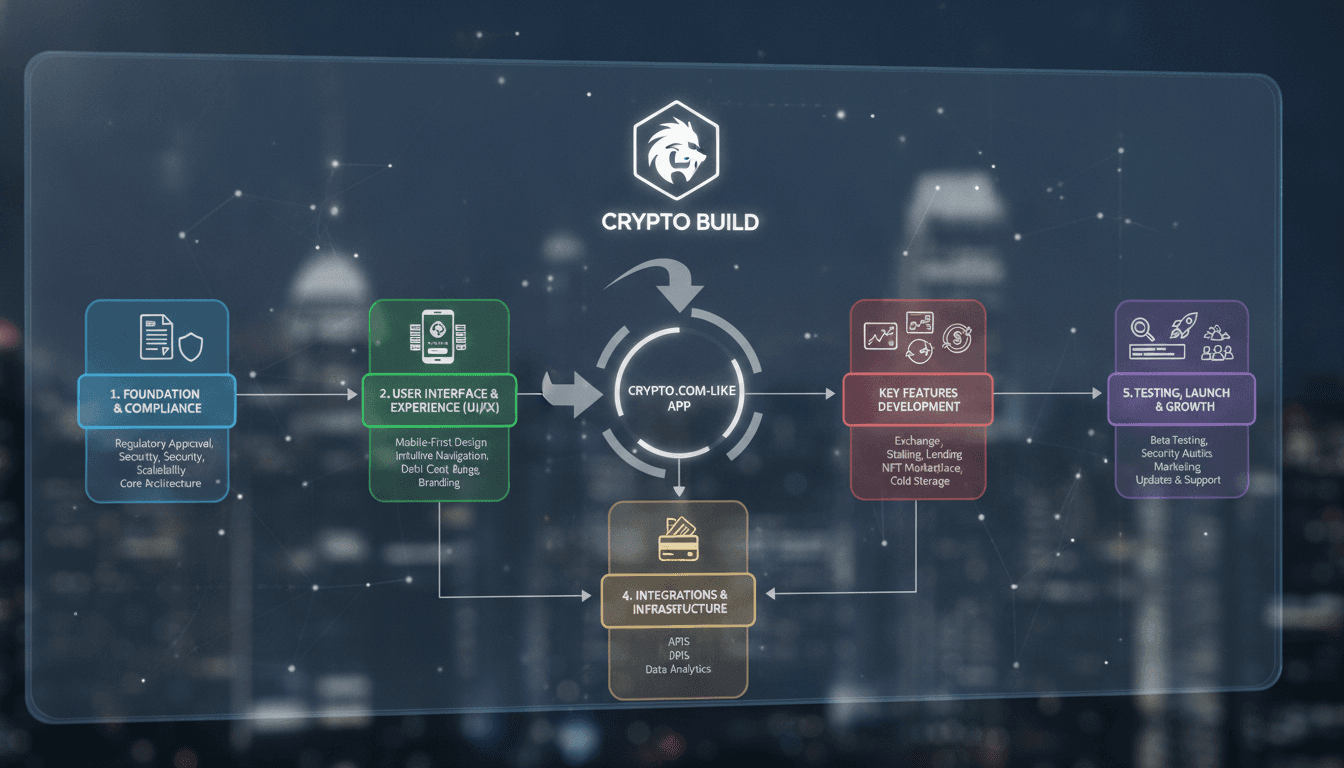
How to Make an App Like Crypto.com
Crypto.com went from a niche exchange to a household name with a stadium bearing its logo and tens of millions of users worldwide. That kind of growth has a lot of founders asking the same question: what would it actually take to build something similar?
The short answer is that Crypto.com isn't one app — it's a bundle of financial products stitched together behind a single login. Understanding that structure is the first step to building your own version, whether you want to replicate the whole ecosystem or carve out one slice of it.
For a closer look at a related topic, read our guide on How to Make an App Like Coinbase.
This guide walks through the product anatomy, the tech stack, the compliance reality, the cost drivers, and the realistic path to launch.
What Crypto.com Actually Is
Before writing a line of code, it helps to break the platform into its component businesses:
- Spot exchange and brokerage — buy, sell, and swap hundreds of tokens with fiat on-ramps
- Custodial wallet — the platform holds keys on behalf of users
- Non-custodial DeFi wallet — a separate app where users control their own keys
- Crypto-backed Visa cards — prepaid debit cards with staking-based cashback tiers
- Earn and staking products — yield on deposited assets
- Derivatives exchange — futures and perpetuals for advanced traders
- NFT marketplace — a curated storefront and secondary market
- Price data and portfolio tracking — the free layer that attracts top-of-funnel users
Each of those is a legitimately hard product on its own. Crypto.com built them over years, backed by a nine-figure war chest. Your v1 should not attempt all of it.
Step 1: Choose Your Wedge
The most common failure mode for crypto startups is trying to clone the full feature list on a seed round. Pick one entry point and make it excellent.
We cover a closely related subject in How to Make an App Like BitPay.
Beginner-friendly brokerage. Simple buy/sell with card and bank transfers. Highest regulatory burden, but the largest addressable market and the clearest revenue model.
Non-custodial wallet. You never touch user funds, which dramatically simplifies licensing. Revenue comes from swap fees, staking commissions, and partner integrations.
Earn-first product. Position around yield rather than trading. Attractive to savers, but you inherit counterparty risk and post-2022 skepticism you'll need to answer with real transparency.
Vertical exchange. Serve a specific region, asset class, or community that incumbents underserve. Narrow markets are easier to dominate.
Card and spending layer. Partner with a BIN sponsor and issuer processor to turn crypto balances into everyday spending. Differentiated, but heavily partner-dependent.
Step 2: Decide Custodial vs. Non-Custodial
This single architectural choice cascades into everything else — your licensing, your insurance costs, your engineering team's composition, and your liability exposure.
Custodial means you hold private keys. Users get password recovery, familiar UX, and instant internal transfers. You get money transmitter obligations, the need for a qualified custody partner or your own key management infrastructure, and existential responsibility for security.
Non-custodial means keys live on the user's device or are split via MPC. Regulatory exposure drops sharply and you can ship faster. The tradeoff is UX friction around seed phrases and recovery, plus a narrower revenue surface.
A pragmatic middle path many teams choose in 2024 and beyond: MPC-based wallets with social or cloud recovery. Providers like Fireblocks, Dfns, Web3Auth, Privy, and Turnkey let you offer non-custodial security with custodial-feeling onboarding.
If this is relevant to your project, check out How to Make an App Like BlockFi.
Step 3: Map the Core Feature Set
Onboarding and KYC
Email or phone signup, device binding, identity verification, sanctions and PEP screening, risk scoring. Vendors like Sumsub, Persona, Jumio, and Onfido handle document capture and liveness checks.
Wallet and Balances
Multi-chain address generation, deposit monitoring, withdrawal queues with hot/warm/cold segregation, address whitelisting, and withdrawal cool-down periods after security-sensitive changes.
Trading Engine
If you're a brokerage, you route orders to liquidity providers and quote a spread. If you're running an exchange, you need a matching engine that can handle price-time priority at low latency — typically written in a performance-oriented language and running in-memory with an event-sourced ledger behind it.
Fiat On-Ramp and Off-Ramp
Card acquiring, ACH/SEPA/Faster Payments, and local rails per market. Many teams start with aggregators like MoonPay, Transak, or Banxa before building direct banking relationships.
Swap and DeFi Integration
Aggregated routing through 0x, 1inch, LI.FI, or Jupiter depending on chains supported. Bridge integrations for cross-chain movement.
Earn and Staking
Validator delegation for proof-of-stake assets, or lending pool integrations. Be explicit about where yield comes from — vague "up to X% APY" marketing is now a regulatory red flag in most jurisdictions.
Card Program
BIN sponsorship, issuer processor integration, real-time authorization logic that converts crypto to fiat at the point of sale, and a rewards ledger.
Security Layer
2FA (TOTP and passkeys, not SMS as a primary factor), biometric unlock, anti-phishing codes, session management, device fingerprinting, and behavioral fraud detection.
Support and Compliance Tooling
An internal admin console for case management, transaction monitoring alerts, manual review queues, and audit trails. Underestimating this internal product is one of the most expensive mistakes teams make.
Step 4: Get the Licensing Right — Early
Compliance is not a phase you bolt on before launch. It shapes your product, your geography, and your runway.
Depending on where you operate, you may need:
- United States: FinCEN MSB registration plus state-by-state money transmitter licenses, or a partnership with a licensed entity. New York requires a BitLicense.
- European Union: MiCA authorization as a Crypto-Asset Service Provider, passportable across member states.
- United Kingdom: FCA cryptoasset registration under the Money Laundering Regulations.
- Singapore: MAS Digital Payment Token license under the Payment Services Act.
- UAE: VARA licensing in Dubai or ADGM in Abu Dhabi.
Two viable strategies exist. Either license yourself — slow and expensive, but you own the moat — or launch on a partner's rails through Licensing-as-a-Service providers, which gets you to market in months rather than years at the cost of margin and control.
Whichever you choose, budget for an AML program, a designated compliance officer, a Travel Rule solution for transfers above threshold, transaction monitoring software, and annual audits.
Step 5: Pick the Tech Stack
Mobile clients: React Native or Flutter for speed to market across iOS and Android; native Swift and Kotlin if you need deep biometric, secure enclave, and NFC control. Financial apps frequently go native for the security-sensitive modules and cross-platform for everything else.
Backend: A microservices architecture is close to mandatory here — the ledger, the trading engine, the KYC service, and the notification service all have wildly different scaling and availability profiles. Go and Rust dominate the performance-critical paths; Node.js, Java, and Python handle the rest.
Data layer: PostgreSQL for the authoritative ledger with strict double-entry accounting, Redis for hot state, Kafka or NATS for the event backbone, and a time-series store like ClickHouse for market data and analytics.
Blockchain interaction: Node infrastructure through Alchemy, QuickNode, Infura, or self-hosted nodes for chains where you need full control. Indexers for transaction history.
Market data: Feeds from exchanges plus an aggregator, with an oracle strategy for pricing that can't be manipulated.
Infrastructure: Kubernetes on AWS or GCP, multi-region, with infrastructure-as-code and immutable deployments. Hot wallet signing services isolated in their own hardened environment with HSMs.
Observability: Full distributed tracing, real-time alerting on ledger imbalances, and reconciliation jobs that compare on-chain balances to internal records continuously.
Step 6: Design for Trust
Crypto UX has a specific psychological problem: users are handing money to a stranger on the internet in an industry with a history of collapses. Your interface has to earn confidence at every step.
Practical design principles that work:
- Show the safety rails. Address whitelists, withdrawal confirmations, and cool-down timers should feel like features, not friction.
- Make fees legible. Hidden spreads erode trust permanently once discovered. Show the all-in price.
- Publish proof of reserves. Merkle-tree attestations with third-party verification have become table stakes for custodial platforms.
- Progressive disclosure. A beginner sees "Buy Bitcoin." A pro taps through to order books and advanced order types. Same app, different depth.
- Honest risk communication. Volatility warnings, clear yield-source explanations, and no dark patterns around leverage.
Step 7: Build in Phases
Phase 1 (Months 1–3): Foundations. Architecture, compliance strategy, vendor selection, design system, and a clickable prototype. Begin licensing conversations now.
Phase 2 (Months 3–7): Core MVP. Onboarding, KYC, wallet, one fiat on-ramp, buy/sell for a short list of major assets, and the admin console. Internal ledger correctness is the priority.
Phase 3 (Months 7–10): Hardening. Third-party security audit, penetration testing, smart contract audits if applicable, load testing the matching engine, and a closed beta with real money at small limits.
Phase 4 (Months 10–12): Launch. Soft launch in one jurisdiction. Monitor reconciliation obsessively. Scale support before you scale marketing.
Phase 5 (Year 2+): Expansion. Staking, swaps, the card program, derivatives, additional markets. Each addition reopens the compliance question.
What It Costs
Ranges vary enormously by scope, but rough planning figures:
- Non-custodial wallet MVP: $80,000 – $180,000
- Custodial brokerage MVP (single market): $200,000 – $450,000
- Full exchange with matching engine and derivatives: $600,000 – $1.5M+
- Card program add-on: $150,000 – $400,000 plus ongoing program fees
Beyond build cost, budget for licensing and legal ($50,000 – $500,000+ depending on jurisdiction), security audits ($30,000 – $100,000 annually), insurance, and a compliance team salary line that never goes away. Ongoing infrastructure and maintenance typically runs 20–30% of the initial build cost per year.
Common Mistakes to Avoid
Treating the ledger as an afterthought. Every balance change must be a double-entry transaction in an append-only ledger. Retrofitting this is a nightmare.
Skipping reconciliation. Automated jobs comparing on-chain state, custodian balances, and internal records should run continuously and page someone on mismatch.
Launching in too many markets at once. Each jurisdiction multiplies compliance work. Prove the model in one.
Under-resourcing support. Crypto users panic about stuck transactions. Slow support becomes a Twitter crisis fast.
Copying the feature list instead of the trust. Crypto.com's moat isn't its feature count — it's brand, liquidity, and regulatory footprint. Compete on something you can actually win.
The Realistic Path
You are unlikely to out-feature Crypto.com. But the market is far from saturated. Regional players, community-specific platforms, self-custody products with genuinely good UX, and niche asset verticals are all winning users right now.
Start narrow. Build the ledger correctly. Get compliance advice before you get design mockups. Ship to one market, earn trust, then expand.
The teams that succeed in this space are the ones that treat it as a financial infrastructure problem with a consumer app on top — not a consumer app with some crypto bolted on.
Have a project in mind? Contact Sodio Technologies to discuss your requirements and explore the right technology solution for your business.
/// Work with us
Talk to the engineers who'd build it
You'll get a technical scope, timeline and cost estimate from the people doing the work, not an account manager. In-house team, no subcontracting, since 2016.