

How to Make an App Like E*TRADE
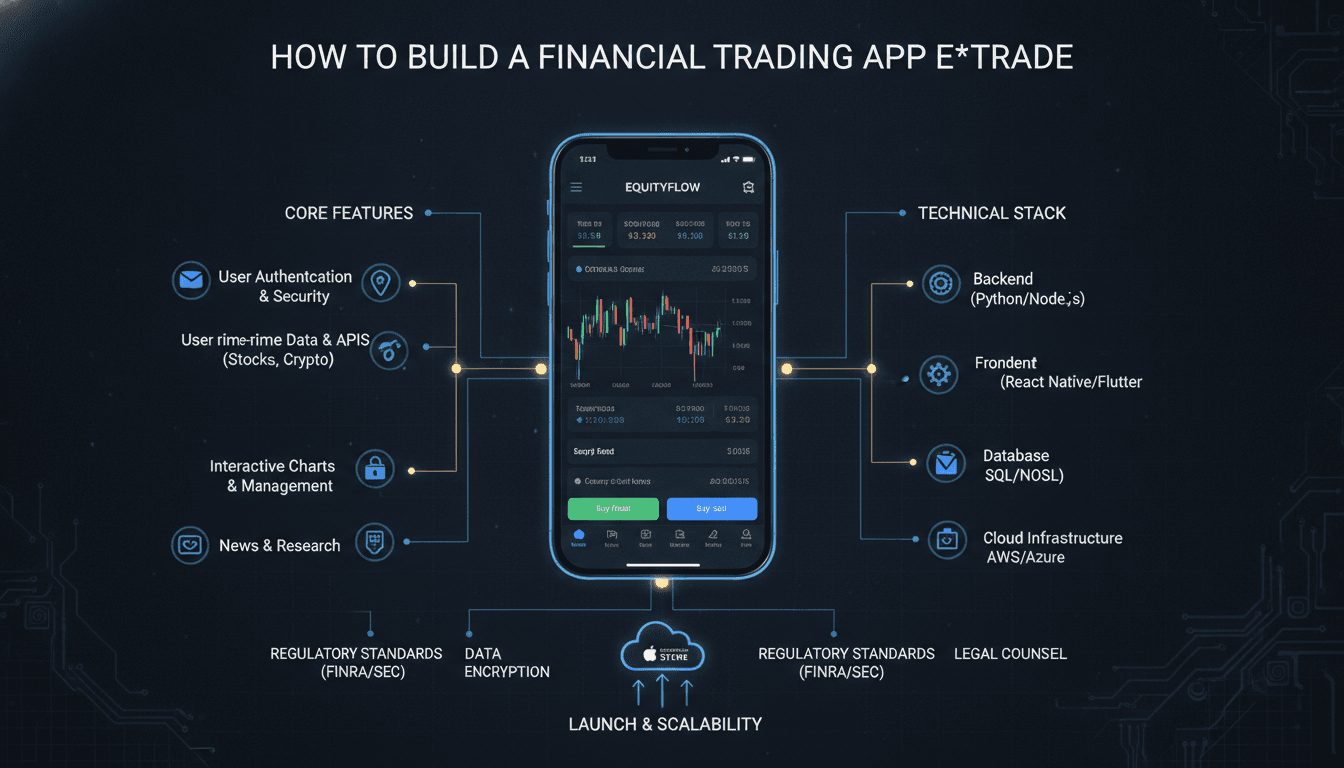
Online brokerage has moved from desktop terminals to the phone in your pocket. E*TRADE helped define that shift, turning what used to be a phone call to a broker into a few taps on a screen. Today, millions of people expect to be able to open an account, fund it, research a stock, and place a trade in under ten minutes — all from a mobile app.
If you're planning to build a trading app like E*TRADE, this guide walks through what the product actually contains, the technology behind it, the regulatory reality you can't design around, and what it costs to get to market.
If this is relevant to your project, check out How to Make an App Like TD Ameritrade.
What E*TRADE Actually Is
E*TRADE is a self-directed online brokerage. Users open a brokerage account, transfer money in, and buy and sell securities — stocks, ETFs, options, mutual funds, bonds — without a human broker in the loop. The platform makes money through order flow, margin lending interest, options contract fees, premium data subscriptions, and cash sweep spreads.
The app itself is a thin, fast interface over an enormous amount of back-office machinery: account management, KYC, clearing, settlement, custody, market data feeds, tax reporting, and compliance surveillance. Most of the engineering effort in a project like this lives in places users never see.
If this is relevant to your project, check out How to Make an App Like SoFi Invest.
Core Features to Build
Onboarding and Account Opening
This is where most brokerage apps lose users. The flow needs to collect identity documents, Social Security or tax ID, employment details, investment experience, and risk tolerance — and it needs to do it in a way that doesn't feel like filing taxes.
For a closer look at a related topic, read our guide on How to Make an App Like Ally Invest.
Key components:
- Identity verification (KYC/AML) with document capture and liveness detection
- Suitability questionnaire to determine what products a user can access
- FINRA affiliation disclosures and employer approval workflows
- E-signature for account agreements
- Progressive onboarding — let users browse and build watchlists before completing full verification
Realistic target: under eight minutes from download to submitted application, with instant approval for the majority of clean applications.
Funding and Withdrawals
- ACH bank linking via Plaid or a similar aggregator
- Wire transfers for larger deposits
- ACAT transfers to pull accounts in from competing brokerages
- Recurring deposit scheduling
- Instant deposit availability up to a risk-based limit
- Clear display of settled vs. unsettled cash to prevent good-faith violations
Market Data and Research
- Real-time or delayed quotes, depending on user tier and exchange agreements
- Interactive charting with multiple timeframes, indicators, and drawing tools
- Level 2 market depth for active traders
- News feeds mapped to tickers
- Analyst ratings, earnings calendars, and fundamentals
- Screeners with saved filter sets
- Watchlists that sync across devices
Market data is a licensing cost, not just an engineering task. Exchanges charge per-user, per-month fees for real-time non-display and display data, and the contracts are non-negotiable for smaller firms.
Order Entry and Execution
The order ticket is the highest-stakes screen in the app. It needs to be fast, unambiguous, and hard to misuse.
- Order types: market, limit, stop, stop-limit, trailing stop
- Time in force: day, GTC, extended hours
- Multi-leg options strategies with visual payoff diagrams
- Fractional share support
- Pre-trade buying power and margin checks
- Confirmation screen showing estimated cost, fees, and worst-case fill
- Real-time order status and fill notifications
Portfolio and Performance
- Positions with cost basis, unrealized P&L, and day change
- Time-weighted and money-weighted return calculations
- Asset allocation breakdowns
- Dividend tracking and reinvestment settings
- Realized gains and tax lot management
- Downloadable statements, trade confirmations, and 1099 forms
Alerts and Notifications
Price alerts, order fills, margin calls, earnings announcements, and unusual volume. Push notification delivery needs to be reliable and fast — a delayed margin call notification is a compliance problem, not just a UX complaint.
Technical Architecture
Recommended Stack
Mobile clients: Native Swift and Kotlin are the default choice for a serious trading app. You need tight control over rendering performance for live-updating price grids and charts, plus access to platform security features like Secure Enclave and biometric APIs. React Native or Flutter can work for a leaner MVP, but expect to drop into native modules for charting and streaming.
Backend: A microservices architecture in Java, Go, or Kotlin. Trading workloads have wildly different scaling profiles — market data streaming, order routing, and account management should scale independently.
Real-time layer: WebSockets for client streaming, with Kafka or Pulsar as the internal event backbone. Market data fan-out is one of the harder scaling problems you'll face; a single volatile session can generate millions of tick updates per second across the user base.
Data: PostgreSQL for account and transactional records, a time-series database like TimescaleDB or kdb+ for tick and bar data, Redis for hot quote caching and session state.
Infrastructure: Cloud-hosted with multi-AZ redundancy, but be aware that co-location matters if you're doing your own order routing. Most new brokerages route through a clearing partner instead.
The Build vs. Partner Decision
This is the single biggest architectural choice in the project.
Full self-clearing means becoming a FINRA-registered broker-dealer, obtaining exchange memberships, maintaining net capital, and building or licensing a clearing and settlement stack. Timeline: two to three years. Cost: eight figures.
Introducing broker with a clearing partner — firms like Apex Clearing, DriveWealth, or Alpaca provide brokerage-as-a-service APIs covering account opening, custody, order routing, clearing, and regulatory reporting. You build the experience layer; they handle the plumbing. Timeline: six to twelve months.
For nearly every new entrant, the partner model is the right answer. You can always migrate to self-clearing once volume justifies it.
Regulatory Requirements
You cannot ship a trading app in the US without addressing these. Treat legal counsel as a line item from day one, not a late-stage checkbox.
- SEC registration as a broker-dealer, or operating as an introducing broker under a registered partner
- FINRA membership and the New Member Application process
- SIPC membership for customer asset protection
- Net capital requirements under SEC Rule 15c3-1
- Pattern Day Trader rules — enforce the $25,000 minimum equity requirement and day trade counting
- Regulation Best Interest disclosures
- AML program with a designated compliance officer, suspicious activity monitoring, and CIP procedures
- Books and records retention under Rules 17a-3 and 17a-4, including WORM-compliant storage
- Order routing disclosure under Rule 606
- Trade surveillance for wash trading, spoofing, and manipulation patterns
International expansion multiplies this. Each jurisdiction — FCA in the UK, BaFin in Germany, MAS in Singapore — has its own licensing regime.
Security Requirements
Brokerage accounts are high-value targets. Security posture needs to exceed typical fintech standards.
- Biometric authentication with device binding
- Mandatory MFA, with hardware key support for high-balance accounts
- Certificate pinning and jailbreak/root detection
- End-to-end encryption in transit, AES-256 at rest
- Withdrawal address whitelisting and cooling-off periods
- Behavioral analytics for account takeover detection
- Session timeout tuned for the trading context
- SOC 2 Type II audit
- Regular penetration testing and a bug bounty program
UX Principles for Trading Apps
Speed is a feature. Quote latency, chart render time, and order submission round-trip are all measurable product qualities. Users notice a 300ms delay on an order ticket.
Make destructive actions deliberate. Order confirmation screens should show what the user is actually about to do in plain language, including the total dollar amount. Slide-to-confirm beats tap-to-confirm for market orders.
Design for two audiences. A casual investor buying an index fund monthly and an options trader managing six open positions need very different interfaces. Progressive disclosure and a configurable home screen handle both without building two apps.
Never hide costs. Commissions, contract fees, regulatory fees, and spreads should be visible before submission, not buried in a statement.
Handle failure gracefully. Market data disconnects, halted symbols, rejected orders, and outages during volatility spikes are inevitable. Every one needs a clear, honest state in the UI.
Development Timeline and Cost
Discovery and compliance planning: 6–8 weeks. Regulatory scoping, clearing partner selection, product definition.
MVP build: 5–7 months. Onboarding, funding, equity and ETF trading, portfolio view, basic charting, watchlists.
Certification and testing: 6–10 weeks. Clearing partner integration testing, security audit, FINRA review if applicable.
Post-launch phase two: options trading, advanced charting, retirement accounts, recurring investments.
Ballpark cost for an MVP on a clearing partner: $300,000 to $650,000, depending on feature depth and whether you build native for both platforms simultaneously. A full-featured platform comparable to E*TRADE runs well past $1.5 million, plus ongoing market data licensing, clearing fees, compliance staffing, and infrastructure.
Recurring costs are easy to underestimate. Market data alone can run tens of thousands per month once you have real users on real-time feeds.
Monetization Options
- Payment for order flow — increasingly scrutinized by regulators, but still a major revenue line
- Margin interest — typically the largest profit center at scale
- Options contract fees — per-contract pricing even in a zero-commission model
- Cash sweep spread — the difference between what you earn on idle cash and what you pay users
- Premium subscriptions — advanced data, research, and tools
- Securities lending — lending out shares in margin accounts
- Advisory services — robo-advisor or managed portfolio tiers
Common Pitfalls
Underestimating compliance. Teams routinely budget for engineering and treat regulation as paperwork. It's the longest pole in the tent.
Building for peak load too late. Your worst day will be a market-wide selloff when every user opens the app simultaneously. Load test against 20x normal concurrency.
Ignoring the boring screens. Tax documents, statements, and transfer status pages get little design attention and generate the most support tickets.
Copying the incumbent's information density. E*TRADE's interface reflects decades of accumulated features. A new app benefits from doing less, better.
Getting Started
Build the regulatory and clearing strategy before writing a line of application code — it determines your architecture, your timeline, and your unit economics. Pick a narrow initial audience rather than trying to serve day traders and passive investors at launch. Then invest disproportionately in onboarding and order entry, because those two flows determine whether users fund an account and whether they trust you enough to keep it there.
A trading app is a financial institution with a mobile interface attached. Teams that treat it that way from the beginning ship faster than teams that discover it halfway through.
Have a project in mind? Contact Sodio Technologies to discuss your requirements and explore the right technology solution for your business.
/// Work with us
Talk to the engineers who'd build it
You'll get a technical scope, timeline and cost estimate from the people doing the work, not an account manager. In-house team, no subcontracting, since 2016.