

How to Make an App Like Fetch Rewards
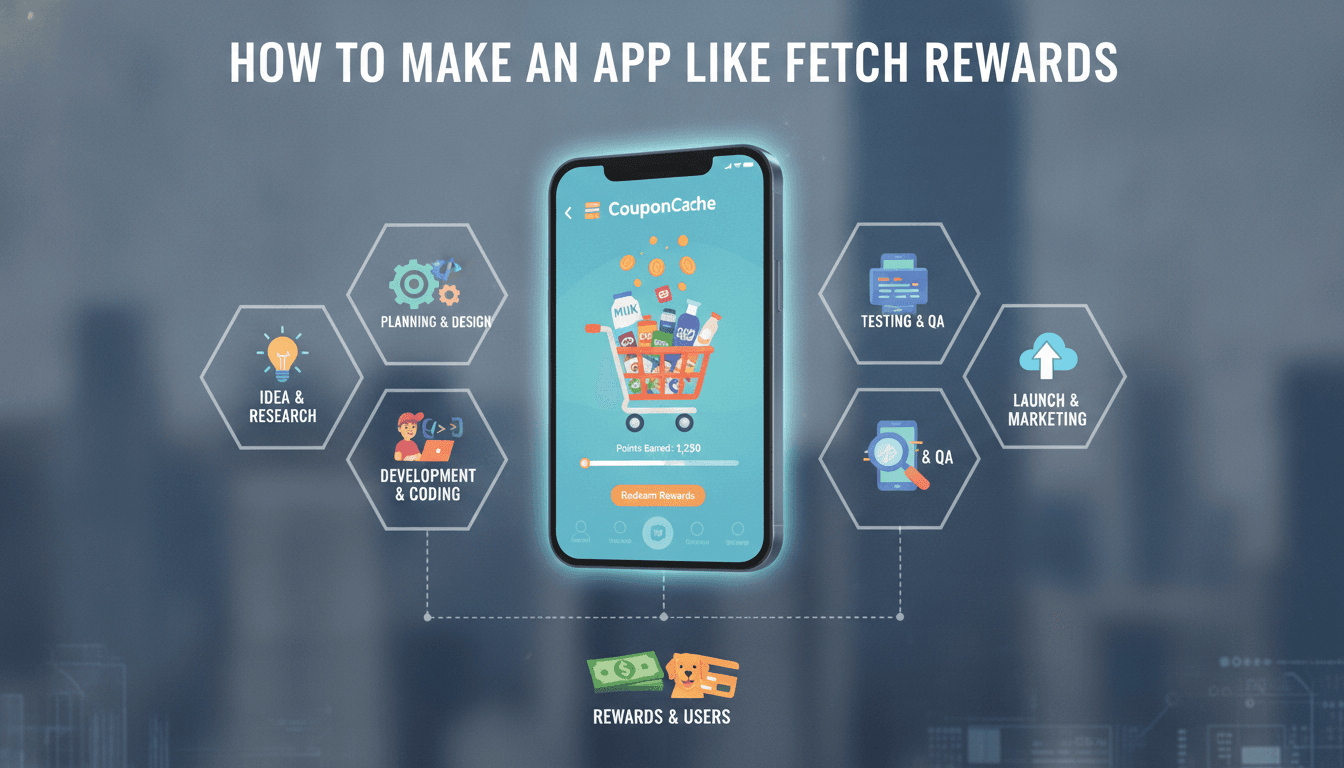
A practical breakdown of the architecture, data flows, and engineering decisions behind a loyalty rewards app — from receipt scanning to point redemption.
What Does a Fetch Rewards Clone Actually Involve?
Fetch Rewards is a receipt-scanning loyalty app. Users photograph purchase receipts, the app extracts item-level data, matches it against brand partner offers, and credits points. Those points redeem against gift cards. Simple on the surface, complex underneath.
The complexity sits in four places: accurate receipt parsing, real-time offer matching, fraud prevention, and a scalable point ledger. If you underestimate any of these, the product fails at the first growth spike.
Before writing a line of code, you need to decide which of those four you are willing to build deeply versus buying as a service. That decision shapes everything else.
How Does Receipt Scanning Actually Work?
This is the hardest engineering problem in the stack. A receipt is a low-resolution, skewed, shadow-heavy image of a thermal printout. OCR accuracy on receipts using a generic engine like Google Cloud Vision or AWS Textract sits around 85–90% out of the box. That sounds acceptable until you realise that one misread line item means a missed reward, and users notice every missed reward.
OCR Pipeline
The standard pipeline looks like this:
- Pre-processing: deskew, denoise, and normalise the image using OpenCV before sending it to the OCR engine.
- OCR: run the cleaned image through Textract (better for structured documents) or a fine-tuned Tesseract 5.x model trained on receipt data.
- Parsing: extract merchant name, date, line items, quantities, and totals using a combination of regex and a named entity recognition model.
- Validation: cross-check subtotals against line item sums. Receipts that fail validation go to a human review queue rather than being silently dropped.
The NER model is where you earn your accuracy. Off-the-shelf models do not understand that "CHIX BRST BNL SS" is boneless skinless chicken breast from a particular retailer. You train this on labelled receipt data, which means you need labelled receipt data. Budget at least three months of data collection and annotation before your parser is production-quality.
Duplicate Detection
Users will photograph the same receipt twice. The canonical approach is perceptual hashing on the image combined with a business-rule check: same merchant, same date, same total within a rolling 30-day window flags as a duplicate. Store hashes in Redis with a TTL rather than querying your primary database on every submission.
What Does the Offer Matching Engine Look Like?
Once you have structured line items, you match them against a catalogue of brand partner offers. The catalogue is typically maintained by a brand ops team via a CMS and has three dimensions: product identifier (UPC/EAN), retailer, and purchase window.
Matching on UPC is exact and fast. The problem is that UPCs vary by pack size and region, so you also need fuzzy matching on product description for items where the barcode is missing or misread. A trigram index in PostgreSQL (using pg_trgm) handles this well enough at moderate scale. At high scale, you move that index into Elasticsearch or OpenSearch.
Offer matching runs as a synchronous step in the receipt processing job, not as a separate async service, unless your catalogue exceeds roughly 500,000 active offers. Below that threshold, keeping it in-process reduces latency and operational overhead.
How Should You Design the Points Ledger?
Points are money. Treat the ledger the way a payments engineer treats a transaction log.
The right pattern is an append-only event log, not a mutable balance field. Every credit and debit is a row in a point_events table with a type, amount, reference ID, and timestamp. The user's current balance is a materialised view or a cached aggregate that rebuilds from the event log on demand.
This matters because:
- It gives you a complete audit trail for fraud investigations.
- It makes reversals trivial (insert a debit event rather than updating a balance).
- It survives concurrent writes without the race conditions you get from read-modify-write patterns.
Use PostgreSQL with SERIALIZABLE isolation for ledger writes. If you are processing more than around 2,000 point events per second, partition the table by user ID hash. That threshold is far above where most loyalty apps sit at launch.
Point expiry adds complexity. The cleanest implementation is a scheduled job that inserts expiry debit events at the appropriate time rather than filtering expired points at read time. This keeps the balance calculation simple and keeps expiry visible in the audit log.
/// Not sure where to start?
Get the architecture before you commit
Tell us what you're building and we'll map the technical approach, stack, and rough timeline. No cost, no obligation, no sales call required.
Fraud Prevention: Where Most Teams Under-Invest
Receipt fraud is a real and constant problem. The main attack vectors are:
- Receipt replay: submitting the same physical receipt multiple times from different accounts.
- Receipt fabrication: generating plausible-looking receipt images digitally.
- Account farming: creating many accounts to claim referral bonuses.
Duplicate detection (described above) handles replay. Fabrication detection is harder. The most reliable signal is metadata consistency: a photo taken at 2 AM in a timezone that does not match the store's timezone, image EXIF data showing a screenshot rather than a camera capture, or uniform pixel distributions that do not match thermal paper texture. None of these signals is conclusive alone. You build a risk score from several weak signals and flag high-risk submissions for manual review rather than auto-rejecting them.
Account farming requires device fingerprinting at registration. Record a device fingerprint (a hash of stable device attributes) and link it to the account. Multiple accounts sharing a fingerprint trigger a review. On iOS, the DeviceCheck API gives you a server-verified device identifier that cannot be spoofed at the app layer. On Android, the Play Integrity API serves the same purpose.
Do not try to build a machine learning fraud model on day one. You do not have enough labelled fraud data. Build rules-based detection first, label your data as you go, and introduce a model when you have at least six months of confirmed fraud cases to train on.
Tech Stack and Infrastructure Choices
There is no single correct stack, but these are defensible defaults for a team of 8–15 engineers:
| Layer | Choice | Rationale |
|---|---|---|
| Mobile | React Native | Single codebase for iOS and Android; adequate camera access for receipt capture |
| API | Node.js (Fastify) or Python (FastAPI) | Fast enough; large ecosystem for image processing integrations |
| OCR | AWS Textract + custom NER | Managed OCR with fine-tuned extraction layer |
| Database | PostgreSQL 16 | Mature, handles ledger patterns well, excellent JSON support for flexible receipt data |
| Cache | Redis 7 | Duplicate hash store, session cache, offer catalogue cache |
| Queue | Amazon SQS or RabbitMQ | Decouple receipt submission from processing |
| Search | OpenSearch | Fuzzy product matching at scale |
| Infra | AWS (ECS or EKS) | Broad managed service support for the integrations above |
If you are on a tight timeline, skip Kubernetes initially. ECS with Fargate is significantly simpler to operate and is adequate until you have specific scheduling or multi-tenancy needs that ECS cannot meet.
Conclusion
Building a Fetch Rewards-style app is primarily a data quality problem. The mobile UI is straightforward. The integrations are well-documented. The hard work is building a receipt parser that is accurate enough that users trust it, a ledger that is correct under concurrency, and fraud detection that catches abuse without punishing legitimate users.
If you are deciding whether to build this in-house or with an external team, the honest question is whether you have engineers who have shipped production OCR pipelines and financial ledger systems before. Both require specific experience that is faster to hire for than to build up through learning on the job.
At Sodio, we have built systems in this category. If you want to talk through your specific requirements, get in touch.
FAQ
How long does it take to build an app like Fetch Rewards? A production-ready MVP with receipt scanning, offer matching, and point redemption takes 6–9 months with a focused team of 8–10 engineers. The OCR training pipeline and fraud detection layer are the longest poles. A lighter prototype without custom NER can ship in 3–4 months.
What does it cost to build a receipt rewards app? Engineering costs vary widely by team location and composition. A realistic range for a full-featured product built by a specialist team is $300,000–$700,000 USD for the initial build. Ongoing infrastructure costs at moderate scale (500,000 monthly active users) typically run $15,000–$30,000 per month on AWS.
Can you use off-the-shelf OCR without custom training? Yes, for a prototype. Google Cloud Vision or AWS Textract will get you to roughly 85–90% line-item accuracy on clean receipts. For a production product where missed items directly affect user trust and retention, you need a custom extraction layer on top of the base OCR output. Most teams underestimate this gap.
How do you handle retailer integrations? Most receipt apps do not integrate directly with retailer POS systems. They parse user-submitted receipt images. Direct retailer integrations (e-receipt APIs) exist with some large chains and improve data quality significantly, but they require commercial agreements that take months to negotiate. Plan to launch on image-based parsing and layer in direct integrations later.
What are the main regulatory considerations? Points programmes that can be converted to cash equivalents may be subject to financial regulations depending on jurisdiction. In India, consult RBI guidelines on prepaid payment instruments. In the US, gift card redemption triggers consumer protection rules under Regulation E in some configurations. Get legal review before launch, not after.
Have a project in mind? Contact Sodio Technologies to discuss your requirements and explore the right technology solution for your business.
/// Work with us
Talk to the engineers who'd build it
You'll get a technical scope, timeline and cost estimate from the people doing the work, not an account manager. In-house team, no subcontracting, since 2016.