

How to Make an App Like Fidelity Investments
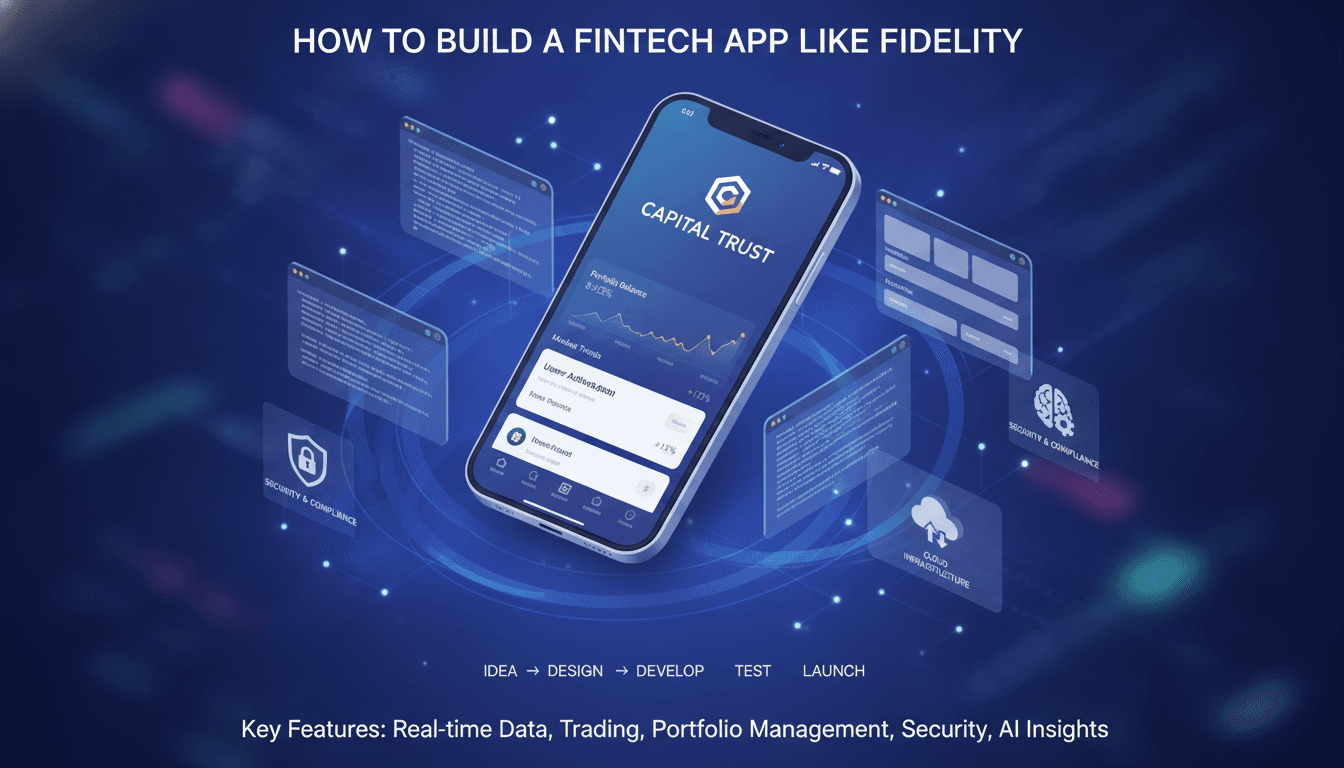
How to Make an App Like Fidelity Investments
Fidelity Investments is one of the most recognized names in personal finance, managing trillions in assets and serving tens of millions of customers through its mobile and web platforms. Its app lets users trade stocks, manage retirement accounts, research securities, deposit checks, and plan their financial futures — all from a phone.
If you're planning to build an investment platform of your own, whether it's a full-service brokerage, a niche robo-advisor, or a retirement-focused savings tool, this guide walks through what it actually takes: the features, the architecture, the compliance burden, the team, the timeline, and the budget.
For a closer look at a related topic, read our guide on How to Make an App Like SoFi Invest.
Understanding What Fidelity Actually Is
Before writing a line of code, it helps to be precise about the product you're modeling. Fidelity's app isn't a single product — it's several businesses stitched into one interface:
- A brokerage. Buy and sell stocks, ETFs, options, bonds, and mutual funds.
- A retirement provider. 401(k), IRA, Roth IRA, and rollover account management.
- A cash management platform. Cash accounts, bill pay, debit cards, mobile check deposit.
- A research and education hub. Analyst reports, screeners, market news, planning calculators.
- An advisory service. Robo-advisory (Fidelity Go) and human advisor access.
Trying to launch all five at once is how startups burn eighteen months and a seed round. The practical path is to pick one wedge, build it exceptionally well, and expand outward once you have users and regulatory footing.
Related reading: How to Make an App Like Charles Schwab.
Step 1: Choose Your Business Model and Wedge
Most investment apps fall into a handful of models:
| Model | How It Makes Money | Typical Build Complexity |
|---|---|---|
| Discount brokerage | Order flow, margin interest, premium tiers | High |
| Robo-advisor | AUM fee (0.25%–0.50%) | Medium |
| Micro-investing | Flat monthly subscription | Medium |
| Retirement/401(k) platform | Plan admin fees, AUM | Very High |
| Research/analytics tool | Subscription, no custody | Low |
| Social/copy trading | Order flow, subscription | High |
The single biggest cost driver is whether you take custody of customer assets. If you do, you need broker-dealer registration, clearing relationships, SIPC coverage, and a compliance department. If you don't — for example, a research tool or an aggregation dashboard — your regulatory load drops dramatically and your time to market shrinks from years to months.
For a closer look at a related topic, read our guide on How to Make an App Like Ally Invest.
A common pragmatic approach for new entrants is to launch as an introducing broker on top of an existing clearing firm, or to build on a Brokerage-as-a-Service API so someone else carries the heaviest licensing weight.
Step 2: Navigate the Regulatory Layer First
This is the step that kills most projects that skip it. In the United States, an investment app typically requires some combination of:
- FINRA broker-dealer registration if you're executing trades
- SEC Registered Investment Advisor (RIA) status if you're giving advice or managing portfolios
- State money transmitter licenses if you're moving cash in certain configurations
- SIPC membership for custody protection
- Reg BI, KYC/AML, and OFAC compliance programs with documented procedures
- Books and records retention under SEC Rule 17a-4 (WORM-compliant storage)
Outside the US, you'll be dealing with the FCA (UK), MAS (Singapore), SEBI (India), or ESMA/MiFID II frameworks in the EU — each with its own capital adequacy and disclosure rules.
Budget for a securities attorney from day one. Registration timelines commonly run six to twelve months, which means legal work should run in parallel with development, not after it.
Step 3: Define Your Feature Set
Core MVP Features
Onboarding and account opening
- Identity verification (KYC) with document capture and liveness checks
- Suitability questionnaire and risk tolerance profiling
- Tax forms (W-9/W-8BEN) and electronic signature
- Account type selection (individual, joint, IRA, custodial)
Funding and cash movement
- ACH bank linking via Plaid, MX, or similar
- Wire transfers and account transfers (ACATS)
- Mobile check deposit with OCR
- Recurring deposit scheduling
Portfolio and holdings
- Real-time balances, positions, and cost basis
- Performance charts across time ranges
- Asset allocation breakdowns
- Dividend and income tracking
- Unrealized and realized gain/loss
Trading
- Symbol search and quote display
- Order ticket with market, limit, stop, and stop-limit types
- Fractional share support
- Order status, fills, and history
- Options chains (if applicable)
Research
- Interactive charts with technical indicators
- Company fundamentals and financials
- Analyst ratings and news feeds
- Screeners and watchlists
Security and account management
- Biometric login and MFA
- Device management and session control
- Statements, trade confirmations, and tax documents
- Alerts and notification preferences
Phase Two Features
- Robo-advisory with automated rebalancing
- Tax-loss harvesting
- Retirement planning and goal projection calculators
- Cash management with debit card and bill pay
- Options and margin trading
- Advisor chat and scheduled consultations
- Educational content library and guided learning paths
Step 4: Design the Architecture
An investment app is a distributed, event-driven system where correctness matters more than almost anything else. A typical architecture looks like this:
Client layer
- Native iOS (Swift/SwiftUI) and Android (Kotlin/Jetpack Compose), or React Native/Flutter if you need speed over raw performance
- Responsive web app in React or Next.js
- Secure local storage with Keychain/Keystore, certificate pinning, jailbreak/root detection
API gateway
- OAuth 2.0 / OIDC authentication with short-lived tokens
- Rate limiting, request signing, and WAF protection
- GraphQL or REST with strict schema validation
Microservices
- Identity and onboarding service
- Account and ledger service (double-entry, immutable)
- Order management system (OMS)
- Market data service
- Portfolio and performance service
- Document and statement service
- Notification service
- Reporting and compliance service
Data layer
- PostgreSQL for transactional and ledger data
- Time-series database (TimescaleDB, InfluxDB) for price history
- Redis for quote caching and session state
- Kafka or Kinesis for the event backbone
- Object storage (S3) with WORM policies for regulatory records
Real-time delivery
- WebSocket connections for streaming quotes and order updates
- Push notifications via APNs/FCM for fills, alerts, and price triggers
Key Integrations
| Function | Common Providers |
|---|---|
| Clearing & custody | Apex, Pershing, DriveWealth, Alpaca |
| Market data | Polygon.io, IEX Cloud, Refinitiv, Nasdaq |
| Bank linking | Plaid, MX, Finicity |
| KYC/AML | Jumio, Onfido, Persona, Alloy |
| Payments/ACH | Dwolla, Stripe Treasury, Modern Treasury |
| Tax reporting | Various 1099 generation providers |
Step 5: Get the UX Right
Financial apps live or die on trust, and trust is communicated through interface design.
Reduce onboarding friction. Every extra screen during account opening costs you conversions. Pre-fill what you can, defer optional questions, and let users explore the app before funding.
Make the order ticket unambiguous. Show estimated cost, buying power impact, and order type in plain language. Add a confirmation step for anything irreversible. Ambiguity in a trading interface creates real financial harm and real liability.
Design for calm. Red-and-green flashing numbers drive anxious behavior. Consider muted palettes, optional performance-hiding, and time-range defaults that emphasize long-term performance over daily noise.
Support accessibility seriously. Large text, VoiceOver/TalkBack labels on every chart and number, sufficient contrast, and no color-only information encoding. Financial services face real accessibility litigation risk.
Be honest in disclosures. Fees, risks, and conflicts should be readable, not buried. Regulators increasingly scrutinize "dark patterns" in fintech interfaces.
Step 6: Build Security Into Every Layer
Investment apps are high-value targets. The baseline expectations include:
- TLS 1.3 everywhere, with certificate pinning on mobile
- Encryption at rest (AES-256) with a managed KMS and key rotation
- Multi-factor authentication, ideally with hardware key support for high-value accounts
- Biometric unlock with secure enclave-backed keys
- Behavioral fraud detection on login, transfers, and withdrawal destination changes
- Withdrawal cooling-off periods and out-of-band confirmation
- Comprehensive, tamper-evident audit logging
- Regular penetration testing and a SOC 2 Type II program
Plan for third-party security audits before launch. Many clearing partners will require them contractually.
Step 7: Testing and Quality Assurance
Testing for a brokerage app goes far beyond typical QA:
- Unit and integration testing with high coverage on ledger and order logic
- Property-based testing for financial calculations — rounding, cost basis, and corporate actions are notorious bug sources
- Simulated market testing against sandbox environments from your clearing and data providers
- Load testing calibrated for market-open surges and volatility events, which can produce 10–20x normal traffic
- Chaos testing for partial outages — what does the app do when market data dies but orders still route?
- Reconciliation testing — daily position and cash reconciliation against clearing firm files
Step 8: Assemble the Team
A realistic team for a serious build:
| Role | Count |
|---|---|
| Product manager | 1 |
| UX/UI designers | 2 |
| iOS engineers | 2 |
| Android engineers | 2 |
| Frontend (web) engineers | 2 |
| Backend engineers | 4–6 |
| DevOps/SRE | 2 |
| QA engineers | 2–3 |
| Data engineer | 1 |
| Security engineer | 1 |
| Compliance officer | 1 |
| Securities counsel | Retained |
Step 9: Understand the Cost and Timeline
Costs vary enormously based on whether you're licensing infrastructure or building it.
MVP (non-custodial research or aggregation tool): $80,000–$180,000 over 4–6 months.
MVP brokerage on Brokerage-as-a-Service rails: $200,000–$400,000 over 6–9 months, plus licensing and partner fees.
Full-featured multi-asset platform with own broker-dealer: $800,000–$2,000,000+ over 12–24 months, plus regulatory capital requirements.
Ongoing costs are easy to underestimate. Market data licensing alone can run from a few thousand to six figures annually depending on redistribution rights and real-time versus delayed feeds. Add cloud infrastructure, compliance staffing, audits, insurance, and customer support.
Step 10: Launch, Monitor, and Iterate
Pre-launch: Run a closed beta with real money at small scale. Paper trading finds UI bugs; real money finds reconciliation bugs.
At launch: Instrument everything. Order latency, fill rates, failed transfers, onboarding drop-off by step, and crash-free session rates are your core dashboard.
Post-launch: Expect support volume to spike during volatile markets. Staff accordingly, and make sure your status page and in-app messaging can communicate degraded service honestly and quickly.
Common Pitfalls to Avoid
- Treating compliance as a launch-blocker instead of a design input. Retrofitting audit trails and disclosure flows is painful and expensive.
- Underinvesting in the ledger. A double-entry, immutable ledger built correctly on day one saves years of pain. Never store balances as mutable fields.
- Using floating-point math for money. Use integer minor units or fixed-point decimals. Always.
- Ignoring corporate actions. Splits, dividends, mergers, and spin-offs will silently corrupt cost basis if unhandled.
- Copying Fidelity's feature breadth. They built it over decades with thousands of engineers. Win on focus, not parity.
Final Thoughts
Building an app like Fidelity Investments is less a software project than a regulated financial business that happens to ship software. The engineering is demanding but tractable; the compliance, partnerships, and trust-building are where most of the real difficulty lives.
The teams that succeed start narrow, choose the right infrastructure partners, involve legal counsel from week one, and obsess over correctness in the ledger and the order path. Do those things, and you have a genuine shot at building something people trust with their financial futures.
Have a project in mind? Contact Sodio Technologies to discuss your requirements and explore the right technology solution for your business.
/// Work with us
Talk to the engineers who'd build it
You'll get a technical scope, timeline and cost estimate from the people doing the work, not an account manager. In-house team, no subcontracting, since 2016.