

How to Make an App Like Flexdrive
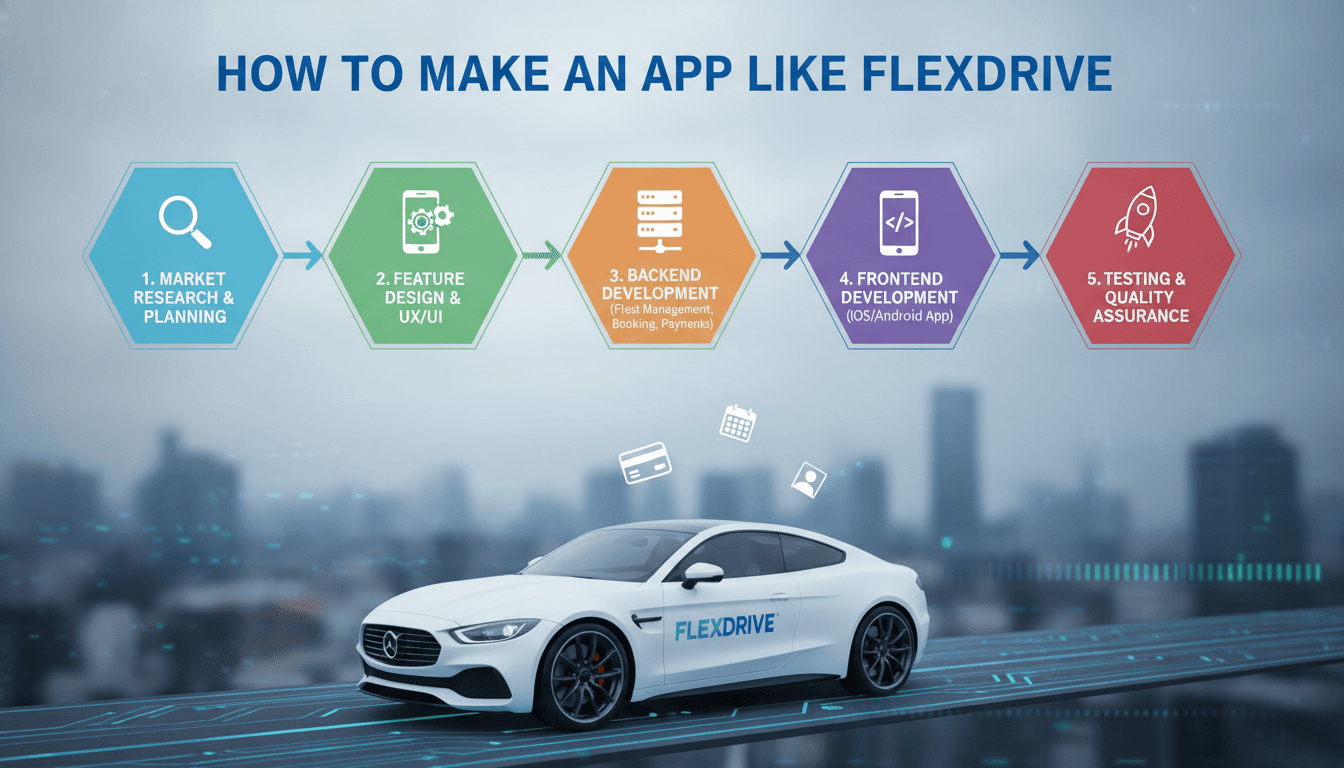
Building a car-sharing or vehicle subscription app is harder than it looks. Flexdrive sits at the intersection of fleet management, dynamic pricing, insurance integration, and real-time telematics. If you're scoping a similar product, this is what the architecture actually looks like.
What Does Flexdrive Actually Do Under the Hood?
Flexdrive is a vehicle subscription platform. Users pick a car, pay a weekly or monthly fee, and get insurance and maintenance bundled in. That sounds simple. The engineering is not.
We cover a closely related subject in How to Make an App Like Life360.
The core complexity comes from four places:
- Fleet state management across hundreds or thousands of vehicles
- Real-time telematics feeding into pricing, insurance, and availability
- Dynamic subscription billing with proration and mid-cycle changes
- Third-party integrations with insurers, DMVs, and OEM telematics APIs
Each of these is a system in itself. When they interact, things get complicated quickly.
What Does the Tech Stack Look Like?
There is no single right answer, but there are patterns that work well for this problem class.
Mobile Layer
React Native is the most common choice at this scale because it lets you share business logic across iOS and Android while keeping native bridge calls for things like background location tracking. Flutter is a reasonable alternative if your team already lives in Dart. What you want to avoid is two completely separate native codebases early on. The maintenance cost compounds.
Related reading: How to Make an App Like Getaround.
For background location, iOS requires CLLocationManager with allowsBackgroundLocationUpdates = true and you need to be precise about your NSLocationAlwaysAndWhenInUseUsageDescription string or App Store review will reject you. Android requires a foreground service with a persistent notification. Both platforms restrict background execution more aggressively with each OS release, so this needs to be retested on every major version.
Backend Layer
A microservices architecture makes sense here, but only if you have the team to run it. If you are under 10 engineers, a well-structured monolith deployed on Kubernetes with clear module boundaries is operationally cheaper and just as scalable until you hit genuine throughput ceilings.
To explore this further, see How to Make an App Like Whistle.
The services you will eventually need to isolate regardless of your starting architecture:
- Vehicle service — availability, state transitions (reserved, in-use, maintenance, off-fleet), geofencing
- Subscription service — plan management, billing cycles, proration logic
- Telematics service — ingestion of GPS, OBD-II, and accelerometer data at high frequency
- Notification service — push, SMS, and email across user lifecycle events
- Insurance service — policy creation, mid-trip coverage changes, claims initiation
Node.js or Go works well for the telematics ingestion layer because you need high concurrency with low memory overhead. Python with FastAPI is a reasonable choice for the subscription and insurance services where the logic is complex but throughput requirements are lower.
Data Layer
Postgres handles your relational data. TimescaleDB (which is a Postgres extension) is worth evaluating seriously for telematics time-series data rather than reaching for InfluxDB or a separate TSDB. Keeping it in the Postgres ecosystem simplifies your operational footprint.
Redis for session state, pub/sub for real-time vehicle status, and a message queue (Kafka or RabbitMQ depending on your durability requirements) for the telematics ingestion pipeline.
/// Not sure where to start?
Get the architecture before you commit
Tell us what you're building and we'll map the technical approach, stack, and rough timeline. No cost, no obligation, no sales call required.
How Do You Handle Insurance Integration?
This is the part most engineering teams underestimate. Insurance in a vehicle subscription context is not a static policy. Coverage needs to change based on who is driving, when, and sometimes where.
Most platforms integrate with a Usage-Based Insurance (UBI) provider via API. Root Insurance, Metromile (now part of Lemonade), and Clearcover all offer API access, though the integration depth varies significantly. Expect to spend 4 to 8 weeks on a proper insurance integration, not 4 to 8 days.
The data you pipe to the insurer typically includes:
- Trip start and end timestamps
- Distance travelled (to the tenth of a mile for billing accuracy)
- Hard braking and acceleration events (from the OBD-II or phone IMU)
- Geofenced zone data if the policy has geographic restrictions
You will also need to handle policy suspension on overdue payments, reinstatement flows, and the audit trail required for claims. Store every telematics event with a durable timestamp. Logs disappear; a Kafka topic with a 30-day retention policy does not.
What Are the Real Costs of Building This?
Be honest with yourself about scope. A minimum viable version of a Flexdrive-style platform, with mobile apps for iOS and Android, a backend that handles fleet state and subscriptions, basic telematics, and a single insurance integration, is roughly a 9-to-14-month build for a team of 8 to 12 engineers. That is before QA, DevOps, and product management.
| Component | Estimated Build Time |
|---|---|
| Mobile apps (React Native) | 4–5 months |
| Core backend services | 5–7 months |
| Telematics pipeline | 2–3 months |
| Insurance integration | 1–2 months |
| Admin dashboard | 2–3 months |
These overlap, but not perfectly. The telematics pipeline cannot be fully tested without real vehicles. The insurance integration usually blocks the subscription billing finalization.
Cloud infrastructure on AWS or GCP for a fleet of 500 vehicles with active telematics runs between $8,000 and $15,000 per month depending on data retention policy and query patterns. That number grows faster than your fleet size if you are not careful about telematics data sampling rates.
How Do You Get Fleet Management Right?
Fleet state is a finite state machine problem. A vehicle moves through states: available, reserved, checked-out, in-maintenance, off-fleet. The transitions need to be atomic and auditable.
Use Postgres transactions for state transitions. Do not rely on application-layer locking. If two users try to reserve the same vehicle simultaneously, only one database transaction should succeed. The other should fail cleanly and return a "vehicle no longer available" response to the client.
Geofencing is a separate concern from state management. You need to know when a vehicle leaves an authorised zone and respond: notify the user, notify ops, and potentially flag the insurance provider. Turf.js handles the geometry calculations well if you are doing this on the backend in Node. PostGIS is the right answer if the queries get complex or frequent.
Vehicle tracking at 1 Hz (one GPS ping per second) generates roughly 86,400 data points per vehicle per day. At 500 vehicles, that is 43 million rows per day. Sample at 0.1 Hz unless the vehicle is in active motion, and you cut that to a manageable 4 to 5 million rows. TimescaleDB's automatic partitioning handles this well with appropriate chunk intervals.
Conclusion
A Flexdrive-style app is a fleet management platform with a consumer-facing subscription layer on top. The mobile experience is the visible part. The real engineering effort lives in telematics ingestion, insurance integration, and fleet state management.
If you are scoping this, the right first step is to map your fleet state transitions explicitly before writing a line of code. Everything downstream, including billing, insurance, and availability queries, depends on getting that state machine right. Talk to the team at Sodio if you want a technical review of your architecture before you commit to a build.
FAQ
How long does it take to build an app like Flexdrive? A functional MVP with mobile apps, fleet management, telematics, subscription billing, and one insurance integration typically takes 9 to 14 months with a team of 8 to 12 engineers. Timelines extend when insurance API access is delayed or when hardware procurement for telematics devices falls behind.
What technology stack should I use for a vehicle subscription app? React Native for mobile, Node.js or Go for high-throughput telematics ingestion, Python or Node for business logic services, Postgres with TimescaleDB for data, and Kafka or RabbitMQ for the event pipeline. Specific choices depend on your team's existing expertise and operational capacity.
How do telematics work in a car-sharing platform? Telematics data comes from OBD-II dongles, OEM APIs (like GM's OnStar or Ford's Connected Vehicle API), or the user's phone IMU. Data is ingested into a time-series store and used for insurance pricing, driver behaviour scoring, maintenance triggers, and geofence enforcement.
Can I use open-source tools to build this, or do I need proprietary platforms? Open-source tools cover most of the stack: PostgreSQL, TimescaleDB, Kafka, Turf.js, and Kubernetes are all production-grade and widely used. The one area where you typically pay is insurance API access, where vendor contracts are unavoidable. OEM telematics APIs may also require commercial agreements.
What is the biggest technical risk in building a Flexdrive-style platform? Insurance integration and telematics data reliability are the two most common blockers. Insurance API documentation is often incomplete, and actual behaviour differs from the spec. Telematics data loss during poor connectivity needs explicit handling at the ingestion layer, not just retry logic at the client.
Have a project in mind? Contact Sodio Technologies to discuss your requirements and explore the right technology solution for your business.
/// Work with us
Talk to the engineers who'd build it
You'll get a technical scope, timeline and cost estimate from the people doing the work, not an account manager. In-house team, no subcontracting, since 2016.