

How to Make an App Like Flo
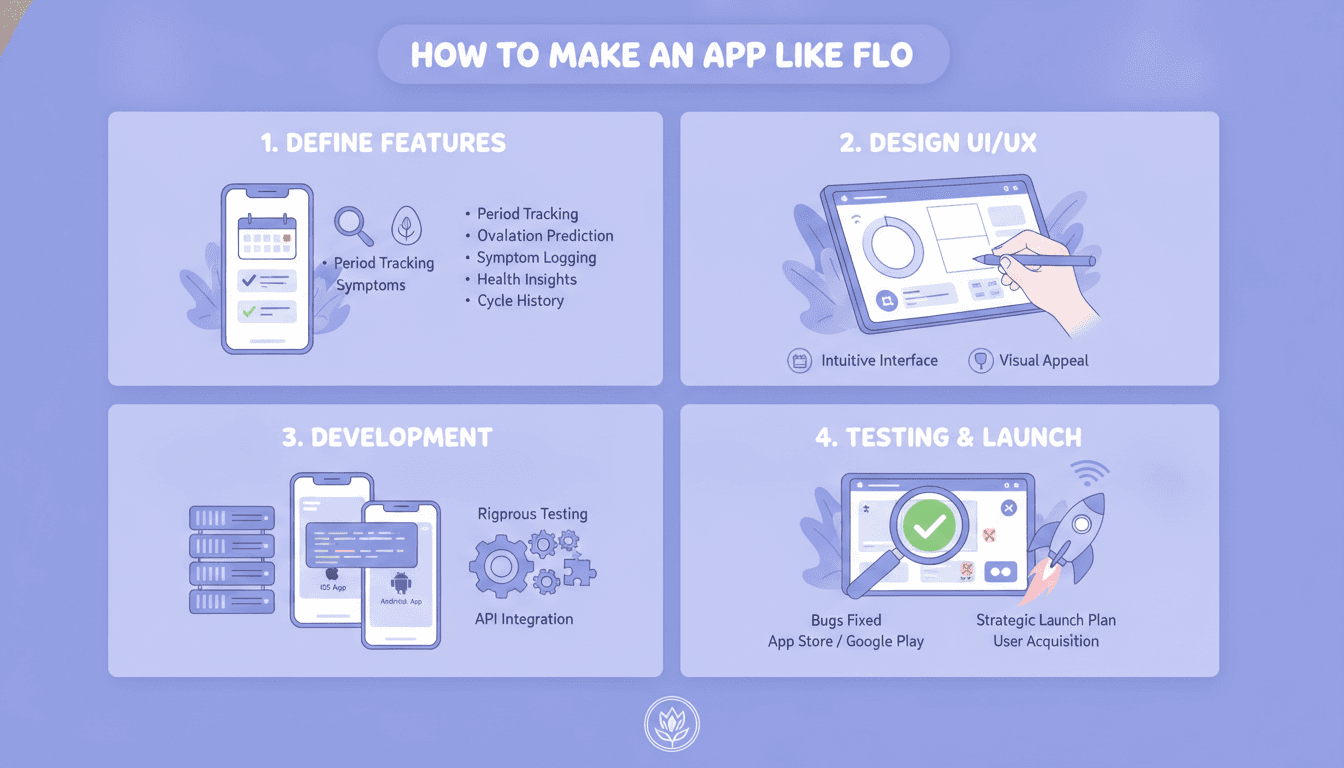
Building a period and reproductive health tracking app is genuinely complex engineering work. The Flo app has over 70 million monthly active users and handles data that is both deeply personal and, in several jurisdictions, legally sensitive. If you are evaluating whether to build something in this space, this post covers what the architecture actually looks like, where the hard problems are, and what it costs to do it properly.
What Does an App Like Flo Actually Do Under the Hood?
Flo's core feature is cycle tracking: a user logs symptoms, flow, mood, and other signals, and the app predicts future cycles and fertile windows. The prediction logic has evolved considerably over the years. Early versions used simple calendar-based methods like the Ogino-Knaus rule. Modern implementations use machine learning models trained on large longitudinal datasets, with Flo publishing research in peer-reviewed journals on their prediction accuracy.
The data model is time-series at heart. Each user has a sequence of logged events tied to dates, and the app needs to infer cycle length, luteal phase length, and ovulation timing from sparse, noisy inputs. Users often skip days. The model has to be robust to gaps.
Beyond tracking, Flo includes a content layer (articles, meditations, a symptom checker), a premium subscription tier with AI-powered insights, and a community forum. These are not trivial to build but are not the hard parts either.
The Prediction Engine
You have two realistic options for the prediction layer.
The first is a rule-based statistical model using established methods like the TwoDay Method or the Standard Days Method. These are well-validated, interpretable, and require no training data. They are also less accurate for users with irregular cycles.
The second is a trained ML model, typically an LSTM or Transformer architecture, trained on sequences of menstrual events. Flo has published work using Bayesian models and neural networks. If you go this route, you need labelled training data, which means either partnering with a clinical dataset provider or accumulating it from users over time. You will not have a competitive model at launch.
| Approach | Accuracy on regular cycles | Accuracy on irregular cycles | Data requirement |
|---|---|---|---|
| Calendar/statistical | ~80% | ~60% | None |
| LSTM/Transformer | ~90%+ | ~75–80% | Millions of labelled cycles |
| Hybrid (rule-based + fine-tuned) | ~85% | ~70% | Thousands of cycles |
A hybrid approach where you start with a rule-based model and fine-tune as data accumulates is the most practical path for a new product.
How Much Does It Cost to Build a Period Tracking App?
This is where most estimates go wrong because they price the MVP and ignore the compliance and infrastructure costs that are not optional.
A basic cross-platform app (Flutter or React Native) with cycle logging, push notifications, and a content feed will cost roughly $80,000 to $150,000 to build to a shippable standard, depending on geography and team composition. That is the easy part.
The costs that catch teams off guard:
- HIPAA compliance architecture in the US costs anywhere from $30,000 to $100,000+ depending on whether you are building from scratch or using a compliant infrastructure provider like AWS HealthLake or Google Cloud Healthcare API.
- GDPR compliance for EU users adds meaningful engineering work: data portability endpoints, deletion pipelines, consent management, and a Data Protection Impact Assessment (DPIA). Budget $15,000 to $40,000.
- Post-Dobbs, several US states have laws with implications for reproductive health data. Legal review and the technical work to implement data minimisation and jurisdictional data routing adds another $20,000 to $50,000.
- A security audit from a firm like NCC Group or Bishop Fox runs $20,000 to $60,000 for a meaningful scope.
A realistic all-in budget for a production-grade v1 in the US and EU markets is $200,000 to $400,000. Anything significantly below that is cutting corners somewhere that will become a liability.
/// Not sure where to start?
Get the architecture before you commit
Tell us what you're building and we'll map the technical approach, stack, and rough timeline. No cost, no obligation, no sales call required.
What Tech Stack Should You Use?
There is no single right answer, but here are the choices that matter most and why.
Mobile: Flutter is the practical choice for a new product targeting both iOS and Android. It gives you a single codebase, good performance for this class of app, and a mature ecosystem. React Native is a reasonable alternative if your team already knows it well. Do not build native iOS and Android separately unless you have a compelling reason; it doubles your mobile engineering cost.
Backend: A Python/FastAPI or Node.js/Express API layer behind a PostgreSQL database is the standard choice. The time-series data for cycle tracking fits well in PostgreSQL with partitioning, or you can move that specific workload to TimescaleDB, which is a PostgreSQL extension purpose-built for time-series. At Flo's scale you would need something more sophisticated, but at launch PostgreSQL handles this comfortably.
ML serving: If you build a custom model, you need an inference endpoint. TorchServe, TensorFlow Serving, or a managed option like AWS SageMaker are all viable. For most teams at early stage, SageMaker reduces operational overhead enough to justify the cost.
Auth and identity: Use a managed identity provider. Cognito, Auth0, or Firebase Authentication all handle the OAuth 2.0 and OIDC flows you need. Do not roll your own auth for an app handling health data.
Push notifications: Firebase Cloud Messaging (FCM) covers both Android and iOS via APNs. This is a solved problem; do not build infrastructure here.
Where Do Teams Underestimate the Engineering Work?
Four areas consistently surprise teams building in this space.
Data deletion is harder than data collection. When a user requests deletion, you need to remove their data from your primary database, your analytics pipeline, your ML training data, your backups, and any third-party integrations. Building deletion that is actually complete, and auditable, requires deliberate architecture from day one. Retrofit work here is expensive.
Notification timing is a product-quality problem. A period tracking app lives or dies on whether its notifications feel accurate and timely. Getting cycle phase notifications right requires the prediction engine to be running continuously in the background and the notification scheduling logic to account for time zones, user-configured quiet hours, and model uncertainty. It is more engineering work than it looks.
Symptom logging UX drives data quality. If the logging interface is friction-heavy, users skip days. Skipped days degrade your model's predictions. This is a product-engineering loop that takes several iteration cycles to tune. Plan for it.
App store compliance for health apps is stricter. Apple and Google both have additional review requirements for apps that handle health data. Apple requires a privacy nutrition label with accurate data-type declarations. Google requires a data safety section. Both will reject apps that request more permissions than they need. Budget extra time for first-submission review cycles.
Conclusion
Building a period tracking app to a standard that users will trust with this category of data is a multi-month, multi-discipline engineering effort. The prediction engine, compliance architecture, and data lifecycle management are all genuinely hard problems, and they compound each other.
If you are deciding whether to build in-house or work with an external team, the honest answer is that it depends on whether your in-house team has prior experience with HIPAA/GDPR-compliant health data systems. If they do not, the learning curve is expensive. If you want to talk through the architecture in more detail, get in touch with the team at Sodio.
FAQ
How long does it take to build an app like Flo? A production-ready v1 with cycle tracking, basic ML predictions, content, and compliance for US and EU markets takes 9 to 14 months with a team of 6 to 8 people. A stripped-down MVP without compliance infrastructure can ship in 4 to 6 months, but you will have significant technical debt to retire.
What is the most important compliance requirement for a period tracking app in the US? Post-Dobbs, the most critical issue is data minimisation and jurisdictional routing. Collect only what you need, do not share it with third parties without explicit consent, and be able to route or restrict data for users in specific US states. HIPAA applies if you are working with covered entities; if you are a direct-to-consumer app, you may fall under the FTC Health Breach Notification Rule instead.
Can you use AI for cycle predictions without a large proprietary dataset? Yes. A hybrid approach using validated statistical models such as the TwoDay Method for initial predictions, combined with a model that fine-tunes as user data accumulates, is a practical path. You will not match Flo's prediction accuracy at launch, but you can reach a competitive baseline within 12 to 18 months with a user base of 50,000 or more active loggers.
What are the main differences between building for iOS versus Android in this category? The review process is stricter on iOS for health apps, and Apple's HealthKit integration (if you want to sync cycle data with the Health app) adds complexity. Android's Health Connect API offers similar functionality. Both require explicit user consent flows. Using Flutter means you write the business logic once, but you still need platform-specific code for HealthKit and Health Connect.
Is a subscription model viable for this type of app? Flo's premium tier is reported to have contributed to a $200M+ ARR run rate as of 2023. Subscription is viable, but conversion rates for health apps typically run 5% to 15% of active users. The key driver of conversion is prediction accuracy and the quality of personalised insights, which means the ML layer and content quality directly affect revenue.
Have a project in mind? Contact Sodio Technologies to discuss your requirements and explore the right technology solution for your business.
/// Work with us
Talk to the engineers who'd build it
You'll get a technical scope, timeline and cost estimate from the people doing the work, not an account manager. In-house team, no subcontracting, since 2016.