

How to Make an App Like Getaround
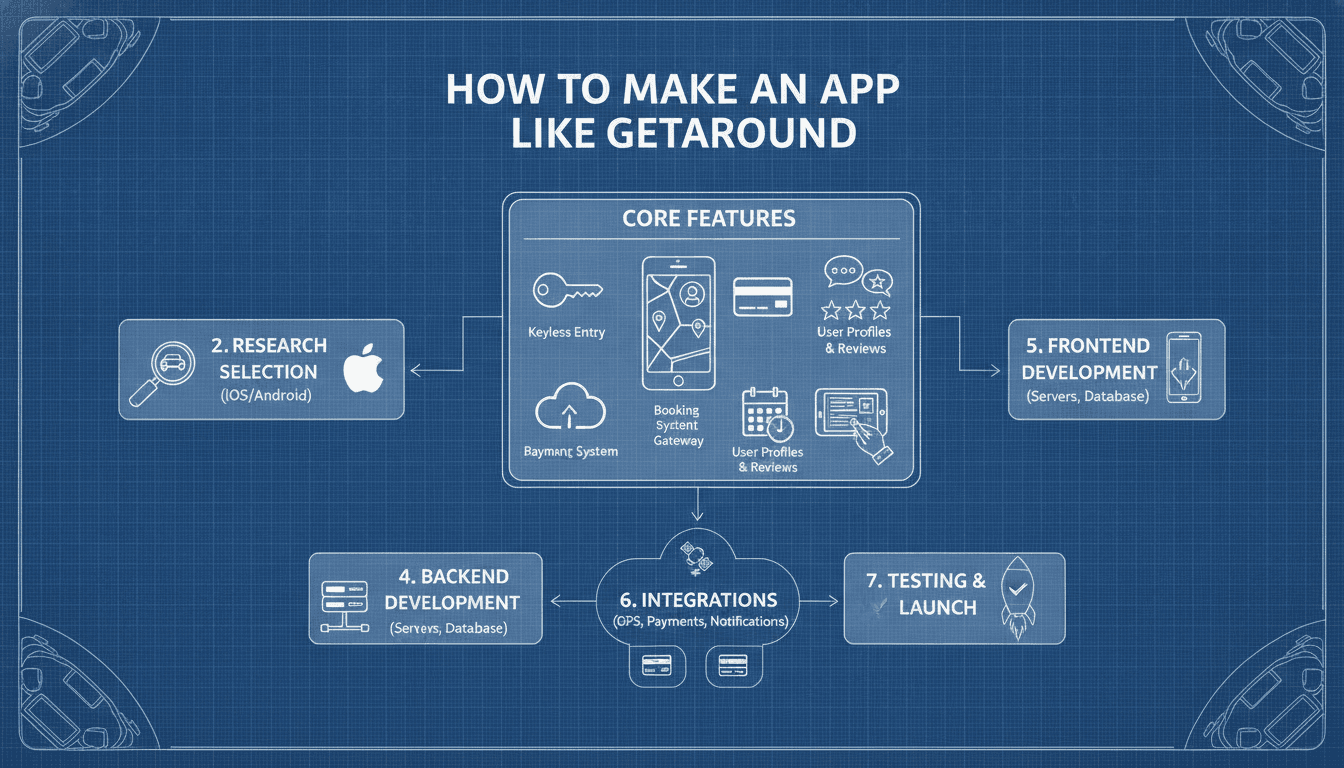
Building a peer-to-peer car-sharing platform is a genuinely complex engineering problem. This post walks through the core systems, the non-obvious technical decisions, and the cost structure you should plan for.
What Does a Platform Like Getaround Actually Do Under the Hood?
Getaround is not just a marketplace. It is a real-time IoT system sitting on top of a two-sided marketplace, sitting on top of an insurance and telematics layer. Most teams underestimate how much of the complexity lives outside the mobile app.
If this is relevant to your project, check out How to Make an App Like Hertz 24/7.
At a high level, you need:
- A mobile app for renters and owners (iOS and Android)
- A hardware device installed in each car that handles remote locking/unlocking
- A backend that coordinates availability, bookings, payments, and hardware commands
- An insurance integration or in-house insurance management layer
- A telematics pipeline for trip data (mileage, speed, location)
- Damage and dispute resolution tooling
The app is the visible surface. The hard work is everything behind it.
How Does the Connected Car Hardware Work?
This is the part most product teams hand-wave over, and it is where projects quietly die.
Getaround uses a proprietary device called the Getaround Connect unit. Functionally, it is a cellular-connected telematics module wired into the car's OBD-II port and door-lock circuit. Renters use the app to send a lock/unlock command; the backend routes it to the device over a persistent MQTT connection.
To explore this further, see How to Make an App Like Flexdrive.
If you are building from scratch, you have three options:
| Approach | Pros | Cons |
|---|---|---|
| Build custom hardware | Full control, own IP | 12–18 month dev cycle, FCC/CE certification required |
| White-label IoT module (e.g. Ruptela, Teltonika) | Faster to market, proven hardware | Limited lock/unlock control, needs custom firmware |
| Partner with a telematics aggregator (e.g. Smartcar API) | No hardware at all for modern cars | Only works on connected cars (roughly 60% of US fleet, lower in India and EU) |
Smartcar's API is worth serious consideration if your initial fleet is skewed toward post-2018 vehicles. It handles token refresh, OEM auth flows, and exposes a clean REST interface for lock, unlock, odometer, and location. The trade-off is that you are entirely dependent on the OEM keeping their connected services active, and several manufacturers have changed API terms with little notice.
For a hardware-first approach, Teltonika's FMB series devices are a reasonable starting point. You will need a firmware engineer who understands CAN bus and cellular fallback behaviour, and you will need to work with a contract electronics manufacturer for enclosures and installation kits.
The Command Reliability Problem
Remote lock/unlock sounds simple. In practice, you are dealing with cellular dead zones, device sleep modes, and command queuing. You need idempotent command dispatch, acknowledgement receipts with a timeout, and a fallback flow for when the command does not go through before the renter arrives.
Build your command queue on something like AWS IoT Core or Azure IoT Hub rather than rolling your own MQTT broker. These services handle device shadows, message persistence, and at-least-once delivery. The cost at scale is low: AWS IoT Core charges roughly $1 per million messages.
We cover a closely related subject in How to Make an App Like HyreCar.
What Does the Backend Architecture Look Like?
A monolith is the wrong starting point here. The booking engine, the IoT command layer, the payment processor, and the telematics ingestion pipeline have very different scaling profiles and failure modes. You want them decoupled from day one.
A reasonable starting topology:
- Booking service: PostgreSQL for transactional consistency. Bookings, availability windows, pricing rules.
- IoT command service: Stateless service that writes commands to AWS IoT Core and reads device shadows.
- Telematics ingestion: A Kafka topic receiving raw GPS and OBD telemetry. A consumer pipeline normalises it and writes to a time-series store (InfluxDB or TimescaleDB).
- Payment service: Stripe Connect for marketplace payments. Handles split payouts between platform and car owner, with a 7-day rolling payout schedule being the most common configuration.
- Notification service: Handles push (FCM/APNs), SMS (Twilio), and email (SendGrid). Booking confirmations, unlock confirmations, trip-end summaries.
All services communicate over an internal event bus (AWS EventBridge or a managed Kafka cluster). Avoid direct service-to-service HTTP calls for anything that can tolerate eventual consistency.
/// Not sure where to start?
Get the architecture before you commit
Tell us what you're building and we'll map the technical approach, stack, and rough timeline. No cost, no obligation, no sales call required.
Availability and Pricing Engine
Getaround's pricing model is dynamic. Owners set a base rate; the platform adjusts based on local demand. If you want to replicate this, you need a pricing engine that can evaluate rules at query time without blocking the availability search.
Pre-compute availability slots in a Redis sorted set keyed by vehicle ID and time bucket. This gives you O(log n) range queries for the search page. Write through from PostgreSQL on every booking mutation.
For dynamic pricing, a simple rule-based engine (demand score × base rate × day-of-week multiplier) outperforms an ML model at early stage. The data volume you need to train a reliable demand model is larger than most early-stage platforms have. Ship the rules engine first.
How Do You Handle Insurance?
This is the biggest commercial dependency in the product. Getaround bundles insurance into every booking using a fleet policy underwritten by a partner insurer. The renter pays a per-trip rate; the owner is covered during the rental period.
If you are building in the US or EU, you have a few paths:
- Partner with an insuretech (e.g. Mobilitas, Wakam in Europe): They offer API-driven per-trip policies. Integration is straightforward; underwriting risk sits with them.
- Self-insure with a captive: Only viable at significant scale (10,000+ active vehicles). Capital intensive.
- Overlay on owner's existing policy: Legally messy in most jurisdictions. Most personal auto policies exclude commercial use.
Budget 20–35% of GMV going to insurance and payment processing combined, depending on geography and fleet type. This is not a line item you can optimise away.
What Will This Cost to Build?
A realistic estimate for an MVP, not a production-grade platform:
| Component | Estimated Cost (USD) |
|---|---|
| iOS + Android apps | $80,000 – $120,000 |
| Backend (booking, payments, notifications) | $60,000 – $90,000 |
| IoT integration (Smartcar or hardware) | $40,000 – $80,000 |
| Admin dashboard | $20,000 – $30,000 |
| Insurance integration | $15,000 – $25,000 |
| Total MVP | $215,000 – $345,000 |
These numbers assume a team of 4–6 engineers over 6–9 months. They do not include hardware unit costs, certification, or ongoing infrastructure. AWS monthly spend for a mid-scale platform (5,000 active vehicles) sits around $3,000–$8,000/month depending on telematics volume.
Conclusion
The technical surface area here is large. The IoT layer alone can consume as much engineering time as the entire mobile and backend stack combined if you underestimate it. The clearest path to a working product is to pick your hardware strategy early, pick Stripe Connect for payments, and resist the temptation to build a fancy ML pricing engine before you have data.
If you are scoping this out and want a realistic estimate for your specific geography and fleet type, talk to us. We have built the IoT pipelines and marketplace backends; we can tell you quickly where your assumptions are off.
FAQ
How long does it take to build a car-sharing app like Getaround? An MVP with basic booking, payments, and IoT integration typically takes 6–9 months with a team of 4–6 engineers. A production-ready platform with dynamic pricing, telematics analytics, and a damage management workflow is closer to 12–18 months. Timeline depends heavily on your hardware strategy.
Do I need custom hardware to build a peer-to-peer car rental platform? Not necessarily. If your target fleet is dominated by post-2018 connected vehicles, Smartcar's API covers lock, unlock, odometer, and location without any installed hardware. For older vehicles or markets with lower OEM connectivity penetration, a telematics module like a Teltonika FMB device is the more practical route.
What is the hardest technical problem in a platform like this? Command reliability between the app and the car. Renters standing in a car park at 11 pm cannot wait for a command to time out. You need persistent device connections, shadow state, retry logic, and a clear fallback UX. Most teams discover this problem in QA, not in design.
How does insurance work in a car-sharing marketplace? The most practical path for a new platform is an API partnership with an insuretech that offers per-trip fleet policies. You pass trip start and end events to their API; they activate and deactivate coverage programmatically. The cost typically falls between 18% and 28% of the booking value, depending on geography and vehicle category.
Can I build this as a single app instead of separate renter and owner apps? Yes, and it is usually the right call at early stage. A single app with role-switching reduces your maintenance surface and speeds up iteration. Split them when the owner-side workflow becomes complex enough to justify it, typically once you are managing fleet analytics, maintenance scheduling, or multi-vehicle owner dashboards.
Have a project in mind? Contact Sodio Technologies to discuss your requirements and explore the right technology solution for your business.
/// Work with us
Talk to the engineers who'd build it
You'll get a technical scope, timeline and cost estimate from the people doing the work, not an account manager. In-house team, no subcontracting, since 2016.