

How to Make an App Like Google Pay
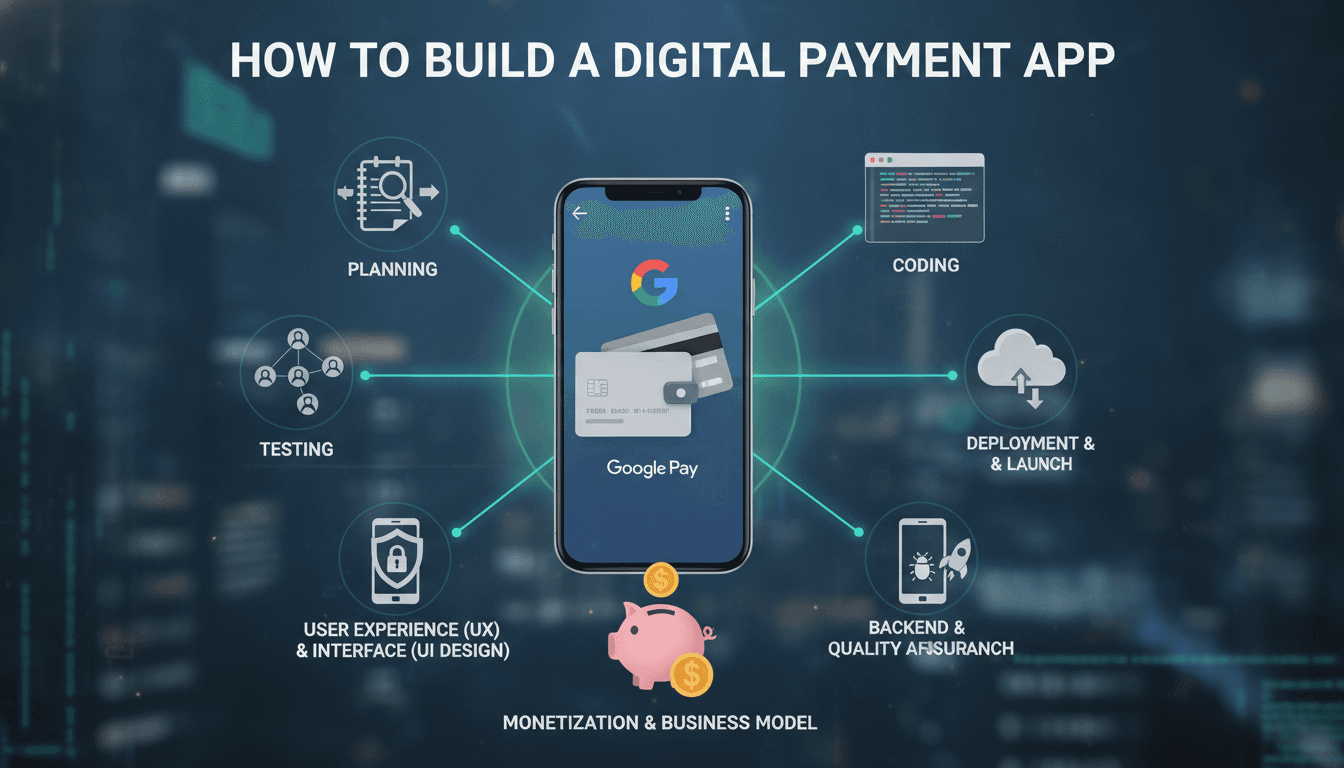
How to Make an App Like Google Pay
Digital wallets have quietly become the default way people move money. Splitting a dinner bill, paying a utility bill, topping up a metro card, sending rent to a roommate — all of it now happens in a few taps. Google Pay sits at the center of that shift, with hundreds of millions of users across dozens of markets.
If you're planning to build something similar, the good news is that the technology stack is more accessible than ever. The hard part isn't the code — it's the compliance, the security architecture, and the trust you need to earn before someone links a bank account to your app.
This guide walks through what it actually takes to build a payment app like Google Pay: the features, the architecture, the regulatory work, the cost, and the mistakes that sink most attempts.
If this is relevant to your project, check out How to Make an App Like Venmo.
What Google Pay Actually Does
Before you clone anything, it helps to understand that "Google Pay" is not one product. It's a bundle of several distinct capabilities that happen to share an icon:
- Peer-to-peer transfers — sending money directly to another user via phone number, email, or a payment handle
- In-store contactless payments — tap-to-pay at a terminal using NFC and tokenized card credentials
- In-app and online checkout — a one-tap payment button embedded in third-party apps and websites
- Bill payments and recharges — utilities, mobile top-ups, subscriptions
- Loyalty, offers, and passes — boarding passes, transit cards, gift cards, cashback rewards
- Spending insights — transaction history, categorization, and search
Most successful payment apps do not launch with all six. They pick one wedge, dominate it, and expand. Venmo started with social P2P. Cash App started with simple transfers. Paytm started with mobile recharges. Decide early which wedge is yours.
If this is relevant to your project, check out How to Make an App Like PayPal.
Step 1: Choose Your Payment Model
This is the single most consequential decision you'll make, because it determines your licensing obligations, your integration partners, and your unit economics.
Related reading: How to Make an App Like Cash App.
Wallet-Based Model
Users load money into a stored-value balance inside your app, then spend from it. You control the ledger, the UX is fast, and you earn float on stored balances.
The trade-off: in most jurisdictions, holding customer funds makes you an e-money institution or money transmitter, which means licensing, capital requirements, and safeguarding rules.
Bank-Rails Model
Money moves directly between the user's bank account and the recipient's. You never touch funds — you're an interface layer. This is how Google Pay operates in India via UPI.
The trade-off: you depend entirely on the rails available in your market, and you need a sponsor bank partnership.
Card Tokenization Model
You store tokenized versions of users' existing cards and pass them to merchants at checkout. This is how Google Pay operates in the US and Europe.
The trade-off: you need to integrate with network tokenization services (Visa VTS, Mastercard MDES) and meet strict PCI DSS requirements.
Hybrid
Most mature apps end up here. Start with one model, add the others as you grow.
Step 2: Understand the Regulatory Landscape
You cannot build your way around this. Budget real time and real money for it.
In the United States, you'll likely need money transmitter licenses on a state-by-state basis (roughly 49 of them), plus FinCEN registration as a Money Services Business. Many startups sidestep this initially by partnering with a licensed Banking-as-a-Service provider that lets you operate under their charter.
In the European Union, you'll need an Electronic Money Institution or Payment Institution license under PSD2, which passports across member states. Strong Customer Authentication requirements apply to nearly every transaction.
In India, integration happens through NPCI's UPI framework, which requires a sponsor bank and NPCI certification. Payment aggregator activity requires RBI authorization.
In the UK, the FCA issues EMI and API licenses with similar requirements to the EU.
Across all markets, you'll need KYC (Know Your Customer), AML (Anti-Money Laundering) transaction monitoring, sanctions screening, and data residency compliance. Plan for a compliance officer on payroll, not as an afterthought.
Step 3: Define Your MVP Feature Set
A realistic first release looks something like this.
User-Facing Essentials
Onboarding and identity verification. Phone number verification, document capture, liveness check, and address validation. This is where most users drop off, so invest in making it fast — automated document OCR and instant verification providers cut abandonment dramatically.
Account and card linking. Bank account connection via an aggregator like Plaid, TrueLayer, or Salt Edge. Card addition via camera scan with real-time validation.
Send and request money. Contact picker, amount entry, optional note, confirmation screen with clear fee disclosure, and a receipt.
Transaction history. Searchable, filterable, with merchant logos and categorization. Users check this more than you'd expect.
Contactless payments. NFC-based tap-to-pay on Android via Host Card Emulation, or Apple's constrained NFC APIs on iOS.
QR code payments. Scan-to-pay and generate-to-receive. Cheap to implement and enormously popular in Asia, Latin America, and increasingly everywhere.
Notifications. Real-time push for every money movement. Silence after a transaction is the fastest way to lose trust.
Support and dispute flow. In-app chat or ticketing, plus a clear path to report unauthorized transactions.
Admin and Operations
- Transaction monitoring dashboard with fraud flags
- KYC review queue for edge cases
- Refund and reversal tooling
- Reconciliation reports against partner settlement files
- Configurable limits by user tier and risk score
Step 4: Design the Architecture
Payment systems fail differently than ordinary apps. A dropped request in a social app is an annoyance; a dropped request in a payment app is a lost or duplicated transfer. Architect accordingly.
Core Principles
Use a double-entry ledger. Every money movement is two entries — a debit and a credit — that must balance. Do not store balances as a mutable integer column. Store immutable ledger entries and derive balances. This makes reconciliation, auditing, and dispute resolution tractable.
Make everything idempotent. Every write operation carries a client-generated idempotency key. Retrying a request must never create a second transfer. This is non-negotiable on mobile networks.
Model transactions as state machines. A transfer moves through explicit states: initiated, authorized, captured, settled, failed, reversed. Every transition is logged with a timestamp and reason code.
Assume partners will fail. Bank APIs go down. Card networks time out. Build circuit breakers, retry queues with exponential backoff, and a reconciliation job that catches anything stuck in limbo.
Never delete anything. Append-only records, soft deletes, and immutable audit logs. Regulators will ask.
A Practical Stack
Mobile clients. Native Swift and Kotlin give you the best access to NFC, biometrics, and secure enclave APIs. Flutter or React Native can work for the non-payment surfaces if you have a small team, with native modules for the sensitive parts.
Backend. Microservices split by domain — identity, ledger, payments, notifications, compliance, rewards. Go, Java, Kotlin, or Rust are common choices for the ledger and payment services because of their concurrency characteristics and predictable performance. Node or Python are fine for peripheral services.
Databases. PostgreSQL for the transactional ledger with strict ACID guarantees. Redis for sessions, rate limiting, and caching. A columnar store or data warehouse for analytics — never run reporting queries against your ledger primary.
Messaging. Kafka or a managed equivalent for the event backbone. Payment events fan out to fraud scoring, notifications, analytics, and rewards without coupling those systems to the payment path.
Infrastructure. Kubernetes on a major cloud, multi-availability-zone at minimum, with a documented disaster recovery plan and tested failover. Payment processing components live in a PCI-scoped, network-segmented environment.
Third-party services. Bank aggregation (Plaid, TrueLayer), KYC/identity (Onfido, Jumio, Persona), fraud (Sift, Sardine, or in-house ML), card issuing/processing (Marqeta, Stripe Issuing, Adyen), and push notifications.
Step 5: Build Security In From Day One
Security is not a phase. It's a constraint on every decision.
Encryption. TLS 1.3 in transit with certificate pinning on mobile clients. AES-256 at rest. Sensitive fields encrypted at the application layer with keys held in a hardware security module or managed KMS.
Tokenization. Never store raw PANs. Use network tokenization so a breach yields useless device-specific tokens rather than usable card numbers.
Authentication. Biometric unlock backed by the device secure enclave. Multi-factor authentication for high-risk actions like adding a payee or raising limits. Device binding so a session can't be replayed from another handset.
Fraud detection. Real-time scoring on every transaction using velocity checks, device fingerprinting, geolocation anomalies, behavioral biometrics, and recipient risk. Step up authentication when the score crosses a threshold rather than blocking outright.
Mobile hardening. Root and jailbreak detection, code obfuscation, anti-tampering checks, screen recording prevention on sensitive screens, and runtime application self-protection.
Ongoing assurance. Annual PCI DSS assessment, quarterly penetration testing, continuous dependency scanning, and a public bug bounty program once you have scale.
Step 6: Get the UX Right
Payment UX has an unusual property: users judge it almost entirely on speed and clarity, not aesthetics.
- Reduce the taps. Every additional screen between intent and completion costs conversions. Google Pay's send flow is roughly four taps. Match that.
- Show fees before confirmation, always. Hidden fees generate chargebacks and one-star reviews.
- Confirm loudly. A clear success state with a receipt, a transaction ID, and a share option.
- Handle failure gracefully. "Transaction failed" is useless. Say why, say whether money moved, and say what happens next.
- Design for interruption. People pay in checkout lines, on trains, with bad signal. Save state aggressively and make retries safe.
- Build for accessibility. Large tap targets, screen reader labels on every amount and action, sufficient contrast. Financial apps carry real legal exposure here in many markets.
Step 7: Plan Your Monetization
Consumer payment apps famously struggle to make money on payments alone. The realistic revenue lines:
- Merchant discount rate — a percentage of in-store and online transaction value, split with acquirers and networks
- Instant transfer fees — a small fee for moving money out immediately rather than waiting for standard settlement
- Interchange on issued cards — if you issue your own debit card, you earn a slice of every swipe
- Float income — interest on stored balances, where regulation permits
- Cross-selling — lending, insurance, investing, and credit products layered on top of payment data
- Merchant services — analytics, promoted offers, and loyalty tooling sold to businesses on your network
- Bill payment commissions — fees from billers and telcos for routing payments
The pattern across the industry is clear: payments acquire the user, adjacent financial products generate the margin.
Step 8: Solve the Cold Start Problem
A payment app with no users is worthless, and a payment app with no merchants is equally worthless. Every entrant faces this.
Approaches that have worked:
Pick a dense niche. A single university campus, a specific city's street vendors, a vertical like salons or tuition centers. Density beats breadth early.
Make receiving frictionless. Let someone receive money without having the app, then convert them during the claim flow. This is how P2P apps grow virally.
Subsidize aggressively but temporarily. Cashback and referral bonuses buy initial habit formation. Budget for them as customer acquisition cost and have a plan to taper.
Lead with a non-payment hook. Bill reminders, spending insights, or split-the-bill tooling can attract users before you ask them to link a bank account.
Go merchant-first in QR markets. A static QR code costs nothing to deploy and gives merchants a reason to push your app to customers.
Development Timeline and Cost
Rough figures for a well-executed build with an experienced team.
Discovery, compliance planning, and architecture: 4 to 8 weeks
MVP development: 5 to 8 months for a single-market app with P2P transfers, bank linking, QR payments, and basic bill pay
Security audit, PCI certification, and partner certification: 2 to 4 months, often overlapping with development
Total to launch: typically 9 to 14 months
Cost varies enormously by region and scope, but a serious MVP generally lands between $150,000 and $400,000 in engineering, with licensing, legal, audit, and compliance adding a comparable amount depending on jurisdiction. A full multi-market platform with NFC, card issuing, and rewards runs well past $1 million.
The most common budgeting error is underestimating the non-engineering line items. Licensing, legal counsel, capital reserves, audits, and partner integration fees frequently match or exceed the development spend.
Mistakes That Sink Payment Apps
Treating compliance as a launch blocker rather than a design input. Retrofitting KYC and AML into a finished product is painful and expensive.
Storing balances as a simple number. You will eventually have a discrepancy, and without a ledger you will have no way to find it.
Skipping idempotency. Duplicate transfers destroy trust faster than almost anything else.
Launching in too many markets at once. Each market has different rails, regulators, and user expectations. One market done well beats three done badly.
Under-resourcing support. When someone's money is missing, they need a human quickly. Automated-only support is a reputational liability in fintech.
Ignoring reconciliation until it breaks. Build the daily reconciliation job before launch, not after your first settlement mismatch.
Getting Started
If you're serious about building a Google Pay competitor, the sequence that works is: pick one market, pick one payment model, secure your licensing path (usually via a BaaS partner initially), design the ledger properly, ship a narrow MVP to a dense user niche, and expand from proven traction.
The technology is solvable. The differentiator is execution discipline around security, compliance, and reliability — because in payments, a single high-profile failure can undo years of growth.
Build it like the money is real, because it is.
Have a project in mind? Contact Sodio Technologies to discuss your requirements and explore the right technology solution for your business.
/// Work with us
Talk to the engineers who'd build it
You'll get a technical scope, timeline and cost estimate from the people doing the work, not an account manager. In-house team, no subcontracting, since 2016.