

How to Make an App Like Grindr
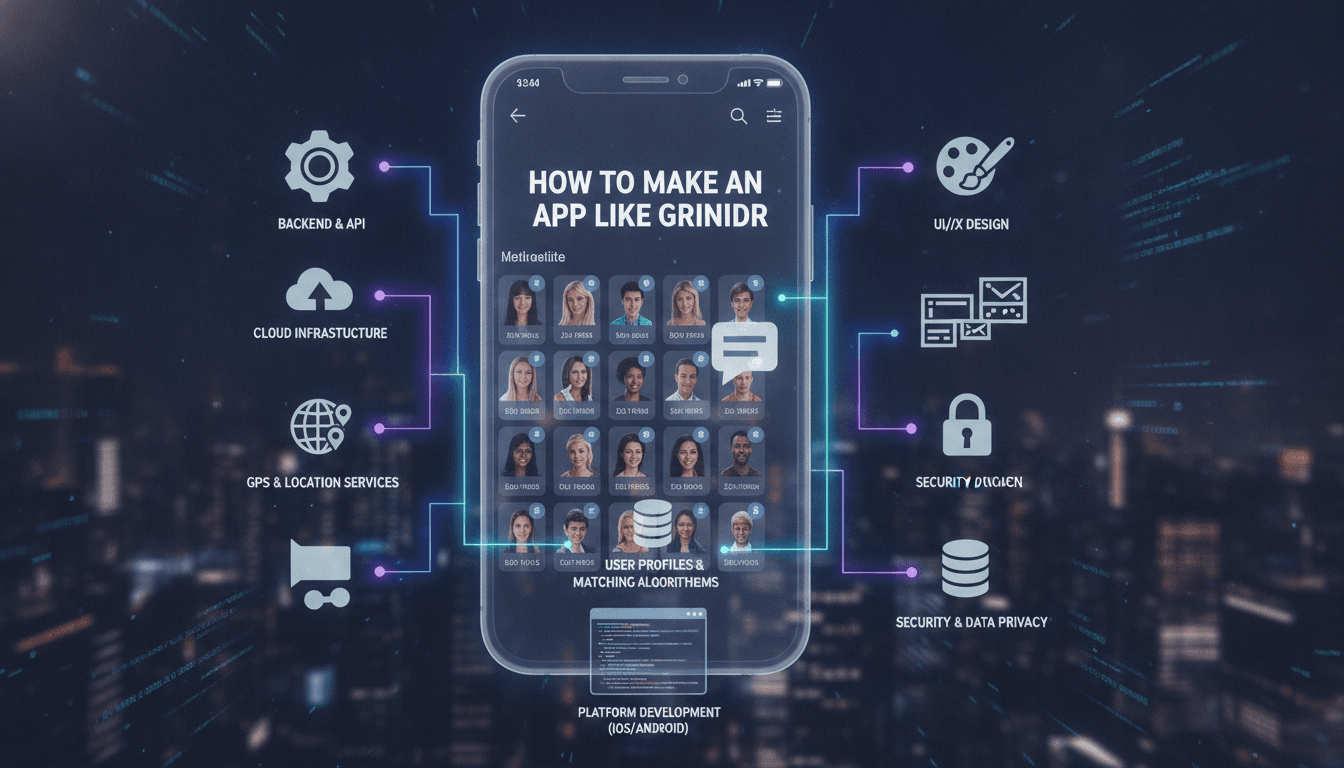
A practical breakdown of the architecture, feature set, compliance requirements, and cost realities involved in building a location-based social and dating app from scratch.
What Does "An App Like Grindr" Actually Mean, Technically?
Grindr is not a chat app with a map. It is a real-time geospatial matching system with ephemeral messaging, media handling, identity verification, content moderation at scale, and a compliance surface that spans GDPR, CCPA, and app store policies simultaneously. Before you write a line of code, you need to be clear about which of those layers you are actually building.
The core technical primitives are:
- Geospatial indexing (PostGIS or similar) to surface nearby profiles within a configurable radius
- Real-time presence and messaging (typically WebSockets or MQTT)
- Media pipeline for profile photos and in-chat image/video
- Push notification delivery across iOS and Android
- Moderation tooling, both automated and human-review
Each of these is a system in its own right. Teams underestimate the moderation and compliance surface most consistently.
What Tech Stack Should You Use?
There is no single correct answer, but there are choices that make the subsequent years easier.
Backend
A Node.js (v20+) or Go service handles WebSocket connections well at scale. Go gives you lower memory overhead per connection, which matters once you have tens of thousands of concurrent users. PostgreSQL with the PostGIS extension is the standard choice for geospatial queries. Redis handles presence state and short-lived session data. For the media pipeline, object storage (S3-compatible) combined with a CDN is the baseline; if you need on-the-fly resizing, ImageMagick or libvips behind a Lambda or Cloud Run function is a common pattern.
For push notifications, Firebase Cloud Messaging covers both platforms. Do not build a custom delivery layer here; FCM handles the edge cases (doze mode on Android, APNs token rotation on iOS) that will consume your engineers otherwise.
Mobile
Flutter is a reasonable choice if you want a single codebase across iOS and Android with near-native performance. React Native is equally viable and has a larger hiring pool. If you have strong platform-specific feature requirements, native Swift (iOS 17+) and Kotlin (Android with Jetpack Compose) will give you the most control over background location, Bluetooth proximity features, and camera access. Most teams building a Grindr-equivalent do not need that level of control at launch.
Real-Time Messaging
WebSockets via a managed service like Ably or Pusher are faster to ship than self-hosted Socket.io clusters. The trade-off is cost at scale and less control over data residency. If data residency matters for your compliance posture, self-hosted is the right call from day one.
How Do You Handle Location Without Exposing Exact Coordinates?
This is where several apps have had serious security incidents. Grindr itself was shown in 2014 to expose exact GPS coordinates through its API, which researchers used to trilaterate user positions to within metres. The fix is not complicated, but it must be a deliberate architectural decision.
Store exact coordinates server-side. Never return them to the client. Return a quantised distance ("within 300m", "within 1km") computed server-side. Use a geohash grid or PostGIS ST_DistanceSphere with a floor applied to the output. Rotate the reference point used for distance calculations at a configurable interval to prevent long-term trilateration.
This approach means you cannot show a "live" position on a map, but that is a feature, not a limitation. The privacy-by-design argument is also a regulatory one: Article 25 of GDPR requires data protection by default.
/// Not sure where to start?
Get the architecture before you commit
Tell us what you're building and we'll map the technical approach, stack, and rough timeline. No cost, no obligation, no sales call required.
What Does Compliance Actually Require?
Dating and social apps that handle sensitive categories of personal data (sexual orientation, health information) face stricter obligations under GDPR Article 9. "Sensitive" is not just what users explicitly submit; it is what the app infers. A gay dating app infers sexual orientation by its nature. That triggers explicit consent requirements, data minimisation obligations, and stricter breach notification timelines (72 hours to the supervisory authority).
Practical implications for your build:
- Consent flows must be granular. A single "I agree to the terms" checkbox does not satisfy Article 7.
- You need a documented Data Protection Impact Assessment (DPIA) before launch.
- Age verification is not optional in several jurisdictions. The UK's Online Safety Act 2023 and the EU's Digital Services Act both impose obligations on platforms that minors might access. Implementing an age-gate backed by a third-party verification provider (Yoti, Veriff, or similar) adds complexity but is increasingly a legal requirement.
- Apple and Google both have explicit policies on apps facilitating adult content. Violating these will get your app delisted, not just warned.
Content moderation deserves its own paragraph. Automated classifiers (AWS Rekognition, Google Cloud Vision) catch a meaningful proportion of explicit or harmful images but produce false positives that frustrate users. A human review queue for flagged content is necessary. Plan for it in your operational budget from day one, not as an afterthought.
What Does It Cost to Build?
The honest answer is: significantly more than most founders expect. Below is a rough breakdown for an MVP with core features (profiles, geospatial feed, real-time messaging, basic moderation).
| Phase | Scope | Estimated Duration | Rough Cost Range |
|---|---|---|---|
| Discovery & Architecture | System design, compliance review, tech stack decision | 3–4 weeks | $8,000–$15,000 |
| Backend & API | Auth, geospatial engine, messaging, media pipeline | 10–14 weeks | $40,000–$70,000 |
| Mobile (Flutter or RN) | iOS + Android, core flows | 10–14 weeks | $35,000–$60,000 |
| Admin & Moderation Tools | Dashboard, review queues, reporting | 4–6 weeks | $15,000–$25,000 |
| QA, Security Audit, Launch | Penetration test, app store submission | 3–4 weeks | $10,000–$20,000 |
These are indicative figures for a competent team working without major rework. A security penetration test is not optional; do not skip it to save budget. Location-based social apps are high-value targets.
Ongoing infrastructure costs for a small but live user base (say, 50,000 MAU) will run $2,000–$5,000 per month depending on your cloud provider and media storage volume.
Conclusion
If you are serious about building in this space, start with the compliance and location privacy architecture, not the UI. Those two areas determine whether your app survives legal scrutiny and user trust long-term. The feature set is solvable; the regulatory exposure is the harder problem.
The concrete next step: commission a technical discovery and compliance scoping engagement before committing to a full build. It costs a fraction of a full build and tells you whether your architecture assumptions are safe. If you want to talk through the specifics of your use case, reach out to the Sodio team directly.
FAQ
How long does it take to build an app like Grindr? A functional MVP with geospatial matching, real-time chat, profile management, and basic moderation tooling typically takes 6–9 months with a full-stack team. That assumes clean requirements, no major pivot mid-build, and a compliance review running in parallel rather than after the fact.
What is the biggest technical risk in a location-based social app? Location data exposure. Multiple dating apps have been shown to leak precise coordinates through their APIs, allowing user positions to be trilaterated. The fix is server-side distance quantisation, but it must be built in from the start. Retrofitting it into an existing API is painful and error-prone.
Do you need a separate iOS and Android app, or can you use a cross-platform framework? For most teams, Flutter or React Native is sufficient. The cases where native Swift and Kotlin are worth the added cost are narrow: complex background location tracking, custom camera pipelines, or deep platform integration. The trade-off is hiring cost and codebase divergence versus marginal performance gains.
What third-party services are essential versus optional? Essential from day one: FCM for push notifications, an S3-compatible store for media, a CDN, and a managed WebSocket service or self-hosted equivalent. Optional at launch but likely needed soon: an age verification provider, an automated content moderation API, and an analytics platform. Do not build any of the "essential" layer yourself; the operational cost is not worth it.
How does GDPR apply to a dating app that targets a specific sexual orientation? Sexual orientation is a "special category" of personal data under GDPR Article 9. Using a dating app oriented toward a particular sexual orientation implies that data is being processed. This requires explicit consent (not just terms acceptance), a DPIA before launch, stricter breach notification obligations, and stronger data minimisation practices. Failure to treat this correctly is not a technical issue; it is a regulatory one with significant financial exposure.
Have a project in mind? Contact Sodio Technologies to discuss your requirements and explore the right technology solution for your business.
/// Work with us
Talk to the engineers who'd build it
You'll get a technical scope, timeline and cost estimate from the people doing the work, not an account manager. In-house team, no subcontracting, since 2016.