

How to Make an App Like Hopper
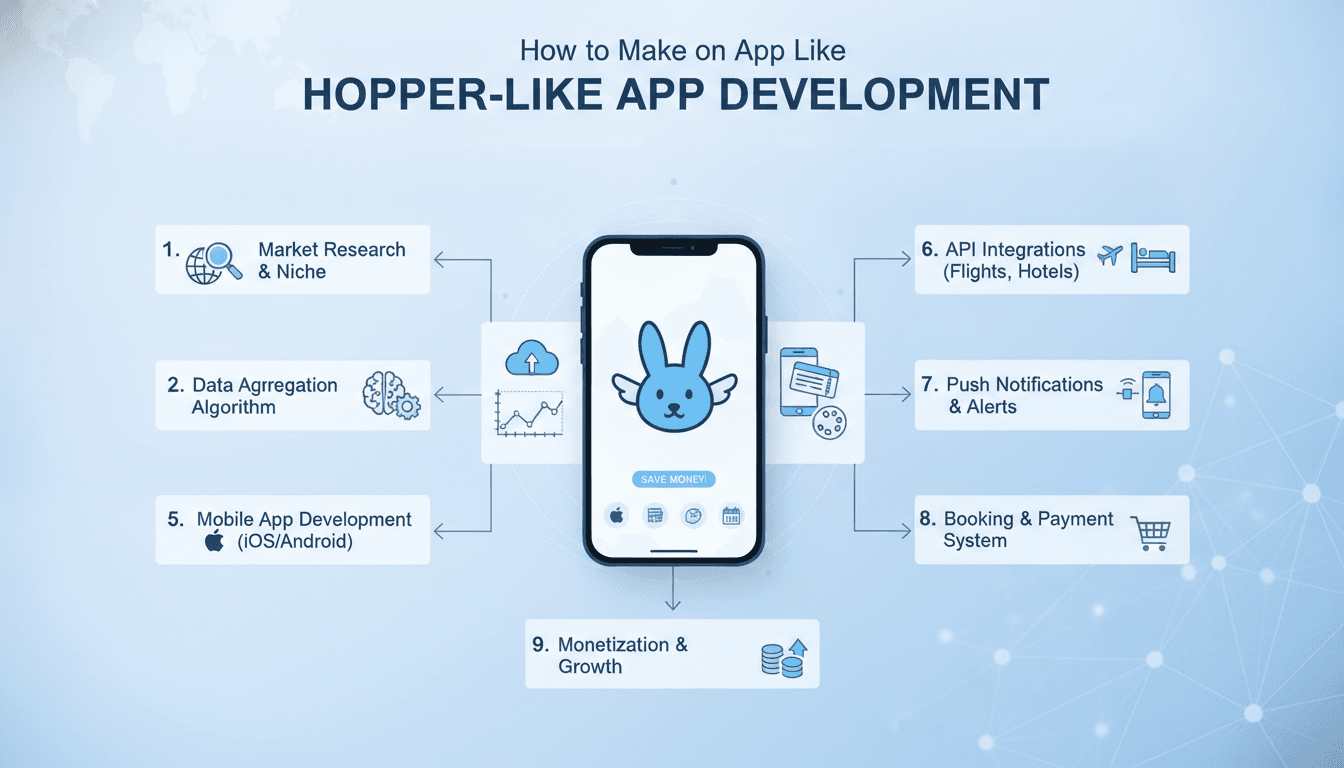
Building a travel fare prediction app is a genuine engineering problem. Price forecasting, real-time inventory, personalisation — each of these is hard on its own. Getting them to work together at Hopper's scale takes deliberate architectural decisions from day one.
This post walks through what it actually takes to build something in that category: the data pipelines, the ML models, the booking integrations, and the product decisions that shape all of them.
What Does Hopper Actually Do Under the Hood?
Hopper's core product is price prediction. It tells users whether to buy now or wait, and it backs that with a price freeze and price watch feature. That sounds simple. The engineering underneath it is not.
The prediction engine has to ingest continuous price feeds from GDS (Global Distribution System) sources like Amadeus, Sabre, or Travelport, or from NDC (New Distribution Capability) APIs that airlines are increasingly pushing. These feeds update constantly. A single transatlantic route can have dozens of fare buckets changing multiple times per day.
On top of that, Hopper has built a synthetic product layer: price freeze lets users lock in a fare for a fee, essentially turning the app into a short-term options market. That requires actuarial modelling, not just prediction.
The Data Layer
You need a time-series store that can handle high write throughput and fast point-in-time lookups. TimescaleDB or InfluxDB work well here. Kafka is the standard choice for ingesting real-time fare updates before they land in storage.
Historical fare data is expensive to acquire. Hopper has years of proprietary data. If you're building from scratch, your options are:
- Licensing historical fare datasets from providers like OAG or Cirium
- Scraping public fare search results (legally complex in most jurisdictions)
- Starting with a narrower route set and building history organically
The narrower-route approach is often the right call for a v1. You get cleaner data and a faster feedback loop on your model accuracy.
The Prediction Model
Hopper uses gradient-boosted trees as a baseline with neural layers for sequence modelling. This is publicly known from their engineering blog posts. The input features include:
- Days to departure
- Day of week for both booking and travel
- Historical price distribution for the route
- Seasonality signals
- Demand indicators (search volume, load factor estimates)
XGBoost or LightGBM handle the tabular features well. For the sequential patterns in fare movement, an LSTM or Transformer-based architecture on top gives you better accuracy on longer booking windows.
Model retraining needs to be near-continuous. Fares shift with fuel prices, competitor moves, and demand shocks. A model trained on pre-COVID data was not useful in 2021. You need MLflow or a comparable model registry with automated retraining pipelines triggered by drift detection.
How Do You Handle Flight and Hotel Booking Integration?
Booking is where most teams underestimate complexity. Displaying prices is a read-only problem. Completing a transaction is a write problem with real money and real inventory.
For flights, the two main paths are:
| Approach | Pros | Cons |
|---|---|---|
| GDS integration (Amadeus, Sabre) | Full inventory, industry standard | Expensive per-segment fees, complex XML/SOAP APIs |
| NDC aggregators (Duffel, Kiwi.com API) | Modern REST APIs, lower friction | Not all airlines participate, variable content |
| OTA white-label | Fast to market | Low margin, limited control |
Duffel has become the default recommendation for new builds because their API surface is sane and they handle the airline settlement layer. You lose some margin but you save months of integration work.
For hotels, Booking.com's Affiliate Partner Programme and Expedia's EPS Rapid API are the two major options. Both offer real-time rates and availability. EPS Rapid has better documentation. Booking.com has wider global inventory.
/// Not sure where to start?
Get the architecture before you commit
Tell us what you're building and we'll map the technical approach, stack, and rough timeline. No cost, no obligation, no sales call required.
Payment and Cancellation Complexity
Travel payments are not standard e-commerce. You're often charging the card at booking but settling with the supplier days or weeks later. Chargebacks on travel bookings are disproportionately high. You need a payment processor that has explicit travel vertical support. Stripe supports this with specific integration guidance; Adyen is the other common choice at higher volumes.
Cancellation policy parsing is an unsolved problem in the industry. Policies are semi-structured text. Building a reliable classifier that extracts refundability signals from free-text policy strings takes real effort and ongoing maintenance.
What Does the ML Infrastructure Need to Look Like?
A Hopper-like app is not a project you can run on a single model deployed behind a REST endpoint. You need a proper ML platform.
The minimum viable stack looks like this:
- Feature store: Feast or Tecton for serving pre-computed features at low latency
- Training infrastructure: Managed jobs on Vertex AI or SageMaker, triggered by Airflow DAGs
- Model serving: Seldon Core or BentoML behind a Kubernetes ingress
- Monitoring: Evidently AI or Arize for drift detection and prediction quality tracking
The feature store matters more than most teams initially expect. Real-time inference at scale means you cannot afford to recompute features on every request. Pre-materialised features served from Redis or Cassandra are standard practice.
Model latency targets for a consumer app should be under 200ms at the p99 level. Prediction calls that block the UI on fare search need to be fast. Caching prediction outputs for frequently searched routes with a short TTL is a reasonable optimisation.
How Much Does It Cost to Build?
Budget varies enormously depending on scope. A narrow MVP covering a handful of routes with a basic buy-now-or-wait prediction, built on Duffel for booking and a managed ML pipeline, realistically takes 12 to 18 months with a team of eight to twelve engineers.
The cost breakdown is roughly:
- Data licensing: $50,000 to $200,000 per year depending on coverage
- GDS or NDC API fees: variable, often per-segment transaction charges
- ML infrastructure: $15,000 to $40,000 per month at moderate scale on AWS or GCP
- Regulatory and compliance: IATA accreditation if you're acting as a ticketing agent adds time and capital requirements
If you're not IATA accredited, you sell through an accredited partner. That's fine for a v1 but affects your margin structure long term.
Conclusion
Building something in Hopper's category is achievable if you're disciplined about scope. Start with one vertical, one geography, and a narrow route set. Get the prediction feedback loop working before you expand inventory. The ML infrastructure is the long pole in the tent.
If you're evaluating whether to build in-house or bring in a team that has done this before, the honest answer is that the GDS integrations and the ML platform setup are the hardest parts to get right quickly. That's where outside experience pays for itself.
If you're at the stage of scoping this project, we're happy to talk through the architecture with you.
FAQ
How long does it take to build a flight price prediction app? A focused MVP with prediction, basic booking via an NDC aggregator, and a working ML pipeline takes 12 to 18 months for a team of eight to twelve engineers. That assumes a narrow geographic and route scope. Expanding to global inventory and multi-vertical booking adds significant time.
Do I need GDS access to build a Hopper-like app? Not necessarily. NDC aggregators like Duffel give you access to airline inventory through modern REST APIs without direct GDS integration. For a v1, this is usually the right choice. GDS access makes sense when you need full global inventory or are operating at very high transaction volumes.
What machine learning models does Hopper use? Hopper has published that they use gradient-boosted trees combined with sequential models for fare prediction. XGBoost and LightGBM are standard for the tabular feature layers. LSTM or Transformer architectures handle the time-series patterns in fare movement.
How do I get historical flight fare data? The main options are licensing datasets from providers like OAG or Cirium, building your own history by logging fare searches over time, or starting with a narrow route set and accumulating data organically. Scraped data is legally complex and inconsistent in quality.
What is the biggest technical risk in building this kind of app? Model drift. Fare patterns shift with external events, airline strategy changes, and macroeconomic conditions. A prediction model that performs well in stable conditions can degrade quickly. Continuous monitoring, automated retraining pipelines, and clear accuracy thresholds for model retirement are non-negotiable parts of the infrastructure.
Have a project in mind? Contact Sodio Technologies to discuss your requirements and explore the right technology solution for your business.
/// Work with us
Talk to the engineers who'd build it
You'll get a technical scope, timeline and cost estimate from the people doing the work, not an account manager. In-house team, no subcontracting, since 2016.