

How to Make an App Like Ibotta
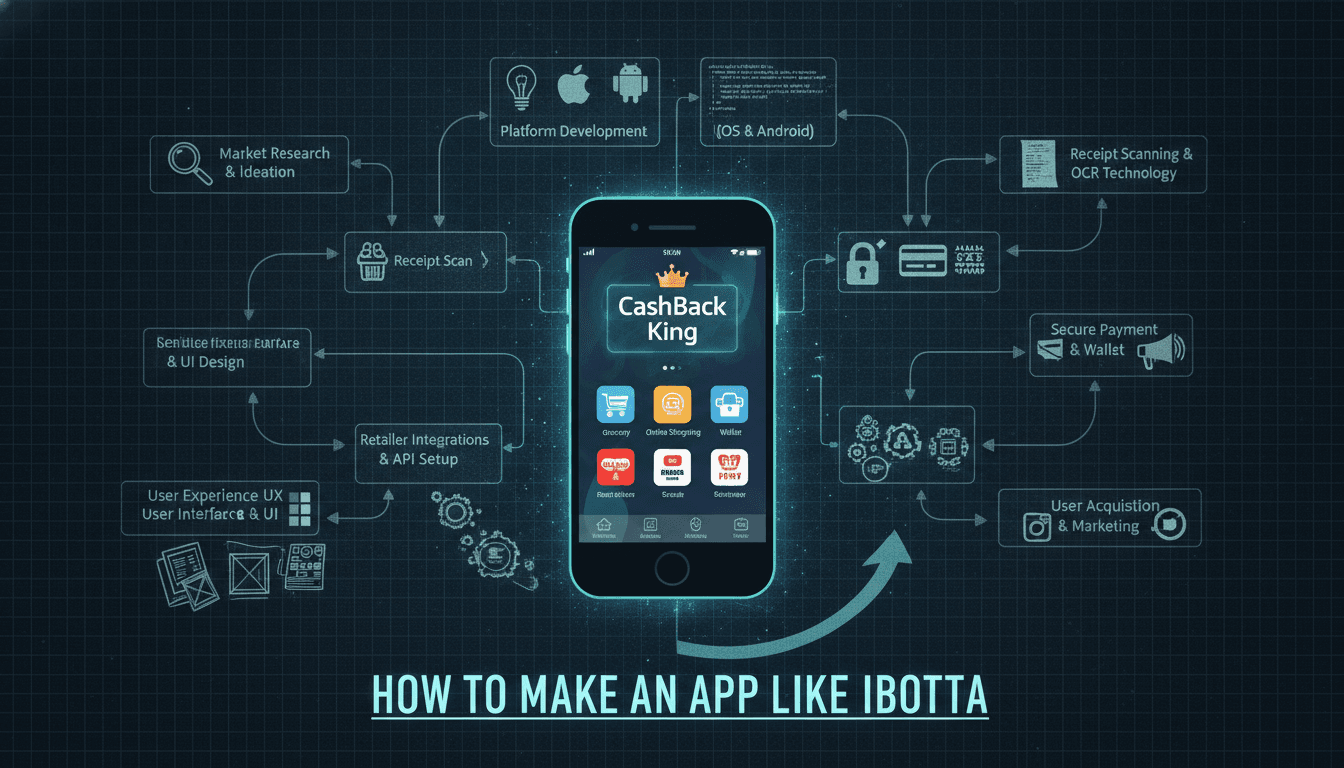
A practical breakdown of the architecture, data flows, and cost decisions behind a cashback rewards app — from receipt parsing to offer matching to payout logic.
What Does an App Like Ibotta Actually Do Under the Hood?
Ibotta's user-facing experience looks simple: scan a receipt, get cash back. The engineering underneath is not simple at all. You're dealing with OCR pipelines, offer matching logic, retailer data integrations, fraud detection, and a payout system that has to be both reliable and cheap to run. Getting any one of these wrong produces either bad user experience or direct financial loss.
The core data flow looks like this:
- User selects offers before or after a purchase
- User submits proof of purchase (receipt image, loyalty card link, or card-linked transaction)
- Backend parses and validates the proof
- Offer matching engine checks line items against active offers
- Cashback is credited to user wallet
- User redeems wallet balance via PayPal, Venmo, gift card, or bank transfer
Each of those steps has real engineering complexity. Let's go through them.
How Does Receipt Parsing Actually Work at Scale?
Receipt OCR is the hardest part of the stack to get right. Receipts are not standardised. Font sizes vary. Paper quality varies. Camera angles vary. You're also dealing with thermal paper that fades and receipts that have been folded, torn, or photographed in bad lighting.
OCR Engine Options
Google Cloud Vision and AWS Textract are the two most-used managed options. Textract has a specific receipt/form extraction mode that returns structured key-value pairs rather than raw text blocks, which saves significant post-processing work. For a greenfield build, Textract is the faster path to usable output.
If you need on-device parsing (for offline use or data-residency reasons), a fine-tuned CRAFT + TPS-ResNet-TPS pipeline via PaddleOCR can run on-device with acceptable accuracy on modern Android and iOS hardware. Accuracy drops roughly 8-12% compared to cloud models on low-quality images, so you pay for the offline capability with accuracy.
Post-OCR Normalisation
Raw OCR output is messy. You need a normalisation layer that:
- Strips irrelevant tokens (store address, cashier ID, tax breakdowns)
- Maps product descriptions to SKUs or UPCs via a product database
- Handles abbreviations (e.g. "DNNTY OREO" → Dunkin' Oreos)
This is where most of the ongoing engineering work lives. Retailers use inconsistent abbreviations, and a new retail partner means a new round of normalisation rules. A fuzzy match against a UPC database (Open Food Facts is a good free starting point; SPS Commerce for commercial-grade data) catches most cases. For the remainder, a fine-tuned classifier trained on your historical receipt corpus closes the gap.
Duplicate Detection
A basic SHA-256 hash of the receipt image catches exact duplicates. You also need perceptual hashing (pHash) to catch re-photographed or slightly cropped versions of the same receipt. Store the receipt timestamp, store ID, and total amount as a composite key. Flag any submission where two of those three match within a configurable time window.
What Does the Offer Matching Engine Look Like?
The offer matching engine is a rules engine at its core, with some probabilistic logic for edge cases.
An offer has a defined structure: target UPC or product category, required quantity, required retailer (optional), validity window, and payout amount. The matcher receives a parsed receipt with line items and checks each line item against active offers indexed by UPC and category.
A Redis-backed inverted index works well here. UPC → list of active offer IDs. Category → list of active offer IDs. You load the relevant offer details from PostgreSQL on a cache miss. At Ibotta's scale (roughly 10 million monthly active users as of their 2024 IPO filing), you'd be handling tens of millions of match requests daily, so the index design matters.
For product-level matching without a UPC (common for produce, deli items, and store brands), you fall back to category matching using your product classifier. This is less precise and generates more disputes, so it's worth investing in the UPC coverage of your product database before launch.
/// Not sure where to start?
Get the architecture before you commit
Tell us what you're building and we'll map the technical approach, stack, and rough timeline. No cost, no obligation, no sales call required.
How Do You Handle Fraud Without Blocking Legitimate Users?
Cashback fraud takes a few forms: duplicate receipt submission, receipt manipulation (editing totals or line items), synthetic receipt generation, and account farming (creating multiple accounts to claim bonuses multiple times).
Detection Signals
| Signal | What it catches |
|---|---|
| pHash similarity across accounts | Re-used receipt images across different user accounts |
| Receipt timestamp vs. submission timestamp delta | Receipts submitted hours after the store closed |
| Device fingerprint (FingerprintJS Pro or similar) | Multiple accounts on one device |
| Velocity rules (n submissions in m minutes) | Automated bulk submission |
| Store-level geofencing | Receipt from a store 800km from user's registered location |
No single signal is reliable enough on its own. A scoring system that combines signals and thresholds redemption above a score cutoff works better than binary rules. Set the threshold conservatively at launch and tune it against your false-positive rate. Blocking legitimate users who submitted real receipts is a retention problem.
Retailer-Linked Verification
The cleanest fraud prevention is not parsing receipts at all. Card-linked offers (via Mastercard Priceless, Visa Offers Platform, or a direct processor integration) verify purchases at the transaction level. There's no receipt image to fake. The trade-off: you're limited to card purchases, you pay integration costs per retailer, and you lose the data richness that comes from parsed receipt line items.
Loyalty card integrations (via retailer APIs where available, or scraping where not) sit in the middle: more structured than receipt images, but with variable data quality and terms-of-service risk on the scraping side.
Wallet, Payouts, and the Regulatory Side
User cashback balances are stored value. Depending on your jurisdiction, that may trigger money transmitter licence requirements. In the US, most states require a licence if you're holding consumer funds. Ibotta's original model structured payouts as rebates rather than payments partly to manage this.
For payouts, Hyperwallet (now PayPal's payout platform) and Stripe Connect are the two most common integrations for PayPal/bank transfers. Gift card payouts go through Tango Card or a direct retailer API. Minimum payout thresholds ($20 is the Ibotta default) reduce transaction costs and fraud by making it harder to cycle small amounts through multiple accounts.
Build a ledger table, not just a balance column. Every credit and debit should be a separate row with a source reference (offer match ID or payout ID). This is mandatory for dispute resolution and regulatory audits. Use an append-only pattern: no UPDATE on ledger rows, ever.
What Does the Mobile Stack Look Like?
React Native with Expo is a reasonable choice for the cross-platform requirement. Camera access, barcode scanning (via react-native-vision-camera), and push notifications all work reliably. If you're building native for performance reasons, Swift on iOS and Kotlin on Android give you more control over camera frame processing, which matters for real-time barcode scanning UX.
The app's primary job is capture (receipt image, barcode, or loyalty card credentials) and display. The heavy logic lives server-side. Keep the app thin.
For the backend, a Python (FastAPI) or Node.js (Express) API layer behind an AWS Application Load Balancer is straightforward. Separate services for offer management, receipt processing (which is CPU-heavy), and payouts. Use SQS for async receipt processing jobs rather than blocking the HTTP request.
Conclusion
A cashback app is, at its core, a data ingestion and matching problem with a payments layer on top. The OCR and normalisation pipeline is where you'll spend the most ongoing engineering time. Fraud detection requires layered signals, not single rules. The ledger architecture is non-negotiable if you want to handle disputes cleanly.
If you're scoping a build, start with card-linked offers and a single retailer integration. It's a smaller surface area, and it lets you validate the offer matching and payout logic before you take on receipt OCR complexity.
At Sodio, we've built data ingestion pipelines, real-time matching systems, and payout integrations across fintech and retail products. If you're evaluating the build scope for a rewards or cashback product, get in touch and we can talk through the architecture specifics.
FAQ
How long does it take to build a cashback app like Ibotta? A basic MVP with receipt OCR, offer matching, and a single payout method typically takes 4-6 months with a team of 4-5 engineers. A production-grade system with fraud detection, multiple retailer integrations, and a compliant wallet layer is realistically 12-18 months of sustained engineering effort.
How much does it cost to build a cashback rewards app? Ballpark figures vary widely by market and team structure. A lean offshore team might build an MVP for $80,000-$150,000. A full-featured product with a mid-market engineering team typically runs $400,000-$800,000 over the first year, including infrastructure costs, third-party API fees, and QA.
What is the biggest technical risk in building a cashback app? Receipt OCR accuracy. The long tail of receipt formats, lighting conditions, and retailer abbreviations means you'll spend significant time on the normalisation layer. Underestimating this is the most common reason cashback app projects run over time and budget.
Do I need a money transmitter licence to build a cashback app? Likely yes if you're holding user balances in the US. Regulations vary by state. Structuring payouts as rebates (reimbursements tied to specific purchases) rather than general-purpose stored value can reduce your regulatory exposure, but you should get legal advice specific to your product structure before assuming you're exempt.
Can I use an existing SDK or platform instead of building from scratch? Yes. Platforms like Fetch Rewards (white-label), Valassis, and Inmar Intelligence offer receipt processing and offer management as a service. You lose control over data, matching logic, and unit economics, but you reduce time to market significantly. This is worth considering for a market validation phase before committing to a custom build.
Have a project in mind? Contact Sodio Technologies to discuss your requirements and explore the right technology solution for your business.
/// Work with us
Talk to the engineers who'd build it
You'll get a technical scope, timeline and cost estimate from the people doing the work, not an account manager. In-house team, no subcontracting, since 2016.