

How to Make an App Like Instacart
How to Make an App Like Instacart
Grocery delivery went from a convenience to an expectation. Instacart proved that people will happily pay a premium to skip the store, and in doing so it created a blueprint that hundreds of startups have followed, adapted, and localized. If you're planning to build something similar — whether it's a national grocery marketplace or a hyperlocal delivery service for a handful of neighborhoods — here's what actually goes into it.
Understanding the Instacart Model
Before writing a line of code, it's worth being precise about what Instacart actually is. It isn't a grocery store. It doesn't own inventory, warehouses, or delivery vans. It's a three-sided marketplace that connects:
- Customers who want groceries delivered
- Retail partners whose shelves supply the orders
- Shoppers (independent contractors) who pick, pack, and deliver
The company makes money through delivery fees, service fees, optional membership subscriptions, retailer commissions, and — increasingly — advertising revenue from brands who want placement inside the app.
We cover a closely related subject in How to Make an App Like Shipt.
This asset-light model is why Instacart scaled quickly, and it's also why the technical challenge is so interesting. You're not building a store. You're building a real-time coordination engine.
Core Features to Build
Customer App
- Store selection by location — surface nearby partner stores based on ZIP code or GPS
- Searchable catalog with categories, filters, dietary tags, and brand browsing
- Cart and multi-store ordering so users can shop several retailers in one session
- Delivery slot scheduling, including express and same-day windows
- Live order tracking with shopper location on a map
- In-app chat with the shopper for substitutions and clarifications
- Substitution preferences set per item, before shopping even begins
- Multiple payment methods, tipping, and digital receipts
- Reorder and saved lists to make repeat shopping nearly frictionless
- Ratings and support tickets
Shopper App
- Batch discovery and acceptance — available orders with estimated pay and distance
- Optimized in-store pick path grouped by aisle or department
- Barcode scanning to verify the correct item
- Out-of-stock flow with suggested replacements and customer approval
- Checkout support via a prepaid company card
- Turn-by-turn navigation to the drop-off point
- Proof of delivery — photo, signature, or ID check for age-restricted items
- Earnings dashboard with tips, bonuses, and payout history
Retailer / Store Portal
- Catalog and inventory sync via API or scheduled feed
- Pricing management, including store-specific and promotional pricing
- Order visibility and fulfillment status
- Promotions and sponsored placement tools
- Sales analytics by category, basket size, and time of day
Admin Panel
- User, shopper, and retailer management with onboarding and verification
- Dispatch and batching controls with manual override
- Commission, fee, and surge configuration
- Dispute resolution and refund workflows
- Content management for banners, categories, and campaigns
- Business intelligence dashboards across orders, retention, and unit economics
The Hard Parts Nobody Warns You About
Catalog Accuracy
This is the single biggest source of customer frustration in grocery delivery. Grocery SKUs number in the tens of thousands per store, prices vary by location, and inventory shifts hourly. Most retailers don't expose clean real-time inventory APIs.
We cover a closely related subject in How to Make an App Like Amazon Fresh.
Practical approaches include periodic feed ingestion, probabilistic availability scoring based on historical out-of-stock rates, and crowd-sourced signals from shoppers marking items unavailable in real time. Plan for a data operations function, not just an engineering one.
Batching and Dispatch
Assigning one order to one shopper is simple. Assigning three overlapping orders across two stores to the shopper who can complete them fastest, while respecting delivery windows and basket sizes, is a constrained optimization problem.
For a closer look at a related topic, read our guide on How to Make an App Like FreshDirect.
Start rule-based: proximity, capacity, delivery window, shopper rating. Graduate to a scoring model once you have enough historical data on pick times, store layouts, and traffic patterns.
Payments and Variable Totals
Grocery orders almost never total what the customer initially saw. Weighted items, substitutions, and out-of-stock removals all change the final amount. The standard solution is pre-authorization with a buffer (typically 15–25% above cart total), followed by capture of the actual amount after checkout. Your payment provider needs to support auth-and-capture with amount adjustment, and your UX needs to explain this clearly to avoid support tickets.
Supply-Side Liquidity
An empty marketplace is useless to everyone. You need enough shoppers online during peak hours or delivery times collapse and customers churn. Early on this means geographic focus, shopper incentives, and guaranteed minimum earnings — a marketing and operations problem as much as a product one.
Recommended Tech Stack
Mobile clients: React Native or Flutter for a shared codebase across iOS and Android; native Swift/Kotlin if you need maximum performance for barcode scanning and background location.
Web: React or Next.js for the customer storefront and all internal portals.
Backend: Node.js, Go, or Python with a service-oriented architecture. Separate services for catalog, ordering, dispatch, payments, and notifications so you can scale the hot paths independently.
Databases: PostgreSQL for transactional data, Elasticsearch or Algolia for product search, Redis for carts, sessions, and dispatch queues.
Real-time: WebSockets or a managed service for live tracking and chat; Kafka or similar for event streaming between services.
Infrastructure: AWS, GCP, or Azure with containerized deployments on Kubernetes or a managed equivalent.
Third-party services: Stripe or Adyen for payments and shopper payouts, Google Maps or Mapbox for geocoding and routing, Twilio for SMS, Firebase or OneSignal for push notifications.
Where AI Adds Real Value
Skip the buzzwords and focus on measurable wins:
- Smart substitutions — recommend replacements based on what similar customers accepted, not just category matching
- Demand forecasting — predict order volume by store and hour to schedule shopper incentives
- ETA prediction — model actual pick and drive times instead of naive distance math
- Personalized merchandising — surface reorder-likely items on the home screen
- Fraud detection — flag anomalous refund patterns, shopper behavior, or payment activity
Development Roadmap
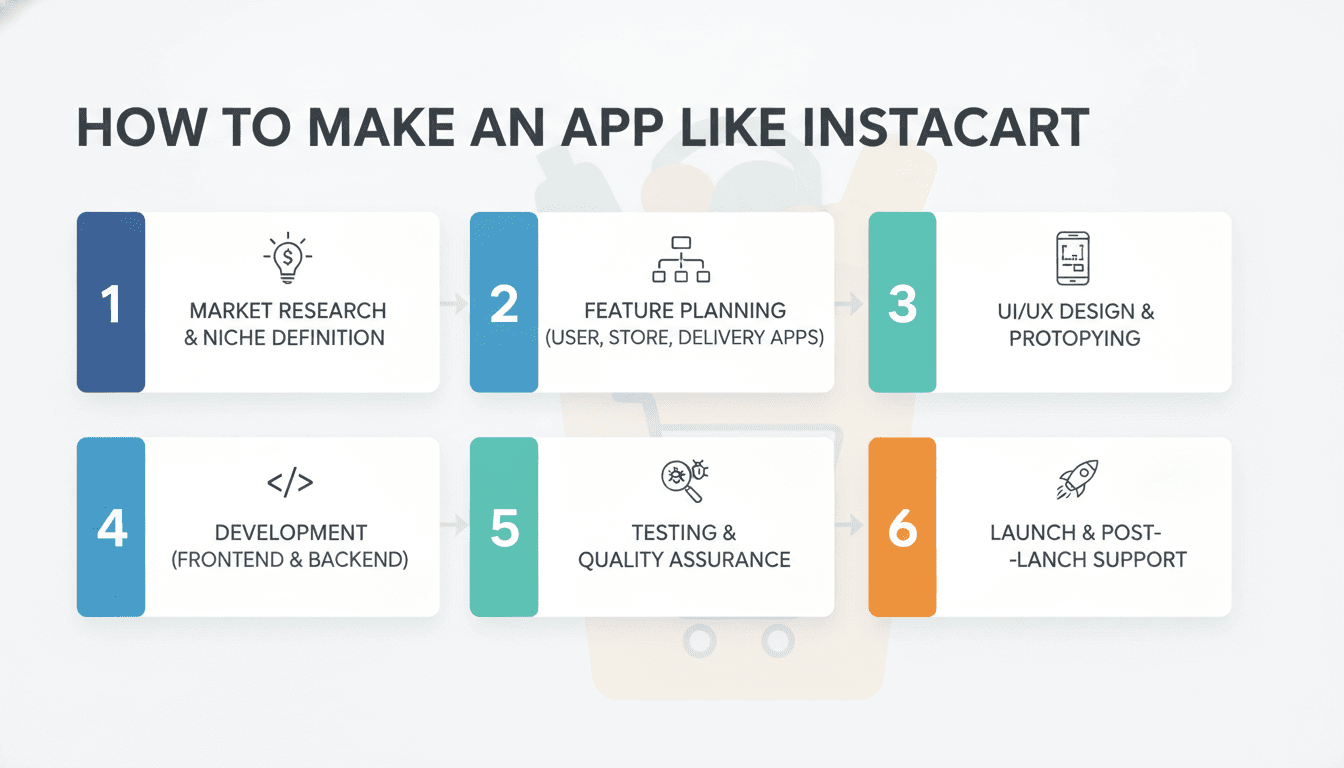
Phase 1 — Discovery and Design (3–5 weeks): Market and competitor research, feature prioritization, user flows, wireframes, and high-fidelity UI for all four surfaces.
Phase 2 — MVP Build (3–4 months): One city, a small set of retail partners, single-store orders, manual or lightly automated dispatch, core customer and shopper apps, basic admin.
Phase 3 — Pilot and Iterate (1–2 months): Launch in a limited geography. Measure fill rate, on-time delivery, substitution acceptance, and cost per delivery. Fix the operational leaks.
Phase 4 — Scale (ongoing): Multi-store carts, automated batching, subscriptions, retailer self-service, advertising inventory, and expansion to new markets.
Budget Expectations
Costs vary widely by region and team composition, but rough ranges for a competent build:
- Lean MVP (single platform, one market): $60,000 – $120,000
- Full-featured multi-platform launch: $150,000 – $300,000
- Enterprise-grade with AI dispatch and retailer APIs: $300,000+
Budget an additional 15–25% of build cost annually for maintenance, infrastructure, and third-party service fees. Payment processing, mapping API calls, and SMS add up faster than most founders expect at scale.
Monetization Options
- Per-order delivery and service fees
- Subscription membership for free or discounted delivery
- Retailer commission on gross merchandise value
- Sponsored product placement and in-app advertising
- Markup on item pricing (common, but disclose it)
- White-label fulfillment for retailers who want their own branded experience
Compliance and Legal Considerations
- Worker classification — contractor vs. employee rules differ sharply by jurisdiction and have driven major litigation in this space
- Age-restricted items — alcohol and tobacco require ID verification workflows and often separate licensing
- Food safety — temperature handling expectations for cold and frozen goods
- Payment compliance — PCI DSS scope reduction via tokenization
- Privacy — GDPR, CCPA, and clear disclosure of location tracking
- Accessibility — WCAG conformance for the customer-facing storefront
Final Thoughts
An app like Instacart is deceptively simple on the surface and genuinely complex underneath. The winning products aren't the ones with the longest feature lists — they're the ones where the catalog is accurate, the ETA is honest, and the substitution feels like a good decision rather than a compromise.
Start narrow. Pick one city, a few stores, and a customer segment you understand well. Get the operational metrics right at small scale, then invest in automation. The technology is achievable; the marketplace discipline is what separates the survivors.
If you're ready to scope your own grocery delivery platform, the best next step is a focused discovery phase that maps your target market, retail partnerships, and unit economics before a single sprint begins.
Have a project in mind? Contact Sodio Technologies to discuss your requirements and explore the right technology solution for your business.
/// Work with us
Talk to the engineers who'd build it
You'll get a technical scope, timeline and cost estimate from the people doing the work, not an account manager. In-house team, no subcontracting, since 2016.