

How to Make an App Like Kraken
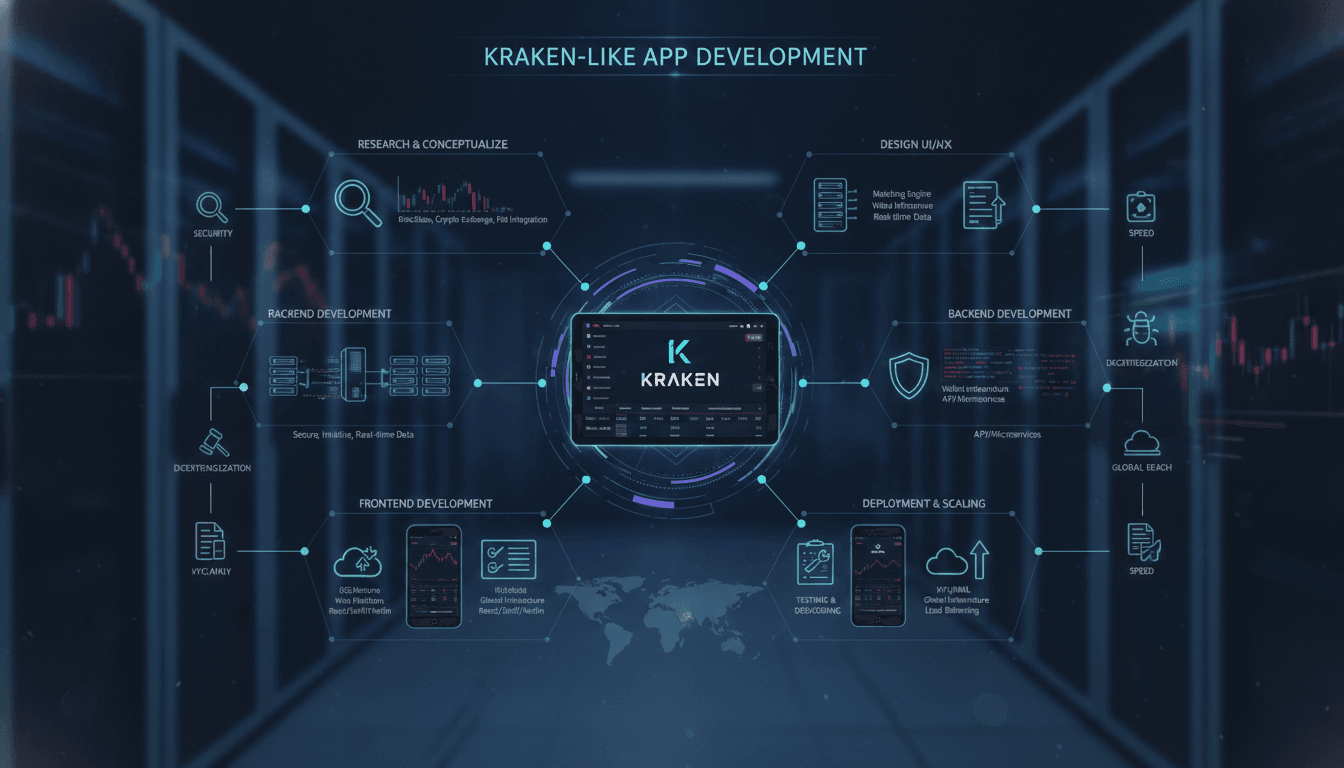
How to Make an App Like Kraken
Cryptocurrency exchanges have moved from niche tools for early adopters to mainstream financial platforms used by millions of people every day. Kraken, founded in 2011, is one of the most recognised names in the space — known for its deep liquidity, strong security track record, and support for both beginner-friendly spot trading and advanced derivatives.
If you're planning to build a crypto exchange app of your own, Kraken is a useful blueprint. This guide walks through what such an app actually contains, how to build it, what it costs, and the pitfalls that sink most crypto projects before launch.
For a closer look at a related topic, read our guide on How to Make an App Like Binance.
What Makes Kraken Work
Before writing a line of code, it's worth understanding why Kraken retained users while dozens of competitors collapsed.
If this is relevant to your project, check out How to Make an App Like Huobi.
- Security first. Kraken has never suffered a major breach of customer funds. Cold storage, proof-of-reserves audits, and rigorous internal controls are the foundation of that reputation.
- Regulatory posture. Kraken pursued licences and compliance early rather than treating regulation as an afterthought.
- Liquidity depth. Tight spreads and reliable order execution keep serious traders on the platform.
- Tiered complexity. A simple "buy crypto" flow for newcomers sits alongside margin, futures, and staking for professionals.
Any app that hopes to compete needs to solve all four, not just the interface.
Core Feature Set
User Onboarding and KYC/AML
Registration, email and phone verification, identity document capture, liveness detection, and sanctions screening. This is non-negotiable in virtually every jurisdiction. Most teams integrate a provider such as Sumsub, Jumio, or Onfido rather than building verification in-house.
Wallet Infrastructure
The heart of the system. You'll need:
- Hot wallets for immediate withdrawal liquidity (typically 2–5% of holdings)
- Cold storage for the bulk of assets, using multi-signature or MPC key management
- Deposit address generation per user, per supported chain
- Blockchain node infrastructure or a managed provider (Alchemy, Infura, QuickNode) for each network you support
Trading Engine
The matching engine pairs buy and sell orders and must handle high throughput with low latency. It should support market, limit, stop-loss, take-profit, and OCO orders. This is usually written in a performance-oriented language — Rust, C++, Go, or Java — and kept separate from the rest of the application.
Order Book and Market Data
Real-time price feeds, depth charts, candlestick charts, historical data, and WebSocket streaming to clients. Most apps integrate TradingView charting libraries rather than reinventing them.
Fiat On/Off Ramps
Bank transfers (SEPA, ACH, SWIFT), card payments, and local payment rails. This requires banking partnerships or integration with providers like MoonPay, Banxa, or Transak.
If this is relevant to your project, check out How to Make an App Like Bitstamp.
Portfolio and Account Management
Balance overview, transaction history, profit/loss tracking, tax reporting exports, and recurring buy schedules.
Security Features
Two-factor authentication, biometric login, withdrawal whitelisting, global settings lock, anti-phishing codes, device management, and session monitoring.
Advanced Trading (Phase Two)
Margin trading, futures, staking, OTC desk, and API access for algorithmic traders.
Technology Stack
Mobile front end: React Native or Flutter for cross-platform reach; native Swift and Kotlin if you need maximum performance and platform-specific security features like Secure Enclave and StrongBox.
Backend: A microservices architecture is standard — separate services for authentication, wallets, trading, notifications, and compliance. Node.js, Go, or Java for most services; Rust or C++ for the matching engine.
Databases: PostgreSQL for transactional and ledger data, Redis for caching and session state, ClickHouse or TimescaleDB for time-series market data.
Messaging: Kafka or RabbitMQ for event streaming between services.
Infrastructure: AWS, GCP, or a hybrid with bare-metal for the matching engine. Kubernetes for orchestration, with multi-region failover.
Blockchain layer: Self-hosted nodes for major chains, plus managed node providers for long-tail assets.
Development Roadmap
1. Legal and Regulatory Groundwork
Decide which markets you'll serve and secure the appropriate registrations — a MSB in the US, VASP registration in the EU under MiCA, an FCA registration in the UK, or a licence in a crypto-friendly jurisdiction such as Lithuania, Estonia, Dubai, or Singapore. Engage specialist counsel before development begins. This step frequently takes longer than the build itself.
2. Discovery and Architecture
Define your supported assets, target user personas, fee model, and liquidity strategy. Produce a technical architecture that separates custody, matching, and application logic.
3. UI/UX Design
Crypto apps live or die on trust signals. Clear fee disclosure, unambiguous confirmation screens, readable charts, and calm visual design all reduce the anxiety of moving money. Design for both the first-time buyer and the power user without forcing either into the other's workflow.
4. MVP Build
A sensible MVP includes: onboarding with KYC, fiat deposit via one rail, spot trading in five to ten major pairs, wallet deposits and withdrawals, and 2FA. Resist the urge to launch with fifty tokens and margin trading.
5. Liquidity Setup
New exchanges have no order flow. You'll need market makers, a liquidity aggregation partner, or shared order books via an established provider to avoid empty books and terrible spreads on day one.
6. Security Audit and Penetration Testing
Independent smart contract audits (if applicable), infrastructure penetration testing, and a bug bounty programme. Budget for this as a recurring cost, not a one-off.
7. Launch and Iterate
Soft launch in a single market, monitor withdrawal patterns and support load, then expand asset listings and geographies.
Monetisation Models
- Trading fees — maker/taker model, typically 0.1%–0.4%, with volume-based discounts
- Withdrawal fees — flat or network-dependent charges
- Spread markup — common on simplified "instant buy" flows
- Margin interest and funding rates on leveraged positions
- Staking commission — a cut of rewards passed to users
- Listing fees from token projects
- Premium API tiers for institutional and algorithmic clients
Cost and Timeline
Costs vary enormously with scope and jurisdiction, but as a rough guide:
| Component | Typical Range |
|---|---|
| MVP exchange app (iOS + Android + backend) | $150,000 – $350,000 |
| Full-featured platform with derivatives | $400,000 – $1,000,000+ |
| Licensing and legal | $50,000 – $500,000 depending on jurisdiction |
| Security audits | $20,000 – $80,000 |
| Annual infrastructure and compliance | $150,000+ |
Timeline for an MVP is generally six to nine months of development, running in parallel with a licensing process that may take six to eighteen months.
Common Pitfalls
Treating compliance as a later problem. Retrofitting KYC, transaction monitoring, and travel rule compliance into a live system is far more expensive than designing for it.
Underestimating custody. Key management is the single hardest engineering problem in this domain. Consider a qualified custodian or MPC provider (Fireblocks, Copper, BitGo) rather than building from scratch.
Launching without liquidity. Users try one trade, see a 3% spread, and never return.
Neglecting support. Crypto users contact support about stuck deposits, wrong-network transfers, and withdrawal delays. Slow responses destroy trust immediately.
Over-scoping the MVP. Every additional asset multiplies node infrastructure, compliance screening, and support burden.
Differentiating Your App
Competing with Kraken head-on is unrealistic for a new entrant. Successful newer exchanges tend to win by narrowing focus:
- Serving a specific region with local payment rails and language support
- Targeting a niche — DeFi-native users, institutional desks, or beginners
- Bundling adjacent services such as tax reporting, yield products, or card spending
- Offering a genuinely better mobile experience in an underserved market
Final Thoughts
Building an app like Kraken is less a mobile development project and more a regulated financial infrastructure project that happens to have an app attached. The interface is the easy part; custody, compliance, and liquidity are where the real work lies.
Teams that succeed treat security and regulation as product features rather than obstacles, launch narrow, and expand only once their operational foundations can take the weight. If you approach it that way, a focused, well-built exchange can carve out a durable position even in a crowded market.
Have a project in mind? Contact Sodio Technologies to discuss your requirements and explore the right technology solution for your business.
/// Work with us
Talk to the engineers who'd build it
You'll get a technical scope, timeline and cost estimate from the people doing the work, not an account manager. In-house team, no subcontracting, since 2016.