

How to Make an App Like Lyft Line
How to Make an App Like Lyft Line
Ride-sharing changed how cities move. Shared ride-sharing — the model popularized by Lyft Line (now Lyft Shared Rides) and UberPool — changed the economics of it. By matching riders heading in roughly the same direction into a single vehicle, shared rides cut fares for passengers, increase earnings per mile for drivers, and reduce the number of cars on the road.
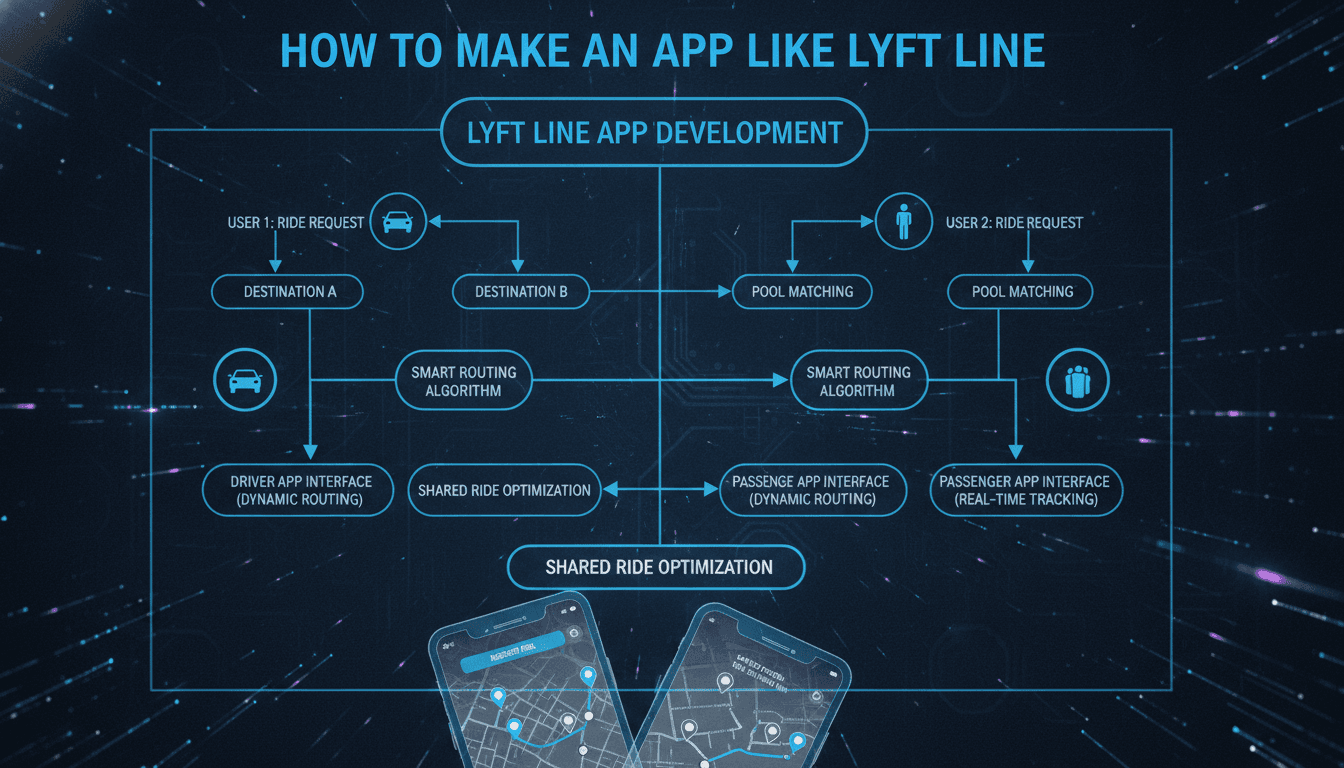
Building an app like Lyft Line is more than putting a "share this ride" toggle on a standard taxi app. It requires real-time matching logic, dynamic route optimization, and pricing that stays fair when a second or third passenger joins mid-trip. This guide walks through what it actually takes.
If this is relevant to your project, check out How to Make an App Like UberPool.
What Makes Lyft Line Different from a Standard Ride-Hailing App
A traditional ride-hailing app solves a relatively simple problem: connect one rider to one nearby driver, then navigate from A to B.
For a closer look at a related topic, read our guide on How to Make an App Like Rideshare.
A shared-ride app has to solve a much harder one. At any moment it must decide:
- Should this new request be matched to an existing trip, or dispatched as a fresh ride?
- Will adding this rider push the current passenger's ETA beyond an acceptable detour threshold?
- What is the optimal pickup and drop-off sequence for two, three, or four passengers?
- How should the fare be split so every rider feels they got a deal and the driver still earns fairly?
These decisions must happen in milliseconds, continuously, across thousands of concurrent trips. That's the core engineering challenge.
Core Features to Build
Rider App
Onboarding and profile Phone-based signup with OTP verification, social login options, profile photo, and emergency contacts. Keep friction low — every extra field costs you signups.
Shared vs. solo ride selection A clear comparison screen showing fare, estimated pickup time, and expected trip duration for each option. Transparency here is what makes riders willing to share.
Smart pickup points Rather than picking riders up at their exact door, shared-ride systems often suggest a nearby corner or main road that reduces detours. This requires a curated or algorithmically generated database of viable pickup nodes.
Live matching status Riders need to see what's happening: "Looking for a match," "Matched — picking up one more rider," "On the way." Uncertainty is the biggest source of cancellations.
Co-rider visibility Show first names, photos, and how many passengers will share the vehicle. Include a mechanism to report an uncomfortable co-rider.
Fare breakdown and split billing Each rider pays only their own portion. Show clearly how the shared fare compares to the solo price.
Safety toolkit Share trip status with contacts, in-app emergency button, driver and vehicle details, and post-trip ratings for both driver and co-riders.
Driver App
Multi-stop trip queue The defining driver-side feature. Instead of a single destination, drivers see an ordered list of pickups and drop-offs that updates as new riders are added.
Turn-by-turn navigation with live re-routing When a new passenger is inserted into the route, navigation must update seamlessly without the driver having to interact with the screen.
Passenger checklist Clear indicators for who's been picked up, who's still waiting, and who gets dropped off next. Include passenger count verification.
Earnings dashboard Per-trip and per-segment earnings, incentive progress, and payout history. Drivers accept shared rides only if the math works for them.
Acceptance controls Let drivers set preferences and see how shared-ride requests affect their utilization.
Admin Panel
- Live map of all active trips, drivers, and pending requests
- Matching algorithm configuration: maximum detour time, maximum wait time, vehicle capacity limits
- Surge and discount rule management by zone and time window
- Driver onboarding, document verification, and background-check workflow
- Dispute resolution, refunds, and rider/driver support tooling
- Analytics: match rate, average detour, vehicle occupancy, cancellation reasons, unit economics per ride
The Matching and Routing Engine
This is where your app either works or doesn't.
Ride Matching
The underlying problem is a variant of the Dial-a-Ride Problem (DARP) — an NP-hard optimization challenge. You won't solve it exactly in production. Instead, you'll use heuristics:
- Geospatial filtering. Use geohashing, H3 hexagonal indexing, or an R-tree to narrow candidates to trips within a plausible radius. This reduces the search space from thousands to dozens.
- Feasibility checks. For each candidate trip, test insertion of the new rider at every possible position in the route sequence. Reject any insertion that violates detour limits, capacity, or existing rider ETA promises.
- Cost scoring. Score feasible insertions on added distance, added time for existing riders, driver deadhead miles, and expected revenue. Pick the best.
- Delayed matching. Holding a request for 20–60 seconds before dispatch dramatically improves match quality, because more requests enter the pool. Balance this against rider impatience.
Route Optimization
Once a trip has multiple stops, you need the optimal visiting order subject to precedence constraints (a rider must be picked up before being dropped off). For small stop counts, brute-force permutation is viable. Beyond that, use insertion heuristics with local search improvements like 2-opt.
To explore this further, see How to Make an App Like Scoop.
Integrate a routing engine that accounts for real traffic. Options include Google Maps Routes API, Mapbox Directions, HERE, or a self-hosted OSRM/Valhalla instance if you need cost control at scale.
Dynamic Pricing
Shared-ride pricing typically works like this:
- Quote each rider an upfront fare based on their individual origin-destination pair
- Apply a shared-ride discount (commonly 20–50%) reflecting expected match probability
- Absorb the risk when no match is found — the rider still pays the discounted price
- Compensate the driver based on total distance and time driven, plus per-passenger bonuses
You'll need a pricing service that models match probability by zone and time of day. Get this wrong and you either bleed money on unmatched rides or quote fares so high nobody chooses shared.
Recommended Tech Stack
Mobile Apps
| Approach | Best For |
|---|---|
| Native (Swift / Kotlin) | Maximum performance, best background-location reliability, smoothest maps |
| Flutter | Fast cross-platform delivery with near-native performance; strong map plugin ecosystem |
| React Native | Teams already invested in JavaScript; good for the rider app specifically |
For the driver app, lean native or Flutter. Background location tracking, battery optimization, and uninterrupted navigation are unforgiving on hybrid stacks.
Backend
- Language/Framework: Go or Node.js for the real-time dispatch services; Python for pricing models and ML; Java/Kotlin or Elixir are also strong choices
- Architecture: Microservices — separate services for identity, dispatch/matching, routing, pricing, payments, notifications, and trip history
- Real-time transport: WebSockets or MQTT for location streaming; gRPC for internal service communication
- Event streaming: Apache Kafka for location events, trip state changes, and analytics pipelines
Data Layer
- PostgreSQL + PostGIS for transactional data and geospatial queries
- Redis for driver location caching, geo-indexing (GEOADD/GEOSEARCH), matching locks, and session state
- Cassandra or TimescaleDB for high-volume location history
- Elasticsearch for search and operational analytics
Infrastructure
- Kubernetes on AWS, GCP, or Azure with regional deployment close to your operating cities
- Autoscaling tuned to commute peaks — traffic is extremely bursty
- Managed Kafka, managed Postgres, and CDN for static assets
- Observability: Prometheus, Grafana, distributed tracing via OpenTelemetry
Third-Party Integrations
- Maps and routing: Google Maps Platform, Mapbox, or HERE
- Payments: Stripe, Braintree, Adyen; regional wallets where relevant
- Communications: Twilio for SMS and masked calling; Firebase Cloud Messaging and APNs for push
- Identity and compliance: Checkr, Onfido, or Persona for driver background checks and document verification
Development Process
1. Discovery and Market Validation
Pick a launch city. Study its commute corridors, existing ride-hailing penetration, regulatory environment, and public transit gaps. Shared rides only work at density — validate that you can reach critical mass in your target geography.
2. Define the MVP
Resist the urge to ship everything. A viable MVP includes: rider signup, solo and shared booking, basic matching for two riders, driver app with multi-stop navigation, in-app payments, ratings, and an admin dashboard. Everything else — scheduled rides, corporate accounts, multi-city support, loyalty programs — comes later.
3. UX and Prototyping
Wireframe the matching experience carefully. The moment of "waiting to be matched" is the most fragile part of the funnel. Prototype and test it with real users before you write production code.
4. Build in Parallel Tracks
Run backend dispatch development alongside mobile app work, with a well-defined API contract between them. The matching engine should be built with a simulation harness so you can test it against synthetic demand before any real driver is on the road.
5. Simulate Before You Launch
Replay historical or synthetic trip data through your matching engine. Measure match rate, average detour, and vehicle occupancy. Tune your parameters here, not in production with real customers.
6. Test Rigorously
Beyond standard QA: GPS drift testing, tunnel and parking-garage signal loss, battery drain over 8-hour driver shifts, concurrent matching race conditions, and payment failure recovery.
7. Launch Narrow, Then Expand
Launch in a few high-density corridors rather than city-wide. Concentrated supply and demand produce higher match rates, which produce better rider experience, which produces growth.
Cost and Timeline
Real numbers depend on team location, scope, and quality bar. A reasonable planning range:
| Scope | Timeline | Indicative Cost |
|---|---|---|
| MVP (one city, two-rider matching, iOS + Android + admin) | 4–6 months | $80,000 – $150,000 |
| Production-grade platform (advanced matching, dynamic pricing, full ops tooling) | 8–12 months | $180,000 – $350,000 |
| Multi-city, high-scale platform | 12–18+ months | $400,000+ |
Ongoing costs are easy to underestimate. Budget for maps API calls (these scale with trips and can become your largest single line item), SMS and push, cloud infrastructure, payment processing fees, background checks, and a support team.
Monetization Models
- Commission per ride — the standard model, typically 15–30% of fare
- Subscription passes — a monthly fee for discounted or capped shared-ride pricing, popular for commuters
- Corporate and campus programs — contracted commute solutions for employers and universities
- Surge premiums — higher take during peak demand
- In-app advertising — location-relevant offers, used carefully to avoid degrading experience
- Driver services — optional paid tiers for better dispatch priority or vehicle financing partnerships
Challenges You Should Plan For
The cold-start problem. Shared rides need both riders and drivers at density. Early on, you'll subsidize both sides. Model that burn honestly before you launch.
Match rate vs. wait time. Longer matching windows improve efficiency but frustrate riders. This tradeoff needs continuous tuning per zone and time of day.
Detour tolerance. Riders accept shared rides for the discount but abandon the product if trips take far longer than promised. Cap detours conservatively at launch.
Driver economics. Shared rides mean more stops, more passenger interactions, and more complexity per trip. If per-hour earnings don't clearly exceed solo rides, drivers will opt out.
Safety and trust. Putting strangers in a car together raises the stakes. Invest in identity verification, co-rider ratings, in-ride audio recording options where legal, and responsive incident response.
Regulation. Ride-hailing rules vary enormously by jurisdiction — licensing, insurance minimums, driver classification, accessibility mandates, and data residency. Engage local counsel early.
Battery and data consumption. Continuous GPS and navigation drain phones fast. Optimize location polling frequency aggressively and use platform-specific background modes correctly.
Making It Better Than the Incumbents
The shared-ride category is mature but far from perfect. Real openings exist:
- Transit integration. Position shared rides as first-mile/last-mile connections to trains and buses rather than a substitute for them.
- Predictive matching. Use historical demand patterns to pre-position drivers and pre-match commuters on recurring routes.
- Verified commuter pools. Restrict matching within corporate or campus networks for a higher-trust experience.
- EV-first fleets. Shared electric rides are a genuinely differentiated sustainability story, and increasingly one customers will pay for.
- Accessibility. Wheelchair-accessible shared options remain badly underserved in most markets.
Final Thoughts
An app like Lyft Line is one of the harder consumer products to build well. The user interface is deceptively simple; the system behind it is a continuous, real-time optimization problem operating under tight latency budgets and unforgiving user expectations.
The teams that succeed treat matching quality as their core product, not a feature. They launch narrow, instrument everything, simulate relentlessly, and tune based on real corridor data rather than assumptions. Get the matching engine and the unit economics right in one city, and expansion becomes a repeatable playbook.
Have a project in mind? Contact Sodio Technologies to discuss your requirements and explore the right technology solution for your business.
/// Work with us
Talk to the engineers who'd build it
You'll get a technical scope, timeline and cost estimate from the people doing the work, not an account manager. In-house team, no subcontracting, since 2016.