

How to Make an App Like Mint
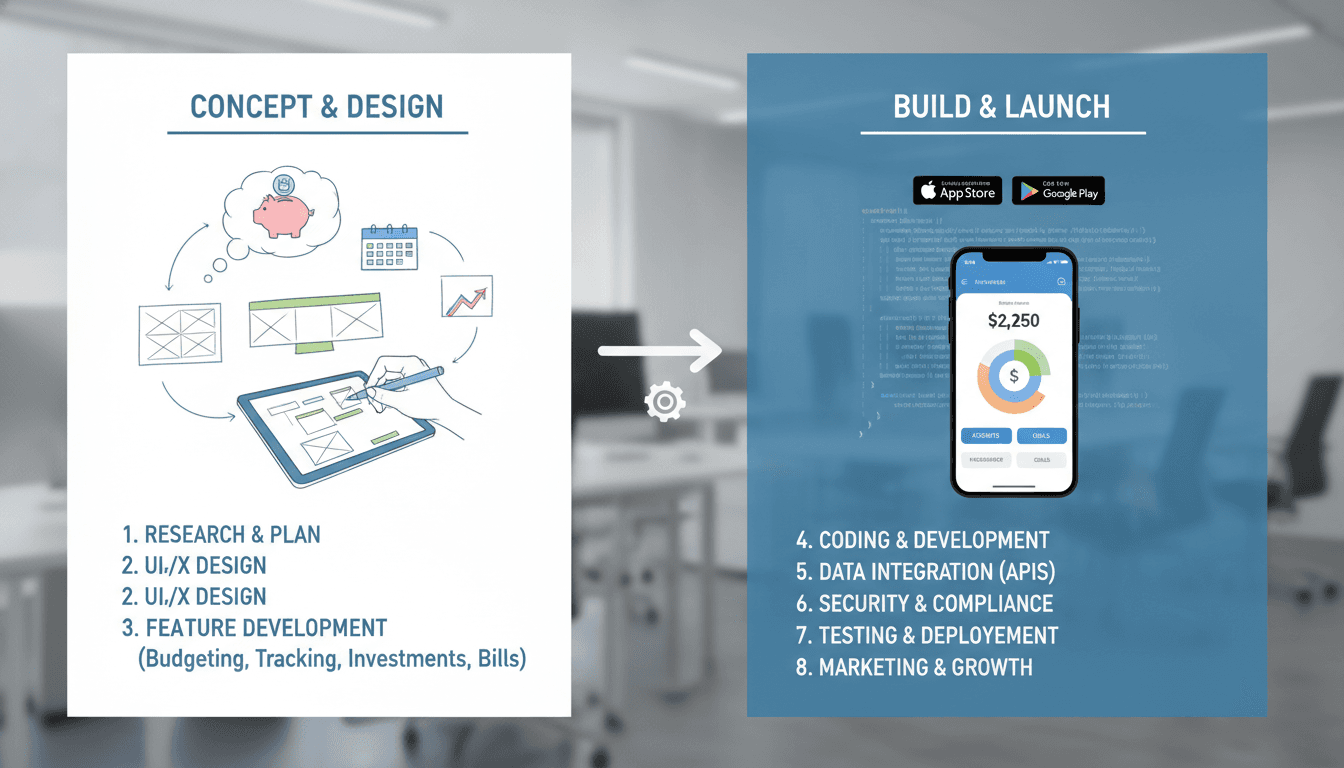
A practical breakdown of the architecture, data integrations, regulatory constraints, and engineering decisions that go into building a personal finance app that actually works at scale.
What Does Mint Actually Do Under the Hood?
Mint aggregates financial data from hundreds of institutions, categorises transactions automatically, tracks budgets, and surfaces alerts. The user-facing product looks simple. The engineering underneath is not.
The core technical challenge is not the UI. It is reliably connecting to thousands of banks and credit unions with wildly inconsistent APIs, normalising the data that comes back, and running categorisation logic fast enough that users see fresh data when they open the app. Every other feature, budgeting, net worth tracking, bill reminders, sits on top of that data pipeline.
Related reading: How to Make an App Like PocketGuard.
If you are building something in this category, the first decision you need to make is whether to build your own financial data aggregation layer or use a third-party aggregator.
Should You Build Your Own Bank Aggregation Layer or Use Plaid?
This is where most teams underestimate the problem.
Connecting to a single bank via screen scraping or direct API is manageable. Connecting to 10,000 institutions across multiple countries, handling MFA flows, token refresh, OAuth 2.0 variations, and daily breakage from bank-side UI changes, is a full-time infrastructure problem. Plaid, Yodlee, MX, and Finicity exist because this problem is genuinely hard and the maintenance surface is enormous.
What third-party aggregators give you:
- Coverage across 12,000+ institutions in the US alone (Plaid's stated number)
- Normalised transaction schemas so you are not writing institution-specific parsers
- Handled consent flows and credential storage that reduce your PCI and SOC 2 scope
- Webhook support for real-time balance and transaction updates
What they cost you:
- Per-connection pricing that compounds as you scale. Plaid's pricing for high-volume apps has historically been in the range of $0.30 to $1.50 per active user per month, depending on tier and negotiation
- Vendor lock-in on a core data dependency
- Rate limits and uptime SLAs that are not yours to control
Building your own aggregation layer using the Financial Data Exchange (FDX) API standard makes sense only if you are targeting a narrow set of institutions that all support FDX, or if you have the engineering headcount to maintain it. For most teams, start with Plaid or MX and revisit at 500,000+ active users when the unit economics shift.
The Transaction Categorisation Problem
Raw bank data is noisy. A transaction labelled "SQ *BLUE BOTTLE SF" needs to become "Coffee" under "Food & Drink." Mint built a categorisation engine that handles millions of transactions per day.
There are two practical approaches.
Rule-Based Categorisation
You maintain a merchant lookup table and a set of string-matching rules. Relatively fast to implement, easy to audit, and predictable. The problem is coverage. The long tail of merchant names is essentially unbounded, and rules break whenever a merchant changes their billing descriptor.
ML-Based Categorisation
Train a text classification model on labelled transaction data. A fine-tuned BERT variant or even a lighter model like fastText performs well here because transaction descriptions are short and the label space is relatively constrained (most apps use 20 to 40 top-level categories). The tradeoff is you need labelled training data to start, and the model needs retraining as new merchants appear.
To explore this further, see How to Make an App Like Personal Capital.
In practice, production systems use both. The rule engine handles high-confidence known merchants. The ML model handles the rest. Human-in-the-loop correction, where users can re-categorise a transaction, feeds back into training data over time.
One thing to get right early: store the raw transaction description alongside your normalised category. You will retrain your model and you will want to re-classify historical data.
/// Not sure where to start?
Get the architecture before you commit
Tell us what you're building and we'll map the technical approach, stack, and rough timeline. No cost, no obligation, no sales call required.
What Does the Backend Architecture Actually Look Like?
A Mint-like app has three distinct data flows that need different infrastructure.
Ingestion pipeline: This is where you pull data from Plaid or your aggregation layer. It runs on a schedule (typically every 4 to 24 hours per account) and on webhook triggers for real-time updates. Use a message queue, Kafka or RabbitMQ, to decouple ingestion from processing. This matters because institution responses are slow and inconsistent. You do not want your web server threads blocking on a Yodlee API call.
Processing pipeline: Categorisation, deduplication, and enrichment run here. Deduplication is more complex than it sounds. Banks sometimes post the same transaction twice, or post a pending transaction and then a settled one with a slightly different amount. You need fuzzy matching on amount, date, and description, not a simple primary key check.
Read layer: Users query their own data, so this is a standard read-optimised store. PostgreSQL handles this fine at moderate scale. Partition by user ID and index on account ID and transaction date. For apps beyond 1 million active users, consider a columnar store like BigQuery or Redshift for analytics queries while keeping PostgreSQL for user-facing reads.
| Component | Recommended option at early scale | Consider switching at |
|---|---|---|
| Message queue | RabbitMQ | 50k+ messages/sec sustained |
| Primary DB | PostgreSQL 15+ | 5M+ users with complex queries |
| Categorisation | Rule engine + fastText | Adequate indefinitely; upgrade model as data grows |
| Aggregation | Plaid or MX | 500k+ MAU (re-evaluate unit economics) |
| Cache | Redis 7 | Add read replicas as needed |
Security and Compliance: What You Cannot Skip
Financial data is regulated. In India, apps handling financial account data fall under RBI's Account Aggregator framework since 2021. In the US, GLBA applies if you receive data from financial institutions, and state-level privacy laws like CCPA add additional obligations. In the EU, PSD2 governs open banking data access.
If this is relevant to your project, check out How to Make an App Like Wally.
The practical engineering implications:
Field-level encryption for sensitive data at rest. Use AES-256 for stored account credentials or tokens. Never log raw bank credentials anywhere in your stack.
Enforce mutual TLS on all connections between your services and your aggregation provider. Certificate pinning on the mobile client reduces the risk of MITM attacks on user sessions.
Credential storage for any bank passwords your system holds (if not using OAuth) must use HSM-backed key management. AWS KMS or GCP Cloud HSM both work. Do not roll your own.
Audit logging is not optional. Every access to a user's financial data needs a timestamped, immutable log entry. This is both a compliance requirement and essential for debugging your categorisation pipeline when users report errors.
Plan for SOC 2 Type II certification if you are selling to US users. It takes 6 to 12 months of evidence collection after you have controls in place. Start the control framework on day one, not after your first enterprise customer asks for the report.
Conclusion
Building a Mint-like app is a data engineering problem more than a product design problem. Get the ingestion pipeline right, choose your aggregation layer carefully, and treat categorisation as a system you will iterate on rather than ship once.
The one concrete next step: before writing any application code, map out which institutions you need to connect to and whether a single aggregator covers them. That decision constrains your architecture, your compliance obligations, and your unit economics more than anything else you will choose in the first six months.
FAQ
How long does it take to build a personal finance app like Mint? A functional MVP with account aggregation, transaction categorisation, and basic budgeting takes 4 to 6 months with a team of 4 to 6 engineers. Production-ready security controls, compliance documentation, and a polished mobile client typically push the timeline to 9 to 12 months before a public launch.
What is the cheapest way to integrate bank data for a fintech app? Using Plaid's development tier is free up to 100 items, which is enough for a prototype. For production, MX and Finicity sometimes offer more competitive per-connection pricing than Plaid for smaller volume tiers. The cheapest option is rarely the right one once you factor in institution coverage and uptime reliability.
Do I need an NBFC licence to build a Mint-like app in India? For read-only account aggregation in India, you need to integrate with a licensed Account Aggregator (AA) entity under the RBI framework rather than hold a licence yourself. If you are only reading data and not facilitating credit or payments, you operate as a Financial Information User (FIU), which requires registration but not an NBFC licence.
How does transaction deduplication work in practice? You cannot rely on transaction IDs alone because institutions assign them inconsistently. A practical approach is to hash a composite of amount, date (within a 2-day window), account ID, and a normalised merchant name. Flag matches above a similarity threshold as probable duplicates, then apply a short hold period before surfacing the transaction to the user.
What data does Plaid actually store, and should that concern me? Plaid stores tokenised access credentials and a copy of the transaction data it has fetched on your behalf. Their privacy policy and data deletion API let end users revoke access. For apps with strict data residency requirements, this is a genuine concern. MX and some regional aggregators offer on-premise or private-cloud deployment options that keep raw financial data within your infrastructure boundary.
Have a project in mind? Contact Sodio Technologies to discuss your requirements and explore the right technology solution for your business.
/// Work with us
Talk to the engineers who'd build it
You'll get a technical scope, timeline and cost estimate from the people doing the work, not an account manager. In-house team, no subcontracting, since 2016.