

How to Make an App Like Monday.com
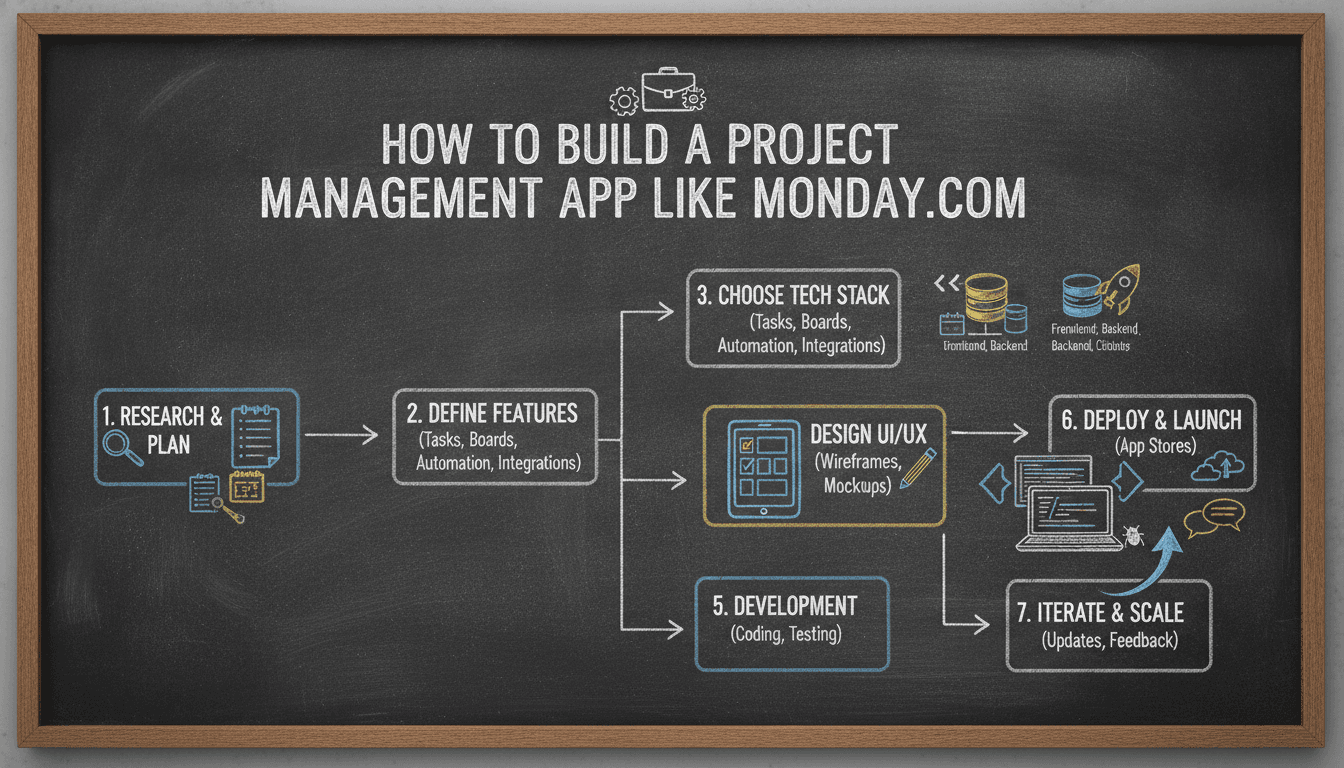
Building a project management platform like Monday.com is a serious engineering undertaking. This post breaks down the architecture, feature set, cost drivers, and trade-offs you'll face — written by engineers who've built systems in this space.
What Does "Like Monday.com" Actually Mean?
Monday.com's core is deceptively simple: a flexible, grid-based data layer where rows are work items, columns are typed fields, and views are projections of that data. The complexity lives in the edges — real-time collaboration, automation pipelines, permission hierarchies, third-party integrations, and a notification system that has to work across web, mobile, and email without becoming noise.
Before writing a line of code, you need to decide what subset of that problem you're solving. A team-facing internal tool is a very different build from a product you plan to white-label or scale to 50,000 seats. The architecture diverges early.
Core Architecture: What's Actually Under the Hood
The Data Model
Monday.com's data model is essentially a schemaless board where column types define behaviour rather than database schema. You're building something closer to a low-code spreadsheet engine than a traditional CRUD app.
A practical implementation looks like this:
- A
boardstable with metadata - An
itemstable (rows), linked to boards - A
column_valuestable storing serialised JSON per cell, keyed by(item_id, column_id)
This gives you schema flexibility, but it creates query performance problems at scale. Postgres JSONB with GIN indexes handles moderate load well. At serious scale (millions of rows), you'll want to move hot data to a columnar store or cache aggressively with Redis.
Column types you need on day one: text, number, status (enum), date, person (user reference), file attachment, and formula. Each type needs its own validation, rendering, and filtering logic. Don't underestimate formula columns — they alone can take weeks to get right.
Real-Time Collaboration
This is where most teams underestimate effort. Real-time sync across multiple users editing the same board requires a WebSocket layer, conflict resolution, and a way to replay state for users who reconnect mid-session.
WebSocket via Socket.io or native ws on Node.js works fine at low concurrency. At higher scale, you need a pub/sub broker. Redis Streams or Kafka both work; Kafka adds operational overhead that's not worth it until you're handling tens of thousands of concurrent users.
For conflict resolution, operational transformation (OT) is the academically correct answer. In practice, most project management tools use simpler last-write-wins semantics with optimistic UI updates, which is acceptable for board-level edits where simultaneous same-cell edits are rare.
Automation Engine
Monday.com's automations ("When status changes to Done, notify person") are the feature that drives the most retention. Building this means building a rule engine.
A trigger-condition-action model works well. Store rules as JSON, evaluate them on state-change events from your backend, and execute actions via a worker queue (BullMQ on Redis, or SQS if you're on AWS). Keep the executor stateless so it scales horizontally.
Third-party action integrations (Slack, Gmail, Jira) should go through an abstraction layer so you can add connectors without touching core engine logic.
/// Not sure where to start?
Get the architecture before you commit
Tell us what you're building and we'll map the technical approach, stack, and rough timeline. No cost, no obligation, no sales call required.
What Does It Cost to Build?
Cost splits across three phases. These are directional figures based on typical team compositions; your numbers will vary depending on geography, seniority mix, and scope.
| Phase | Scope | Rough Duration | Team Size |
|---|---|---|---|
| MVP (web only) | Boards, items, basic column types, user auth | 4–6 months | 3–4 engineers |
| V2 (collaboration + automations) | Real-time, rule engine, notifications | 3–5 months | 4–6 engineers |
| Scale & integrations | Performance, mobile, OAuth integrations | Ongoing | 5–8 engineers |
MVP with a small, experienced team in India typically runs between ₹60–90 lakhs. The same team in Western Europe or North America is 3–4x that. If you need mobile (iOS + Android) from the start, add 30–40% to your estimate.
The hidden cost is maintenance. A platform of this complexity generates a steady stream of edge cases, performance regressions, and integration failures. Budget for at least two engineers on maintenance from month seven onwards.
How Long Does It Take to Build?
A usable MVP — boards, drag-and-drop items, basic views, user accounts, and email notifications — is achievable in 16–20 weeks with the right team. That assumes no platform pivots mid-build and product requirements that are locked for the first two months.
Real-time collaboration adds six to ten weeks. The automation engine, done properly, adds another eight to twelve. Mobile apps, if built in Flutter (a single codebase targeting both platforms), add roughly ten to fourteen weeks on top of a stable web API.
The realistic timeline from zero to a feature-competitive product is 12–18 months. Anyone quoting you six months for the full feature set is either scoping a very narrow product or underestimating.
Should You Build In-House or Outsource?
This is a genuine trade-off, not a sales pitch.
Build in-house if: your product is the platform, you expect to iterate for years, and you have the runway to hire and retain a strong engineering team. Ownership of the codebase matters long-term.
Outsource (or co-build) if: you need to hit a market window, you're validating product-market fit before committing to headcount, or your core business isn't software.
A common mistake is outsourcing the MVP and then struggling to hire engineers who understand the existing codebase. The handover problem is real. Whether you outsource or not, invest in documentation and keep your internal product lead technically literate.
Conclusion
Building a Monday.com-grade platform is a multi-year, multi-team effort. The architecture is tractable — the hard parts are the automation engine, real-time sync, and the combinatorial complexity of column types and view logic.
The clearest next step: define your MVP scope in terms of column types and views, not features. That forces a concrete data model conversation before you write any code, and it's the fastest way to get a reliable estimate.
FAQ
How much does it cost to build an app like Monday.com? A focused MVP covering boards, basic column types, and user management typically costs between ₹60–90 lakhs with an experienced team in India, or $200,000–$350,000 with a comparable team in North America or Europe. Real-time collaboration and automation features add significant cost on top of that baseline.
What tech stack should I use? React on the frontend with a Node.js or Go backend works well. Postgres with JSONB handles the flexible data model at moderate scale. Redis is needed early for real-time pub/sub and queue processing. For mobile, Flutter gives you a single codebase targeting both iOS and Android without maintaining two separate teams.
How is Monday.com's data model structured? It's a flexible entity-attribute-value pattern. Boards contain items (rows), and each item has typed column values stored as serialised data rather than fixed schema columns. This gives product flexibility but requires careful indexing and caching strategy to avoid slow queries as data volume grows.
What's the hardest part of building a project management tool? Real-time collaboration and the automation engine are consistently the most underestimated parts. Formula columns are also deceptively complex. The board and item CRUD is straightforward; the difficulty is in making everything feel instant and consistent for multiple concurrent users.
Can I use Monday.com's API to extend it instead of building from scratch? Yes, and for most use cases you should. Monday.com has a GraphQL API and supports custom apps via its Apps Framework. Build from scratch only if you need white-labelling, data residency control, fundamentally different pricing economics, or core features the platform won't support.
Have a project in mind? Contact Sodio Technologies to discuss your requirements and explore the right technology solution for your business.
/// Work with us
Talk to the engineers who'd build it
You'll get a technical scope, timeline and cost estimate from the people doing the work, not an account manager. In-house team, no subcontracting, since 2016.