

How to Make an App Like Money Lover
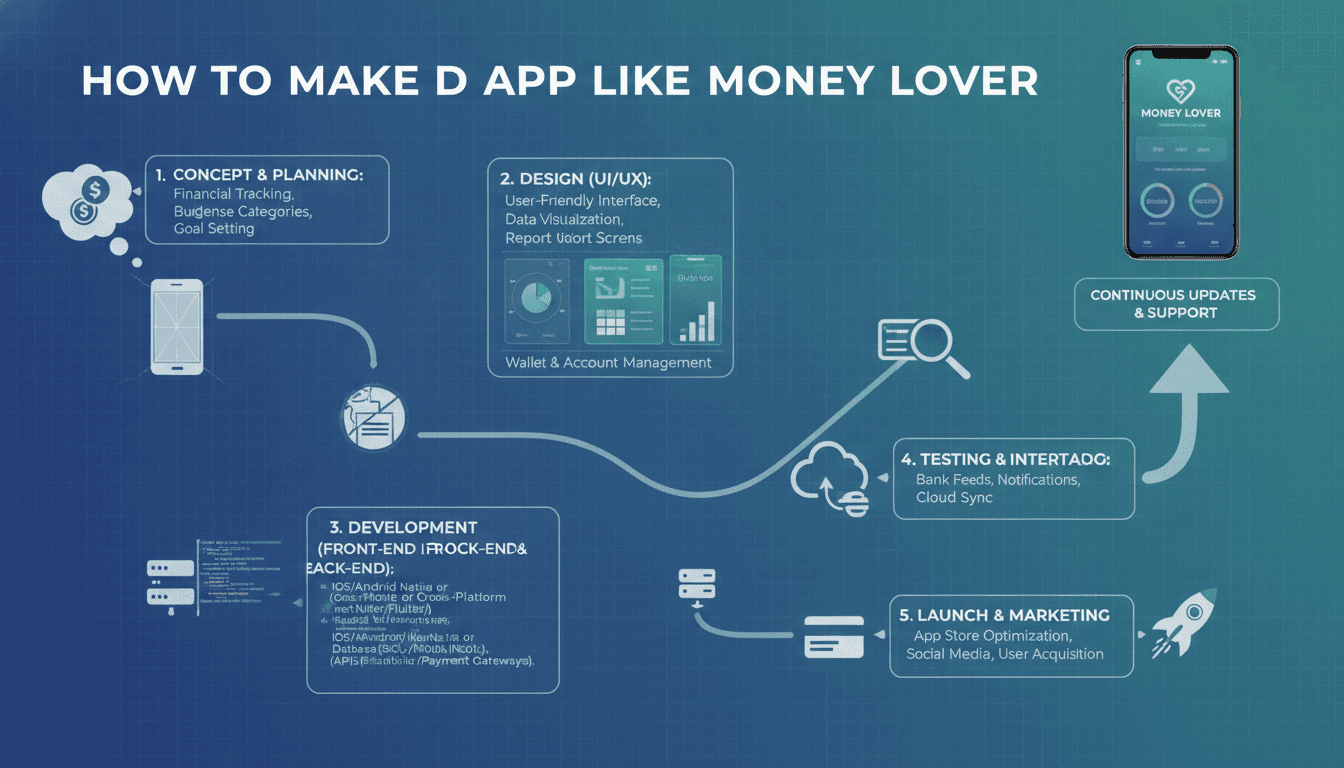
A practical breakdown of the architecture, feature set, and cost structure behind a personal finance app — written for teams who want to build something that actually works, not just something that ships.
What Does Money Lover Actually Do Under the Hood?
Money Lover is a personal finance tracker. Users log income and expenses, assign them to categories, set budgets, and get reports. The app supports multiple wallets, recurring transactions, and syncs across iOS and Android. It is not doing anything algorithmically exotic. The complexity is in the UX, the reliability of sync, and the trust users place in it with their financial data.
If this is relevant to your project, check out How to Make an App Like Fudget.
If you want to build something like it, you are building:
- A double-entry ledger engine (even if users never see it described that way)
- A real-time or near-real-time sync layer across devices
- A budgeting and goal-tracking system
- A reporting and visualisation layer
- A secure auth and data storage setup
That is the actual scope. Everything else is polish.
What Tech Stack Should You Use?
This depends on your existing team, timeline, and whether you are targeting one platform or two. Here is how we would think through it.
Mobile
React Native is the most common choice for teams building cross-platform finance apps on a budget. It gives you one codebase for iOS and Android, and the ecosystem for charting (Victory Native, React Native Chart Kit) is mature enough for most reporting needs.
Flutter is a valid alternative if your team already knows Dart or you want smoother animations at 60fps. The widget system gives you more control over the UI, and the performance on lower-end Android devices is noticeably better than React Native in our experience. The trade-off is a smaller library ecosystem and a steeper onboarding curve for engineers coming from JavaScript.
Native Swift (iOS) and Kotlin (Android) only make sense if you are building features that require deep OS integration, like HealthKit linking, widget extensions, or tight Siri Shortcuts support. For a finance tracker, this is usually overkill.
We cover a closely related subject in How to Make an App Like YNAB (You Need A Budget).
Backend
A Node.js backend with Express or Fastify works well for the transaction and budget APIs. The I/O is light and the throughput is predictable. If your team is Python-first, FastAPI with async support handles the same load with less ceremony.
For the database layer, PostgreSQL is the right call. You want ACID compliance. Financial data has no tolerance for eventual consistency bugs where a transaction appears in one wallet but not another. Use PostgreSQL 15 or later, take advantage of the improved logical replication if you are scaling read replicas, and add a Redis layer in front for session management and caching dashboard aggregates.
Sync
This is where most teams underestimate the work. If a user adds a transaction on their phone while offline, then opens the app on a tablet that has been online, you need a conflict resolution strategy. Options:
- Last-write-wins with timestamps: simple, but users lose data if clocks drift
- CRDTs (Conflict-free Replicated Data Types): technically correct, complex to implement from scratch
- Operational Transform: used in collaborative editors, overkill here
The pragmatic approach for a v1 is timestamp-based last-write-wins with a server-side audit log. Flag conflicts to the user rather than resolving silently. Most users log one transaction at a time from one device. Sophisticated conflict resolution can wait for v2.
How Do You Handle the Data Security Layer?
Users are giving you access to their most sensitive personal data. This is not something to retrofit.
Start with encryption at rest using AES-256 on your database volumes. In transit, TLS 1.3 across all endpoints. Do not store raw bank credentials if you are integrating with Open Banking APIs. Use a provider like Plaid or Saltedge, which handles the credential layer and gives you tokenised access. You take on the liability of a tokenised transaction feed, not raw login details.
For authentication, implement OAuth 2.0 with refresh token rotation. Add biometric authentication on mobile using the platform's secure enclave, not a third-party library. On iOS, this is LocalAuthentication; on Android, BiometricPrompt. These use the device's hardware-backed keystore and are significantly more secure than any software implementation.
GDPR compliance matters even if your initial market is India. If any EU user installs the app, you are in scope. Build a data deletion endpoint from day one. It is far cheaper to build it early than to retrofit it after you have complex foreign-key relationships across eight tables.
/// Not sure where to start?
Get the architecture before you commit
Tell us what you're building and we'll map the technical approach, stack, and rough timeline. No cost, no obligation, no sales call required.
What Features Actually Differentiate a Finance App?
The core feature set is table stakes. Here is what separates a good product from a forgettable one in this category.
| Feature | Complexity | User Value | Build or Buy |
|---|---|---|---|
| Recurring transaction detection | Medium | High | Build |
| Bank sync via Open Banking | High | Very High | Buy (Plaid/Saltedge) |
| Budget alerts (push + email) | Low | High | Build |
| Receipt OCR scanning | Medium | Medium | Buy (Google ML Kit) |
| Currency conversion | Low | High | Buy (Fixer.io or Exchangerate API) |
| Spending insights / AI categorisation | High | High | Buy (OpenAI or fine-tune your own) |
Receipt OCR is worth calling out separately. Google ML Kit's text recognition model runs on-device, which means no round-trip to a server and no privacy concern about uploading images of receipts. It handles printed receipts well. Handwritten receipts are a different problem and not worth solving in v1.
AI-based transaction categorisation is increasingly expected. You can train a lightweight classifier on your own transaction data once you have enough volume, or route uncategorised transactions to GPT-4o with a structured prompt. The API cost at low volume is negligible, around $0.01 per 1,000 tokens for the input tier.
How Long Does It Take and What Does It Cost to Build?
Honest answer: a production-quality personal finance app with cross-platform mobile, backend, sync, bank integration, and security done correctly takes a team of four engineers roughly six to eight months to v1.
If this is relevant to your project, check out How to Make an App Like Personal Capital.
A smaller two-person team can hit an MVP in four months if you cut scope aggressively. That means: manual transaction entry only (no bank sync), single currency, no receipt scanning, basic reporting. That is still a useful product, and it lets you validate retention before investing in expensive integrations.
Cost estimates at current market rates for a team based in India:
- 2 engineers, 4 months MVP: ₹18–25 lakh
- 4 engineers, 7 months production: ₹55–75 lakh
- With bank sync integration and compliance: add ₹10–15 lakh
These are rough figures. The actual number depends heavily on whether you are building a consumer product (high design cost) or a white-label B2B tool (lower design, higher integration cost).
Conclusion
Building a personal finance app is a well-understood problem. The risk is not technical novelty; it is underestimating the sync layer, skipping security fundamentals, or over-building features before validating that users will engage daily.
Start with manual entry, solid sync, and one clear reporting view. Prove retention over 30 days. Then add bank integration and AI categorisation when you have the data to make them useful.
If you want to talk through architecture specifics or scope out a build, reach out to us at Sodio. We have built financial and fintech products and can help you avoid the decisions that look fine in a sprint but hurt six months later.
FAQ
How much does it cost to build an app like Money Lover? A minimal viable product with manual transaction entry, budgeting, and basic reporting costs roughly ₹18–25 lakh with a two-engineer team over four months. A full production build with bank sync, multi-currency, and proper security compliance is closer to ₹65–90 lakh depending on team size and market.
Do I need to build separate iOS and Android apps? Not for most use cases. React Native or Flutter gives you one codebase that runs on both platforms. Native development only becomes necessary when you need deep OS-level integrations like widget extensions or hardware sensor access that cross-platform frameworks do not expose cleanly.
How do personal finance apps sync data across devices without losing transactions? Most use timestamp-based last-write-wins with a server-side audit log. More sophisticated implementations use CRDTs, but that adds significant engineering complexity. For most apps, surfacing a conflict to the user is safer than silently resolving it in the wrong direction.
What is the biggest technical mistake teams make when building finance apps? Underestimating the offline-first sync layer. Teams build the happy path where the user is always online and then discover edge cases in production. Building offline support from the start, with a clear conflict resolution strategy, saves significant rework later.
Should I use a third-party service for bank account integration or build it myself? Use a third party. Plaid, Saltedge, and similar providers handle bank credential security, regulatory compliance, and maintain connections to hundreds of banks. Building this yourself is a multi-year effort and puts you in scope for financial regulation you do not want to own as a product company.
Have a project in mind? Contact Sodio Technologies to discuss your requirements and explore the right technology solution for your business.
/// Work with us
Talk to the engineers who'd build it
You'll get a technical scope, timeline and cost estimate from the people doing the work, not an account manager. In-house team, no subcontracting, since 2016.