

How to Make an App Like Opendoor
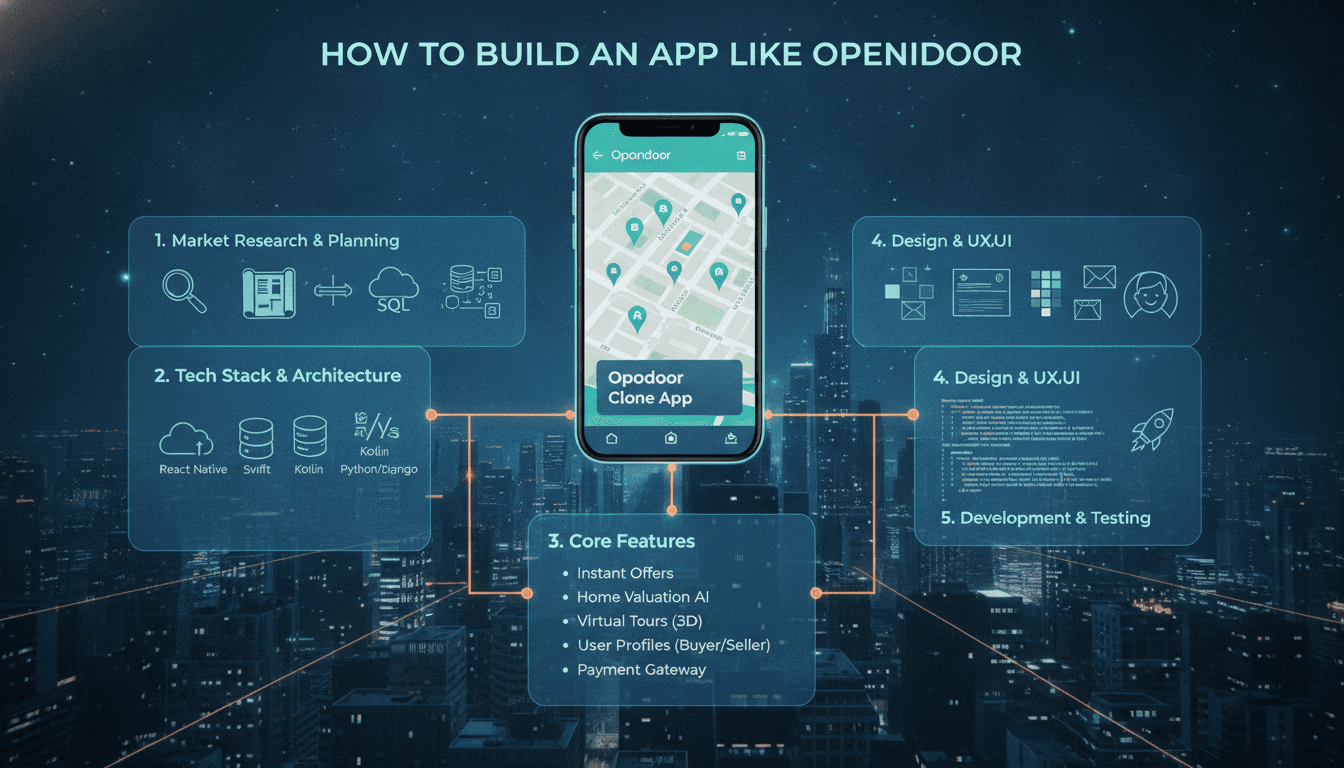
A technical breakdown of the architecture, data pipelines, and product decisions behind an iBuyer platform — what it actually takes to build one, and where most teams underestimate the complexity.
What Does Opendoor Actually Do, Technically?
Opendoor is an iBuyer. It makes instant cash offers on homes, holds them briefly, and resells them. The user-facing experience is deceptively simple: enter your address, get an offer in minutes. The engineering underneath is not simple at all.
At its core, the platform does three things: it prices residential property algorithmically, it manages a transaction workflow that spans offer, inspection, closing, and resale, and it coordinates a network of third-party services including title, escrow, and repair vendors. Each of those is a significant engineering problem on its own. Combined, they form a system where a bug in the pricing model can translate directly into financial loss on an asset worth hundreds of thousands of pounds.
That context matters when you're deciding what to build and what to buy.
The AVM: Where Most Teams Underestimate the Work
The Automated Valuation Model (AVM) is the centrepiece. It takes a property address and outputs a price. Getting that price right, consistently, across different markets and property types, is the hard part.
Data Sourcing and Normalisation
You will need structured data from multiple sources. In the US, that means MLS feeds (via RETS or RESO Web API), county assessor records, deed transfer history, and third-party enrichment providers like CoreLogic or Attom. In India or the UK, equivalents exist but the coverage and quality vary significantly by geography.
Each source has its own schema, update cadence, and quality issues. A property that sold six months ago might appear in one feed with one address format and in another with a different one. Deduplication and entity resolution are non-trivial. Plan for a dedicated data engineering effort before a single ML model is trained.
The Model Itself
Most teams start with a gradient boosting approach, XGBoost or LightGBM, trained on comparable sales (comps). Features include square footage, bedroom/bathroom count, lot size, year built, school district ratings, distance to amenities, and recent sale prices of nearby properties.
The challenge is recency. Property markets move. A model trained on data from 18 months ago will misprice in a rising or falling market. You need a retraining pipeline, not a one-time training job. At Opendoor's scale, that means near-daily retraining with drift monitoring. For a smaller team, weekly retraining with manual review of outlier predictions is a reasonable starting point.
Confidence intervals matter as much as point estimates. The model should output a range, and your offer logic should factor spread into the bid. A wide confidence interval on a property is a signal to either pass or widen your margin, not to offer at the midpoint.
What Does the Transaction Workflow Look Like Under the Hood?
The pricing model is only 20% of the problem. The other 80% is orchestrating what happens after someone accepts an offer.
State Machine Design
Model the transaction as a finite state machine. States include: offer made, offer accepted, inspection scheduled, inspection complete, repair estimates generated, adjusted offer sent, closing scheduled, title cleared, funds disbursed, property listed, and sold. Each transition has pre-conditions, triggers, and side effects.
Use a durable workflow engine here. Temporal.io is a strong choice. It gives you persistent workflow state, retry semantics, and activity timeouts without you having to build that infrastructure yourself. Alternatives include AWS Step Functions if you're already AWS-native, though Step Functions has tighter limits on workflow duration and payload size.
Avoid building this as a series of microservices with async events and no central orchestration. It feels clean initially and becomes very hard to reason about when a transaction gets stuck mid-flow.
Third-Party Integrations
Title and escrow are unavoidable. In the US, companies like Doma or States Title offer API access. Outside the US, the equivalent services are often more fragmented and require more custom integration work. Budget time for this. These integrations are not documented like Stripe. Expect PDFs, phone calls, and bespoke data formats.
Inspection scheduling, repair vendor coordination, and listing syndication to portals like Zillow or Rightmove each add integration surface area. Use an integration layer with circuit breakers. When a vendor API goes down, you want the transaction to pause gracefully, not cascade into an inconsistent state.
/// Not sure where to start?
Get the architecture before you commit
Tell us what you're building and we'll map the technical approach, stack, and rough timeline. No cost, no obligation, no sales call required.
How Do You Handle the Search and Discovery Layer?
The consumer-facing property search is a solved problem in terms of tooling, but it still requires careful choices.
Elasticsearch or OpenSearch handles property search well. Geospatial queries using geo_distance and geo_bounding_box filters are performant at the scale of a city or region. For polygon-based search (draw a boundary on a map), use geo_shape queries. Index properties with pre-computed embeddings if you want to support natural language search like "3-bed with a garden near good schools."
Map rendering is usually Mapbox GL JS or Google Maps Platform. Mapbox gives you more control over tile rendering and custom styling. Google Maps has broader geocoding accuracy in more geographies. For a v1, Google Maps is the safer default. Switch if you hit cost ceilings or need custom cartography.
Property images need a CDN and on-the-fly resizing. Cloudflare Images or imgix both work. Do not serve full-resolution images directly from S3 to end users.
Build vs. Buy: Where the Decision Points Actually Are
| Component | Build | Buy/SaaS |
|---|---|---|
| AVM / pricing model | Almost always build | No off-the-shelf product matches your market |
| Transaction workflow engine | Use Temporal or Step Functions | Do not build from scratch |
| Title & escrow | Integrate via API | Always third-party |
| Property data feeds | Build ingestion, buy the data | CoreLogic, Attom, RESO |
| Search & maps | Build on Elasticsearch + Mapbox | UI libraries help, core search is custom |
| CRM / seller comms | Buy (HubSpot, Salesforce) | Integration is worth more than ownership |
The AVM is the only true moat. Everything else is plumbing. If you're a team of eight engineers trying to replicate this, focus your proprietary effort on the model and use off-the-shelf tooling everywhere else.
Conclusion
Building an Opendoor-style platform is a multi-year engineering investment. The pricing model needs real market data before it's useful, which means the data infrastructure has to come first. The transaction engine is complex enough that cutting corners on state management will cost you later. And the third-party integration surface is larger than it looks from the outside.
If you're evaluating whether to build this yourself, start with the data layer. Commission or licence property data for your target geography, build the ingestion pipeline, and train a baseline AVM on historical sales. That work alone will tell you how hard the problem is in your specific market before you've committed to the full product.
If you want a technical review of your current architecture or help scoping the build, get in touch with the team at Sodio.
FAQ
How long does it take to build an app like Opendoor? A basic v1 with AVM, offer flow, and seller-facing UI typically takes 12 to 18 months with a team of 8 to 12 engineers. That assumes data sourcing is sorted in the first quarter. A production-quality transaction workflow with third-party integrations adds another 6 months on top.
What technology stack does Opendoor use? Opendoor has publicly discussed using Python for data science, Ruby on Rails historically for backend services, and React for frontend. They run on AWS. For a new build, Python with FastAPI or Django REST Framework, React or Next.js on the front end, and PostgreSQL plus Elasticsearch is a reasonable starting stack.
How accurate does the AVM need to be? For an iBuyer model to be financially viable, the AVM needs to price within roughly 2 to 3% of actual sale price at median. Opendoor has reported median error rates around 1.9% in stable markets. In volatile markets that figure degrades and you compensate with wider offer spreads and stricter eligibility criteria.
Can you build this without real estate-specific data? No. Public data alone, such as Zillow's Zestimate API or government records, is not sufficient for AVM accuracy. You need MLS data or equivalent, which requires licensing agreements. In markets where MLS access is restricted or fragmented, the data acquisition problem can take longer to solve than the engineering.
What's the biggest technical risk in a project like this? Pricing model accuracy in edge cases. Unusual properties, non-standard lot configurations, or properties in thin markets with few comps are where the model breaks down and where you take financial risk. Building a robust review queue for low-confidence predictions and pricing them conservatively is not optional.
Have a project in mind? Contact Sodio Technologies to discuss your requirements and explore the right technology solution for your business.
/// Work with us
Talk to the engineers who'd build it
You'll get a technical scope, timeline and cost estimate from the people doing the work, not an account manager. In-house team, no subcontracting, since 2016.