

How to Make an App Like Peanut
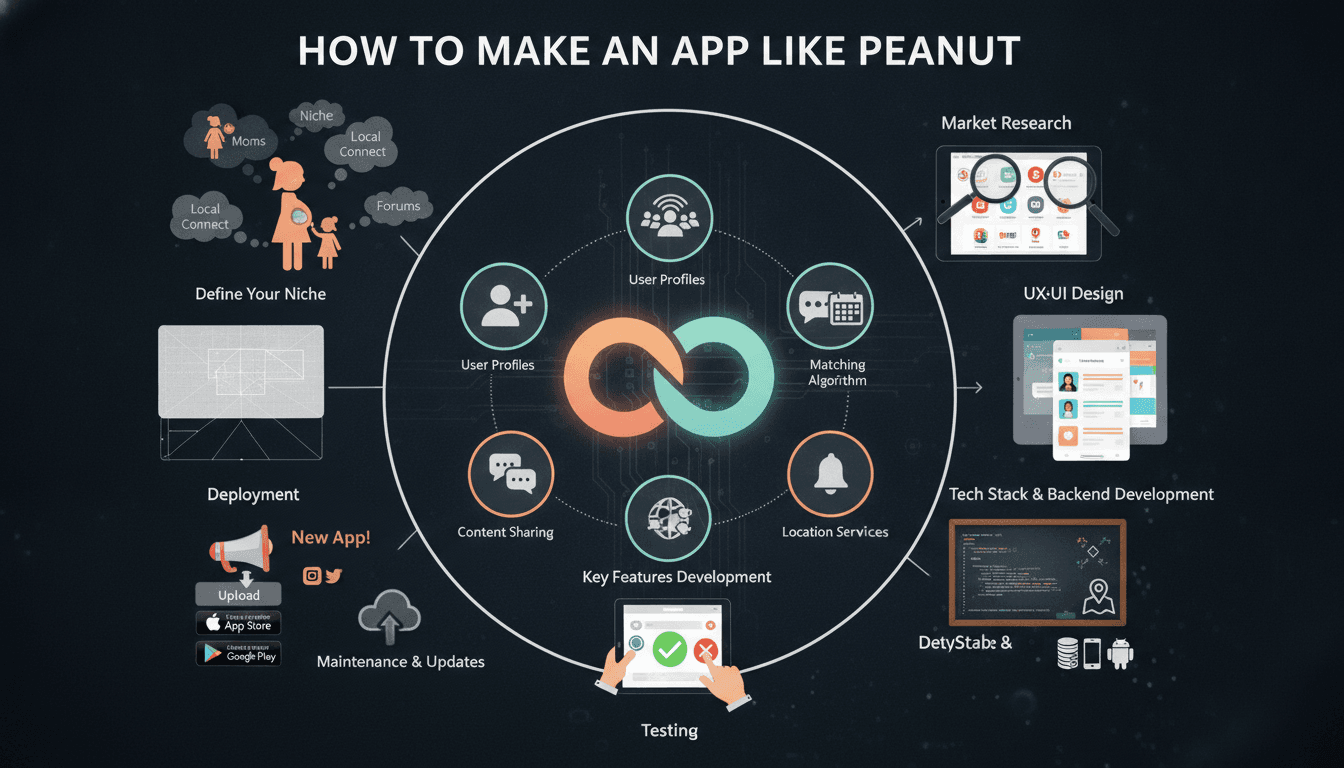
A practical breakdown of the architecture, compliance requirements, and product decisions that go into building a social payments app for women — covering wallet infrastructure, trust mechanics, and what the hard problems actually are.
What Is Peanut and Why Is It Worth Studying?
Peanut is a social finance app built specifically for women, focused on peer-to-peer lending circles, group savings, and small-group money management. It sits at the intersection of fintech and community trust mechanics. The core idea, rotating savings and credit associations (ROSCAs), is centuries old. Peanut digitised it with a clean mobile UX and layered on social accountability features.
For a closer look at a related topic, read our guide on What a Fintech MVP Actually Costs.
If you're building something similar, you're not just building a payments app. You're building a trust layer on top of financial rails. That distinction matters for every architectural and product decision you'll make.
What Tech Stack Does an App Like Peanut Actually Need?
The honest answer: less exotic than you'd expect, and more operationally complex than it looks.
Mobile Front-End
React Native is the practical choice for a first version. You get a single codebase for iOS and Android, a large hiring pool, and enough native bridge access for biometrics and push notifications. Flutter is a viable alternative if your team already knows Dart, but React Native has more mature fintech-specific libraries.
Do not underestimate the UI/UX investment. Social finance apps live or die on perceived trustworthiness. Users are handing money to people they know, coordinated by software they don't. Every interaction that feels uncertain costs you retention.
Backend and APIs
Node.js or Python (FastAPI) both work fine at the scale you'll start at. The more important decision is your payment processor. In India, that means integrating with a payment aggregator licensed under the RBI's Payment Aggregator framework — Razorpay, Cashfree, and PayU are the main options. Each has different webhook reliability characteristics and dispute handling workflows. Test all three before committing.
For group wallet logic, you need a ledger that can handle multi-party state: who has contributed, who is next in the rotation, who is overdue. A general-purpose relational database (PostgreSQL) works here. Do not reach for a blockchain unless you have a specific reason — the added complexity is rarely worth it for a product at early scale.
Notifications and Social Nudges
This is where a lot of the product differentiation lives. Peanut uses social pressure constructively: reminders, contribution confirmations, and group-visible status updates. Firebase Cloud Messaging handles push delivery. The harder part is designing the notification logic so it encourages without annoying. That is a product problem, not an engineering one, but your architecture needs to support configurable notification rules per group per user.
How Do You Handle KYC, Compliance, and RBI Regulations?
This is the part most teams underestimate.
If your app touches money movement between users, you are operating in regulated territory. In India, the relevant frameworks are:
- RBI's Prepaid Payment Instruments (PPI) guidelines if you hold balances
- Payment Aggregator (PA) licensing if you're aggregating payments
- PMLA (Prevention of Money Laundering Act) for KYC obligations
- DPDP Act 2023 for data privacy
You almost certainly do not want a full PA licence on day one. The capital requirement is ₹25 crore (net worth), and the compliance overhead is substantial. The practical path is to partner with a licensed aggregator and operate under their licence initially. This limits your product control but gets you to market faster.
KYC is non-negotiable. At minimum, you need Aadhaar-based eKYC or PAN verification for any user transacting above the RBI's minimum KYC thresholds. V-CIP (Video-based Customer Identification Process) is required for full KYC. Digilocker integration is worth evaluating for document fetch.
Transaction limits vary by KYC tier. Minimum KYC users are capped at ₹10,000 wallet balance and ₹10,000 monthly transactions. Full KYC removes these caps. Design your onboarding flow around these tiers from the start, not as an afterthought.
/// Not sure where to start?
Get the architecture before you commit
Tell us what you're building and we'll map the technical approach, stack, and rough timeline. No cost, no obligation, no sales call required.
How Do You Build the Trust Layer That Makes Group Finance Work?
This is the genuinely hard problem. The payments infrastructure is solvable. Getting people to trust the software with group money is not.
We cover a closely related subject in Split Payments and Payouts in a Two-Sided Marketplace.
Social Graph and Group Mechanics
Peanut limits groups to people who know each other. That is a deliberate product choice that reduces default risk. Your group creation flow should enforce a minimum trust signal: mutual contacts, invite-only joins, or phone number verification of an existing relationship.
For ROSCA mechanics specifically, you need to handle:
- Contribution scheduling (fixed dates, amount per member)
- Payout ordering (random draw, bidding, or fixed sequence)
- Late payment handling and grace periods
- Default resolution (what happens when someone doesn't pay)
The default resolution piece is the hardest. You have three real options: social pressure only (Peanut's primary mechanism), a guarantee fund topped up by members, or credit insurance. Each has different unit economics and risk profiles. Be explicit about which one you're implementing and communicate it clearly to users.
Dispute Resolution
Build a dispute flow before you launch. You will need one within weeks. At minimum: a structured reporting form, a human review process, and a clear policy document. Automating dispute resolution at early scale tends to produce worse outcomes than a manual process done consistently.
For a closer look at a related topic, read our guide on Card Issuing Through Transact Payments: 12 Months to a Regulated Launch.
What Does It Cost to Build and How Long Does It Take?
A realistic first version, covering group creation, KYC onboarding, contribution tracking, push notifications, and basic payout flows, takes 4 to 6 months with a team of one product manager, two mobile developers, two backend developers, and one designer. That is assuming your compliance partnerships (aggregator, KYC provider) are in place before development starts.
| Component | Estimated Timeline |
|---|---|
| KYC and compliance setup | 6–10 weeks |
| Mobile app (iOS + Android) | 12–16 weeks |
| Backend and ledger logic | 10–14 weeks |
| Admin panel and ops tooling | 4–6 weeks |
| QA and security audit | 4 weeks |
The compliance setup timeline is the one most teams get wrong. Aggregator onboarding, KYC provider contracts, and RBI-related documentation take longer than engineering. Start them in parallel, not sequentially.
Cost varies significantly by team location and seniority. A product at this scope, built with experienced developers in Bengaluru, runs between ₹60 lakh and ₹1.2 crore depending on team composition and whether you're also building internal ops infrastructure.
What Can Go Wrong That Most Founders Don't Anticipate?
Four things, specifically.
First, ledger correctness. Multi-party financial state is hard to keep consistent under concurrent writes. Use database transactions properly, write exhaustive tests for edge cases (two users paying at exactly the same time, a payout triggered mid-contribution cycle), and treat your ledger logic as the most critical code in the system.
Second, fraud at onboarding. Synthetic identity fraud is common in social finance apps. Build velocity checks and anomaly detection into your KYC flow from day one.
Third, group abandonment. Real-world ROSCAs fail when a group member defaults or goes silent. Your product needs a clear protocol for frozen groups and a way to surface this to admins before it becomes a full default.
Fourth, notification fatigue. Social nudge mechanics that work in month one become annoying by month three. Build opt-down controls, not just opt-out.
Conclusion
Building an app like Peanut is a solvable engineering problem wrapped in a genuinely difficult trust and compliance problem. The payments infrastructure exists. The KYC tooling exists. The hard work is designing group mechanics that hold up under real-world social friction, and getting your compliance stack in place before you write a single line of feature code.
If you're evaluating this build, the first step is scoping your compliance pathway: which aggregator, which KYC provider, and what your initial transaction limits will be. That decision shapes everything downstream.
FAQ
How long does it take to build an app like Peanut? A functional first version, covering KYC, group creation, contribution tracking, and payout flows, takes 4 to 6 months with a team of five to six people. Compliance setup, including payment aggregator onboarding, often takes 6 to 10 weeks and should run in parallel with development, not after it.
Do I need an RBI licence to build a group savings app? Not necessarily a direct licence. If you partner with a licensed Payment Aggregator, you can operate under their framework initially. You will still need to comply with KYC obligations under PMLA and, if you hold balances, the RBI's PPI guidelines. Get legal counsel familiar with RBI fintech regulations before making this call.
What's the biggest technical risk in a ROSCA app? Ledger correctness under concurrent writes. When multiple users contribute simultaneously or a payout overlaps with a contribution cycle, you need database-level transaction guarantees. This is not glamorous, but getting it wrong means real money goes missing or is double-counted.
Should I use blockchain for group wallet transparency? Almost certainly not at early scale. A well-structured PostgreSQL ledger with an audit log gives you the transparency you need without the operational overhead of on-chain infrastructure. Blockchain adds meaningful value when you need trustless settlement between parties who don't share a database. In a social finance app, you own the ledger.
How do I handle a user who defaults on their ROSCA contribution? You have three real options: social pressure only, a member-funded guarantee pool, or third-party credit insurance. Most early-stage apps use social pressure by default. Be explicit in your terms about what happens, and build an admin escalation flow so group organisers have a structured path when a member goes silent.
Have a project in mind? Contact Sodio Technologies to discuss your requirements and explore the right technology solution for your business.
/// Work with us
Talk to the engineers who'd build it
You'll get a technical scope, timeline and cost estimate from the people doing the work, not an account manager. In-house team, no subcontracting, since 2016.