

How to Make an App Like Personal Capital
Building a personal finance aggregator is a serious engineering undertaking. Pulling in accounts from hundreds of financial institutions, calculating net worth in real time, and doing it safely is not a weekend project. This post walks through what that actually takes — architecture, data, compliance, and the decisions that will make or break your build.
What Does an App Like Personal Capital Actually Do?
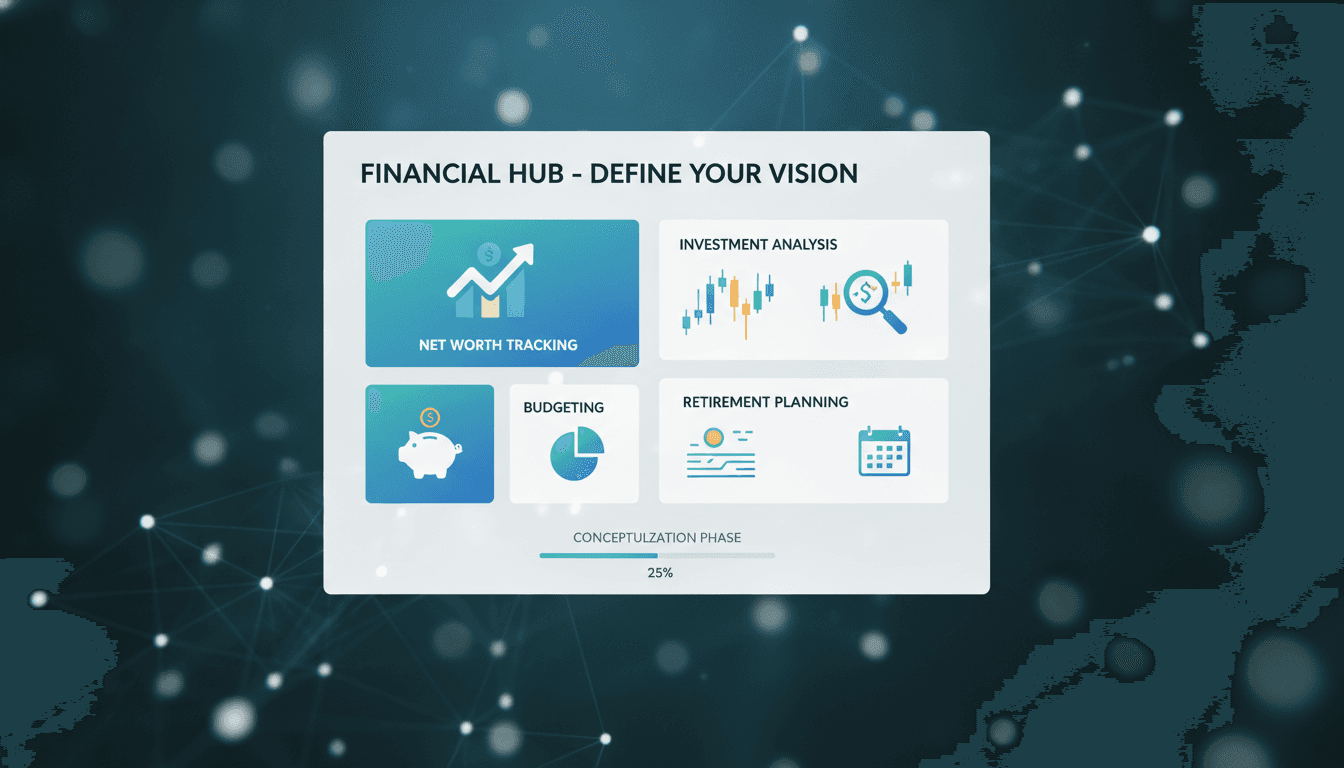
Personal Capital (now Empower Personal Dashboard) connects to users' bank accounts, investment portfolios, credit cards, and loans via aggregation APIs. It then calculates net worth, tracks cash flow, runs retirement projections, and surfaces fee analysis on investment accounts.
The feature surface looks simple in a product demo. Underneath it, you are dealing with:
- OAuth flows and credential vaulting across 14,000+ financial institutions (Plaid's network size as of 2024)
- Real-time and near-real-time transaction normalisation
- Portfolio performance calculations that account for cost basis, dividends, and currency
- Retirement Monte Carlo simulations
- A security model that has to survive SOC 2 Type II and, depending on your market, PCI-DSS or FCA/RBI scrutiny
Each of these is a sub-system worth scoping separately.
How Do You Connect to Financial Institutions?
This is the first architectural fork. You can use a data aggregation middleware layer or build direct integrations.
Using an Aggregation API
Plaid, MX, Finicity (Mastercard), and Yodlee are the dominant options. They abstract away the per-institution complexity and give you a normalised schema. Plaid's /transactions/get endpoint, for instance, returns categorised transactions with merchant enrichment already applied.
| Provider | Institution coverage | Auth standard | Approx. pricing (2024) |
|---|---|---|---|
| Plaid | 12,000+ US institutions | OAuth + credentials | $0.30–$0.50 per connected account/month |
| MX | 16,000+ institutions globally | OAuth-first | Custom, typically similar band |
| Finicity | 15,000+ | OAuth-first (US Open Banking) | Custom |
| Yodlee | 17,000+ | Mixed | Custom enterprise |
Going directly to bank APIs (Open Banking in the UK, FDX in the US, AA framework in India) is cheaper at scale but costs 18–24 months of integration work upfront and requires your own connection maintenance. The right call depends on your geography and volume. At under 100,000 connected accounts, an aggregator almost always wins on total cost.
Handling Credential-Based Fallback
Many institutions, particularly smaller credit unions and regional banks, do not support OAuth yet. Aggregators handle this through screen scraping or credential relay. If you build on Plaid or MX, this is their problem, not yours. If you go direct, you are writing and maintaining that scraping layer, and it breaks every time a bank updates its UI.
What Does the Data Architecture Look Like?
You need three distinct data layers.
Raw ingestion layer. Store exactly what the aggregator sends you, unmodified, with a timestamp and a source version. This is your audit trail. Use an append-only store — S3 or Google Cloud Storage in Parquet format works well. Never mutate this layer.
Normalised ledger. Transform raw transactions into a canonical schema: account_id, transaction_id, amount, currency, posted_date, merchant_name, category_l1, category_l2, is_pending. PostgreSQL with partitioning by posted_date handles this well up to roughly 500 million rows before you need to start thinking about columnar stores like BigQuery or Redshift.
Derived metrics layer. Net worth snapshots, portfolio returns (TWR and MWR calculated separately), spending aggregates, and projection inputs. These are computed on a schedule and cached. Redis works for sub-second net worth lookups. For retirement projections, you are running Monte Carlo simulations server-side; Python with NumPy is fast enough for 10,000-iteration simulations in under two seconds on a modest EC2 instance.
/// Not sure where to start?
Get the architecture before you commit
Tell us what you're building and we'll map the technical approach, stack, and rough timeline. No cost, no obligation, no sales call required.
How Do You Handle Security and Compliance?
This is where most fintech builds underestimate scope. Security here is not just encryption at rest and in transit.
Access Token Management
Plaid and MX return access tokens, not raw credentials. Store these tokens encrypted using AES-256, with the encryption key in AWS KMS or Google Cloud KMS. Do not store them in your application database directly. Your application should never log them.
Rotate tokens proactively. Plaid tokens do not expire by default, but you should build re-authentication flows for accounts that return ITEM_LOGIN_REQUIRED errors and audit token usage continuously.
Data Residency and Regulatory Scope
If you are building for Indian users, the RBI's data localisation requirement means transaction data must sit on servers in India. For UK users post-Brexit, FCA COBS rules apply. The US has no single federal data residency law, but CCPA (California) and state-level equivalents affect how you store and share PII.
SOC 2 Type II is the baseline trust signal for a product in this space. Budget 6–9 months for your first audit. Tools like Vanta or Drata automate a significant chunk of the evidence collection.
If this is relevant to your project, check out How to Make an App Like Mint.
Authentication
Implement MFA from day one. TOTP (RFC 6238) via Google Authenticator or Authy is the minimum. Biometric auth on mobile through platform APIs (Face ID, Android BiometricPrompt) is now expected. Passkeys (FIDO2/WebAuthn) are worth considering for new builds in 2024 — adoption is accelerating.
Building the Investment Analysis Features
Net worth tracking is the easy part. Investment analysis is where the real complexity sits.
Time-weighted return (TWR) requires you to track sub-period returns between each cash flow event. Linking them correctly across dividend reinvestments, partial sales, and transfers in kind is non-trivial. Personal Capital's fee analyser, which shows users how much they are paying in fund expense ratios over time, requires you to maintain a database of fund metadata — tickers, expense ratios, fund type — and refresh it on a schedule. Morningstar and FactSet sell this data; budget $15,000–$50,000 per year depending on the dataset depth you need.
Retirement projections are typically Monte Carlo simulations parameterised by expected return, standard deviation, and inflation assumptions. You can use historical return distributions (Damodaran's NYU dataset is publicly available) or forward-looking capital market assumptions from a data provider. Be explicit in the UI about which you are using. Users who do not understand the difference will make decisions on numbers that look more precise than they are.
Related reading: How to Make an App Like Spendee.
What Is the Right Team and Timeline?
A minimum viable version of this product, covering account linking, net worth, basic transaction categorisation, and a mobile app, takes 8–12 months with a team of six to eight engineers. That assumes you use an aggregation API rather than building direct integrations.
You may also find our article on How to Make an App Like Money Lover useful.
The breakdown roughly looks like:
- 1 backend lead (Go or Python, strong on data pipelines and security)
- 2 backend engineers (API layer, data normalisation, jobs)
- 1 data engineer (warehouse, transformations, metrics calculations)
- 2 mobile engineers (iOS Swift, Android Kotlin, or React Native if you are budget-constrained)
- 1 frontend engineer (web dashboard)
You can run this with React Native for mobile to reduce headcount, but expect some performance trade-offs on animation-heavy screens and slower access to new platform APIs.
Conclusion
The architecture of a personal finance aggregator is well-understood at this point. The hard parts are not the algorithms — they are the integration maintenance, the compliance scope, and the security model. Pick your aggregation provider before you design anything else, because that choice shapes your data schema, your error-handling logic, and your cost model.
If you are at the stage of scoping this out, the most useful thing you can do next is run a spike: connect Plaid's sandbox, ingest a week of synthetic transactions, and try to build a net worth calculation on top. The friction you hit in that spike will tell you where your team's gaps are.
FAQ
How much does it cost to build an app like Personal Capital? A serious MVP, covering account aggregation, net worth tracking, transaction categorisation, and a mobile app, typically costs $400,000–$800,000 in engineering and infrastructure over 8–12 months. Ongoing costs are dominated by aggregation API fees, data provider subscriptions, and compliance maintenance, which can run $150,000–$300,000 per year.
Do you need a financial licence to build a personal finance aggregator? In most jurisdictions, read-only aggregation that does not move money or give regulated advice does not require a financial services licence. The moment you add features like money transfers, investment recommendations, or credit products, you cross into regulated territory. Get a fintech-specialist lawyer to map your feature set to your target jurisdictions before you build.
Is Plaid the only option for bank data aggregation in India? No. India has the Account Aggregator (AA) framework, regulated by the RBI, which allows licensed AAs like Finvu, OneMoney, and CAMS FinServ to share financial data with explicit user consent via a standardised API. For an Indian-market product, the AA framework is the correct integration path, not Plaid.
How do you keep financial data accurate when banks change their APIs? If you use an aggregation middleware like Plaid or MX, they absorb most of that maintenance. If you build direct integrations, you need a dedicated team monitoring connection health, running automated reconciliation checks, and maintaining a ticketing system for per-institution issues. Plan for at least one full-time engineer doing nothing but integration maintenance once you have 50+ direct connections.
What is the biggest security risk in a personal finance app? Access token compromise. If an attacker gets your Plaid or MX access tokens, they can read the connected financial accounts until the tokens are revoked. Store tokens encrypted in a secrets manager, audit access continuously, and build automated alerts for anomalous token usage patterns. Credential stuffing at the login layer is the second biggest risk; rate limiting and MFA address most of it.
Have a project in mind? Contact Sodio Technologies to discuss your requirements and explore the right technology solution for your business.
/// Work with us
Talk to the engineers who'd build it
You'll get a technical scope, timeline and cost estimate from the people doing the work, not an account manager. In-house team, no subcontracting, since 2016.