

How to Make an App Like PocketGuard
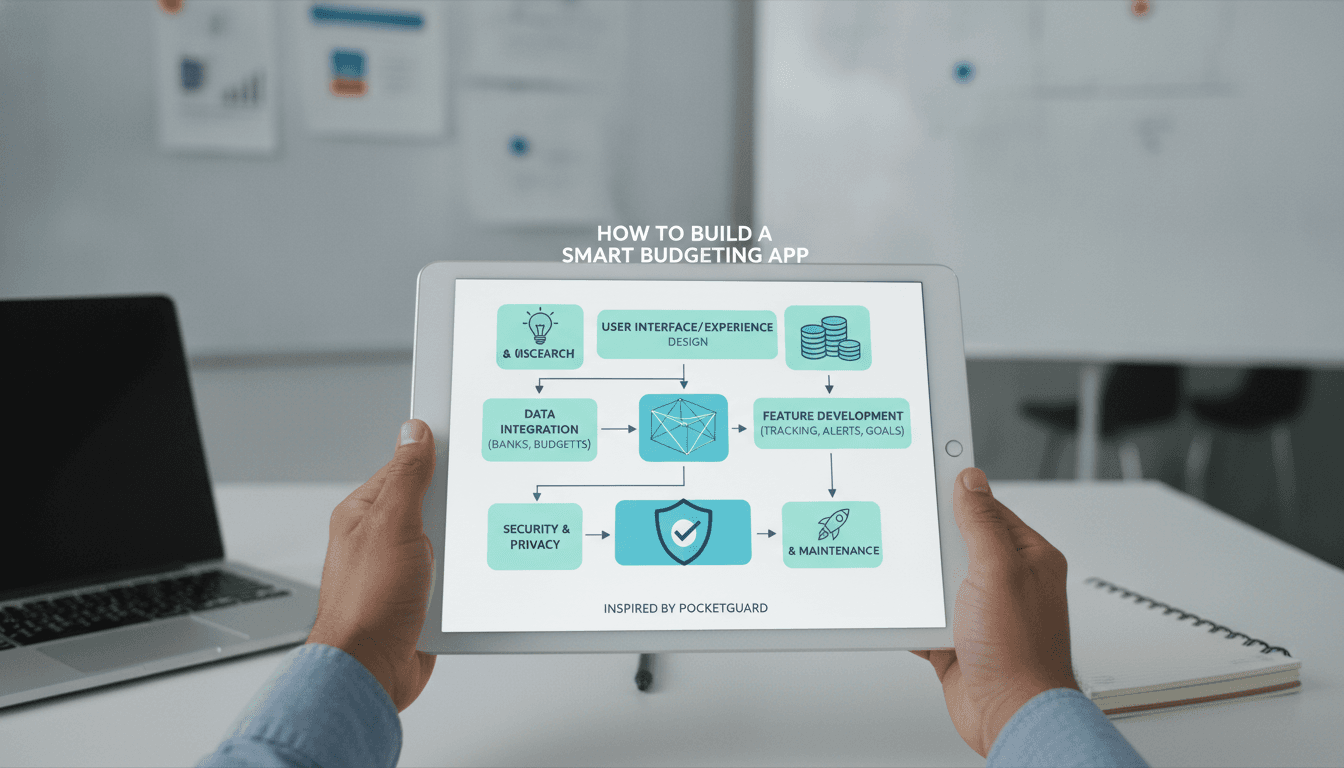
A practical breakdown of the architecture, data integrations, compliance requirements, and cost realities involved in building a personal finance app — written for technical teams who are serious about doing this properly.
What Does PocketGuard Actually Do Under the Hood?
PocketGuard is a personal finance management (PFM) app. Its core promise is simple: connect your bank accounts, categorise your transactions, show you how much you have left to spend after bills and savings. The UX is clean. The engineering underneath is not trivial.
To explore this further, see How to Make an App Like Mint.
The three things that make PFM apps genuinely hard to build are:
- Reliable, real-time bank data aggregation
- Accurate transaction categorisation at scale
- Staying compliant with financial data regulations across jurisdictions
If you're evaluating whether to build something similar, the rest of this post walks through each layer honestly.
How Do You Connect to Bank Accounts Reliably?
This is the hardest part and the one most teams underestimate.
Open Banking APIs vs Aggregators
In the UK and EU, you can use Open Banking (PSD2-compliant APIs) directly. Banks are legally required to expose read access to account and transaction data via standardised APIs. In practice, the quality varies significantly. A Tier-1 bank like Barclays or HSBC has a well-documented sandbox. A regional building society may have an API that returns inconsistent field names, drops connections under load, or simply goes dark for hours.
You may also find our article on How to Make an App Like Wally useful.
In the US, there is no equivalent regulatory mandate. You use a data aggregator: Plaid, MX, or Finicity (now part of Mastercard). Plaid is the most widely used, with connections to over 12,000 financial institutions as of 2024. Their Link SDK handles OAuth flows and credential-based screen scraping where OAuth is unavailable.
The trade-off with aggregators is cost. Plaid's pricing is per-item (connected account), per month. At scale, that bill gets serious. You also inherit their uptime SLA, their error rates, and their response latency. Plaid reports 99.9% uptime, but that still means roughly 8.7 hours of downtime per year, and bank-side failures are not included in that figure.
Building direct integrations with individual banks is possible but only makes sense if you have a small, known set of banks and a compliance team to manage the bilateral agreements. For most product teams, aggregators are the right call until you're past 500,000 active users.
Webhooks vs Polling
Both Plaid and Open Banking APIs support webhooks for transaction updates. Use them. Polling on a schedule is wasteful and introduces latency that makes your app feel stale. Set up webhook handlers that write to a message queue (Kafka or SQS both work), process asynchronously, and update the user's ledger without blocking the API response.
If this is relevant to your project, check out How to Make an App Like Spendee.
Transaction Categorisation: Rules, ML, or Both?
PocketGuard categorises transactions automatically. This sounds straightforward until you look at raw bank transaction descriptions. A Tesco charge might appear as "TESCO STORES 3255", "TSC PETROL", or "TESCO.COM". McDonald's shows up as "MCD", "MCDONALDS", and sometimes a string that includes the franchisee's company name.
Rule-based systems
A rule-based system using merchant name normalisation and keyword matching gets you to roughly 70-75% accuracy quickly. You maintain a lookup table of known merchant strings mapped to categories. It's fast, deterministic, and easy to debug. For an MVP, this is where to start.
ML-based categorisation
To get above 85% accuracy, you need a model. The standard approach is a text classification model trained on labelled transaction data. BERT-based models fine-tuned on financial transaction text perform well here. Monzo has published some detail on their categorisation pipeline, which gives useful public benchmarks.
The input features that matter most: merchant name (normalised), transaction amount, day of week, time of day, and merchant category code (MCC) if your aggregator returns it. MCC alone gets you a long way for card transactions.
Budget for ongoing retraining. Categories drift as merchants change names, new spending patterns emerge, and your user base grows into demographics your training data didn't cover well.
What Does Compliance Actually Require?
If you're storing financial data, you are in scope for multiple regulatory frameworks depending on your markets.
| Market | Relevant Framework | Key Obligations |
|---|---|---|
| UK | FCA AISP registration, UK GDPR | Explicit consent, data minimisation, 90-day re-authentication |
| EU | PSD2, GDPR | Same as UK, plus eIDAS for identity |
| US | No federal PFM law; state-level varies | CCPA in California; GLBA if you partner with banks |
| India | RBI data localisation, DPDP Act 2023 | Data must reside on Indian servers |
The 90-day re-authentication requirement under PSD2 and UK Open Banking is frequently overlooked. Your users will need to re-consent to data access every 90 days. Design this into your UX from day one. Bolting it on later is painful.
Encrypt data at rest (AES-256) and in transit (TLS 1.3). Store credentials never. Store tokens with short expiry. Run penetration testing before launch, not after.
/// Not sure where to start?
Get the architecture before you commit
Tell us what you're building and we'll map the technical approach, stack, and rough timeline. No cost, no obligation, no sales call required.
Architecture: What the Stack Looks Like in Practice
A PFM app at PocketGuard's scale has roughly these layers:
Data ingestion layer: Aggregator SDKs (Plaid Link or equivalent), webhook receivers, message queue (Kafka or AWS SQS), idempotent transaction processors.
Storage layer: PostgreSQL for relational data (accounts, users, budgets). A time-series store like TimescaleDB for transaction history, which gives you efficient range queries and aggregations without fighting a standard relational model. Redis for session state and short-lived caches.
Categorisation service: A separate microservice. It reads from the transaction queue, runs inference, writes category labels back to the transaction record. Keeping this decoupled means you can swap or retrain the model without touching the core API.
API layer: REST or GraphQL depending on your client team's preference. GraphQL has a genuine advantage here because mobile clients often need to compose account summaries, recent transactions, and budget status in a single request. Over-fetching on mobile has a real cost in battery and data.
Mobile clients: React Native is a reasonable choice for cross-platform if your team is JavaScript-heavy. Flutter gives you better UI performance on Android at the cost of a smaller hiring pool. If you're targeting iOS-first, native Swift with SwiftUI is the fastest path to a polished experience.
How Long Does This Take to Build and What Does It Cost?
Honest numbers, assuming a competent team:
An MVP with bank connection, transaction feed, basic categorisation, and simple budget tracking takes 4 to 6 months with a team of 5 to 7 engineers. That includes a backend engineer, a mobile engineer (or two for native), a data/ML engineer for categorisation, and a QA engineer. You'll spend 3 to 4 weeks of that on compliance review and Plaid integration alone.
A production-grade system with multi-currency support, goal tracking, bill detection, and spending forecasting is 12 to 18 months of work for a full team.
Plaid costs roughly $0.30 to $0.50 per connected account per month at startup-tier pricing. At 50,000 users with an average of 2 accounts each, you're at $30,000 to $50,000 per month in aggregator costs before a single line of your own infrastructure. Plan for this.
Conclusion
Building a PFM app is a solvable engineering problem. The bank connectivity layer is the biggest external dependency and the one most likely to introduce latency, reliability issues, and unexpected cost. Get your data aggregation strategy right before you design anything else.
If you're weighing whether to build this in-house or engage a specialist team, the honest answer is: the ML categorisation layer and the compliance architecture are the two areas where experience shortens the timeline most. Everything else is standard distributed systems work.
The clearest next step is to define your target markets first, because that determines which aggregators you need and which regulatory frameworks you're building against. Everything else flows from that decision.
FAQ
How long does it take to build an app like PocketGuard? An MVP with core features — bank connection, transaction feed, and basic budgeting — takes 4 to 6 months with a team of 5 to 7 engineers. A full-featured product with forecasting, bill detection, and multi-currency support is closer to 12 to 18 months depending on scope and team size.
Do I need a financial licence to build a PFM app? In the UK and EU, you need to register as an Account Information Service Provider (AISP) with your national regulator (FCA in the UK) to access Open Banking data directly. If you use an aggregator like Plaid, they hold the licence and you operate under their regulatory umbrella, which is how most startups begin.
Which bank data aggregator should I use — Plaid, MX, or build direct? Plaid has the widest US bank coverage (12,000+ institutions) and the most mature SDK. MX is a strong alternative with better analytics tooling built in. Direct bank integrations only make sense if you have a small, fixed set of banking partners and a compliance team to manage agreements. Start with an aggregator.
How accurate is automatic transaction categorisation? Rule-based systems with merchant name normalisation reach around 70 to 75% accuracy. Fine-tuned ML classifiers using transaction text and merchant category codes get to 85 to 92% depending on training data quality. Accuracy degrades over time without retraining, so budget for ongoing model maintenance from the start.
What are the biggest technical risks in building a PFM app? Bank API reliability is the top risk — even well-documented APIs have inconsistent behaviour across institutions. The second risk is the 90-day re-authentication requirement under PSD2 and UK Open Banking, which many teams design around too late. Aggregator cost at scale is the third risk that surprises teams who didn't model unit economics early.
Have a project in mind? Contact Sodio Technologies to discuss your requirements and explore the right technology solution for your business.
/// Work with us
Talk to the engineers who'd build it
You'll get a technical scope, timeline and cost estimate from the people doing the work, not an account manager. In-house team, no subcontracting, since 2016.