

How to Make an App Like Priceline
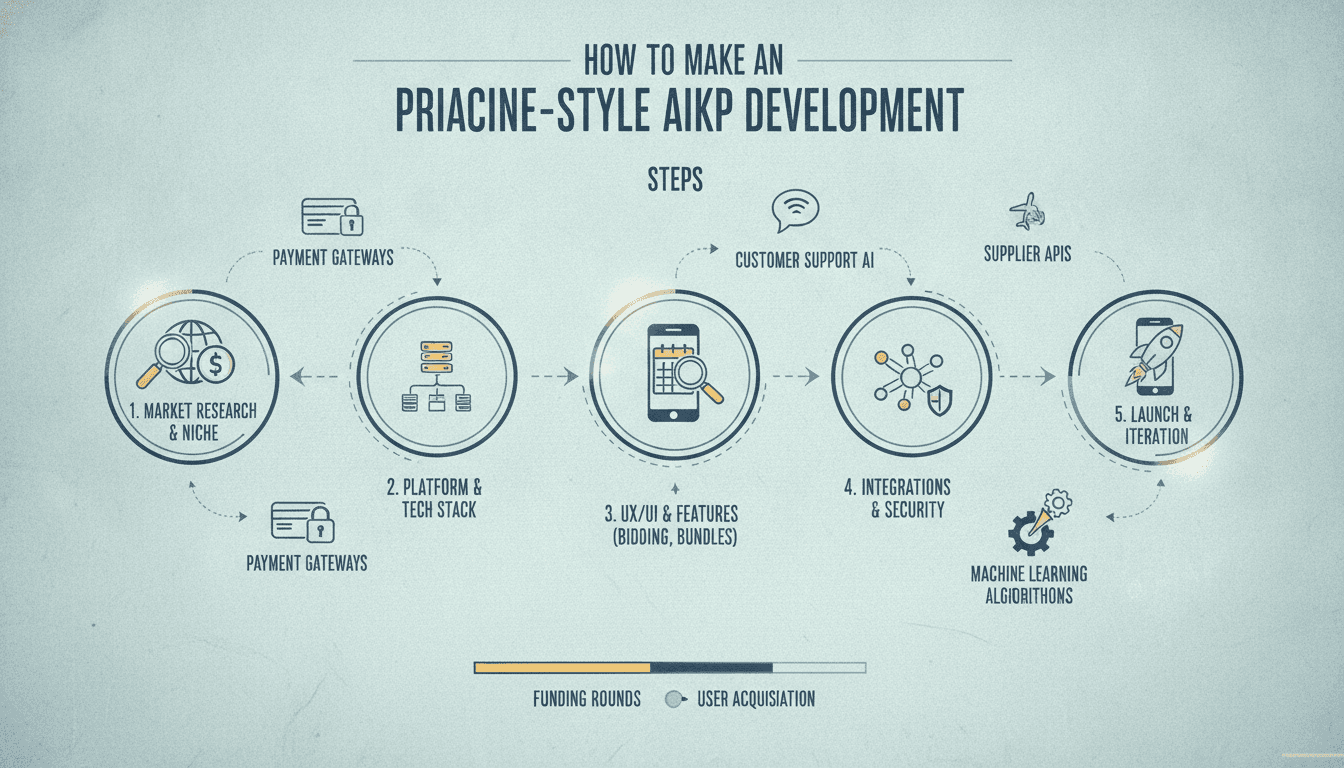
Building a travel aggregator that competes in the same space as Priceline is a substantial engineering undertaking. This post covers the architecture, integrations, and trade-offs you'll face — from GDS connectivity to dynamic pricing logic.
What Does a Platform Like Priceline Actually Do Under the Hood?
Priceline is not a travel agency. It is a real-time aggregation and pricing engine sitting between suppliers (airlines, hotels, car rental companies) and consumers. The core technical challenge is pulling live inventory from dozens of incompatible upstream systems, normalising it, applying pricing logic, and returning results in under two seconds.
There are three distinct product modes Priceline has historically operated:
- Retail mode: standard search and book, comparable to Expedia or Booking.com.
- Express Deals: opaque pricing where the brand or property is hidden until purchase.
- Name Your Own Price (NYOP): now largely deprecated, but it was a reverse-auction model where users bid and the system matched against pre-negotiated floor rates.
If you're building a competitor, you'll most likely start with retail mode and layer opaque deals later. NYOP is contractually complex and not worth the early investment.
Core Architecture: What You Need to Build First
Supplier Connectivity
This is where most teams underestimate the work. Travel inventory comes through three main channels:
GDS (Global Distribution Systems): Amadeus, Sabre, and Travelport are the big three. They provide access to airline content via APIs (Amadeus NDC, Sabre REST APIs) or legacy EDIFACT over X.25, depending on the carrier's distribution agreement. NDC (New Distribution Capability), the IATA standard, is increasingly common for direct airline content, but adoption is still uneven — as of 2024, fewer than 40% of airlines are fully NDC-capable.
Direct supplier APIs: Major hotel chains (Hilton, Marriott) and OTAs like Booking.com offer their own APIs. Rates through direct connections are often cheaper because you skip the GDS markup, but the integration work multiplies with each supplier.
Bed banks and wholesalers: Companies like Hotelbeds aggregate hotel inventory and resell it. Useful for breadth early on; margins are thinner, and you lose some rate control.
Your integration layer needs to handle authentication, rate limiting, response normalisation, and error recovery across all of these simultaneously. Build this as a set of independent adapter services, not a monolithic connector.
Caching and Inventory Freshness
Live pricing calls are expensive. A single flight search can trigger 15 to 20 upstream API calls. At any meaningful scale, you cannot make all of these synchronously on every user query.
The standard approach is a two-layer cache:
- Search cache: Store aggregated search results for 3 to 5 minutes. Stale results get flagged at the verification step.
- Booking verification: Before confirming a transaction, make a live availability check. Prices shift, seats fill, and what was available 90 seconds ago may not be now.
Apache Kafka works well for async price refresh jobs. Redis handles the hot path. PostgreSQL or CockroachDB for transactional booking records.
Pricing Engine
Priceline's pricing is not just "take the supplier price and add margin." There are several layers:
- Base rate from supplier
- Currency conversion (real-time FX, not daily rates)
- Demand-based markup (higher demand = higher margin floor)
- Promotional pricing (deal logic, member rates)
- Opaque pricing rules (for Express Deal-type products)
The demand signal can come from your own search volume data or from third-party signals. At early stage, a simpler rule-based engine is fine. ML-based dynamic pricing (using models trained on historical booking conversion rates against price points) is worth investing in after you have 6 to 12 months of clean transaction data.
/// Not sure where to start?
Get the architecture before you commit
Tell us what you're building and we'll map the technical approach, stack, and rough timeline. No cost, no obligation, no sales call required.
What Does It Cost to Build This?
Be honest with yourself about the numbers. A minimal viable aggregator, covering flights and hotels with a single GDS connection and a direct hotel API, will take a team of 6 to 8 engineers roughly 9 to 12 months to get to production quality. That's not a soft launch with known bugs. That's a system that can handle real payments and real supplier confirmations without data loss.
Cost breakdown approximation:
| Component | Estimated Build Time |
|---|---|
| GDS integration (Amadeus or Sabre) | 8–12 weeks |
| Hotel direct API integrations (5 suppliers) | 10–16 weeks |
| Search, caching, and pricing engine | 12–16 weeks |
| Booking flow, PCI-compliant payments | 8–10 weeks |
| Admin, reporting, and operations tooling | 6–8 weeks |
| QA, load testing, and security review | 6–8 weeks |
These overlap, but even running parallel workstreams, you're looking at 10 to 14 months for a production-ready v1. Infrastructure costs on AWS or GCP for a mid-traffic product (100k monthly active users) run around $8,000 to $15,000 per month, depending heavily on caching strategy.
How Do You Handle Payments and Compliance?
Payment processing in travel is more complex than standard e-commerce. You're dealing with:
PCI DSS Level 1 compliance if you store or process card data. Most teams use Stripe or Adyen to reduce scope, but you still need to pass an annual SAQ or ROC depending on volume.
Merchant of record vs. agent model: If you process the payment and remit to the supplier, you're the merchant of record and carry the liability for refunds and chargebacks. If the supplier processes payment directly, you act as agent and earn commission. The latter is simpler operationally but limits your pricing flexibility.
Refund and cancellation logic is a genuine engineering problem. Airline fare rules are encoded in structured data (ATPCO fare basis codes), and parsing them correctly to determine refundability, change fees, and penalty windows is non-trivial. Most teams get this wrong the first time.
Is This the Right Thing to Build In-House?
Depends on your competitive differentiation. If your edge is in a specific vertical, geography, or customer segment, and the travel booking is a means to an end, integrate with an existing white-label OTA platform (Travelport's Locomote, or similar). You'll give up margin and customisation, but you'll ship in 3 months instead of 12.
If the booking experience itself is your product, and you're planning to iterate on pricing, loyalty mechanics, or opaque deal structures, then building in-house is the right call. You cannot meaningfully differentiate on something you don't own.
The honest trade-off: white-label gets you to market faster with lower upfront cost, but you'll eventually hit a ceiling on what you can customise. Custom build is slower and more expensive, but you own the pricing logic, the data, and the supplier relationships.
Conclusion
Building a Priceline-style platform is achievable, but it requires a clear-eyed understanding of where the complexity lives. Supplier integration and pricing logic are harder than most teams expect. Payments and compliance will slow you down if you plan for them late.
Start by deciding whether you're the merchant of record or the agent, and whether you're connecting via GDS or direct APIs. Those two decisions shape most of what comes after.
If you're at the architecture planning stage and want a second opinion on your integration approach or technology stack, get in touch with the Sodio team.
FAQ
How long does it take to build an app like Priceline? A production-ready v1 with flight and hotel aggregation, a working booking flow, and PCI-compliant payments takes 10 to 14 months for a team of 6 to 8 engineers. That assumes you have GDS access already negotiated, which itself can take 4 to 8 weeks.
What APIs do you need to build a travel aggregator? At minimum: a GDS connection (Amadeus, Sabre, or Travelport), at least one hotel content API (Booking.com Connectivity, Expedia Rapid, or direct chain APIs), and a payment processor (Stripe or Adyen). For car rentals, TravelFusion or similar aggregators are the fastest path.
What is the difference between GDS and NDC in travel tech? GDS (Global Distribution Systems) like Amadeus and Sabre are legacy distribution networks, predominantly EDIFACT-based. NDC (New Distribution Capability) is an IATA XML standard that allows airlines to distribute richer, personalised content directly. NDC bypasses some GDS fees but requires individual airline integrations.
How do opaque travel deals like Priceline Express Deals work technically? The supplier pre-loads discounted inventory with a condition that the brand is hidden until purchase. Your system receives the rate, applies your own markup rules, and displays the rate without identifying the hotel or airline. Once payment is confirmed, the booking is made and the brand is revealed to the customer.
How much does it cost to run a travel aggregator at scale? Infrastructure costs vary widely. A platform serving 100,000 monthly active users will typically spend $8,000 to $15,000 per month on cloud infrastructure, depending on caching efficiency, API call volume, and redundancy requirements. GDS access fees and supplier commissions are separate and negotiated per contract.
Have a project in mind? Contact Sodio Technologies to discuss your requirements and explore the right technology solution for your business.
/// Work with us
Talk to the engineers who'd build it
You'll get a technical scope, timeline and cost estimate from the people doing the work, not an account manager. In-house team, no subcontracting, since 2016.