

How to Make an App Like Redfin
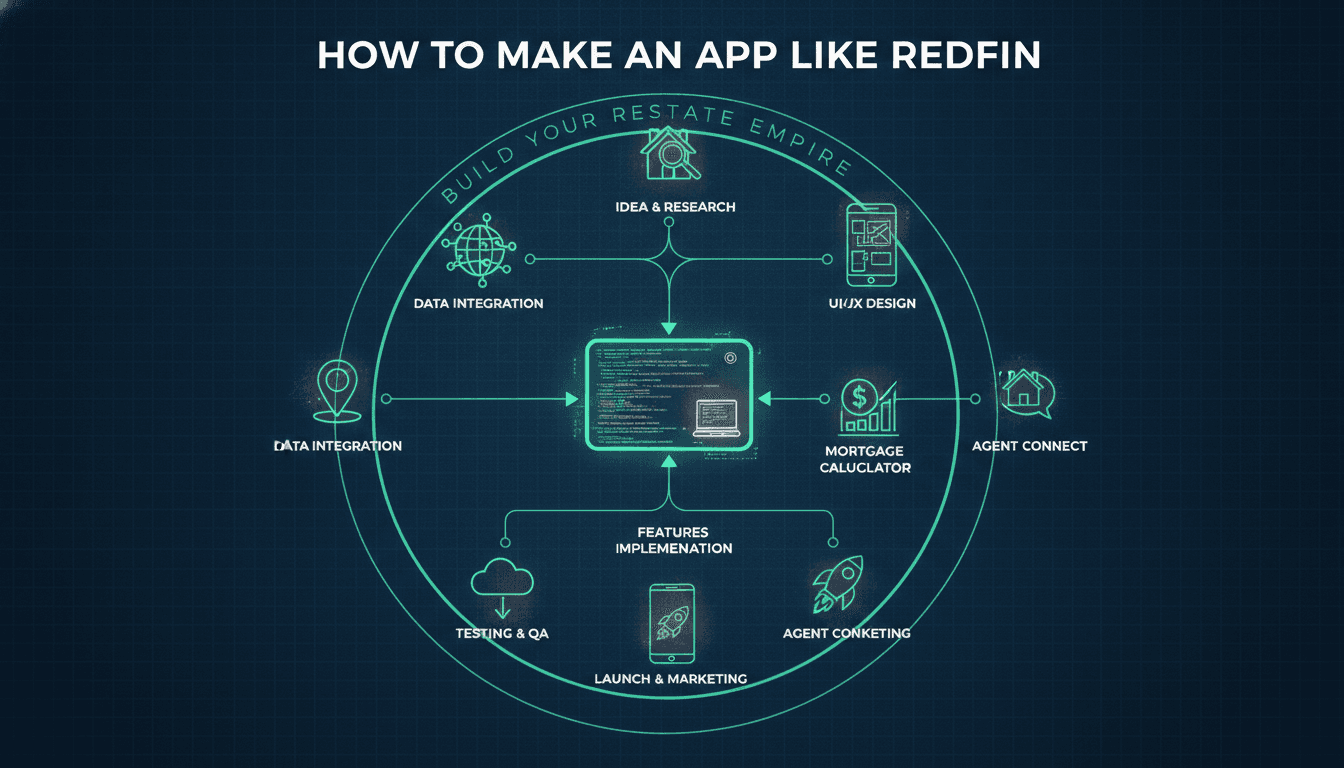
Building a real estate platform with the depth of Redfin means solving hard problems across data ingestion, map rendering, search, and trust. This post walks through what that actually takes — architecture decisions, trade-offs, and the parts most teams underestimate.
What Does Redfin Actually Do Under the Hood?
Most people think of Redfin as a property search app with nice maps. That framing undersells the engineering. At its core, Redfin is a real-time data aggregation platform sitting on top of Multiple Listing Service (MLS) feeds, layered with proprietary agent tooling, automated valuation models (AVMs), and a transaction workflow engine.
The three systems that make it work:
- MLS data ingestion — Redfin pulls from hundreds of regional MLS providers, each with different schemas, update frequencies, and RETS or RESO Web API endpoints. Normalising that into a single property schema is a significant ETL challenge.
- Search and ranking — Property search is geospatial, faceted, and latency-sensitive. Listings have to surface in under 200ms even with polygon-based map queries.
- Trust and compliance — Real estate is regulated at state and sometimes county level. Fair Housing Act compliance alone touches your filtering UI, your recommendation algorithm, and your marketing copy.
If you're building a comparable platform, your architecture has to account for all three from the start, not as bolt-ons.
How Do You Handle MLS Data at Scale?
This is where most teams hit a wall first.
RESO Web API (the modern standard, replacing RETS) is a RESTful interface built on OData. The standard is good, but adoption is inconsistent. Some MLSs run full RESO 2.0; others still gate access behind RETS 1.7 endpoints with proprietary field names. You will write custom adapters. There is no way around it.
Ingestion Architecture
A reasonable starting point for a mid-scale build:
- Apache Kafka for inbound feed events. Each MLS is its own topic partition. This gives you replay capability when a downstream normaliser fails.
- Apache Spark or dbt for transformation. Spark if you're doing heavy enrichment (geocoding, photo tagging, AVM scoring) in the same pipeline; dbt if your transforms are mostly SQL-expressible and you want lineage out of the box.
- PostgreSQL with PostGIS as your operational store. Most property queries are geospatial. PostGIS's
ST_WithinandST_DWithinfunctions handle polygon and radius search well up to tens of millions of records. Beyond that, you start looking at Elasticsearch with geo_shape queries or a dedicated spatial database.
Update latency matters. Redfin surfaces new listings within minutes of MLS publication. That means your Kafka consumers need to be low-latency, and your search index needs near-real-time refresh. Elasticsearch's index refresh interval defaults to 1 second; that's usually acceptable. If you're on PostgreSQL full-text search, you're pushing index refresh manually, which gets painful at volume.
Photo and Media Handling
Listings typically carry 20–50 high-resolution images. You need an image pipeline: ingest from MLS CDN or direct URL, resize to multiple breakpoints, push to your own CDN (CloudFront or Cloudflare R2), and optionally run a vision model for room classification or virtual staging. AWS Rekognition handles basic classification at low cost. For virtual staging, you're looking at fine-tuned diffusion models, which is a separate project.
What Does the Map Search Architecture Look Like?
The map is the primary UI. Users draw polygons, zoom into neighbourhoods, and expect the listing pins to update in real time. Getting this right without hammering your database on every viewport change requires a tile-based or cluster-based approach.
Vector tiles (Mapbox GL JS or MapLibre) are the standard choice. You pre-generate tiles at different zoom levels using PostGIS and serve them as .mvt files from a CDN. At high zoom, you show individual pins. At low zoom, you cluster with a count badge. This is what Redfin does, and it's what you should do too.
The tricky part is keeping tiles fresh when listings update. Static pre-generated tiles go stale. The pattern that works: pre-generate tiles for stable data (neighbourhood boundaries, school districts, transit lines) and handle listing pins as a dynamic overlay fetched via a lightweight API call bounded to the current viewport. Your frontend sends { bounds: {...}, filters: {...} } and gets back a GeoJSON FeatureCollection. Keep that endpoint cached at the edge with a short TTL (15–30 seconds) and invalidate on listing update events.
/// Not sure where to start?
Get the architecture before you commit
Tell us what you're building and we'll map the technical approach, stack, and rough timeline. No cost, no obligation, no sales call required.
How Do You Build the Automated Valuation Model?
Redfin's Estimate is an AVM. It's not magic; it's a gradient boosted tree (likely XGBoost or LightGBM) trained on transaction history, comparable sales, property attributes, and local market signals.
Building your own AVM from scratch requires:
- Training data — Historical sold prices with property attributes. CoreLogic and ATTOM Data Solutions license this. Budget $30,000–$100,000+ per year depending on coverage.
- Feature engineering — Square footage, bed/bath count, lot size, year built, distance to amenities, days on market of comparables, and local price per square foot trends. The signal from recency-weighted comps is strong.
- Model validation — Median absolute percentage error (MdAPE) is the standard metric. Zillow publishes theirs; Redfin publishes theirs. Getting below 3% MdAPE nationally is hard. Expect 4–6% to start, improving with more local transaction data.
If you don't have the training data budget, use a licensed AVM API (HouseCanary, Quantarium, or First American) and surface their estimates under your own UI. That's a faster path, at the cost of margin and differentiation.
Compliance and Trust: The Parts That Kill Timelines
Fair Housing Act compliance is non-negotiable in the US. The Act prohibits steering users toward or away from listings based on protected class characteristics. That sounds obvious until you realise it affects:
- Recommendation algorithms — If your "similar listings" feature correlates with neighbourhood demographics, you have a problem.
- Search filters — Certain filters (school district search, for example) have been challenged as proxies for race.
- Marketing and retargeting — Facebook settled with HUD in 2019 for $5 million over discriminatory ad targeting in real estate.
Run your recommendation outputs through a fairness audit. IBM's AI Fairness 360 toolkit gives you a starting point for measuring disparate impact. This is not optional architecture; bake it in from the start.
On the data side, encrypt PII at rest (AES-256) and in transit (TLS 1.3). If you're handling mortgage pre-qualification or identity verification, you're touching GLBA-regulated data. That changes your vendor contracts, your logging retention policy, and your incident response obligations.
Conclusion
Building a Redfin-like platform is achievable, but the complexity lives in the data layer and compliance, not the frontend. Get your MLS ingestion architecture right first. Choose PostGIS for search up to tens of millions of records, then evaluate Elasticsearch. Use vector tiles with a dynamic overlay pattern for the map. License AVM data if you don't have a $100k+ data budget. And audit your recommendation model for Fair Housing compliance before you ship.
The next concrete step: map out which MLS providers cover your target geography, check whether they're on RESO Web API or legacy RETS, and estimate your adapter build time from there. Everything else follows from that data access question.
FAQ
How long does it take to build a real estate app like Redfin? A minimum viable version with MLS ingestion, map search, and listing detail pages takes 6–10 months with a competent team of 4–6 engineers. A full platform with AVM, agent tooling, and transaction workflow is an 18–24 month project. Timeline is usually gated by MLS data access approvals, not engineering velocity.
How much does it cost to build a Redfin-like app? A realistic budget for an MVP is $300,000–$600,000 in engineering costs, not counting data licensing. A full-featured platform with proprietary AVM and transaction management is $1.5M–$3M over two years. MLS data access, AVM licensing, and mapping API costs (Mapbox charges per map load) add $50,000–$200,000 annually in infrastructure.
Do you need MLS access to build a real estate app? Not necessarily. Aggregators like Zillow Group's Bridge Interactive, Spark API, and ListHub provide normalised listing feeds without direct MLS relationships. The trade-off is data freshness (aggregators add latency), coverage gaps, and additional licensing costs. Direct MLS access gives you faster updates and more control, but requires individual agreements with each MLS.
What tech stack does Redfin use? Redfin has published engineering blog posts indicating use of Java and Kotlin on the backend, React on the frontend, and PostgreSQL as a primary data store. They use Kafka for event streaming and have built proprietary tooling around RESO data normalisation. For mapping, they use a combination of Mapbox and custom tile rendering.
What's the biggest technical mistake teams make when building real estate platforms? Treating the MLS data problem as solved once you have API access. The real work is in normalisation: field mapping, deduplication across overlapping MLS coverage areas, handling photo URL expiry, and managing the difference between active, pending, and off-market status across providers. Teams that underestimate this end up with corrupt search indexes and frustrated users six months in.
Have a project in mind? Contact Sodio Technologies to discuss your requirements and explore the right technology solution for your business.
/// Work with us
Talk to the engineers who'd build it
You'll get a technical scope, timeline and cost estimate from the people doing the work, not an account manager. In-house team, no subcontracting, since 2016.