

How to Make an App Like RetailMeNot
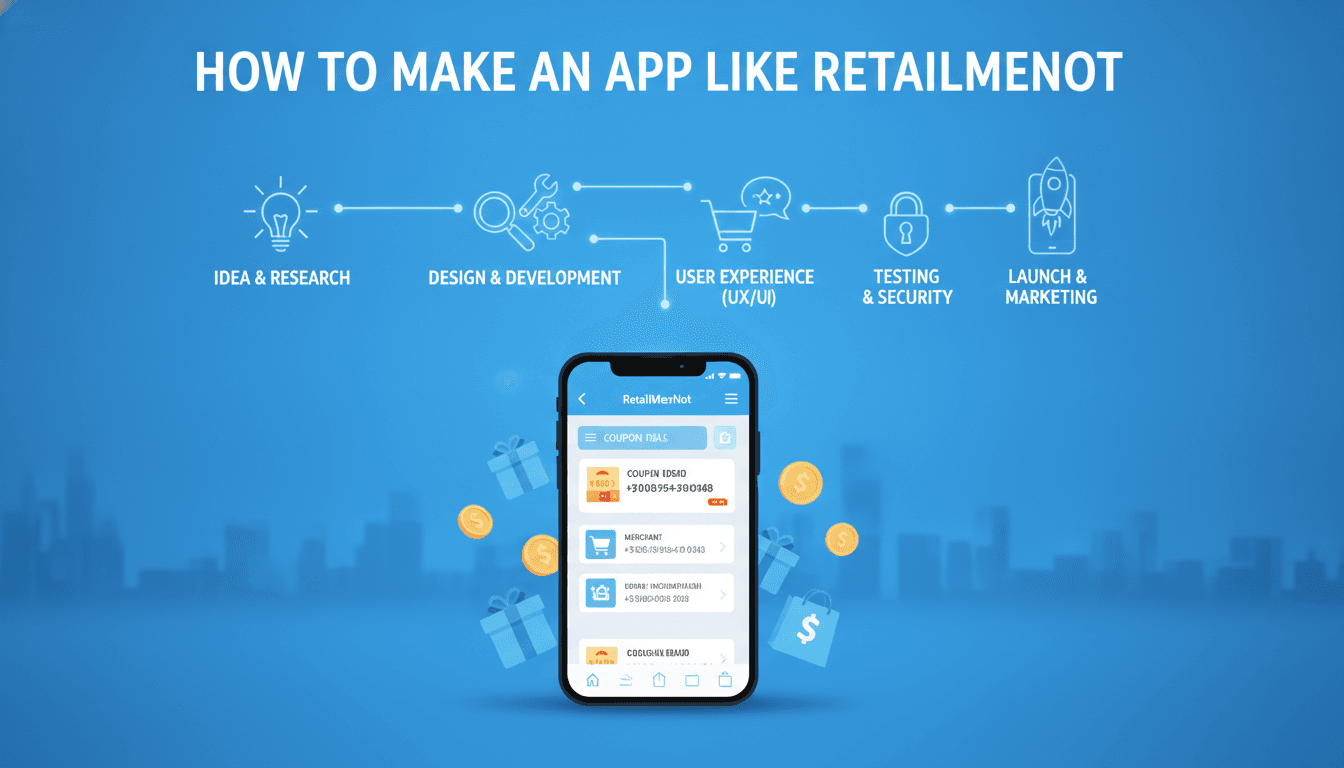
A practical breakdown of the architecture, data flows, and monetisation logic behind a coupon and cashback aggregator — what to build, what to buy, and where most teams get it wrong.
What Does a RetailMeNot-Style App Actually Do?
At its core, a coupon aggregator does three things: collects offer data from merchants and affiliate networks, presents it to users in a searchable and personalised interface, and tracks conversions so the right party gets credited. Each of those three functions has real engineering depth behind it.
RetailMeNot itself operates across web, iOS, and Android, and indexes millions of offers from thousands of retailers. The offers come from multiple sources: direct merchant relationships, affiliate networks like CJ Affiliate, Rakuten Advertising, and Impact, plus user-submitted codes. Each source has different data formats, update frequencies, and reliability characteristics. Your ingestion layer has to handle all of that without polluting your offer catalogue with stale or duplicate codes.
How Does the Offer Ingestion Pipeline Work?
This is where most teams underestimate complexity. You're not just scraping a feed. You're reconciling data from:
- Affiliate network APIs (CJ, Rakuten, ShareASale each have their own schema)
- Direct merchant integrations via custom XML or JSON feeds
- Browser extension telemetry (if you build one)
- User submissions
Deduplication and Validation
Every offer needs a canonical identifier. A merchant might appear in three affiliate networks with overlapping codes. Without deduplication logic, users see the same 20% off code listed six times. Use a combination of merchant ID normalisation, coupon code hashing, and expiry-date windowing to collapse duplicates before they hit your database.
Validation is harder. A code being live in a feed does not mean it works at checkout. RetailMeNot shows a "success rate" metric next to codes precisely because they can't guarantee validity. You can approximate this with crowd-sourced feedback loops, automated headless-browser testing for high-value codes, or a combination of both. Headless testing with Playwright or Puppeteer against a test checkout environment works well for top-traffic merchants, but it doesn't scale to tens of thousands of retailers.
Data Storage
For offer storage, a relational model (PostgreSQL works fine) handles the structured attributes: merchant, discount type, percentage, expiry, category. Use a search index like Elasticsearch or OpenSearch on top for faceted search and relevance ranking. Offer data is read-heavy and relatively low-write, so a read replica strategy keeps query latency acceptable.
What Does the Tracking and Attribution Layer Look Like?
This is the part that connects user behaviour to revenue. When a user clicks through to a retailer via your app, you need to fire an affiliate tracking link that encodes your publisher ID, the user's session, and the offer they clicked. The affiliate network records the click, and if the user converts, they fire a postback to your server.
The postback contains the order value and a commission amount, typically 1–8% of order value depending on the category. You credit the user's cashback account with a portion of that commission after a confirmation window (usually 30–90 days, to allow for returns).
Building Your Own Tracking vs. Using a Third Party
You can use a platform like Tune or Partnerize to handle postback tracking, or build your own click-tracking service. Building your own gives you full control over attribution logic and avoids per-click fees, but you need to handle click deduplication, fraud detection, and postback verification yourself. For a first version, a third-party platform is almost always faster.
One non-obvious issue: cookie-based attribution breaks in Safari due to ITP (Intelligent Tracking Prevention). For iOS web traffic, you need server-side click ID passing or SKAdNetwork if you're tracking app installs. Plan for this from day one, not as a retrofit.
/// Not sure where to start?
Get the architecture before you commit
Tell us what you're building and we'll map the technical approach, stack, and rough timeline. No cost, no obligation, no sales call required.
How Do You Personalise Offers Without Building a Full Recommendation Engine?
Basic personalisation doesn't require a machine learning pipeline. Start with rules: show offers from categories the user has clicked before, boost merchants in their purchase history, surface cashback rates higher than the category average. That gets you 80% of the personalisation value with a fraction of the engineering effort.
When you do add ML, collaborative filtering (users who clicked X also clicked Y) is the most straightforward approach. You can run this as a batch job on Spark or with a managed service like AWS Personalize. Real-time inference isn't necessary for offer ranking; a daily recompute is usually sufficient.
The bigger lever is notification timing. Push notifications for expiring offers or newly added high-value codes drive significantly more conversion than ranked feeds. Firebase Cloud Messaging for Android and APNs for iOS handle delivery; the intelligence is in your segmentation logic.
Core Technology Stack and Trade-offs
| Component | Recommended option | Alternative | Trade-off |
|---|---|---|---|
| Backend API | Node.js (Fastify) or Django REST | Rails | Fastify handles high concurrency better; Django has better ORM for complex queries |
| Offer database | PostgreSQL 15+ | MySQL | Postgres JSONB is useful for variable merchant metadata |
| Search | Elasticsearch 8.x | Algolia | Algolia is faster to set up but costs more at scale |
| Cashback ledger | PostgreSQL with event sourcing | MongoDB | Ledger needs ACID guarantees; avoid document stores here |
| Mobile | React Native | Flutter | React Native has more mature cashback/affiliate SDKs available |
| Affiliate tracking | Tune or in-house | Partnerize | In-house only makes sense above ~$5M annual GMV |
| Browser extension | Chrome/Firefox MV3 | Safari extension | Safari App Extension has stricter review; lower install rate |
The browser extension deserves special mention. RetailMeNot's Genie extension and Honey (now PayPal) built significant moats through extensions because they intercept checkout intent at the point of action. An MV3-compliant Chrome extension with declarativeNetRequest rules can surface applicable codes automatically. The install conversion from this is dramatically higher than app-only flows for desktop users.
Monetisation Beyond Affiliate Commission
Affiliate commission is the primary revenue model, but it has a ceiling. Merchants cap payouts, and network competition is intense. The secondary models worth building for:
- Featured placement: Merchants pay for top-of-feed positioning. This requires a separate ad server or a simple in-house bidding table.
- Exclusive deals: You negotiate direct with a merchant for codes only available on your platform. Higher commission rates (sometimes 2x network rate) and better user retention.
- B2B loyalty programs: White-labelling your offer catalogue and cashback infrastructure for banks, credit card issuers, or HR benefits platforms. This is a meaningful revenue diversification that RetailMeNot's parent, Ziff Davis, has pursued actively.
- Data licensing: Aggregated, anonymised purchase intent data has value to market research firms. This requires careful compliance work under GDPR and CCPA before you can monetise it.
Conclusion
The hard parts of building a RetailMeNot-style app are not the UI or the basic search. They're offer data quality, attribution accuracy under browser privacy restrictions, and building enough merchant relationships to have a catalogue worth returning to.
Start with two or three affiliate networks, build solid ingestion and deduplication from the beginning, and get your postback tracking verified before you spend a cycle on personalisation. A functional cashback loop with 500 reliable merchants is more valuable than a beautiful app with unreliable codes.
If you're scoping this out and want to talk through the architecture in detail, the team at Sodio has built data aggregation and affiliate tracking systems across the fintech and e-commerce space. Reach out with your constraints and we'll tell you honestly where custom build makes sense and where it doesn't.
FAQ
How long does it take to build a coupon aggregator app from scratch? A minimum viable version with offer ingestion from two affiliate networks, a mobile app, and basic cashback tracking takes roughly 4–6 months with a team of four to five engineers. The browser extension and ML personalisation add another two to three months depending on scope and integration complexity.
What is the typical commission rate for a coupon aggregator? Affiliate commissions vary by category: retail apparel typically pays 4–8%, electronics 1–3%, and financial products can reach 20–30% of the referred sale value. Most platforms pass 50–80% of earned commission back to users as cashback and retain the rest as margin.
Do I need a separate app for iOS and Android, or can I use one codebase? React Native or Flutter let you share most business logic and UI across platforms. The main divergence points are push notification handling, deep linking, and anything touching in-app browsers at checkout. Plan for around 15–20% platform-specific code regardless of which cross-platform framework you choose.
How do I handle fraudulent cashback claims? The primary vectors are fake accounts, manufactured transactions (buying and immediately returning), and click stuffing. Defend with device fingerprinting on registration, minimum order value thresholds before cashback is credited, and a confirmation hold period that aligns with the merchant's return window (typically 30–60 days).
Can I build this without direct merchant relationships? Yes, initially. Joining CJ Affiliate, Rakuten, and ShareASale gives you access to thousands of merchants without individual negotiations. Direct relationships become important once you have traffic to offer merchants in exchange for better commission rates or exclusive codes, usually above 100,000 monthly active users.
Have a project in mind? Contact Sodio Technologies to discuss your requirements and explore the right technology solution for your business.
/// Work with us
Talk to the engineers who'd build it
You'll get a technical scope, timeline and cost estimate from the people doing the work, not an account manager. In-house team, no subcontracting, since 2016.