

How to Make an App Like Rocket.Chat
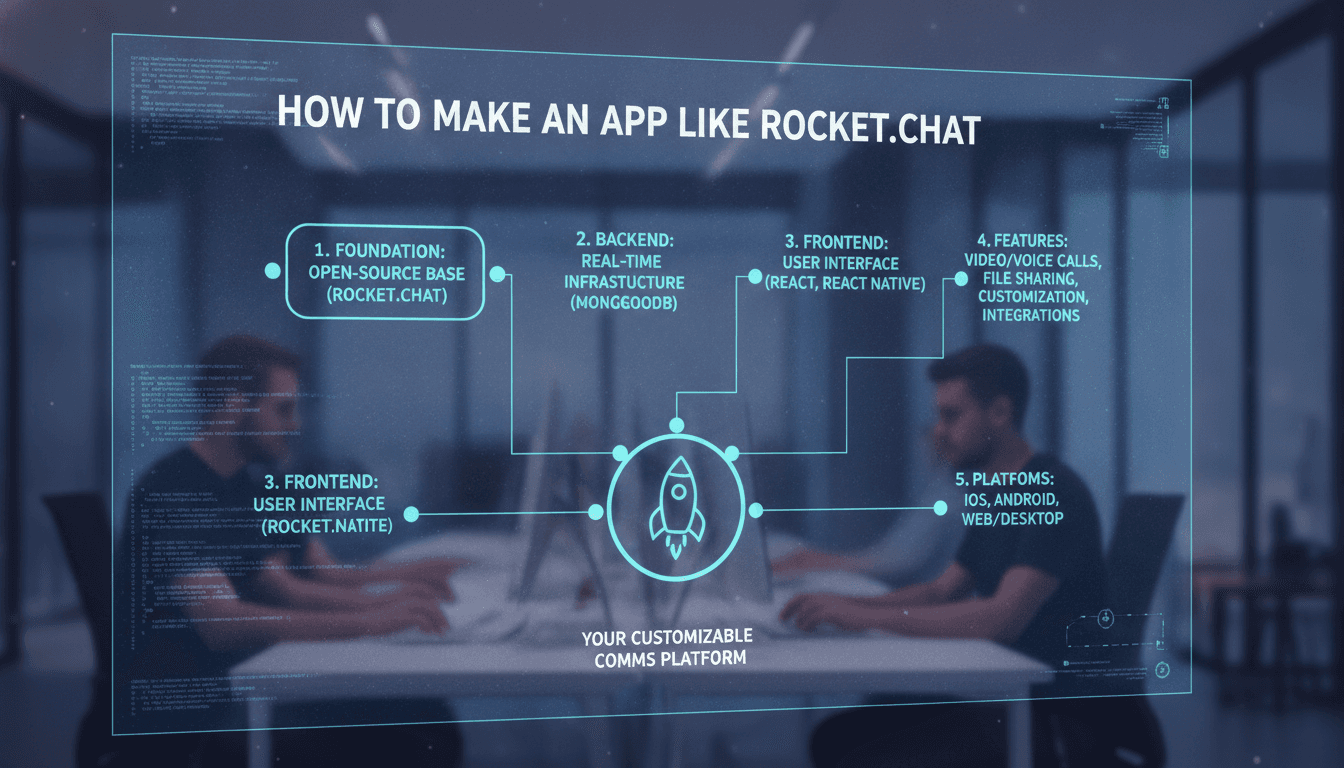
How to Make an App Like Rocket.Chat
Team communication has quietly become the backbone of how modern organizations operate. Slack popularized the category, Microsoft Teams bundled it into the enterprise stack, and Rocket.Chat carved out its own space by doing something neither of them would: giving companies full ownership of their conversations through open-source, self-hosted infrastructure.
That positioning is exactly why so many founders and CTOs want to build something similar. Whether you're targeting a regulated industry that can't send data to third-party clouds, a region with strict data-residency laws, or a niche vertical that needs chat tightly woven into its own workflows, there's real room for a Rocket.Chat-style product.
To explore this further, see How to Make an App Like Cisco Webex.
This guide walks through what it actually takes to build one — the features, the architecture, the tech stack, the costs, and the traps that sink most messaging projects.
What Makes Rocket.Chat Different
Before you write a line of code, understand what you're actually replicating. Rocket.Chat isn't just "Slack but free." Its differentiators are structural:
- Self-hosting and data sovereignty. Organizations deploy it on their own servers or private cloud. Nothing leaves their perimeter.
- Open-source core. The codebase is auditable, forkable, and extendable — a major trust signal for security-conscious buyers.
- Omnichannel capability. It merges internal team chat with customer-facing livechat, WhatsApp, email, and social channels in one inbox.
- Federation and interoperability. Support for protocols like Matrix lets separate servers talk to each other.
- Deep extensibility. Apps, webhooks, bots, and a marketplace let teams bend the platform to their processes.
If you're building an alternative, pick which of these pillars you're competing on. Trying to match all of them on day one is how teams burn eighteen months and ship nothing.
Core Feature Set
Messaging Fundamentals
These are table stakes. Users will abandon your app instantly if any of them feel janky.
- One-to-one direct messages and group channels (public and private)
- Threaded replies to keep conversations from derailing
- Message editing, deletion, pinning, starring, and forwarding
- Rich text formatting, code blocks, and markdown support
- Emoji reactions and custom emoji
- Read receipts, typing indicators, and presence status
- Full-text search across messages, files, and channels
- @mentions, @here/@channel broadcasts, and keyword alerts
File Sharing and Media
- Drag-and-drop uploads with previews for images, PDFs, and video
- Configurable size limits and storage backends (local disk, S3, GridFS, MinIO)
- Inline link previews and OpenGraph unfurling
- Virus scanning hooks for enterprise deployments
Voice, Video, and Real-Time Collaboration
- One-to-one and group audio/video calls via WebRTC
- Screen sharing and recording
- Voice messages
- Integration paths for Jitsi, LiveKit, or BigBlueButton rather than building a media server from scratch
Administration and Governance
This is where enterprise deals are won or lost.
- Role-based access control with custom permission sets
- SSO via SAML, OAuth2, LDAP, and Active Directory
- Two-factor authentication and device management
- Audit logs and message retention policies
- Data export and compliance tooling (GDPR, HIPAA, SOC 2 readiness)
- Usage analytics and workspace-level dashboards
Extensibility
- REST API and real-time API for third-party integrations
- Incoming and outgoing webhooks
- Slash commands and bot framework
- An app/plugin architecture with a sandboxed runtime
Omnichannel (Optional but Valuable)
- Livechat widget embeddable on customer websites
- Agent routing, queues, and canned responses
- Bridges to WhatsApp Business, Telegram, SMS, and email
Architecture: The Part That Actually Matters
Chat apps look simple and are deceptively hard. The difficulty isn't the UI — it's delivering millions of tiny messages with sub-second latency, guaranteed ordering, and zero loss, across flaky mobile networks.
Real-Time Transport
WebSockets are the default choice for persistent bidirectional connections. Plan for:
- Connection management at scale. A single server handles maybe 10k–50k concurrent sockets. Beyond that you need horizontal scaling with a shared pub/sub layer (Redis, NATS, or Kafka) so a message published on Node A reaches a subscriber on Node B.
- Graceful degradation. Fall back to long-polling or SSE where WebSockets are blocked by corporate proxies.
- Reconnection and catch-up. When a client reconnects after a dropout, it needs to fetch everything it missed — usually via a cursor or sequence number, not a naive timestamp.
Message Delivery Guarantees
Design for at-least-once delivery with client-side deduplication. Every message gets a client-generated UUID so retries don't create duplicates. Maintain a monotonic sequence per channel so clients can detect gaps and backfill.
Data Model
A typical schema includes:
users— identity, profile, presenceworkspaces/teams— tenant boundaryrooms— channels, DMs, threads (often unified into one entity with a type flag)subscriptions— the join between a user and a room, holding unread counts, notification prefs, and last-read markersmessages— content, author, room, timestamp, attachments, reactions, thread parent
That subscriptions table is the hot path. Every message write updates unread counts for every member of the room. At scale this becomes your primary bottleneck — plan to denormalize aggressively and consider write-behind caching.
Storage Strategy
- Hot messages in your primary database, indexed by room and sequence
- Search offloaded to Elasticsearch or OpenSearch — never run full-text search against your transactional store
- Media in object storage with signed URLs, never served through your app servers
- Cold archives tiered out after a retention window to keep the working set small
Microservices vs. Monolith
Start modular-monolith. Extract services only when a specific component demands independent scaling — typically the WebSocket gateway, the notification dispatcher, and the media processing pipeline. Premature microservices in a chat app multiply your latency and your on-call pain.
We cover a closely related subject in How to Make an App Like Mattermost.
Recommended Tech Stack
Backend
- Node.js with TypeScript (Rocket.Chat's own choice, via Meteor historically) for fast iteration and a huge real-time ecosystem
- Go or Elixir if raw concurrent connection handling is your primary concern — Elixir's Phoenix Channels are purpose-built for this
- Python with FastAPI if your team leans that way and you're pairing chat with ML features
Database
- MongoDB for flexible message documents and fast writes (Rocket.Chat's approach)
- PostgreSQL if you need strong relational guarantees, JSONB for flexibility, and mature tooling
- Redis for presence, unread counters, rate limiting, and pub/sub fanout
Real-Time Layer
- Socket.IO or native
wsfor Node - NATS or Redis Streams for inter-node message distribution
- Kafka if you need durable event replay and analytics pipelines
Frontend
- React with TypeScript for web
- React Native or Flutter for cross-platform mobile
- Electron or Tauri for desktop clients (Tauri produces dramatically smaller binaries)
Voice/Video
- LiveKit or mediasoup as your SFU
- Jitsi as a drop-in if you want something battle-tested quickly
Infrastructure
- Docker and Kubernetes for the self-hosted story — your customers will expect a Helm chart
- Terraform for reproducible cloud deployments
- Prometheus, Grafana, and OpenTelemetry for observability
Security and Compliance
If you're competing with Rocket.Chat, security isn't a feature — it's the entire value proposition.
- Encryption in transit with TLS 1.3 everywhere, including internal service traffic
- Encryption at rest for databases and object storage
- End-to-end encryption for sensitive rooms. Be honest about the tradeoffs: E2EE breaks server-side search, message previews in notifications, and compliance archiving. Most enterprise buyers actually want auditability more than E2EE, so make it opt-in per room.
- Rate limiting and abuse prevention on every endpoint, especially auth and invite flows
- Input sanitization — markdown rendering and link unfurling are classic XSS and SSRF vectors
- Dependency scanning and SBOM generation, since open-source buyers will ask
- Penetration testing before any enterprise pilot
Compliance targets worth planning for: GDPR, HIPAA (if healthcare is a market), SOC 2 Type II, and ISO 27001. Building audit logging and data-export tooling early is far cheaper than retrofitting it.
Mobile Considerations
Mobile is where chat apps live or die, and it's the hardest surface to get right.
- Push notifications need a dispatcher that respects per-user, per-room, and per-device preferences, with quiet hours and mention-only modes. For self-hosted deployments you'll need to either proxy through your own FCM/APNs gateway or let customers configure their own credentials.
- Offline-first sync. Cache recent messages locally with SQLite or Realm. Queue outgoing messages and reconcile on reconnect.
- Battery and data efficiency. Aggressive socket keep-alives will get your app uninstalled. Use platform push to wake the app rather than holding connections open indefinitely.
- Background limitations. iOS and Android both aggressively kill background processes. Design around that, not against it.
Development Roadmap
Phase 1 — Foundation (8–12 weeks) Auth, user management, 1:1 and group messaging, basic web client, message persistence, and real-time delivery.
Phase 2 — Core Product (10–14 weeks) File sharing, search, threads, reactions, notifications, mobile clients, admin panel, and role management.
Phase 3 — Enterprise Readiness (10–16 weeks) SSO, audit logs, retention policies, self-hosting packaging, Helm charts, monitoring, and compliance documentation.
Phase 4 — Differentiation (ongoing) Voice and video, omnichannel, bot framework, app marketplace, federation, and whatever vertical-specific capability justifies your existence.
Cost Expectations
Ranges vary enormously by region and team composition, but as a planning anchor:
- MVP (web + one mobile platform, core messaging): roughly $60,000–$120,000
- Full-featured product (web, iOS, Android, desktop, admin, SSO): roughly $150,000–$350,000
- Enterprise-grade with voice/video, omnichannel, and compliance: $400,000+
Add ongoing costs for infrastructure, security audits, app store compliance, and the perpetual maintenance burden of five client platforms. Building for self-hosting adds meaningful overhead — you're shipping a product customers install themselves, which means documentation, upgrade paths, and support for environments you can't see.
You may also find our article on How to Make an App Like Zoho Cliq useful.
Monetization Models
Rocket.Chat's playbook is open-core: free self-hosted community edition, paid enterprise features (SSO, engagement dashboards, high-availability), and a managed cloud tier. Variations worth considering:
- Per-seat SaaS pricing with a free tier capped by history or members
- Perpetual enterprise license plus annual support contract
- Vertical SaaS where chat is bundled into a larger workflow product at a premium
- Managed hosting for customers who want sovereignty without operating servers
Mistakes to Avoid
Underestimating the unread-count problem. It sounds trivial. It is not. Getting badges, mentions, and last-read markers correct across five clients and intermittent connectivity is genuinely one of the hardest parts of the product.
Building your own SFU. WebRTC media servers are a multi-year specialty. Integrate LiveKit or Jitsi.
Shipping search as an afterthought. Users judge chat apps by how well they find old messages. Plan your search infrastructure from day one.
Ignoring the migration story. Nobody adopts a new chat platform from zero. Import tooling for Slack, Teams, and Discord exports is often the single highest-ROI feature you can build.
Competing on features instead of positioning. You will not out-feature Slack. You win by serving a market Slack structurally cannot — regulated industries, air-gapped environments, specific geographies, or verticals with workflows nobody else will build.
Final Thoughts
Building an app like Rocket.Chat is a serious engineering undertaking, but it's a well-mapped one. The hard problems — real-time fanout, offline sync, presence, unread state, scalable search — are known problems with known solutions. What's less obvious, and far more important, is the strategic question underneath the technical one: why would a team switch to you?
Answer that clearly, pick the two or three pillars you'll genuinely excel at, and build the rest to be good enough. Start with a focused MVP, get it in front of real teams early, and let the friction they hit guide your roadmap rather than a feature-comparison spreadsheet.
If you're evaluating what it would take to bring a communication platform like this to life, the right technical partner — one who has already solved WebSocket scaling, mobile sync, and enterprise SSO — will save you far more than they cost.
Have a project in mind? Contact Sodio Technologies to discuss your requirements and explore the right technology solution for your business.
/// Work with us
Talk to the engineers who'd build it
You'll get a technical scope, timeline and cost estimate from the people doing the work, not an account manager. In-house team, no subcontracting, since 2016.