

How to Make an App Like Shipt
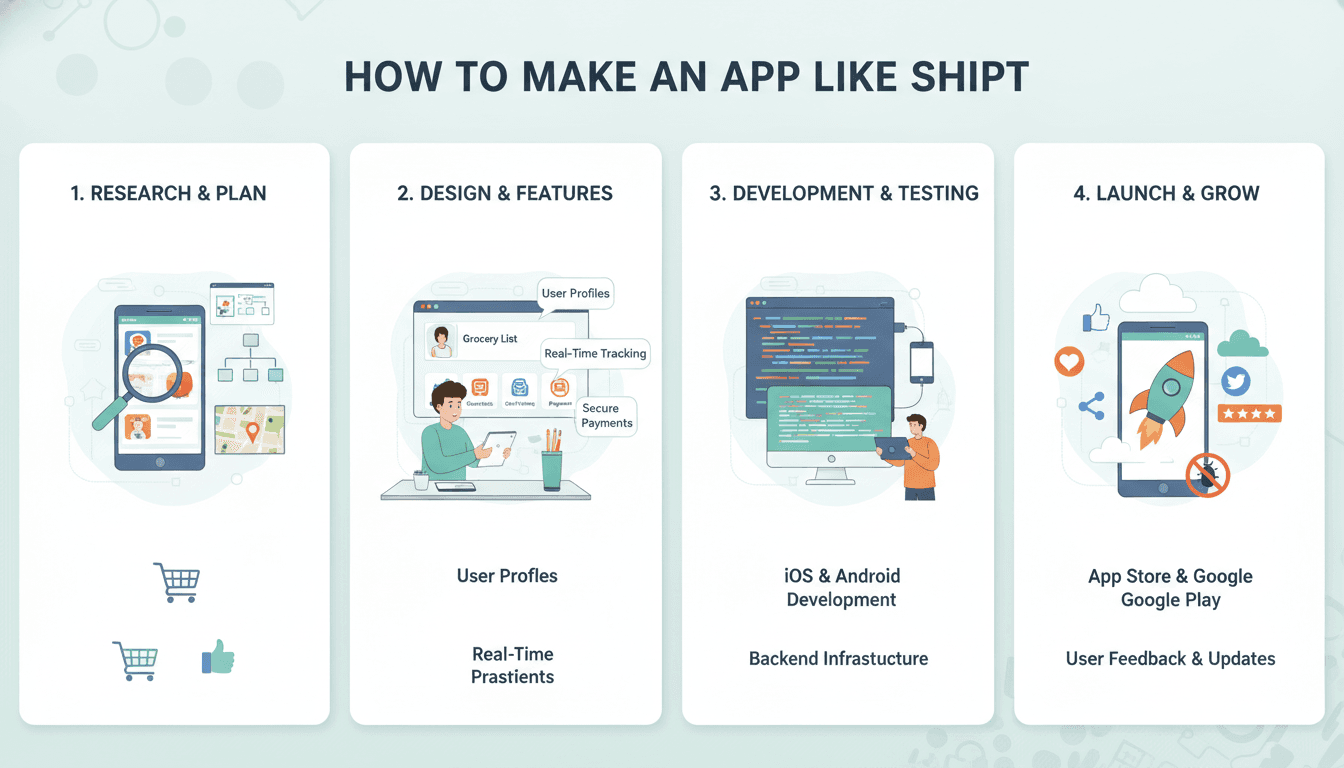
How to Make an App Like Shipt
Grocery delivery went from a convenience to an expectation in the span of a few years. Shipt, acquired by Target for around $550 million, proved that a well-executed marketplace connecting shoppers, stores, and customers can scale into a household name. If you're considering building something similar, the opportunity is real — but so is the complexity.
This guide walks through what it actually takes to build a Shipt-style delivery app: the business model, the feature set, the tech stack, the cost, and the pitfalls that sink most first attempts.
You may also find our article on How to Make an App Like Instacart useful.
What Shipt Actually Is (And Why That Matters)
Before writing a line of code, it's worth understanding the model you're copying. Shipt is a membership-based, three-sided marketplace:
- Customers pay an annual or monthly membership fee (plus per-order fees in some cases) for unlimited deliveries above a minimum order value.
- Shoppers are independent contractors who accept orders, physically shop the aisles, and deliver to the door.
- Retail partners — grocery chains, big-box stores, pharmacies — provide inventory and, critically, product catalog data.
That third leg is the one most founders underestimate. The membership model smooths revenue, but it also means you need enough order density in a given ZIP code to make membership feel worth it. Shipt launched city by city for exactly this reason.
If this is relevant to your project, check out How to Make an App Like Thrive Market.
Your first strategic decision: are you building a membership marketplace like Shipt, a per-delivery-fee model like Instacart's basic tier, or a white-label platform that grocery chains license to run their own delivery? Each drives a very different product.
Core Feature Set
A delivery marketplace is really three applications sharing one backend. Plan for all three from day one.
Customer App
- Onboarding and address capture — ZIP-code gating so users in unserved areas join a waitlist instead of bouncing
- Store selection — browse partnered retailers available at their location
- Product catalog with search and filters — the make-or-break experience; must handle tens of thousands of SKUs per store
- Cart and substitution preferences — "if out of stock, replace with similar" vs. "refund" vs. "ask me"
- Delivery window scheduling — hourly slots with real-time capacity limits
- Membership management — plan selection, billing, renewals, pause/cancel
- Live order tracking — shopper location on map, item-by-item progress
- In-app chat — customer-to-shopper messaging for substitutions and access instructions
- Tipping, rating, and reorder — tips heavily influence shopper acceptance rates
Shopper App
- Application and background check flow — identity verification, driving record, onboarding quiz
- Order marketplace — available batches with payout, item count, distance, and store shown upfront
- Guided in-store shopping — aisle-sorted pick list, barcode scanning, item-found confirmation
- Substitution workflow — photo of alternative, push to customer, wait for approval
- Checkout support — prepaid card integration or reimbursement flow
- Navigation handoff — deep link to Google Maps or Waze
- Proof of delivery — photo capture, geotag, timestamp
- Earnings dashboard — per-batch breakdown, tips, weekly payout schedule
Admin Panel
- Catalog and pricing management — per-retailer, per-location
- Shopper supply monitoring — heat maps of coverage gaps by hour
- Order intervention tools — reassign, refund, comp a membership
- Dispute and support queue
- Analytics — order density, basket size, fulfillment rate, shopper churn, CAC by market
The Hard Part: Catalog and Inventory Data
This deserves its own section because it's where delivery startups quietly die.
Customers expect an accurate catalog with real prices and real availability. Getting there requires one of these approaches:
Direct retailer integration. The gold standard. You get API access to the chain's product master and, ideally, near-real-time inventory. It requires a signed partnership, which requires traction, which requires a catalog. Classic chicken-and-egg.
Shopper-crowdsourced data. Your shoppers scan barcodes and flag out-of-stock items, gradually building an accurate picture of each store. Slow, but it compounds and it's how several players bootstrapped.
Third-party catalog providers. Services like Syndigo, Label Insight, or Nielsen Brandbank sell UPC-level product data with images and attributes. Solves product info; doesn't solve store-level availability or price.
Practical recommendation: start with a third-party catalog for product metadata, layer shopper-scanned availability on top, and use that operational data as leverage when negotiating direct integrations. Be honest in the UI — show "usually in stock" rather than pretending you have live inventory you don't have.
Technical Architecture
Recommended Stack
Mobile clients
- React Native or Flutter for the customer app — the UI is largely list-and-form driven and cross-platform saves meaningful budget
- Consider native (Swift/Kotlin) for the shopper app if you rely heavily on barcode scanning, background location, and battery-efficient tracking over long shifts
Backend
- Node.js/NestJS, Go, or Python/Django depending on team strength
- Microservices or a modular monolith split along clear boundaries: catalog, orders, dispatch, payments, identity, notifications
Data layer
- PostgreSQL for transactional data (orders, users, payouts)
- Elasticsearch or Algolia for product search — Postgres full-text search will not hold up at catalog scale
- Redis for session state, delivery-slot capacity counters, and rate limiting
- PostGIS or a dedicated geospatial store for shopper location and zone matching
Real-time infrastructure
- WebSockets (Socket.IO, or a managed service like Ably/Pusher) for order status and chat
- Firebase Cloud Messaging and APNs for push
- Kafka or a managed queue for the order event stream that dispatch, analytics, and notifications all subscribe to
Third-party services
- Payments: Stripe Connect handles both customer charges and shopper payouts, including 1099 tax reporting in the US
- Shopper payment cards: Marqeta or Stripe Issuing for virtual cards shoppers use at checkout
- Maps and routing: Google Maps Platform or Mapbox
- Identity and background checks: Checkr, Persona
- Communications: Twilio for masked calling and SMS, so shoppers and customers never exchange real numbers
The Dispatch Engine
This is your competitive moat. A naive "broadcast to everyone nearby" system creates chaos; a good matching engine considers:
- Shopper proximity to the store, not just to the customer
- Historical accuracy and rating of the shopper
- Batch compatibility — can two orders from the same store be shopped together?
- Delivery window deadlines and estimated shop time based on item count and store layout
- Fairness, so high-performing shoppers don't hoard all the good batches and new shoppers churn out
Start with a rules-based scoring function. You will not have enough data for machine learning until you have thousands of completed orders, and pretending otherwise wastes months.
If this is relevant to your project, check out How to Make an App Like RideAmigos.
Development Timeline and Cost
Rough planning numbers for a US or Western European market launch:
| Phase | Duration | Scope |
|---|---|---|
| Discovery and design | 4–6 weeks | User research, UX flows, UI system, technical architecture |
| MVP build | 4–6 months | Customer app, shopper app, basic admin, one metro area |
| Pilot and iteration | 2–3 months | Live operations in one ZIP cluster, fix what breaks |
| Scale features | ongoing | Batching, memberships, multi-retailer, advanced analytics |
Cost ranges vary enormously by team location and scope:
- Lean MVP, offshore team: $80,000 – $150,000
- Full-featured MVP, mixed onshore/offshore: $150,000 – $300,000
- Enterprise-grade, US/EU agency: $350,000 – $600,000+
Budget separately for ongoing costs that surprise founders: maps API calls scale with order volume, SMS and masked calling add up fast, background checks run $30–$80 per shopper, and payment processing takes 2.9% + $0.30 off every transaction.
Regulatory and Operational Realities
- Worker classification is the single biggest legal risk. California's AB5, similar legislation in other states, and EU platform-work directives all pressure the independent-contractor model. Build your shopper relationship — and your app's control mechanisms — with legal counsel involved.
- Alcohol delivery requires per-state licensing and ID scanning at the door. Lucrative, but not an MVP feature.
- Pharmacy and OTC items touch HIPAA-adjacent territory in the US.
- Price transparency rules in several jurisdictions require disclosing markups over in-store pricing.
- Accessibility (WCAG 2.1 AA / ADA) is both a legal requirement and a real user need for a grocery product.
Go-to-Market: Density Beats Coverage
The instinct to launch in ten cities at once is the most common fatal error. Shipt's playbook was the opposite — saturate one market until the flywheel spins, then replicate.
A workable launch sequence:
- Pick a single metro area with a partner-friendly regional grocery chain
- Recruit 50–100 shoppers before opening to customers — a marketplace with no supply feels broken
- Open to a few ZIP codes only, with a waitlist for the rest that doubles as demand signal
- Offer aggressive first-month membership pricing and measure repeat rate, not signups
- Only expand once your fulfillment rate is consistently above 95% and shopper retention past 60 days is healthy
Differentiating from the Incumbents
You will not beat Instacart on catalog breadth or Shipt on brand. You can win on focus:
- Vertical specialization — halal, kosher, organic-only, ethnic grocery, or pharmacy-first
- Underserved geography — mid-size cities and suburbs the big players deprioritize
- Retailer-owned white label — sell the platform to chains that want their own branded delivery rather than surrendering customer data to a marketplace
- Superior shopper economics — shopper churn is the industry's chronic wound; a platform that pays transparently and schedules fairly builds a quality advantage customers feel
Wrapping Up
Building an app like Shipt is less a mobile development project than an operations business with a mobile interface. The code is well-understood; the hard problems are catalog accuracy, dispatch quality, shopper retention, and market density.
Scope the MVP ruthlessly: one city, one or two retail partners, one customer app, one shopper app, and an admin panel good enough for a small ops team to intervene manually. Everything else — batching algorithms, membership tiers, alcohol delivery, multi-market expansion — comes after you've proven that people in one ZIP code will pay you twice.
If you're ready to move from concept to architecture, the next step is a discovery phase that pins down your retailer strategy and dispatch logic before development starts. Those two decisions shape everything else you build.
Have a project in mind? Contact Sodio Technologies to discuss your requirements and explore the right technology solution for your business.
/// Work with us
Talk to the engineers who'd build it
You'll get a technical scope, timeline and cost estimate from the people doing the work, not an account manager. In-house team, no subcontracting, since 2016.