

How to Make an App Like Slickdeals
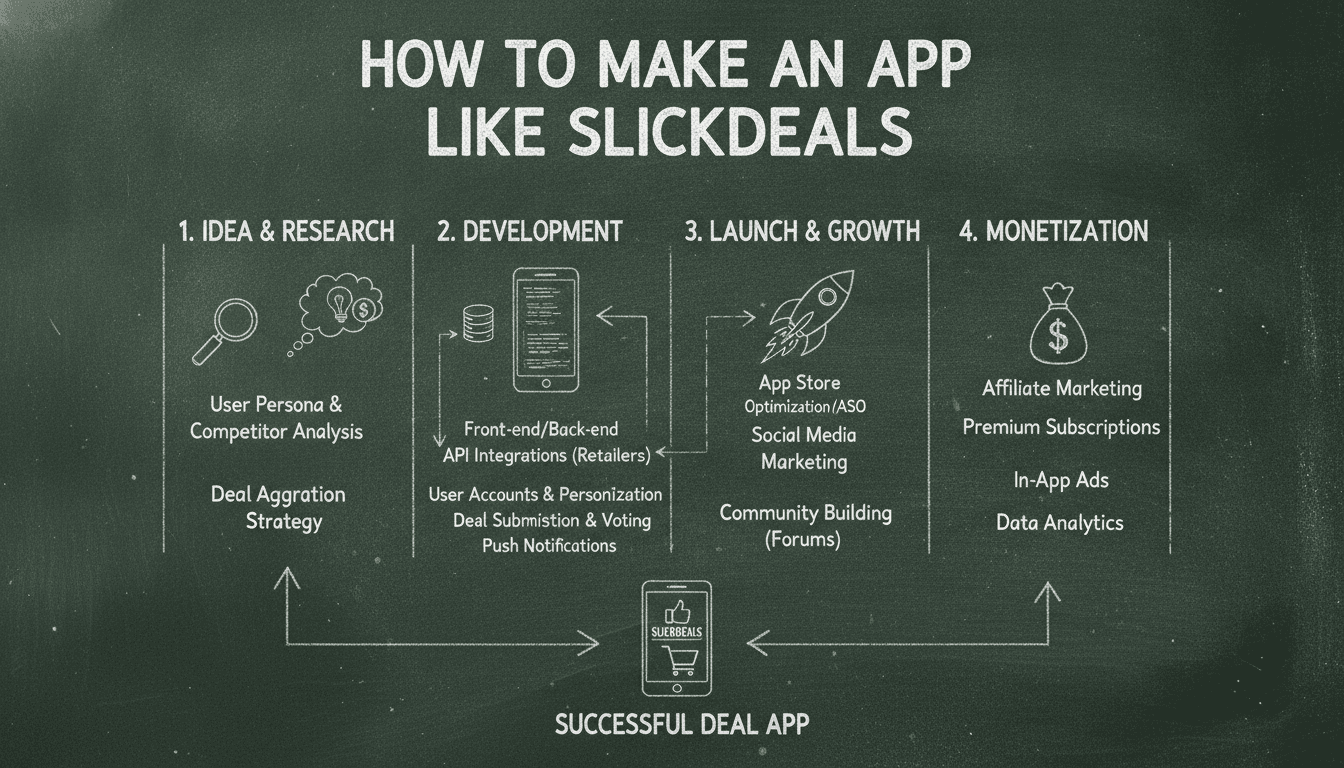
A practical breakdown of the architecture, data pipelines, and monetisation logic behind a deal-aggregation platform — written for engineers who need to make real build decisions.
What Does a Platform Like Slickdeals Actually Do Under the Hood?
Slickdeals is not a deals database. It is a community-moderated, algorithmically ranked feed of price intelligence. That distinction matters enormously for architecture.
The core loop is: ingest price signals from retailers, let users submit deals, run a voting and reputation system, rank items by a heat score, and serve personalised feeds at scale. Each of those steps has its own data shape, latency requirement, and failure mode.
The traffic profile is spiky. A viral deal on a flagship product can drive 10x normal load in under five minutes. Your architecture has to absorb that without falling over, and without serving stale prices after a retailer has changed a price.
Price ingestion
You have two options: scraping and affiliate feeds.
Affiliate feeds (Commission Junction, Impact, ShareASale, Rakuten Advertising) give you structured product and price data on a schedule, usually every one to four hours. The data is clean but lagged. For a deal that expires in 90 minutes, a four-hour feed cycle is useless.
Scraping fills the gap. A Playwright or Puppeteer-based scraper fleet can check specific product URLs on a tight cadence. You need rotating residential proxies (Bright Data or Oxylabs are the common choices), CAPTCHA solving (2Captcha or CapSolver), and browser fingerprint randomisation. Budget for this: scraping infrastructure at moderate scale costs $2,000–$6,000/month before engineering time.
The two sources have to be reconciled. A product might appear in a CJ feed as "Sony WH-1000XM5" and be scraped from Best Buy as "Sony Noise Cancelling Headphones WH1000XM5." You need a product matching layer, usually a combination of GTIN/UPC lookup, fuzzy string matching (RapidFuzz works well in Python), and a vector similarity fallback using embeddings from a model like text-embedding-3-small.
The heat score and ranking engine
Slickdeals uses a "hot deals" algorithm that factors in vote velocity, comment activity, and click-through rate. You need something similar.
A simple starting model:
heat = (upvotes - downvotes) / (age_hours + 2)^gravity
This is the classic Hacker News formula with a tunable gravity constant (HN uses 1.8). You can start here. As you accumulate click and purchase data, you layer in a feature-weighted ranking model using XGBoost or a simple two-tower neural network if you have enough training signal.
The important thing to get right early is vote legitimacy. Without fraud controls, your feed becomes a spam surface within weeks. Minimum account age thresholds, IP-based deduplication, and a reputation score tied to deal accuracy history are baseline requirements, not optional features.
/// Not sure where to start?
Get the architecture before you commit
Tell us what you're building and we'll map the technical approach, stack, and rough timeline. No cost, no obligation, no sales call required.
What Does the Tech Stack Actually Look Like?
There is no single correct stack. Here is a comparison of the realistic choices at different scale points:
| Layer | Early-stage (< 50k MAU) | Growth-stage (50k–500k MAU) |
|---|---|---|
| Backend | FastAPI or Django REST | FastAPI + async workers |
| Feed ranking | PostgreSQL + cron jobs | Redis Sorted Sets + Celery |
| Search | PostgreSQL full-text | Elasticsearch or Typesense |
| Price ingestion | Single Playwright worker | Distributed Scrapy cluster |
| Notifications | Firebase Cloud Messaging | FCM + SNS for multi-channel |
| Auth | Supabase Auth or Auth0 | Custom JWT + refresh token rotation |
| CDN | Cloudflare Free/Pro | Cloudflare Enterprise or Fastly |
For the feed, Redis Sorted Sets are the right tool once you have meaningful traffic. You store deal IDs as members with their heat score as the score. A ZREVRANGE call returns the top N deals in O(log N + M) time. Update the score on every vote event via a Celery task. The feed read path becomes very fast; the complexity is in keeping scores accurate under high write concurrency.
Notifications and deal alerts
This is where Slickdeals retains users. Price-drop alerts and deal-match notifications are a significant engineering surface.
Each user stores a set of alert rules: a keyword or product, a target price threshold, and optionally a category filter. When a new deal is ingested, you need to match it against potentially millions of active rules efficiently. A naive approach (loop over every rule for every deal) does not scale past ~100k active rules.
The standard approach is an inverted index on keywords, stored in Redis or Elasticsearch. A new deal triggers a keyword extraction step, then a lookup against the index to find matching rule IDs, then a fan-out to the notification layer. Celery Beat with a Redis broker handles this well up to a few million rules. Beyond that, you are looking at a purpose-built matching service or Apache Flink.
How Do You Make Money?
There are four realistic revenue streams, and they behave very differently:
Affiliate commissions are the primary one. Every outbound click carries your affiliate tag. When the user purchases, you earn a commission (typically 1–8% depending on category and retailer). This requires deals to link through your affiliate redirect, which means building a redirect service that resolves to the correct tagged URL and logs the click event.
Promoted deals are deals that retailers or brands pay to surface above organic ranking. This is a managed sales channel, not self-serve at early stage. You need clear disclosure to users, otherwise you erode trust fast.
Premium subscriptions (Slickdeals has a "Pro" tier) unlock features like price history charts, higher alert limits, and ad-free browsing. The conversion rate on freemium deal platforms is low, typically 2–5%, so you need meaningful MAU before this is worth building.
Display advertising via Google Ad Manager is straightforward to implement but competes with user experience. On a deal platform where speed and density matter, banner ads can visibly degrade the product.
What Are the Hardest Engineering Problems?
Price accuracy is the one that costs you the most in user trust if you get wrong. A deal that shows "$49" but resolves to "$89" at checkout destroys retention. You need near-real-time price verification on any deal before it is promoted or notified. That means your scraper has to confirm the price within minutes of a deal going live.
Duplicate deal detection is the second hard problem. Users submit the same deal from different URLs constantly. You need content deduplication across product identity (UPC/GTIN), retailer, and price. A MinHash LSH approach works at moderate scale; at higher volume you want a dedicated dedup service with a Bloom filter for fast rejection of obvious duplicates.
Search relevance on a deal platform is different from standard e-commerce search. Users search for "AirPods" but mean "any AirPods variant below $150." Integrating price filters into a relevance ranking model, not just as a post-filter, requires custom scoring in Elasticsearch or Typesense.
Conclusion
Building a Slickdeals-style platform is tractable, but the complexity is not in the front-end. It is in price accuracy, feed ranking integrity, and notification matching at scale. Get those three right and everything else is standard web engineering.
If you are at the design stage, the next concrete step is to map your affiliate feed sources and decide whether you are launching with scraping on day one or after you have affiliate data flowing. That decision shapes your ingestion architecture more than any other single choice.
FAQ
How long does it take to build a deal aggregation platform? An MVP with user submissions, voting, a ranked feed, and affiliate link tracking takes four to six months with a focused team of three to four engineers. Full price-alert infrastructure, duplicate detection, and a personalised feed add another three to four months. Timeline depends heavily on how many retailer integrations you need at launch.
Do you need to scrape retailers, or are affiliate feeds enough? Affiliate feeds alone are insufficient for a real-time deal platform. Feed refresh cycles of one to four hours are too slow for short-window deals. Scraping is necessary for price verification and rapid ingestion, but it requires ongoing maintenance as retailers change their page structure regularly.
How do affiliate commissions actually get tracked?
You create a redirect endpoint (e.g., yoursite.com/go/deal-id) that logs the click, resolves the affiliate-tagged URL for the correct network, and redirects the user. The affiliate network sets a cookie and credits the commission when a qualifying purchase is completed, usually within a 30-day attribution window.
What database should you use for the deals feed? PostgreSQL is the right starting point for deal storage and metadata. Redis Sorted Sets handle the ranked feed efficiently once you have traffic. Elasticsearch or Typesense add search. Running all three together is standard practice and not excessive; each handles a distinct query pattern.
What is the biggest mistake teams make building these platforms? Underestimating vote fraud. A deal aggregation platform has a clear economic incentive for merchants to game votes. Without IP deduplication, account age requirements, and rate limiting on vote actions from the first sprint, you will spend months retroactively cleaning a corrupted ranking system.
Have a project in mind? Contact Sodio Technologies to discuss your requirements and explore the right technology solution for your business.
/// Work with us
Talk to the engineers who'd build it
You'll get a technical scope, timeline and cost estimate from the people doing the work, not an account manager. In-house team, no subcontracting, since 2016.