

How to Make an App Like SoFi Invest
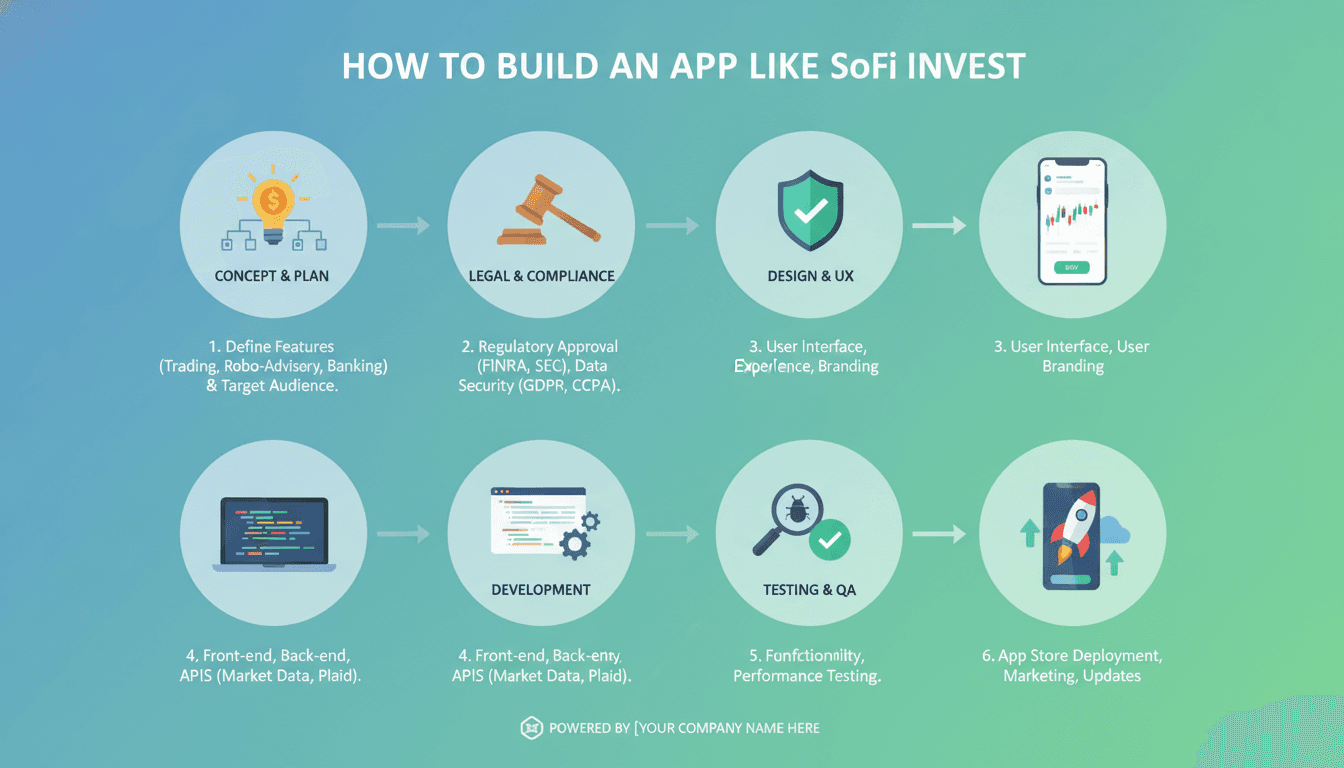
How to Make an App Like SoFi Invest
Retail investing has moved from wood-paneled brokerage offices to the phone in everyone's pocket. SoFi Invest sits at the center of that shift — offering commission-free stock and ETF trading, fractional shares, automated portfolios, retirement accounts, and crypto access inside a single, approachable interface.
If you're planning to build something similar, the hard part isn't the UI. It's the licensing, the clearing relationships, the compliance workflows, and the real-time data infrastructure sitting behind that clean screen. This guide walks through what it actually takes.
What Makes SoFi Invest Work
Before writing a line of code, it helps to understand what you're actually competing with. SoFi Invest is not a standalone trading app — it's a wedge into a broader financial ecosystem that includes lending, banking, and credit products. The investing app is deliberately simple because its job is acquisition and retention, not power-user trading.
You may also find our article on How to Make an App Like Robinhood useful.
Its core value propositions:
- Zero-commission trading on stocks and ETFs
- Fractional shares (branded as "Stock Bits") that let users buy $5 of a $400 stock
- Automated investing — robo-advisory portfolios with low or no management fees
- IRAs and retirement accounts alongside taxable brokerage accounts
- Crypto trading within the same app
- Member perks — financial advisor access, rate discounts, community events
The lesson: the trading engine is table stakes. Differentiation comes from what you wrap around it.
Step 1: Pick Your Regulatory Model
This is the decision that determines your budget, timeline, and everything downstream. In the U.S., there are three realistic paths.
Become a Registered Broker-Dealer
You register with the SEC, join FINRA, and become a member of SIPC. You control the full stack, own the customer relationship completely, and capture the most economics — payment for order flow, margin interest, securities lending, cash sweep revenue.
The cost is steep. FINRA's New Member Application process routinely takes 6–12 months, requires substantial net capital, demands registered principals (Series 7, 24, 27 licensed staff), written supervisory procedures, an AML program, and a compliance officer. Budget well into seven figures before launch.
Use a Brokerage-as-a-Service Provider
Providers like Alpaca, DriveWealth, Apex Clearing, and Atomic offer API-first infrastructure where they hold the broker-dealer license and you build the experience on top. You go to market in months instead of years, at a fraction of the cost.
If this is relevant to your project, check out How to Make an App Like E*TRADE.
The tradeoffs: thinner margins, less control over the product roadmap, and platform risk if your provider changes terms or has an outage.
Introducing Broker Arrangement
A middle path — you register as a broker-dealer but clear trades through a partner like Apex or Pershing. You own the customer relationship and brand while offloading custody, settlement, and much of the operational burden.
Related reading: How to Make an App Like Fidelity Investments.
Recommendation for most teams: start with brokerage-as-a-service, validate demand, then evaluate bringing licensing in-house once volume justifies it.
Step 2: Map the Compliance Requirements
Compliance isn't a phase — it's a constraint that shapes every feature.
KYC and identity verification. You need name, address, date of birth, and SSN (or tax ID) for every account. Most teams integrate Persona, Alloy, Socure, or Jumio for document capture and identity resolution.
AML and sanctions screening. OFAC screening at onboarding and on an ongoing basis, plus transaction monitoring and SAR filing workflows.
Suitability and risk profiling. Regulation Best Interest requires you to understand a customer's investment profile before recommending anything. If you offer automated portfolios, you're likely also operating as a Registered Investment Advisor, which brings Form ADV, fiduciary duty, and a separate registration track.
Disclosures and record retention. Account agreements, fee schedules, risk disclosures for options and crypto, trade confirmations, monthly statements, and tax documents (1099-B, 1099-DIV, 5498 for IRAs). SEC Rule 17a-4 requires records be retained in write-once-read-many format for specified periods.
Advertising review. FINRA Rule 2210 governs how you market. Every screenshot showing hypothetical returns needs review. Social media posts count.
Outside the U.S. the picture changes entirely — FCA authorization in the UK, MiFID II across the EU, SEBI registration in India. Pick your launch geography early and design to its rules.
Step 3: Define Your MVP Feature Set
Resist the urge to clone every SoFi feature. Here's a sequencing that works.
Launch Features
Onboarding and account opening. Target under five minutes. Progressive disclosure, document scanning with OCR, instant identity decisioning where possible. Every additional screen costs you conversions.
Funding. ACH transfers via Plaid for instant bank linking, plus debit card funding and wire support. Handle the settlement delay clearly — users get confused when money appears but isn't tradable yet.
Market data and discovery. Real-time or delayed quotes, price charts across multiple timeframes, company fundamentals, news, and analyst ratings. Search that tolerates typos and supports both tickers and company names.
Order placement. Market and limit orders at minimum. Clear preview screens showing estimated cost, fees, and buying power before confirmation.
Fractional shares. Critical for your target demographic. This requires your clearing partner to support fractional allocation and adds complexity to corporate actions, dividends, and transfers.
Portfolio view. Positions, cost basis, unrealized and realized gains, allocation breakdown, and performance over time. Make time-weighted vs. money-weighted returns a deliberate choice, not an accident.
Notifications. Price alerts, order fills, dividend payments, account activity.
Phase Two
- Automated/robo portfolios with periodic rebalancing
- Recurring investments and dividend reinvestment
- IRA accounts (Traditional, Roth, SEP)
- Options trading
- Crypto
- Margin accounts
- Tax-loss harvesting
- Educational content and community features
Step 4: Design for Trust and Clarity
Financial apps fail on trust before they fail on features.
Make the numbers legible. Large, unambiguous typography for balances and P&L. Consistent color semantics — and let users flip red/green for colorblindness or regional convention.
Reduce the fear of the first trade. Preview screens, plain-language confirmations, and a clear undo path where possible. Many successful apps use a paper-trading or simulation mode to lower the barrier.
Never hide costs. Even with zero commissions, there are regulatory fees, spreads, and potential currency conversion costs. Show them.
Treat education as a feature. Inline explainers for terms like "market order," "settlement," "wash sale," and "expense ratio." SoFi's growth came substantially from making investing feel learnable.
Design the empty and bad states. What does the app look like during a market crash? When an order is rejected? When ACH funding fails? These moments define retention.
Accessibility matters. WCAG 2.1 AA compliance, dynamic type support, VoiceOver and TalkBack labels on every financial figure.
Step 5: Choose Your Technical Architecture
Mobile Clients
Native (Swift, Kotlin) gives you the best performance for real-time chart rendering, the strongest biometric and Keychain/Keystore integration, and the smoothest animations. For a flagship fintech product, this is the default recommendation.
Cross-platform (React Native, Flutter) cuts your team size and speeds iteration. Both are viable for trading apps — several production brokerages ship on them — but you'll write native modules for secure storage, certificate pinning, and high-frequency chart updates.
Backend
A microservices approach maps cleanly to the domain:
- Identity and auth service — registration, MFA, session management
- Account service — KYC status, account types, beneficiaries
- Funding service — ACH, wires, transfer state machines
- Order service — validation, routing to clearing partner, lifecycle tracking
- Portfolio service — positions, cost basis, performance calculation
- Market data service — quote ingestion, normalization, fan-out
- Notification service — push, email, SMS
- Reporting service — statements, confirmations, tax documents
Go, Java/Kotlin, and .NET dominate this space for their concurrency characteristics and mature financial libraries. Node.js and Python work well for orchestration and data services.
Data Layer
PostgreSQL for transactional data with strict ACID guarantees. A time-series store (TimescaleDB, ClickHouse, or InfluxDB) for market data and price history. Redis for quote caching and session state. Kafka or a similar event log for order events, audit trails, and service decoupling.
Use the event-sourcing pattern for anything money-related. You need to reconstruct exactly what happened and when — both for debugging and for regulators.
Real-Time Delivery
WebSockets for streaming quotes and order updates. Design for fan-out: one upstream market data feed serving thousands of concurrent subscribers, with per-symbol subscription management so you're not pushing the entire universe to every client.
Market Data Vendors
Polygon.io, Intrinio, Refinitiv, IEX Cloud, and direct exchange feeds all serve different price and latency tiers. Note that real-time data redistribution carries exchange licensing fees that scale with your user count — model this into your unit economics early.
Step 6: Build Security In, Not On
Authentication. Biometric login backed by a device-bound key, MFA for sensitive actions, and step-up authentication for withdrawals and beneficiary changes.
Transport and storage. TLS 1.3 everywhere, certificate pinning on mobile, AES-256 encryption at rest, and field-level encryption for SSNs and account numbers. Manage keys in a dedicated KMS or HSM.
Client hardening. Jailbreak and root detection, screenshot prevention on sensitive screens, no sensitive data in logs, obfuscation of the release build.
Fraud controls. Device fingerprinting, velocity limits on transfers, anomaly detection on withdrawal patterns, and a cooling-off period on newly added bank accounts.
Compliance frameworks. SOC 2 Type II is effectively required for partnerships. PCI DSS if you touch card data. Penetration testing at least annually, plus a bug bounty program once you're at scale.
Step 7: Understand Your Revenue Model
Zero commissions doesn't mean zero revenue. The standard fintech stack:
- Payment for order flow — routing revenue from market makers (banned in some jurisdictions, under scrutiny in others)
- Net interest margin on uninvested cash balances
- Margin lending interest
- Securities lending — lending out shares to short sellers and sharing the rebate
- Premium subscriptions — advanced data, research, higher instant-deposit limits
- Advisory fees on managed portfolios (typically 0.25%–0.50% AUM)
- Crypto spreads — usually materially wider than equity economics
- Cross-sell — SoFi's actual strategy. Investing acquires users cheaply; lending and banking monetize them
Step 8: Plan the Build Realistically
Discovery and compliance planning (4–8 weeks). Regulatory path, partner selection, feature scoping, legal review.
Design (6–10 weeks). Research, information architecture, high-fidelity UI, design system, prototype testing.
Core development (16–28 weeks). Backend services, mobile clients, clearing partner integration, market data pipeline, admin tooling.
Testing and certification (6–10 weeks). QA, security assessment, partner certification, load testing against market-open traffic spikes.
Launch and stabilization (ongoing). Staged rollout, monitoring, iteration.
A realistic MVP with a brokerage-as-a-service partner lands in the $180,000–$400,000 range depending on scope and team location. Full broker-dealer registration with in-house clearing pushes total program cost well past $1.5M, with licensing, capital requirements, and compliance staffing as the dominant line items.
Ongoing costs are easy to underestimate: market data licensing, cloud infrastructure that must handle 9:30 AM ET load spikes, compliance staffing, audits, customer support, and app store presence.
Common Mistakes to Avoid
Treating compliance as a launch-week task. It shapes your data model, your onboarding flow, and your logging strategy. Bring a securities attorney in during discovery, not during QA.
Under-engineering for market open. Your traffic isn't uniform. It spikes hard at 9:30 AM ET, on earnings days, and during volatility events — exactly when downtime is most damaging. Load test against the worst case.
Ignoring the reconciliation problem. Your ledger must match your clearing partner's, every day, to the penny. Build automated reconciliation and break-detection from day one.
Shipping a trading terminal to beginners. SoFi won by being simple. Candlestick charts and Level 2 data will alienate the audience you're actually targeting.
Neglecting tax reporting. 1099 generation, cost basis tracking across lots, wash sale rules, and corporate actions are genuinely hard. Scope them honestly.
Vague performance reporting. Users will notice if your return calculations don't match their intuition. Be explicit about methodology.
Final Thoughts
Building an app like SoFi Invest is roughly 30% product engineering and 70% regulated financial infrastructure. The teams that succeed are the ones that pick a narrow initial wedge — a specific audience, a specific behavior — nail the onboarding and first-trade experience, and expand deliberately from there.
Start with a brokerage-as-a-service partner. Ship a focused MVP. Prove that people will fund accounts and trade. Then decide whether owning more of the stack is worth what it costs.
If you're evaluating the build, the most valuable first step is a discovery engagement that maps your regulatory path and partner options before any design work begins. Getting that sequence right saves more time and money than any technology decision you'll make later.
Have a project in mind? Contact Sodio Technologies to discuss your requirements and explore the right technology solution for your business.
/// Work with us
Talk to the engineers who'd build it
You'll get a technical scope, timeline and cost estimate from the people doing the work, not an account manager. In-house team, no subcontracting, since 2016.