

How to Make an App Like Square
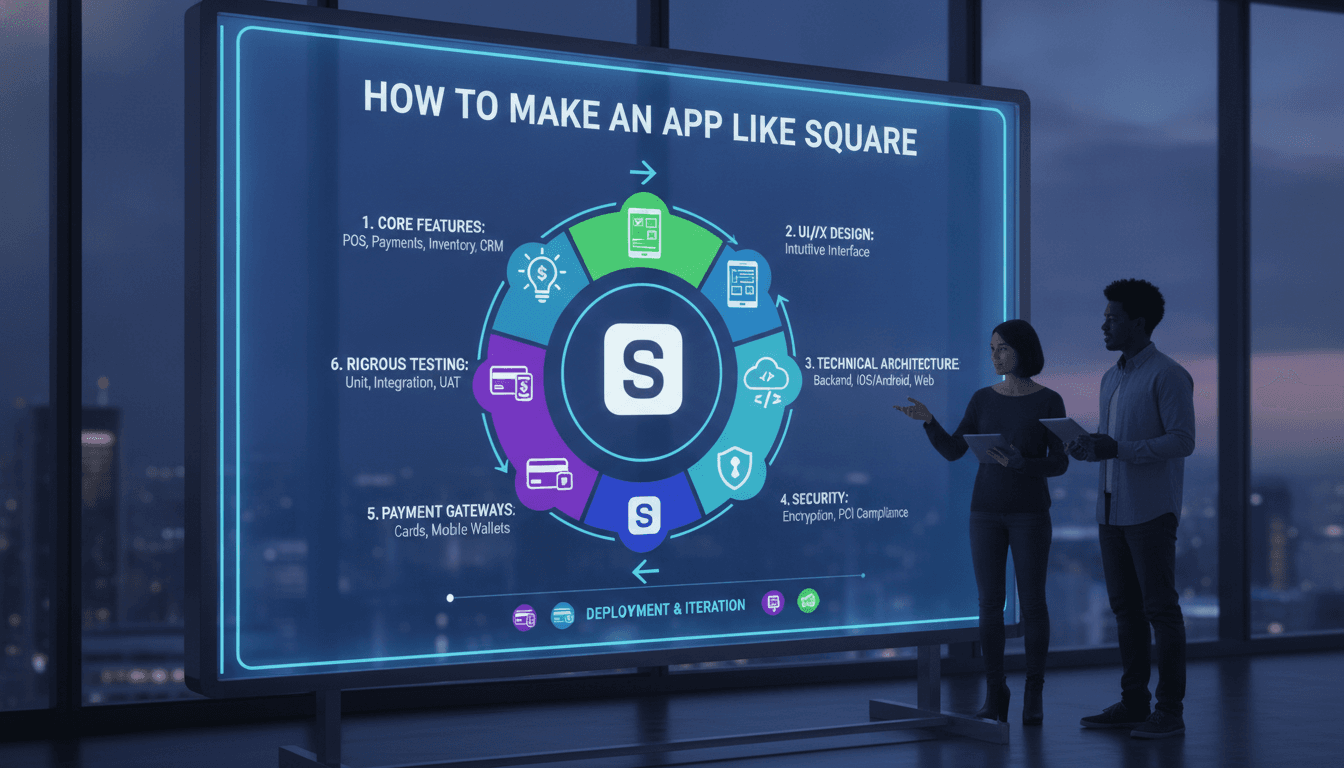
Building a payment platform like Square means dealing with card networks, banking rails, hardware, and compliance simultaneously. This post breaks down the architecture, the trade-offs, and the parts that will slow you down if you underestimate them.
What Does "Like Square" Actually Mean at the Architecture Level?
Square is not a single product. It is a payments platform, a point-of-sale system, a merchant dashboard, a banking product, and a hardware ecosystem that communicates with all of the above. When someone says "build an app like Square," they usually mean one or two of those layers, not all of them.
Before writing a line of code, define your scope precisely:
- Are you building a mobile POS with card reader support?
- Are you building a payment gateway with merchant onboarding and dashboards?
- Are you building both, plus recurring billing and invoicing?
Each combination has a different regulatory footprint and a different integration surface. Getting this wrong at the start adds months, not weeks, to delivery.
The core payment flow itself is relatively straightforward: your app calls a payment processor, the processor talks to the card network (Visa, Mastercard), the card network talks to the issuing bank, and the authorization comes back. Square handles this in-house because they are a registered payment facilitator (PayFac). You almost certainly are not, and you should not try to be at v1.
How Do Card Payments Actually Work Under the Hood?
The EMV standard (Europay, Mastercard, Visa) governs how chip cards communicate with terminals. If you want physical card acceptance, your hardware must be EMV-certified. Square's card readers went through this. It is expensive and time-consuming. For a first build, use a certified hardware partner or integrate directly with a reader SDK from Stripe Terminal, Adyen, or Worldline.
For card-not-present (CNP) transactions, you are dealing with:
- PCI DSS Level 1 or Level 2 compliance, depending on transaction volume
- 3D Secure 2.0 (3DS2) for authentication, which is mandatory in Europe under PSD2 and increasingly expected elsewhere
- Tokenisation to avoid storing raw PANs (Primary Account Numbers)
Never store raw card numbers. Use a payment processor's vault or a certified HSM-backed tokenisation service. If your architecture passes raw card data through your servers at any point, you own the full PCI DSS audit burden. Most teams underestimate what that costs to maintain.
Choosing a Payment Processor
If you are not becoming a PayFac yourself, you have two real paths:
| Option | Example providers | Control | Time to market | Revenue per transaction |
|---|---|---|---|---|
| Payment facilitator model (use their PayFac status) | Stripe Connect, Adyen for Platforms | Moderate | Fast (weeks) | Lower (they take a cut) |
| Registered ISO / merchant acquirer | Direct acquiring bank relationships | High | Slow (6–18 months) | Higher |
For most teams building a Square-like product, Stripe Connect or Adyen for Platforms is the correct starting point. You can migrate to direct acquiring later when volume justifies it.
What Does the Mobile Architecture Look Like?
The mobile app has two distinct concerns: the payment terminal side and the merchant management side.
Payment Terminal
For iOS, you will use the CoreBluetooth or ExternalAccessory frameworks to communicate with your card reader, depending on whether it connects via BLE or Lightning/USB-C. On Android, the equivalent is Android Bluetooth or USB Host API. Both Square's and Stripe's reader SDKs abstract most of this, but you still need to handle connection state, firmware updates, and offline mode carefully.
Offline mode is where most teams cut corners and regret it. Square supports offline card acceptance up to $200 per transaction and stores up to $10,000 in offline transactions. If you want this, your local device must queue encrypted transaction data, handle clock drift for timestamps, and reconcile when connectivity returns. This is not a week of work.
Merchant Dashboard
The merchant-facing dashboard is a standard React Native or Flutter mobile app backed by a GraphQL or REST API. The interesting engineering is in the reporting layer. Merchants expect real-time settlement views, per-item sales breakdowns, and refund workflows. Your data model needs to track transactions, line items, applied discounts, tax calculations, and tip amounts as separate entities from the start. Collapsing these into a single transaction record is a mistake that is painful to undo.
/// Not sure where to start?
Get the architecture before you commit
Tell us what you're building and we'll map the technical approach, stack, and rough timeline. No cost, no obligation, no sales call required.
How Do You Handle Merchant Onboarding and KYC?
Merchant onboarding is the part most teams underestimate the most. To accept payments on behalf of merchants, you need to verify their identity and business. This is Know Your Business (KYB) and Know Your Customer (KYC) compliance, and it is governed by FinCEN in the US, the FCA in the UK, and equivalent bodies elsewhere.
At minimum, you need:
- Legal business name, registration number, and address verification
- Beneficial ownership (anyone owning more than 25% of the business)
- Bank account verification for settlement
- Risk scoring and ongoing transaction monitoring
Building this yourself is possible but slow. Services like Persona, Onfido, and Stripe Identity handle document verification. For business verification, Middesk and Alloy cover the US market well. Budget for false positives in your onboarding funnel; overly aggressive KYC rules will reject legitimate merchants.
Square's fraud detection runs on proprietary ML models trained on billions of transactions. You will not replicate that at v1. Use a rules-based fraud engine initially (Stripe Radar, Sift, or Kount), and collect training data for a custom model later once you have volume.
What Are the Infrastructure and Compliance Requirements?
PCI DSS is the baseline. If you use Stripe or Adyen and keep card data entirely off your servers, you qualify for SAQ A or SAQ A-EP, which is a self-assessment questionnaire rather than a full QSA audit. That is a significant difference in cost and effort.
Beyond PCI, your infrastructure needs:
- 99.99% uptime on the payment API path. This requires multi-region deployment and circuit breakers on downstream processor calls.
- Idempotency keys on every payment request to prevent duplicate charges during network retries.
- Webhook delivery with retry logic and dead-letter queues for downstream events like
payment_intent.succeededorcharge.dispute.created. - Audit logs that are tamper-evident and retained for at least 7 years in most jurisdictions.
Run your payment services separately from your product services. A deploy that takes down your inventory management should not affect in-flight transactions.
Conclusion
Building a payments product at Square's level is a multi-year engineering effort involving card network compliance, hardware certification, KYC infrastructure, and fraud tooling. The realistic path for most teams is to use a PayFac like Stripe Connect or Adyen for Platforms for the first version, keep PCI scope minimal, and invest engineering effort in the merchant experience and reporting layers where differentiation actually lives.
If you are scoping this build and want a second opinion on architecture or the build-vs-integrate decisions, talk to the team at Sodio. We have built payment infrastructure across fintech and retail and can help you avoid the decisions that are expensive to reverse.
FAQ
How long does it take to build an app like Square? A minimum viable mobile POS with card reader support, merchant onboarding, and a basic dashboard takes 6 to 9 months with a team of 5 to 7 engineers, assuming you use an existing PayFac rather than direct acquiring. Adding hardware manufacturing, direct acquiring relationships, or banking products adds years, not months.
Do I need to become a payment facilitator to build this? No, and you probably should not for v1. Payment facilitators like Stripe Connect and Adyen for Platforms let you build a Square-like product while sitting under their regulatory umbrella. Direct acquiring relationships require 6 to 18 months of bank negotiations, significant capital requirements, and a full PCI DSS Level 1 audit.
What is the biggest technical mistake teams make when building payments products? Storing or routing raw card data through their own servers when they do not need to. It dramatically expands PCI DSS scope and audit costs. Using processor-hosted fields or SDKs to capture card data keeps raw PANs off your infrastructure entirely.
How do you handle refunds and disputes technically? Refunds are separate API calls to the processor that reverse or partially reverse a charge. Disputes (chargebacks) arrive as webhook events and require you to submit evidence within a deadline (typically 7 to 21 days depending on the card network). Your data model needs to link transactions to the original order, receipt, and shipping evidence from the start.
Can you build offline payment support in a mobile POS app? Yes, but it requires careful design. You encrypt and queue transactions locally, validate card data against a stored offline floor limit, and sync when connectivity returns. Square caps offline transactions at $200 per transaction. The risk of bad debt from declined transactions settled offline sits with whoever owns the PayFac relationship.
Have a project in mind? Contact Sodio Technologies to discuss your requirements and explore the right technology solution for your business.
/// Work with us
Talk to the engineers who'd build it
You'll get a technical scope, timeline and cost estimate from the people doing the work, not an account manager. In-house team, no subcontracting, since 2016.