

How to Make an App Like Square Cash
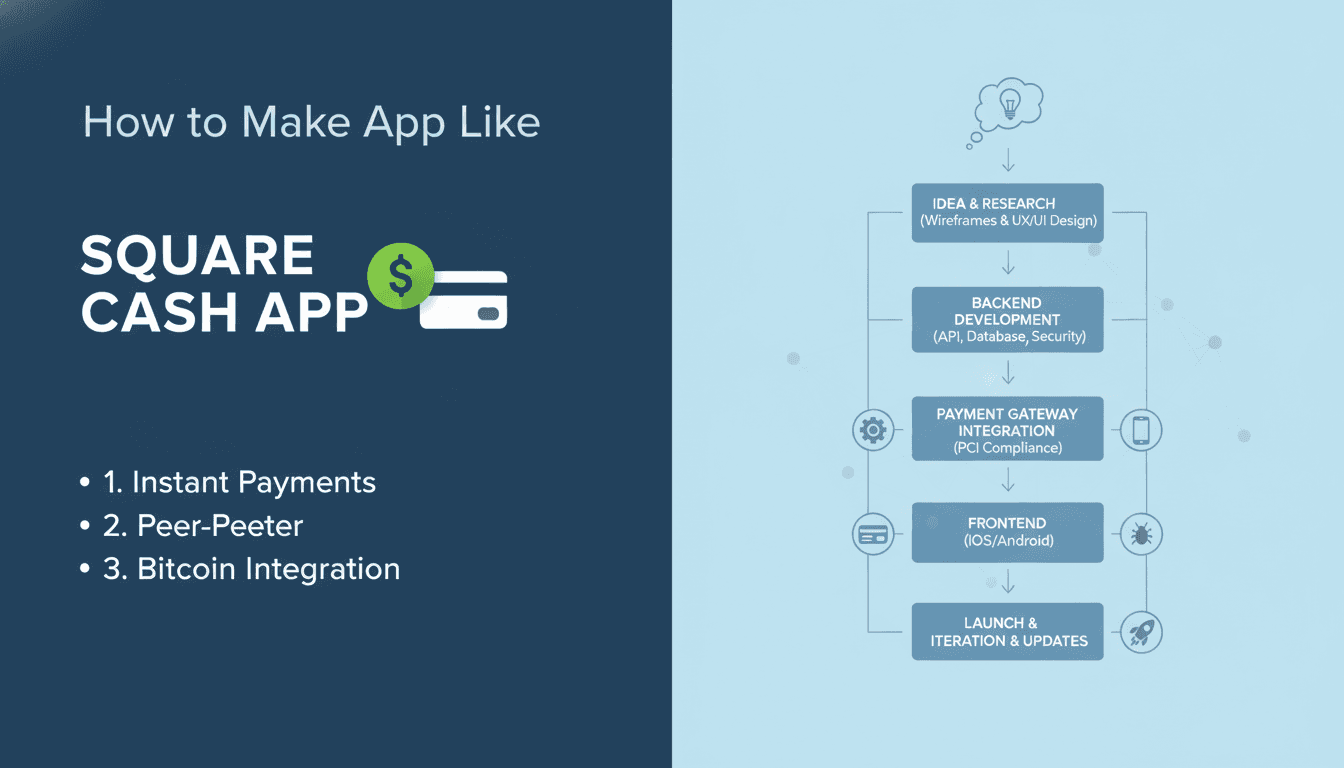
How to Make an App Like Square Cash
Peer-to-peer (P2P) payment apps have quietly become one of the most-used categories of software on the planet. Square Cash — better known today as Cash App — turned the simple act of sending money to a friend into a habit for tens of millions of people, then layered on debit cards, direct deposit, stock trading, and bitcoin.
If you're planning to build something similar, the good news is that the technology stack for payments is more accessible than it has ever been. The challenging news is that money apps live or die on trust, compliance, and unit economics — not on UI polish alone.
If this is relevant to your project, check out How to Make an App Like Alipay.
This guide walks through what it actually takes to design, build, and launch an app like Square Cash.
What Cash App Actually Does
Before writing a line of code, it helps to break the product down into its real components. What looks like one app is really several stacked businesses:
- P2P transfers. Send and request money using a username, phone number, or email.
- Stored balance. Funds sit in the app until the user cashes out or spends them.
- Linked funding sources. Debit cards and bank accounts fund transfers.
- Instant cash-out. Move money to a bank in seconds for a small fee.
- A physical/virtual card. Spend the balance anywhere, with customizable design.
- Direct deposit. Receive a paycheck, which makes the app a primary account.
- Investing and crypto. Fractional stock and bitcoin purchases.
- Business profiles. Accept payments as a merchant or creator.
You do not need all of this on day one. In fact, you shouldn't attempt it. Cash App launched in 2013 as a single-purpose tool for emailing money to a friend. Everything else came later.
To explore this further, see How to Make an App Like Cash App.
Step 1: Pick a Wedge, Not a Feature List
Generic P2P payments is one of the hardest markets to enter, because incumbents have network effects and can afford to run at a loss. Successful newer entrants almost always start with a specific wedge:
- Geographic gaps. Markets where existing apps don't operate or where local rails (UPI, PIX, M-Pesa-style mobile money) dominate.
- Remittance corridors. Cross-border transfers where fees are still painfully high.
- Group and shared expenses. Roommates, trips, teams, clubs.
- Vertical communities. Creators, gig workers, campus ecosystems, faith communities, sports leagues.
- Teen and family banking. Parent-controlled accounts with allowances and chores.
- B2B micro-payments. Contractor payouts, tips, and instant wage access.
Your wedge determines your compliance burden, your payment rails, and your growth loop. Decide it first.
Step 2: Understand the Regulatory Reality
This is the part most teams underestimate. Holding or moving other people's money is a licensed activity nearly everywhere.
In the United States, options generally include:
- Registering as a Money Services Business (MSB) with FinCEN and obtaining state money transmitter licenses — expensive, slow, and often state-by-state.
- Partnering with a sponsor bank and a Banking-as-a-Service (BaaS) provider, which lets you operate under their licenses. This is how most startups launch.
- Using a payment facilitator model through providers that already hold the necessary permissions.
Elsewhere, you'll be looking at e-money institution (EMI) or payment institution licenses in the EU/UK, PSP authorization in various APAC markets, and central bank registration in most of Latin America and Africa.
Regardless of route, you will need:
- KYC (Know Your Customer): identity verification, document capture, liveness checks.
- AML (Anti-Money Laundering): transaction monitoring, sanctions/PEP screening, suspicious activity reporting.
- PCI DSS compliance if card data touches your systems (tokenize aggressively so it doesn't).
- Data protection compliance: GDPR, CCPA, or local equivalents.
- Record retention for transaction histories, often five to seven years.
Budget for legal counsel early. A compliance mistake is far more expensive than a rebuild.
Step 3: Design the Core User Experience
Payment apps win on perceived speed and reduced anxiety. Every design decision should serve one of those two goals.
Onboarding
Ask for the minimum needed to let someone send their first dollar. Phone number, verification code, name, and a funding source. Defer full KYC until a user crosses a threshold — regulators generally permit tiered verification, and it dramatically improves conversion.
The $Cashtag Insight
Cash App's $cashtag was a genuinely smart product decision. A memorable, shareable, human-readable handle:
- Removes the need to share bank details
- Works as a link in a bio, a text, or a QR code
- Creates a viral surface — every shared handle is marketing
Build an identity layer like this. Make handles unique, claimable, and easy to display as a QR code.
The Send Flow
Aim for three taps: amount, recipient, confirm. Use a large numeric keypad, not a text field. Show fees before confirmation, never after. Confirm with haptics and a clear, celebratory success state.
Trust Signals
- Show recipient name and avatar before sending
- Warn on first-time recipients
- Make transaction history searchable and detailed
- Never hide fees, exchange rates, or settlement times
- Provide clear, fast paths to dispute and support
Requests and Social Layer
Requests, splits, notes, and emoji reactions turn a utility into a habit. Cash App and Venmo both proved that a little social texture increases frequency — but respect privacy defaults. Public feeds are a liability more than an asset in 2024 and beyond.
If this is relevant to your project, check out How to Make an App Like Zelle.
Step 4: Choose Your Architecture
Mobile
- Native (Swift + Kotlin): best security posture, access to Secure Enclave/Keystore, smoothest performance. The right default for a serious money app.
- React Native or Flutter: substantially faster to ship two platforms, with mature payment SDK support. Perfectly viable, especially for a wedge product or MVP. Be prepared to write native modules for biometrics, secure storage, and card scanning.
Backend
A payments backend is an accounting system that happens to have an API. Design it accordingly.
- Double-entry ledger. Every movement of money is two entries. Never store balances as a mutable integer you increment — derive balances from immutable ledger entries.
- Idempotency everywhere. Every write endpoint takes an idempotency key. Networks retry; users double-tap. Charging someone twice is unforgivable.
- Event-driven design. Payments are asynchronous state machines:
initiated → authorized → settled → completed, withfailed,reversed, anddisputedbranches. Model them explicitly. - Microservices where it helps. Common splits: identity/KYC, ledger, payments orchestration, notifications, risk/fraud, support tooling.
Typical stack choices: Go, Java/Kotlin, or Node/TypeScript for services; PostgreSQL as the system of record; Kafka or similar for events; Redis for caching and rate limits; Kubernetes on AWS, GCP, or Azure.
Payment Rails and Integrations
- Card networks via a processor for funding and instant cash-out
- ACH / SEPA / Faster Payments / UPI / PIX for low-cost bank transfers
- BaaS provider and sponsor bank for accounts, cards, and stored value
- Card issuing platform for your debit product
- KYC/AML vendors for verification and monitoring
- Crypto custody partner if you offer bitcoin
Build an abstraction layer over these providers from day one. You will switch at least one of them.
Step 5: Build Security In, Not On
- Encrypt in transit and at rest. TLS 1.3, AES-256, strict key management via KMS/HSM.
- Tokenize card data. Ideally it never enters your infrastructure.
- Device binding and biometrics. Face ID / fingerprint for app entry and high-value transactions.
- Certificate pinning and jailbreak/root detection on mobile.
- Step-up authentication on risky actions: new device, new recipient, large amount, changed bank account.
- Rate limiting and velocity checks on every money-moving endpoint.
- Least-privilege internal access with full audit trails. Insider risk is real.
- Regular penetration testing and a bug bounty once you have volume.
Step 6: Take Fraud Seriously From Day One
Fraud is not an edge case in payments; it is a permanent operating cost. Plan for:
- Account takeover (ATO): credential stuffing, SIM swaps, social engineering
- Stolen card funding: loading a balance with a stolen card, then cashing out
- Scams: fake goods, romance scams, "accidental" overpayment schemes
- Money muling: accounts opened purely to launder funds
- Chargeback abuse: legitimate purchases disputed as fraud
Mitigations include device fingerprinting, behavioral signals, graph analysis of who transacts with whom, ML risk scoring, holds on new accounts, and cash-out delays for high-risk profiles. Staff a real ops team — automated rules alone won't hold.
Step 7: Decide How You'll Make Money
Cash App's revenue is instructive. Very little comes from basic P2P transfers, which are a loss leader for acquisition.
- Instant transfer fees (a percentage for immediate cash-out)
- Interchange revenue from the debit card
- Merchant/business account fees
- Crypto and equities spread
- Lending and cash-advance products
- Subscription tiers with perks, higher limits, or better rates
- Float income on stored balances
Model this early. A P2P app with no monetization path burns cash on processing fees while growing.
Step 8: Build the MVP
A realistic first release:
- Phone-based signup with tiered KYC
- Unique user handles plus QR codes
- Link a debit card or bank account
- Send, request, and receive money
- Stored in-app balance
- Standard and instant cash-out
- Transaction history and receipts
- Push notifications
- Basic fraud rules and admin/support tooling
Realistic timeline: four to seven months to a compliant MVP with an experienced team, assuming a BaaS partner. Licensing conversations can run in parallel but often take longer than the software.
Team shape: iOS, Android (or two cross-platform devs), two to three backend engineers, a designer, a QA engineer with payments experience, a DevOps/security engineer, a product manager, and access to fintech legal counsel. A compliance officer becomes mandatory as you scale.
Cost range: MVPs commonly land between $80k and $250k in development, plus legal, licensing, and partner setup costs that can easily match that figure depending on jurisdiction.
Step 9: Solve the Cold Start Problem
A payment app with no users is useless. Growth has to be engineered into the product.
- Referral bonuses. Cash App's $5-for-$5 referrals were relentlessly effective.
- Pull-based invites. Requesting money from a non-user pulls them in.
- Shareable handles and links. Every handle in a bio is a free acquisition channel.
- Community seeding. Launch inside a campus, city, workplace, or niche where density compounds.
- Creator partnerships. Tipping and fan payments drive real adoption.
- Giveaways. Cash App's Twitter giveaways generated enormous organic reach.
Step 10: Measure What Matters
- Activation rate (signup → first successful transfer)
- Time to first transaction
- Weekly and monthly transacting users
- Transactions per active user per month
- Transaction success rate and failure reasons
- Fraud loss as a basis-point percentage of volume
- Cost per transaction versus revenue per transaction
- Support contacts per thousand transactions
- Retention by cohort at 30, 60, and 90 days
Common Mistakes to Avoid
- Treating compliance as a phase two problem. It shapes your architecture.
- Mutable balance fields instead of a ledger. You will not be able to reconcile, and reconciliation is the job.
- No idempotency. Duplicate charges destroy trust instantly.
- Cloning the full feature set. Depth on one use case beats shallow parity.
- Underinvesting in support. People panic about money. Slow support becomes a churn engine and a regulatory complaint source.
- Ignoring unit economics. Processing fees are real and immediate.
- Skipping edge cases. Failed settlements, partial refunds, reversals, closed bank accounts, and deceased-user flows all need defined behavior.
Final Thoughts
Building an app like Square Cash is genuinely achievable — the rails, partners, and SDKs exist, and a capable team can ship a compliant MVP in months rather than years. What separates the products that survive is not the sending screen. It's the ledger that always balances, the fraud system that catches the mule accounts, the compliance posture that keeps your bank partner comfortable, and the support experience that makes people trust you with their paycheck.
Start narrow. Get the money movement boringly reliable. Then earn the right to become the financial hub your users open every day.
If you're evaluating a P2P payments or neobank build, the most valuable first step is a technical and regulatory discovery phase — mapping your wedge, rails, licensing path, and architecture before development begins. It's the cheapest way to avoid the expensive mistakes.
Have a project in mind? Contact Sodio Technologies to discuss your requirements and explore the right technology solution for your business.
/// Work with us
Talk to the engineers who'd build it
You'll get a technical scope, timeline and cost estimate from the people doing the work, not an account manager. In-house team, no subcontracting, since 2016.