

How to Make an App Like Talkspace
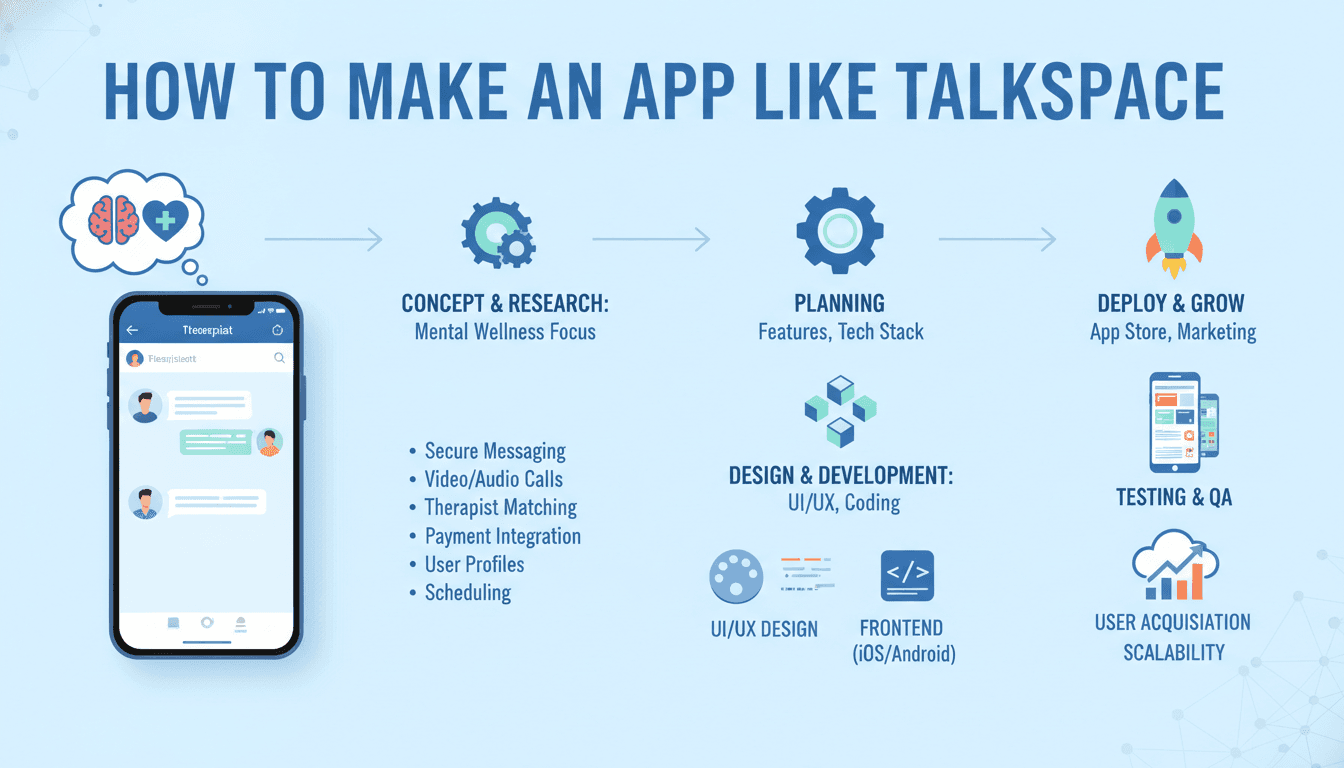
How to Make an App Like Talkspace
Therapy used to mean a waiting room, a 50-minute appointment slot, and a commute. Talkspace changed that equation by putting licensed therapists inside a chat window. The result: millions of users, partnerships with major insurers, and a category — online therapy — that keeps expanding as demand for mental health support outpaces the supply of clinicians.
If you're planning to build something similar, this guide walks through what Talkspace actually is under the hood, the features that matter, the compliance work you can't skip, the tech stack choices, and realistic costs and timelines.
We cover a closely related subject in Telemedicine Scheduling Across Clinician Availability and Regulation.
What Talkspace Actually Does
At its core, Talkspace is a marketplace plus a communication platform plus a clinical record system, wrapped in a subscription business model.
A user answers an intake questionnaire, gets matched with a licensed therapist in their state, and then communicates through asynchronous messaging, live chat, audio, or video. Subscriptions are billed monthly, and increasingly covered by employers or health insurance. Psychiatry services add medication management and prescriptions on top.
Three things make this harder than a typical chat app:
- Provider licensure is jurisdictional. A therapist licensed in Texas generally cannot treat a client sitting in Ohio. Your matching logic has to enforce this.
- Everything is protected health information. Messages, intake answers, session notes, and payment data all fall under HIPAA in the US (and GDPR, PIPEDA, or local equivalents elsewhere).
- There's clinical risk. If a user expresses suicidal intent at 2 a.m., your product needs a defined escalation path — not a "we'll get back to you in 24 hours" autoresponder.
Validate the Model Before You Build
Before writing code, get clear on a few decisions that shape everything downstream.
Pick your care model. Text-first asynchronous therapy, scheduled video sessions, or both? Asynchronous messaging is cheaper to deliver and easier to scale, but has murkier reimbursement. Live video maps more cleanly to existing billing codes.
Choose your niche. The generalist mental health space is crowded. Focused plays win more often: therapy for teens, couples counseling, addiction recovery, perinatal mental health, therapy for veterans, faith-aligned counseling, or support in a specific language or cultural context.
Decide who pays. Direct-to-consumer subscriptions are the fastest to launch but expensive to acquire. B2B2C — selling to employers, universities, or health plans — has longer sales cycles but far better retention and unit economics. Many successful platforms start D2C and layer in enterprise later.
Solve supply first. This is the mistake most founders make. Users are relatively easy to acquire with paid media; licensed, credentialed, available therapists are not. Recruit and onboard a provider bench in your launch markets before you spend a dollar on user acquisition.
Core Features to Build
Client-Side
Onboarding and intake. A conversational questionnaire covering presenting concerns, symptom severity (validated instruments like PHQ-9 and GAD-7 are standard), therapy preferences, demographics, and state of residence. Keep it under three minutes — drop-off here is brutal.
Therapist matching. Either algorithmic (filter by license state, specialty, availability, language, then rank) or assisted, where a care coordinator reviews intake and recommends options. A hybrid works well: show three algorithmically matched profiles and let the user choose.
Messaging room. The heart of a Talkspace-style product. Persistent, threaded conversation with the assigned therapist. Support text, voice notes, image and document attachments, read receipts, and typing indicators. Crucially: set and display expectations about response times so users aren't left guessing.
Live sessions. Scheduled video and audio calls with a waiting room, in-session chat, screen sharing for worksheets, and automatic reconnection on network drops.
Scheduling. Calendar view of therapist availability across time zones, with booking, rescheduling, cancellation policies, and reminders via push, email, and SMS.
Subscriptions and billing. Plan selection, payment method management, insurance eligibility checks, copay collection, invoices, and superbills for out-of-network reimbursement.
Progress tracking. Periodic re-administration of assessment instruments, mood check-ins, journaling, and a visual trend view so users can see movement over time. This is a major retention lever.
Crisis resources. A persistent, always-accessible button surfacing hotline numbers, text lines, and local emergency services based on the user's location.
Therapist switching. Fit matters more than anything in therapy outcomes. Make switching frictionless — a bad match that a user can't escape becomes a cancellation.
Provider-Side
Therapists are your other user group, and a bad provider experience directly causes churn on the client side.
Unified inbox with caseload view, unread counts, priority flags, and last-contact timestamps.
Clinical documentation — session notes with SOAP/DAP templates, treatment plans, diagnosis codes (ICD-10), and a full client history view.
Availability management so providers can set recurring hours, block time, and cap new client intake.
Earnings dashboard with per-session and per-client compensation, payment history, and tax documents.
Secure clinical messaging for supervision, case consultation, and escalation to a clinical lead.
Risk alerts — automated flags on messages containing crisis language, surfaced immediately rather than buried in a queue.
Admin and Clinical Operations
Provider credentialing pipeline — license verification, NPI lookup, malpractice insurance, background checks, and periodic re-verification with expiry alerts.
Quality and outcomes monitoring — response time SLAs, symptom score improvement, session attendance, client satisfaction.
Case management for escalations, complaints, and crisis incidents with a full audit trail.
Analytics covering funnel conversion, match acceptance, retention cohorts, provider utilization, and revenue per user.
Compliance: The Part You Can't Shortcut
This is where a mental health app differs most from a consumer app. Build it in from day one — retrofitting compliance is expensive and often means rewriting your data layer.
If this is relevant to your project, check out How to Make an App Like BetterHelp.
HIPAA (US). You need administrative, physical, and technical safeguards. Practically: encryption in transit (TLS 1.2+) and at rest (AES-256), role-based access control, unique user identification, automatic logoff, and comprehensive audit logging of every PHI access event. Every vendor touching PHI — cloud host, video provider, analytics, email, SMS, error monitoring — needs a signed Business Associate Agreement. This immediately rules out a lot of default tooling.
Data minimization. Don't collect what you don't need, and don't pipe PHI into third-party marketing SDKs. Several telehealth companies have paid large FTC settlements for exactly this. Keep advertising pixels entirely out of authenticated, PHI-containing surfaces.
State licensure enforcement. Encode license jurisdiction into your matching and booking logic as a hard constraint, not a soft filter. Track license expiry dates and automatically suspend matching for lapsed credentials.
Prescribing rules. If you offer psychiatry, controlled substance prescribing via telehealth is governed by the Ryan Haight Act and evolving DEA rules. Get specialist counsel.
Consent and documentation. Informed consent for telehealth, explicit limits of confidentiality, mandatory reporting disclosures, and clear terms about what the service is and is not (it is not emergency care).
Outside the US. GDPR treats health data as a special category requiring explicit consent and a lawful basis. Expect data residency requirements. UK, Canada, Australia, and the EU each have their own provider registration regimes.
Accessibility. WCAG 2.2 AA is both a legal expectation in many markets and a genuine usability requirement for a population that includes users in distress.
Technical Architecture
Client Apps
React Native or Flutter give you iOS, Android, and a shared codebase — sensible for most teams at this stage. Go native (Swift/Kotlin) if you need deep platform integration with HealthKit, Google Fit, or advanced background behavior. Pair mobile with a responsive web app; a significant share of therapy sessions happen on desktop.
Backend
A modular monolith is usually the right starting point, with clear service boundaries you can extract later. Natural seams:
- Identity and access
- Matching engine
- Messaging service
- Scheduling and calendar
- Clinical records (EHR)
- Billing and insurance
- Notifications
- Analytics and reporting
Node.js/NestJS, Python/Django, Go, or Java/Spring Boot are all defensible. Choose based on team expertise and hiring market.
Real-Time Messaging
You can build on WebSockets with a managed pub/sub layer, or use a HIPAA-eligible chat provider. Requirements: guaranteed delivery, ordering, offline queuing, media attachments, and end-to-end or at-minimum strong at-rest encryption. Whatever you pick, you must retain messages as part of the clinical record — which rules out ephemeral-by-design approaches.
Video and Voice
Don't build WebRTC infrastructure yourself. Use a HIPAA-eligible provider with a BAA — options in this space offer SDKs with waiting rooms, recording controls, and network resilience built in. Configure recording off by default and require explicit consent when it's on.
Data Layer
PostgreSQL for transactional and clinical data, with row-level security and column-level encryption on the most sensitive fields. Redis for sessions, presence, and caching. Object storage with server-side encryption for attachments and recordings. A separate, access-controlled warehouse for de-identified analytics — never run BI queries against production PHI.
Infrastructure
AWS, Google Cloud, and Azure all offer HIPAA-eligible services under a BAA. Use infrastructure-as-code, private subnets for data stores, secrets management, and a dedicated audit log stream that is append-only and independently retained. Set up on-call rotation and incident response procedures before launch, not after your first outage.
Where AI Fits
Used carefully, AI adds real value:
- Triage and intake summarization — condense questionnaire responses into a clinical snapshot for the therapist
- Risk detection — classify messages for crisis language and escalate in real time
- Documentation assistance — draft session notes from session content, always with therapist review and sign-off
- Matching optimization — learn which client-therapist pairings produce better retention and outcomes
- Between-session support — psychoeducational content, CBT-based exercises, guided journaling prompts
What AI should not do: deliver therapy autonomously, diagnose, or make clinical decisions. Be explicit with users about where AI is involved. And if you're sending PHI to a model provider, you need a BAA and a zero-retention arrangement.
If this is relevant to your project, check out How to Make an App Like 7 Cups.
Design Considerations
Your users are often anxious, depressed, or in crisis. Standard growth-hacking UX patterns are actively harmful here.
- Reduce cognitive load. Single-focus screens, plain language, generous spacing, no dense forms.
- Calm visual language. Muted palettes, soft contrast within accessibility limits, minimal animation.
- No dark patterns. Cancellation should be as easy as signup. Manipulative retention flows in a mental health product are an ethical failure and a regulatory risk.
- Privacy affordances. Discreet app icon options, biometric lock, quick-exit gestures, and control over notification content on the lock screen.
- Trust signals. Show therapist credentials, license numbers, specialties, and photos. Explain encryption and confidentiality in human terms.
- Set expectations honestly. If asynchronous response time is within 24 hours, say so prominently rather than letting users assume it's instant.
Monetization
Subscription tiers — messaging-only at the entry point, messaging plus monthly live sessions, then messaging plus weekly sessions. This is Talkspace's core structure and it works.
Insurance and employer coverage — the highest-leverage channel. Requires payer contracting, eligibility verification, claims submission, and clinical coding. Operationally heavy, but it dramatically lowers the user's out-of-pocket cost and improves retention.
Psychiatry add-on — medication evaluation and management, typically priced per visit.
Couples and teen programs — differentiated offerings at premium price points.
B2B licensing — per-employee-per-month contracts with employers, universities, and health systems.
Team and Timeline
A credible build team:
- Product manager
- UX/UI designer
- 2–3 backend engineers
- 2 mobile engineers
- 1 frontend engineer
- QA engineer
- DevOps/security engineer
- Clinical advisor (licensed clinician, part-time)
- Compliance consultant or healthcare attorney
Rough phasing:
| Phase | Scope | Duration |
|---|---|---|
| Discovery | Market, care model, compliance scoping, clinical protocols | 3–5 weeks |
| Design | Flows, wireframes, UI system, prototype | 5–7 weeks |
| MVP build | Auth, intake, matching, messaging, scheduling, video, billing, provider tools, admin | 16–24 weeks |
| Compliance and security | Risk assessment, pen testing, BAAs, policy documentation | 4–6 weeks (overlapping) |
| Pilot | Closed beta in one or two states with a small provider cohort | 6–8 weeks |
| Launch and iterate | Public launch, growth, expansion | Ongoing |
Cost ranges vary widely by region and scope. A genuinely compliant MVP with messaging, video, scheduling, billing, provider tools, and admin typically lands between $120,000 and $250,000. A full-featured platform with insurance integration, psychiatry, AI features, and multi-state operations runs $300,000 to $600,000+. Budget separately for ongoing compliance, security audits, and provider operations — these are recurring costs, not one-time line items.
MVP Scope: What to Cut
Ship narrow. A defensible v1:
- One or two launch states
- Asynchronous messaging plus scheduled video
- Algorithmic matching with a manual review fallback
- Two subscription tiers, card payments only
- Provider web console with notes and availability
- Admin console for credentialing and escalations
- PHQ-9 and GAD-7 at intake and monthly
- Crisis resources and escalation protocol
Defer: insurance claims, psychiatry, group therapy, wearable integrations, native tablet layouts, multi-language support, and AI documentation. Each is worth building — after you've proven the core loop works and that therapists want to practice on your platform.
Metrics That Matter
- Intake-to-match conversion and time-to-first-therapist-response
- Match acceptance rate and switch rate
- Week 4, week 12, and month 6 retention
- Session attendance and no-show rate
- Symptom improvement — percentage of users with clinically significant PHQ-9/GAD-7 reduction
- Provider utilization and provider churn
- CAC by channel against LTV
Outcome data isn't just a vanity metric here. It's what you need to sell to employers and payers, and it's what justifies the product's existence.
Common Pitfalls
Treating compliance as a phase two problem. It touches schema design, vendor selection, and logging. Retrofitting means rewriting.
Under-investing in provider experience. Therapists leave platforms with clunky tools, and their clients leave with them.
Ignoring crisis protocols. Define escalation paths, train providers, and staff coverage before launch. This is a safety obligation.
Launching too broadly. Multi-state licensure, payer contracts, and provider supply each get harder with geography. Prove one market first.
Leaking PHI to analytics. Audit every SDK and pixel. This is the single most common and most expensive mistake in digital health.
Over-promising on AI. Users and regulators are both increasingly skeptical. Be precise about what your AI does.
Final Thoughts
An app like Talkspace isn't technically exotic — messaging, video, scheduling, and payments are well-trodden ground. What makes it hard is everything around the technology: licensure, compliance, clinical safety, provider supply, and reimbursement.
The teams that win here treat those constraints as the product, not as obstacles to the product. Start with a narrow niche, a small provider bench, one or two states, and a compliance foundation you won't have to tear out. Get the therapeutic relationship working well for a few hundred people, then scale the machinery around it.
Have a project in mind? Contact Sodio Technologies to discuss your requirements and explore the right technology solution for your business.
/// Work with us
Talk to the engineers who'd build it
You'll get a technical scope, timeline and cost estimate from the people doing the work, not an account manager. In-house team, no subcontracting, since 2016.