

How to Make an App Like TD Ameritrade
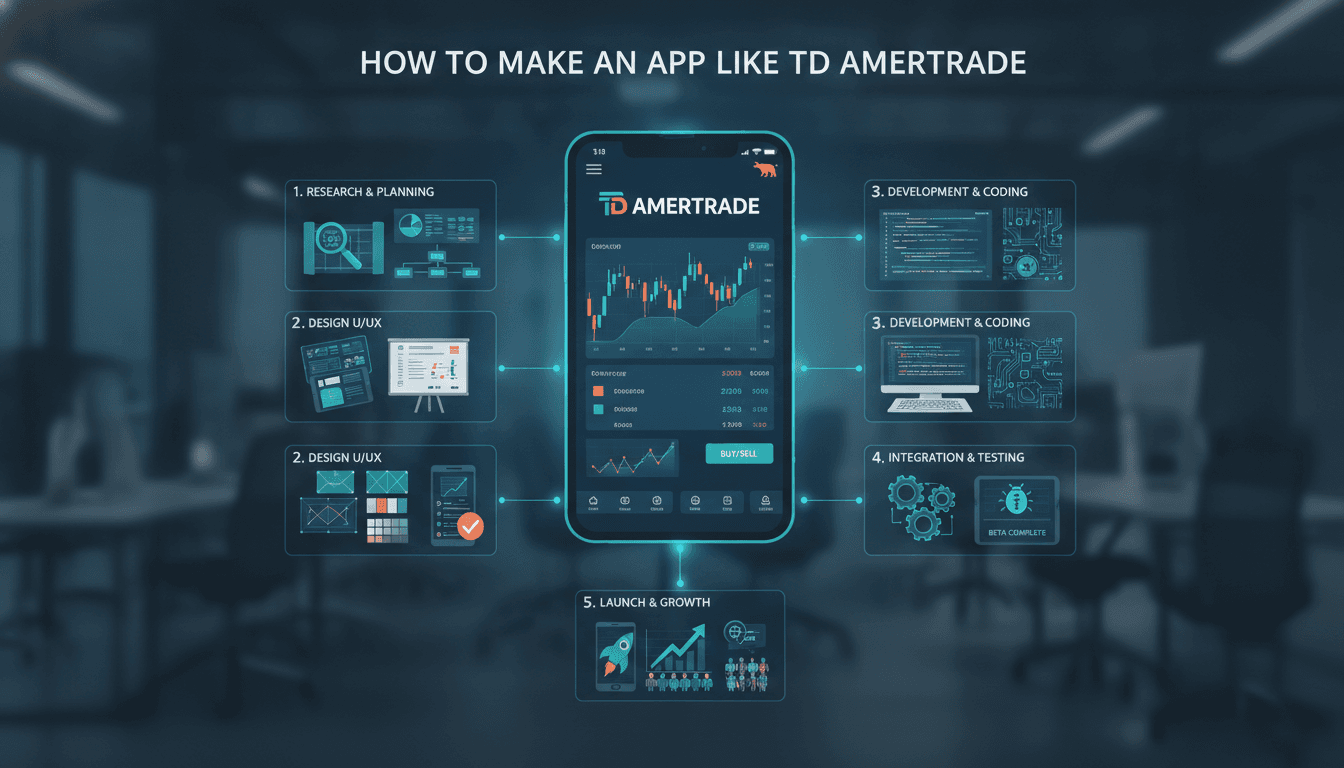
How to Make an App Like TD Ameritrade
Retail investing has moved from the trading floor to the pocket. TD Ameritrade — and its thinkorswim platform — set the benchmark for what a serious brokerage app can be: real-time market data, advanced charting, options chains, research tools, and paper trading, all wrapped in an experience that works for both first-time investors and active day traders.
If you're planning to build a trading app of your own, here's a practical breakdown of what it takes: the features, the architecture, the compliance work, the costs, and the pitfalls that sink most fintech projects before launch.
If this is relevant to your project, check out How to Make an App Like E*TRADE.
Understand What You're Actually Building
"An app like TD Ameritrade" can mean very different products depending on your business model. Before writing a line of code, decide which of these you are:
- A registered broker-dealer. You hold customer accounts, route orders, and carry the full regulatory burden. Highest cost, highest control, highest margin potential.
- An introducing broker. You own the front end and the customer relationship, while a clearing firm handles custody, settlement, and much of the back office.
- A broker-agnostic front end. You build the interface and analytics, and connect to third-party brokerages via APIs so users trade through accounts they already have.
Most startups begin as an introducing broker or an API-connected front end. It shortens time to market dramatically and lets you validate demand before committing to a full clearing and custody stack.
Core Feature Set
Onboarding and KYC
Account opening is where most brokerage apps lose users. You'll need identity verification, document capture, address and employment details, tax forms, suitability questionnaires, and AML screening against sanctions and PEP lists. Aim for a guided, resumable flow that takes under ten minutes. Integrations with identity providers can automate most of this.
Funding and Withdrawals
Support ACH transfers, wire transfers, debit card funding, and account transfers from other brokerages (ACATS in the US). Show users clearly when funds settle and what's available for trading versus withdrawal — ambiguity here generates a huge volume of support tickets.
Market Data and Watchlists
Real-time quotes, Level 1 and optionally Level 2 depth, pre- and post-market pricing, and customizable watchlists. Market data licensing is a real line item in your budget; exchanges charge per user per month, and the difference between delayed and real-time data has a material cost.
Charting and Technical Analysis
Interactive candlestick, line, and bar charts with multiple timeframes, drawing tools, and dozens of indicators (RSI, MACD, moving averages, Bollinger Bands). This is where thinkorswim earned its reputation. Rendering performance on mobile matters enormously — users will judge your app on how smoothly a chart pinches and zooms.
We cover a closely related subject in How to Make an App Like Webull.
Order Entry and Management
Market, limit, stop, stop-limit, trailing stop, and bracket orders at minimum. Serious traders will expect conditional and multi-leg options orders. Every order screen needs a clear confirmation step, estimated cost, and buying power check.
Portfolio and Performance
Positions, cost basis, unrealized and realized gains, dividend tracking, allocation breakdowns, and performance over time. Users check this screen more than any other, so it should load instantly and update live.
Options, Futures, and Advanced Instruments
Options chains with greeks, probability analysis, and strategy builders (spreads, straddles, iron condors) separate a hobby app from a professional one. These add significant complexity — treat them as phase two unless active traders are your core audience.
For a closer look at a related topic, read our guide on How to Make an App Like Robinhood.
Research and Education
News feeds, analyst ratings, earnings calendars, screeners, and third-party research. Education content — video lessons, glossaries, guided tutorials — drives retention among new investors and is comparatively cheap to produce.
Paper Trading
A simulated trading mode with virtual funds is one of the most effective acquisition tools in this category. It lets prospects experience the product before funding an account and gives existing users a sandbox to test strategies.
Alerts and Notifications
Price alerts, order fills, margin calls, earnings announcements, and news on watched symbols. Get the delivery reliability right — a missed fill notification erodes trust immediately.
Technical Architecture
Frontend
For mobile, native development in Swift (iOS) and Kotlin (Android) gives you the best control over chart rendering and real-time data performance. React Native or Flutter are viable if you need to ship on both platforms quickly and your charting library supports it well. Plan on a responsive web app too — many traders prefer a large screen for analysis and mobile for monitoring.
Backend
A microservices architecture suits this domain well because different components have wildly different scaling profiles:
- Market data ingestion and distribution service
- Order management system (OMS)
- Account and portfolio service
- Risk and margin engine
- Notifications service
- Reporting and tax documents service
Common stacks include Java, Go, or C++ for latency-sensitive services and Python or Node.js for analytics and supporting APIs.
Real-Time Data Pipeline
Use WebSockets or a similar persistent connection for streaming quotes to clients, backed by a message broker such as Kafka for ingesting exchange feeds. Cache aggressively with Redis. Design for the reality that market open produces an order-of-magnitude traffic spike over an average minute.
Data Storage
A relational database (PostgreSQL) for accounts, orders, and transactions where ACID guarantees are non-negotiable. A time-series database (TimescaleDB, InfluxDB, or ClickHouse) for historical price data and analytics.
Third-Party Integrations
Unless you're building clearing infrastructure yourself, you'll integrate with:
- A clearing and custody partner
- Market data vendors and exchange feeds
- Identity verification and AML screening providers
- ACH and payment processors
- News, research, and fundamentals providers
Regulation and Compliance
This is the part that distinguishes fintech from ordinary app development, and it is not optional.
In the US, you'll typically need to register as a broker-dealer with the SEC, become a member of FINRA, and join SIPC. Expect requirements around net capital, supervisory procedures, books and records retention, trade reporting, best execution, and communications archiving. Other jurisdictions have equivalents — the FCA in the UK, ASIC in Australia, and so on.
Engage securities counsel and a compliance consultant before development starts, not after. Regulatory requirements shape your data model, your audit logging, your retention policies, and your feature set. Retrofitting them is far more expensive than designing for them.
Security
A brokerage app is a high-value target. Baseline expectations include:
- Multi-factor authentication and biometric login
- End-to-end encryption in transit and encryption at rest
- Device fingerprinting and anomaly detection on login and withdrawal
- Role-based access control and least-privilege internal systems
- Immutable, tamper-evident audit logs for every account and order action
- Regular penetration testing and third-party security audits
- SOC 2 compliance as a practical requirement for partners
UX Considerations Specific to Trading
Trading apps have a design tension that most products don't: the same interface must serve a nervous beginner and an experienced trader placing a multi-leg options order. Approaches that work:
- Progressive disclosure. Simple default views with advanced controls one tap away.
- Configurable layouts. Let power users build their own dashboards and watchlist columns.
- Friction where it belongs. Confirmations and warnings on irreversible or high-risk actions, and nowhere else.
- Honest performance display. Clear, unglamorous presentation of losses builds long-term trust better than gamified interfaces.
- Dark mode as a default option. Traders stare at these screens for hours.
Monetization
- Payment for order flow (where permitted and disclosed)
- Margin lending interest — historically the largest revenue line for many brokerages
- Net interest on uninvested cash balances
- Premium subscriptions for advanced data, research, or tooling
- Options and futures contract fees
- Account transfer, wire, and paper statement fees
- Managed portfolios and advisory fees
Development Timeline and Cost
A realistic phased approach:
Phase 1 — Discovery and compliance groundwork (2–3 months). Legal structure, licensing path, partner selection, product definition, and UX prototyping.
Phase 2 — MVP (5–8 months). Onboarding, funding, watchlists, basic charting, equity trading, portfolio view, and notifications.
Phase 3 — Expansion (6–12 months). Options, advanced charting, screeners, research integrations, paper trading, and desktop or web platform.
Costs vary enormously with your regulatory model. An API-connected front end can launch for a fraction of what a fully licensed broker-dealer requires, where legal, capital, and compliance costs alone can exceed the entire engineering budget. Budget realistically for ongoing costs too: market data licensing, clearing fees, compliance staff, and infrastructure that must stay up during market hours without exception.
Common Mistakes to Avoid
- Treating compliance as a late-stage checklist. It's an architectural constraint.
- Underestimating market data costs. They scale with your user count and can wreck unit economics.
- Building for the average user only. Active traders generate disproportionate revenue and will leave over missing order types.
- Ignoring peak load. Your worst day will be a volatile market day, exactly when downtime is most damaging.
- Skipping the reconciliation layer. Position and cash discrepancies between your system and your clearing partner must be caught automatically, daily.
Getting Started
Start narrow. Pick one underserved audience — options traders, a specific geography, a particular asset class, a demographic that existing brokerages handle badly — and build the best possible product for them. TD Ameritrade took decades and enormous capital to reach its current breadth. What it didn't have at the beginning was a clear, defensible reason for a specific group of people to switch.
Find that reason first. The engineering, hard as it is, is the more solvable half of the problem.
Have a project in mind? Contact Sodio Technologies to discuss your requirements and explore the right technology solution for your business.
/// Work with us
Talk to the engineers who'd build it
You'll get a technical scope, timeline and cost estimate from the people doing the work, not an account manager. In-house team, no subcontracting, since 2016.